What Is Zoox and How Does It Work in Las Vegas?
Zoox is an Amazon-owned autonomous vehicle company that has been operating its purpose-built, bidirectional robotaxi on the streets of Las Vegas since mid-2024. Unlike Waymo's retrofitted Jaguar I-PACE vehicles or Tesla's driver-assist systems, Zoox designed a ground-up carriage-style vehicle with no steering wheel, no pedals, and no driver's seat. Passengers sit face-to-face in a four-seat cabin while the vehicle handles all driving tasks within a geofenced service area.
If you have been searching for the Zoox Las Vegas map to figure out where you can catch a ride, this guide breaks down the current operational zone, how to request a trip, what the technology under the hood actually does, and the real-world limitations you should expect before you hail one.
Zoox operates at SAE Level 4, meaning the vehicle performs all driving tasks without human intervention within its defined operational design domain (ODD) — specific geofenced areas under specific conditions. There is no human driver in the vehicle, no steering wheel, and no expectation that a passenger will take over. This is fundamentally different from Level 2 driver-assist systems like Tesla Autopilot, Ford BlueCruise, or GM Super Cruise, which require a licensed, attentive driver behind the wheel at all times. Zoox is a true driverless robotaxi service, not a car you buy and drive yourself.
The Zoox Las Vegas Service Map: Where Can You Ride Right Now?
Zoox launched its commercial robotaxi service in Las Vegas in June 2024, initially covering a compact zone along and near the Las Vegas Strip. As of early 2026, the service area has expanded but remains geofenced — the vehicle will not operate outside its approved boundary, even if you request a destination beyond it.
| City | Status | Service Area | Hours |
|---|---|---|---|
| Las Vegas, NV | Commercial service (live) | Strip corridor + adjacent areas (~8–10 sq mi geofence) | Limited hours, expanding |
| San Francisco, CA | Testing / employee rides | Select neighborhoods | Not public commercial |
| Foster City, CA | Testing | Headquarters vicinity | N/A |
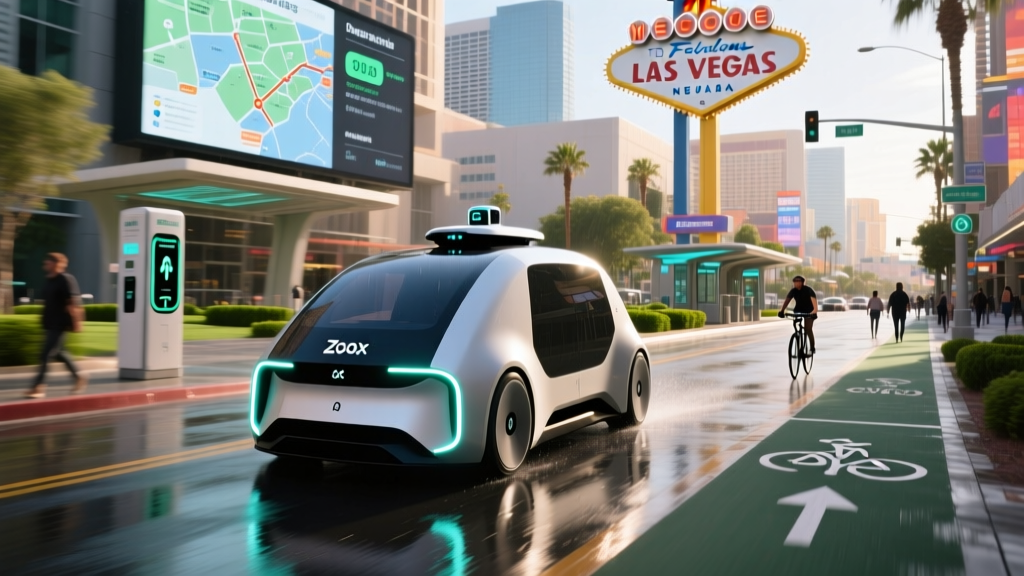
Where can I use this robotaxi service right now? As of 2026, the only city where you can hail a Zoox robotaxi as a paying (or invited) passenger is Las Vegas. The geofenced zone centers on the Las Vegas Strip corridor — covering major hotel-casinos, convention centers, and nearby restaurants — but does not extend to the airport (Harry Reid International), downtown Fremont Street, or suburban Henderson. The exact boundary shifts as Zoox receives regulatory approval for expansion, so the in-app map is the most reliable source for real-time coverage.
How to Hail a Zoox Robotaxi and What It Costs
Zoox's rider experience is app-based, similar to Uber or Lyft. You download the Zoox app, create an account, set your pickup and dropoff points within the service zone, and a vehicle dispatches to your location. Because the vehicle has no driver, the pickup experience is different: the Zoox carriage pulls to the curb, unlocks its doors automatically, and you settle into one of the four inward-facing seats. An in-cabin screen displays your route, and you can play music or adjust climate controls from your seat.
| Service | Est. Fare | Surge Pricing? | Notes |
|---|---|---|---|
| Zoox | Promotional / free (invite-based rollout) | No | Pricing not yet publicly standardized; early riders report complimentary or heavily subsidized fares |
| UberX | $10–$18 | Yes | Varies heavily by time of day and demand on the Strip |
| Lyft | $9–$16 | Yes | Similar surge dynamics to Uber |
| Waymo (if available) | $12–$20 | Limited | Waymo operates in Phoenix, SF, LA — not yet Las Vegas commercially |
How much does it cost vs Uber/Lyft? Zoox has not published a standardized public fare structure as of early 2026. The company is in a controlled commercial rollout phase, meaning rides are offered to invited users, event attendees, and select partners — often at no charge or at promotional rates. When Zoox transitions to open commercial pricing, industry analysts expect fares competitive with Uber/Lyft baseline rates (roughly $1.50–$2.50 per mile), since the absence of a driver removes the largest cost component of rideshare. However, until general-public access opens, direct price comparison is premature.
Zoox Technology Stack: Lidar, Cameras, and the Purpose-Built Vehicle
Unlike Tesla's camera-only approach to autonomy, Zoox employs a redundant multi-sensor suite that combines lidar, cameras, and radar. This is the same sensor-fusion philosophy used by Waymo (Alphabet) and Cruise (GM), and it reflects a conservative engineering choice: if one sensor modality is degraded — for example, cameras blinded by direct sun glare — lidar and radar can still perceive the environment.
- Vehicle: Purpose-built Zoox carriage — bidirectional (drives equally well forward and backward), symmetrical design, no steering wheel or pedals
- Sensors: Lidar arrays (roof-mounted and corner units), multiple high-resolution cameras (360° coverage), radar units for velocity detection and adverse-weather penetration
- Compute: Onboard high-performance computing platform processing sensor data in real time; redundant systems for safety-critical functions
- Top speed: 75 mph (capable of highway speeds, though current Las Vegas deployment is on surface streets)
- Powertrain: Fully electric — battery-electric with zero tailpipe emissions; exact kWh capacity not publicly disclosed, though the compact carriage form factor suggests a ~50–70 kWh pack for urban duty cycles
- Geofencing: High-definition mapped operational design domain (ODD); the vehicle will not navigate outside pre-mapped, pre-approved routes
- Remote assistance: Zoox employs remote fleet operators who can provide high-level guidance (e.g., rerouting around an unmapped construction zone) but do not directly steer or control the vehicle in real time
The purpose-built vehicle is a significant differentiator. Most robotaxi competitors retrofit existing production vehicles — Waymo uses the Jaguar I-PACE, Cruise used the Chevrolet Bolt EUV — which means sensors are added onto a car designed for a human driver. Zoox engineered its carriage from the ground up for autonomy: four-wheel steering for tight urban maneuvers, crumple zones designed around a passenger-only cabin, and sensor placement optimized for 360° perception without the compromises of a retrofit.
Safety Record: What the Data Shows
How safe are robotaxis? This is the most important question for any prospective rider, and it requires concrete data rather than marketing claims. Zoox's public safety record is still relatively young compared to Waymo, which has logged tens of millions of driverless miles across Phoenix, San Francisco, and Los Angeles.
- Driverless miles logged: Zoox has accumulated hundreds of thousands of driverless miles across Las Vegas and California test operations. Exact cumulative figures are not as publicly reported as Waymo's.
- At-fault collisions: As of early 2026, Zoox has not been involved in a widely reported serious-injury or fatal collision during driverless commercial operations in Las Vegas.
- NHTSA reporting: All Level 4 operators are required to report crashes involving their automated driving systems to NHTSA under Standing General Order 2021-01. Zoox is subject to this requirement.
- Context: For comparison, Waymo reported in its 2024 safety data that across 7.1 million driverless miles, it experienced 70% fewer police-reported injury-causing crashes compared to human benchmarks in equivalent urban environments. Zoox's dataset is smaller, making statistical comparison less robust.
The broader robotaxi safety picture is mixed. Cruise's suspension in California in late 2023 — following a pedestrian-dragging incident in San Francisco — demonstrated that Level 4 operations carry real risk and that regulatory bodies will act when operators fall short. Zoox, with its more cautious and limited rollout, has avoided similar incidents, but its smaller operational scale means the dataset is less mature. As Zoox scales in Las Vegas and potentially additional cities, more comprehensive safety statistics will become available through NHTSA filings and the company's own transparency reports.
Current Limitations: Weather, Geofencing, and Edge Cases
What are the current limitations? Every Level 4 robotaxi operates within an Operational Design Domain (ODD) — a defined set of conditions under which the system is validated to drive. When conditions fall outside the ODD, the vehicle will not operate. Here is what that means practically for Zoox in Las Vegas:
- Geofence boundary: You cannot ride to Harry Reid International Airport, downtown Fremont Street, Summerlin, or Henderson. If your destination falls outside the mapped zone, the app will not let you book the trip.
- Heavy rain and flash flooding: Las Vegas monsoon-season downpours (typically July–September) can degrade lidar and camera performance. Zoox vehicles will pull over or decline to dispatch during severe precipitation events.
- Construction zones: Unmapped lane closures, temporary barriers, and flaggers directing traffic represent edge cases. Zoox vehicles may stop and wait for remote fleet guidance rather than navigating unfamiliar construction layouts.
- Limited hours: Service is not 24/7. Zoox has operated with restricted availability windows, particularly during the initial rollout phase. Late-night and early-morning coverage may be unavailable.
- No highway driving (currently): Although the vehicle is rated for 75 mph, Las Vegas operations are confined to surface streets within the geofence. Highway merges and high-speed lane changes are not part of the current ODD.
- Accessibility: The carriage-style vehicle has specific entry/exit configurations. Riders with mobility devices should check the app for wheelchair-accessibility options, as the compact form factor may have limitations compared to a retrofitted SUV.
- Capacity: Maximum four passengers. No trunk space for large luggage — this is an urban shuttle, not an airport transfer vehicle.
Regulatory Landscape: Who Approves Zoox to Operate?
Robotaxi operations in the United States are governed by a patchwork of state and federal regulations, not a single unified framework. Understanding who holds authority is essential for evaluating where Zoox can legally expand.
Federal level: The National Highway Traffic Safety Administration (NHTSA) sets vehicle safety standards and investigates crashes. However, NHTSA has not yet issued comprehensive Federal Motor Vehicle Safety Standards (FMVSS) specifically for driverless vehicles without steering controls. Zoox received a critical exemption from NHTSA to produce its steering-wheel-free carriage — without this exemption, the vehicle would not meet existing FMVSS requirements that assume a human driver position.
State level (Nevada): Nevada was one of the first states to pass autonomous vehicle legislation, and the Nevada Department of Motor Vehicles (DMV) issues permits for testing and commercial deployment. Zoox holds a Nevada autonomous vehicle permit that authorizes its commercial operations within the approved geofence. The state requires operators to carry insurance, report disengagements and collisions, and demonstrate safety-case documentation.
State level (California): The California DMV issues testing permits, while the California Public Utilities Commission (CPUC) regulates commercial robotaxi fares and service. Zoox holds a California testing permit but has not received CPUC authorization for commercial passenger service in the state as of early 2026. This is why Zoox rides in San Francisco remain limited to employees and invited testers.
The regulatory environment remains in flux. Following Cruise's 2023 suspension, several states and municipalities have increased scrutiny of robotaxi operators. Zoox's cautious, geofenced, and slower-speed approach has so far kept it out of the regulatory crosshairs that affected Cruise, but expansion into new cities will require individual state and local approvals — a process that varies significantly by jurisdiction and is not guaranteed.
Zoox vs. Waymo vs. Cruise: Robotaxi Landscape in 2026
| Attribute | Zoox | Waymo | Cruise |
|---|---|---|---|
| Parent company | Amazon | Alphabet (Google) | General Motors |
| Vehicle | Purpose-built carriage (no steering wheel) | Jaguar I-PACE (retrofitted), Hyundai Ioniq 5 (upcoming) | Chevrolet Bolt EUV (retrofitted), Origin (paused) |
| Commercial cities | Las Vegas | Phoenix, San Francisco, Los Angeles, Austin | Limited/paused post-2023 suspension; gradual re-entry |
| SAE Level | Level 4 | Level 4 | Level 4 |
| Sensor approach | Lidar + cameras + radar | Lidar + cameras + radar | Lidar + cameras + radar |
| Public availability | Invite-based / controlled rollout | Open to public via Waymo app | Restricted / re-launching |
Zoox's Las Vegas presence is real but narrow compared to Waymo's multi-city commercial network. Waymo remains the clear leader in accumulated driverless miles, public ridership volume, and geographic coverage. Zoox's advantage is its purpose-built vehicle — designed from scratch for passengers rather than retrofitted from a driver-oriented car — but it will need to scale operations and open access to demonstrate that advantage at volume.
Frequently Asked Questions
Is Zoox truly self-driving, or is there a hidden driver?
Zoox is genuinely driverless — SAE Level 4. There is no human in the vehicle, no steering wheel, no pedals, and no expectation that a passenger will intervene. The vehicle operates autonomously within its geofenced service area. Remote fleet operators can provide high-level route guidance (e.g., "take the next left to avoid a blocked road") but do not control steering, braking, or acceleration in real time. This is categorically different from Level 2 driver-assist systems like Tesla FSD (Supervised) or Ford BlueCruise, which require a licensed driver behind the wheel.
Can I ride Zoox from the Las Vegas airport to my hotel?
No. As of early 2026, Harry Reid International Airport is outside the Zoox geofence. The service zone covers the Strip corridor and adjacent commercial areas, but airport pickups and dropoffs are not available. You would need to take a taxi, Uber, Lyft, or the Las Vegas Monorail to reach the Zoox service area.
Is Zoox free to ride?
During its controlled commercial rollout, many Zoox riders have reported receiving complimentary or heavily subsidized rides. The company has not published a standardized public fare structure. When open commercial service launches, expect pricing comparable to Uber/Lyft baseline rates — potentially lower, since there is no driver to pay — but this has not been confirmed.
What happens if the Zoox vehicle encounters an emergency?
Zoox vehicles are equipped with redundant safety systems. If the vehicle detects a system fault, it will execute a controlled stop (pulling to the curb when possible). Remote fleet operators monitor the fleet and can provide guidance. In the event of a collision, the vehicle contacts emergency services automatically, and passengers can reach Zoox support via an in-cabin button at any time.
How does Zoox compare to Waymo in terms of availability?
Waymo has a significant lead in public availability. Waymo One operates commercially in Phoenix, San Francisco, Los Angeles, and Austin, with open public access via the Waymo app. Zoox is currently limited to Las Vegas with invite-based access. Waymo has logged over 25 million paid driverless trips as of late 2025, while Zoox's commercial ridership numbers are much smaller due to the controlled rollout. If you want to ride a robotaxi today with minimal friction, Waymo is the more accessible option in its service cities.
Will Zoox expand beyond Las Vegas?
Zoox has tested in San Francisco, Foster City (its headquarters), and other California locations, but commercial expansion requires regulatory approval in each jurisdiction. The company has signaled intent to grow its service footprint, but no additional commercial city launches have been confirmed with firm dates as of early 2026. Expansion depends on NHTSA compliance, state permits, and local municipal agreements — a process that Cruise's 2023 suspension has made more cautious industry-wide.
Sources: NHTSA Automated Vehicles Safety, Zoox official site, manufacturer disclosures. Service availability and pricing reflect information current as of early 2026 and are subject to change. Always verify operational status via the Zoox app before planning a trip.