Quick Answer: Is Zoox Available in Las Vegas Right Now?
Yes — Zoox is available in Las Vegas, but only inside a geofenced corridor on and around the Las Vegas Strip. The Amazon-owned robotaxi operator launched its first commercial, fare-charging service in late 2024 and has since expanded its Las Vegas operating zone to cover key casino resorts, the Convention Center, and Harry Reid International Airport's rideshare pickup area. As of early 2026, Zoox also operates paid rider service in San Francisco and Los Angeles, with testing (not yet paid rides) continuing in Foster City, CA, and Austin, TX.
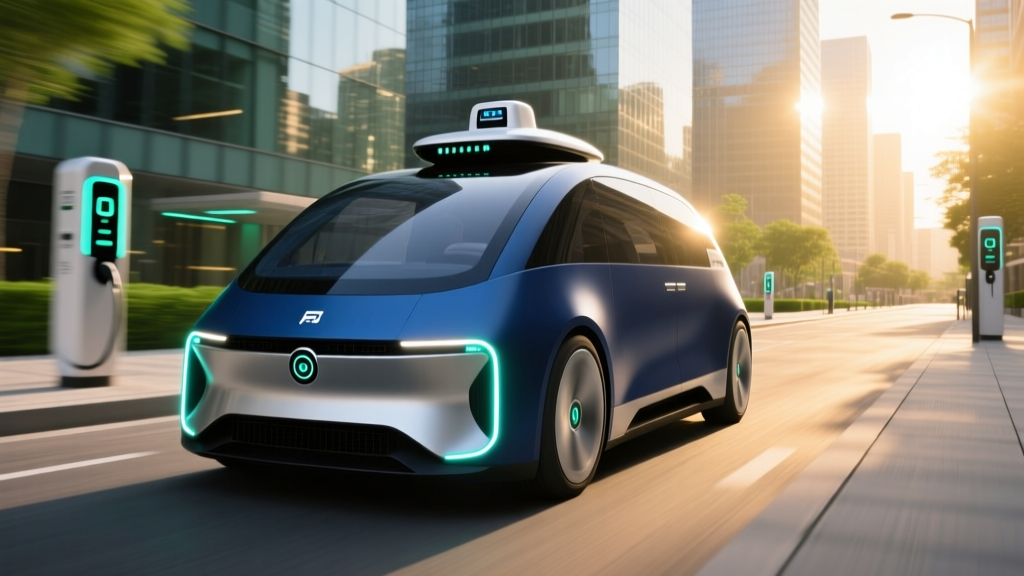
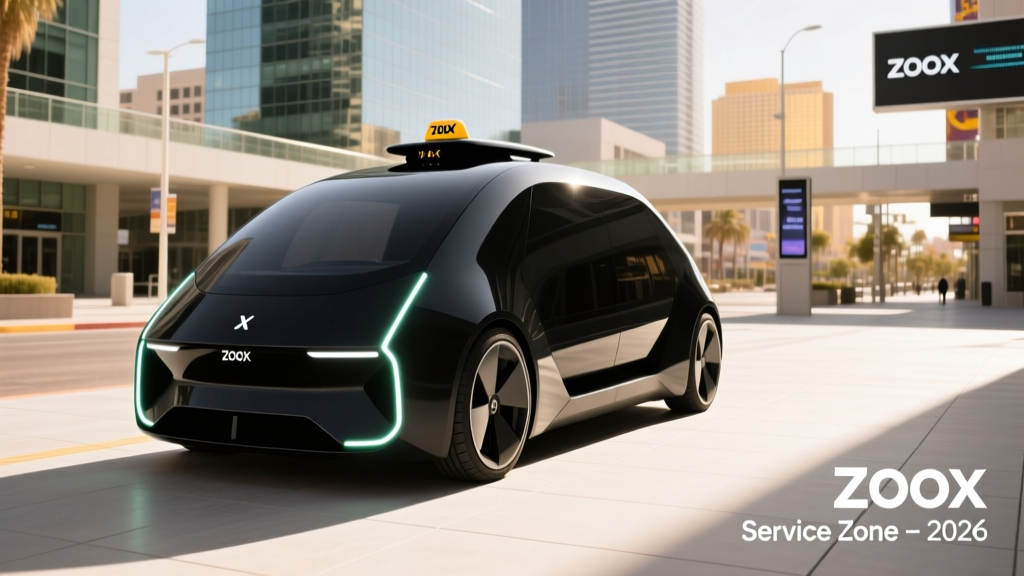
Unlike Waymo's broader city-wide footprint, Zoox runs a purpose-built, bidirectional carriage-style vehicle with no steering wheel — an SAE Level 4 robotaxi that handles every driving task inside its approved zone without any human behind the wheel. Below, we break down exactly where you can hail one, what it costs, how its safety record stacks up, and the real limitations you'll hit as a rider.
SAE Level 4 — Not Driver-Assist
Zoox is a Level 4 automated vehicle per SAE J3016: the system performs all driving tasks within its Operational Design Domain (geofenced area, specific weather, mapped roads) with zero expectation of human intervention. This is fundamentally different from Level 2 systems like Tesla Autopilot, GM Super Cruise, or Ford BlueCruise, which require an attentive driver ready to take over at any moment. When you ride in a Zoox, there is no driver seat, no steering wheel, and no pedals.
Where Can You Use Zoox in 2026?
Zoox rolls out city by city, and even within a city the service is restricted to a mapped and approved geofence. Here is the current operating map as of Q1 2026:
| City | Service Type | Approximate Geofence Coverage | Hours |
|---|---|---|---|
| Las Vegas, NV | Paid commercial rides | Las Vegas Strip corridor, Convention Center, airport rideshare lot | ~8 AM – 2 AM daily |
| San Francisco, CA | Paid commercial rides | SoMa, Mission Bay, Embarcadero, parts of downtown | ~6 AM – midnight daily |
| Los Angeles, CA | Paid commercial rides | Downtown LA, Koreatown, select Westside corridors | ~7 AM – 11 PM daily |
| Foster City, CA | Testing only (no paid rides) | Full city test zone | N/A |
| Austin, TX | Testing only (no paid rides) | Limited downtown and South Austin routes | N/A |
Las Vegas specifics: The Vegas geofence is optimized for the tourist corridor. You can hail a Zoox between major resorts like Mandalay Bay, Aria, Bellagio, Caesars Palace, and the Venetian, plus the Las Vegas Convention Center's West and Central halls. Airport pickups are available at the designated rideshare level of Terminal 1 and Terminal 3. Trips to suburban Henderson, Summerlin, or Red Rock Canyon are not supported — the vehicle will refuse to route outside its mapped zone.
How to Hail a Zoox and What It Costs vs Uber/Lyft
Zoox operates through its own mobile app (iOS and Android). You enter a pickup and dropoff point within the geofence, confirm the fare upfront, and the vehicle arrives — typically within 4–8 minutes in Las Vegas during non-peak hours. The carriage-style cabin seats four passengers face-to-face, with no partition and no driver.
| Metric | Zoox (Las Vegas) | UberX (Vegas Strip) | Lyft Standard (Vegas Strip) |
|---|---|---|---|
| Base fare (typical 3-mile Strip trip) | $9 – $13 | $12 – $18 | $11 – $17 |
| Per-mile rate | ~$1.40/mi | ~$1.60/mi | ~$1.55/mi |
| Surge pricing | No dynamic surge (as of 2026) | Yes, up to 2–3x | Yes, up to 2–3x |
| Tips expected | No (driverless) | Yes (~15–20%) | Yes (~15–20%) |
| Avg wait time (non-peak) | 4–8 min | 3–6 min | 3–6 min |
| Promo pricing | Frequent new-rider credits | Occasional | Occasional |
Zoox is currently pricing aggressively to build ridership — many new users report paying $0 for their first three rides via promo credits. Even at standard rates, the lack of surge pricing and tipping makes Zoox 20–35% cheaper than a comparable UberX trip on the Strip during weekend nights when rideshare surge kicks in. The tradeoff: longer wait times at peak hours and a smaller service zone.
How Safe Are Zoox Robotaxis? The Real Data
Safety is the first question every prospective rider asks. Zoox, like all Level 4 operators in California, files disengagement and collision reports with the DMV; in Nevada it reports to the state's Autonomous Vehicle Testing program. Federal crash data is reported to NHTSA under the Standing General Order for automated driving systems.
Zoox Safety Snapshot (through late 2025 reporting)
- Total autonomous miles driven (all cities): ~4.2 million miles in driverless mode
- Reported at-fault collisions: 0 known at-fault incidents involving injury to passengers or pedestrians as of Q4 2025 filings
- Total reported contact incidents: A small number of low-speed (<5 mph) contacts with stationary objects during early deployment, none resulting in injury
- Remote-assist interventions: Zoox uses a remote guidance system (not remote driving) where a human operator can confirm or select a path when the vehicle encounters an unmapped scenario; intervention rate reported at approximately 1–2 per 1,000 miles in early deployment, declining as the geofence matures
- NHTSA Standing General Order: Zoox is subject to mandatory crash reporting; check NHTSA's ADS crash dashboard for the latest filings
For context, Waymo — the largest Level 4 operator in the US — has logged over 30 million driverless miles and published peer-reviewed data showing its vehicles are involved in ~85% fewer injury-causing crashes per million miles than human benchmarks in comparable urban environments. Zoox's mileage is an order of magnitude smaller, so its statistical sample is narrower, but its safety record to date is consistent with that trend. The purpose-built Zoox vehicle also features a symmetric crash structure, four-wheel steering for tight avoidance maneuvers, and rear-facing seats that reduce whiplash risk.
Bottom line: the available data suggests riding in a Zoox is at least as safe as a rideshare trip with a human driver on the same roads — and likely safer in low-speed urban environments where human distraction is a leading crash factor. But the mileage sample is still growing, and every robotaxi operator is still learning edge cases.
The Technology Stack: Lidar, Cameras, and Geofencing
Zoox's approach to perception and planning is sensor-fusion heavy — a deliberate contrast to Tesla's camera-only FSD strategy. The purpose-built Zoox vehicle (the "carriage") is packed with redundant sensing:
Zoox Sensor & Compute Architecture
- Lidar: Multiple solid-state and spinning lidar units providing a 360° 3D point cloud out to ~150 meters; redundant fields of view at every corner
- Cameras: High-dynamic-range cameras covering 360° with overlapping fields for depth estimation and traffic-light/sign recognition
- Radar: Forward and corner radars for velocity detection of other vehicles, particularly in rain or fog where lidar and cameras degrade
- Audio sensors: External microphones to detect sirens from emergency vehicles before they are visible
- HD maps + geofencing: Centimeter-accurate pre-mapped routes within the operational zone; the vehicle will not operate outside the mapped boundary
- Compute: Custom Zoox AI stack running on dual-redundant vehicle computers; if the primary system faults, the backup brings the vehicle to a safe stop
- Remote guidance: A human remote-assist operator can resolve ambiguous scenarios (e.g., a construction zone with conflicting signage) by approving a path — but does not joystick-drive the vehicle in real time
This multi-sensor approach gives Zoox a meaningful advantage in low-light and partial-occlusion scenarios versus camera-only systems. The tradeoff is cost: each Zoox vehicle is estimated to carry $100,000+ in sensor and compute hardware, which is why the company is scaling fleet size deliberately rather than flooding cities with thousands of cars.
Regulatory Landscape: Who Approves Zoox to Operate?
Robotaxi operations in the US are governed by a patchwork of state and federal rules — there is no single national license.
- Nevada: The Nevada Department of Motor Vehicles (DMV) issues Autonomous Vehicle Testing and Deployment permits. Zoox holds a deployment permit allowing driverless commercial service in Clark County within approved geofences. Nevada law (AB 511 framework) allows fully driverless vehicles with no human in the vehicle.
- California: The California DMV issues both testing and deployment permits; the California Public Utilities Commission (CPUC) separately authorizes paid passenger service. Zoox holds both. California's regulatory environment has tightened since the 2023 Cruise suspension, with stricter incident-reporting and fleet-cap requirements.
- Federal (NHTSA): The National Highway Traffic Safety Administration does not currently "approve" ADS vehicles but mandates crash reporting under the Standing General Order and retains recall authority. Zoox's purpose-built vehicle received a special exemption from certain FMVSS requirements (e.g., no steering wheel, no mirrors) under a limited production-volume petition.
- Texas: Austin testing operates under the state's 2017 autonomous vehicle law (SB 2205), which permits driverless testing with local coordination.
The regulatory trend is toward more reporting and accountability, not less. Post-Cruise-incident scrutiny in late 2023 raised the bar for every operator — Zoox included — on incident disclosure, fleet monitoring, and first-responder interaction protocols.
Current Limitations: Where Zoox Falls Short
Level 4 robotaxis are genuinely impressive inside their operational design domain, but that domain has hard edges. Here's what Zoox cannot do today:
- Geofence boundaries: The vehicle will not drive outside its pre-mapped zone. In Las Vegas, that means no trips to Lake Mead, Red Rock Canyon, or most of North Las Vegas.
- Heavy weather: Zoox reduces or suspends service during heavy rain, dust storms (common in Vegas monsoon season, July–September), or dense fog. The lidar and camera stack degrades in these conditions, and the conservative safety policy is to pull over or refuse the ride.
- Construction zones: Major, unmapped road reconfigurations can cause the vehicle to stop and request remote guidance, adding minutes to your trip. Vegas Strip construction in particular causes occasional reroutes.
- No highway driving: The current Zoox geofences are urban/suburban surface streets only. No I-15 freeway runs to Jean or Primm.
- Accessibility gaps: The Zoox carriage is wheelchair-accessible via a ramp, but availability of accessible vehicles in the fleet is limited — you may wait longer or need to schedule in advance.
- Pet policy: Service animals are permitted; personal pets are not currently allowed in the cabin.
- Peak-hour availability: Fleet size is still limited. On a Saturday night on the Strip, expect 10–15 minute waits or temporary unavailability — Uber/Lyft still have the density edge at peak demand.
- No multi-stop trips: Currently point-A to point-B only. No "stop at the pharmacy on the way" routing.
Should You Try Zoox on Your Next Vegas Trip?
If your trip stays on or near the Strip and you value a no-surge, no-tipping, genuinely driverless experience, Zoox is worth hailing at least once. The ride itself is quiet, the cabin is roomy for four adults, and the novelty factor is real — you are sitting in a vehicle that is navigating Las Vegas Boulevard traffic with no one in the front seat.
If you need to go off-Strip, travel during monsoon weather, or need a ride at 3 AM after the service window closes, you'll still be opening Uber or Lyft. Robotaxis in 2026 are a compelling complement to rideshare, not a full replacement — and Zoox's Las Vegas service is one of the clearest examples of that reality.
Frequently Asked Questions
Is Zoox truly self-driving, or is there a remote human driving it?
Zoox is SAE Level 4 — fully self-driving within its geofence, with no human driver in the vehicle and no remote joystick control. A remote guidance operator can approve a path when the AI encounters an ambiguous situation (like an unusual construction detour), but the vehicle executes all steering, braking, and acceleration itself.
How much does a Zoox ride cost compared to Uber in Las Vegas?
A typical 3-mile Strip trip costs $9–$13 on Zoox versus $12–$18 on UberX, and Zoox does not use dynamic surge pricing. With new-rider promo credits, your first few rides may be free. Factor in no tipping, and Zoox is typically 20–35% cheaper on equivalent routes.
Can I take a Zoox from the Las Vegas airport to my hotel?
Yes, if your hotel is within the Zoox geofence (most major Strip resorts are). Pickup is at the designated rideshare level. Check the app for your specific hotel before booking.
How safe is Zoox compared to a human Uber driver?
Based on available data through late 2025 — approximately 4.2 million driverless miles with zero known at-fault injury collisions — Zoox's safety record is at least comparable to, and likely better than, human-driven rideshare in low-speed urban environments. Peer-reviewed data from Waymo (a larger fleet) shows ~85% fewer injury-causing crashes per million miles versus human benchmarks. Check NHTSA's ADS crash reporting dashboard for the latest filings.
Does Zoox operate in the rain or during Vegas dust storms?
Zoox will reduce or suspend service in heavy rain, dust storms, and dense fog. Las Vegas monsoon season (July–September) can trigger service interruptions. Plan for a rideshare backup during those windows.
What cities will Zoox expand to next?
Zoox has been testing in Austin, TX, and Foster City, CA, which are the most likely candidates for future commercial launches. The company has also signaled interest in Miami and Washington, DC, but no dates or permits have been confirmed for those markets as of early 2026. Always check Zoox's official site for the latest city announcements.
Can I bring luggage in a Zoox?
The Zoox carriage has limited cargo space compared to a sedan — a couple of carry-on bags or backpacks fit, but large checked suitcases for a group of four will be tight. For airport runs with heavy luggage, an UberXL or Lyft XL is the safer bet.