A Cabin Designed for Passengers, Not Drivers
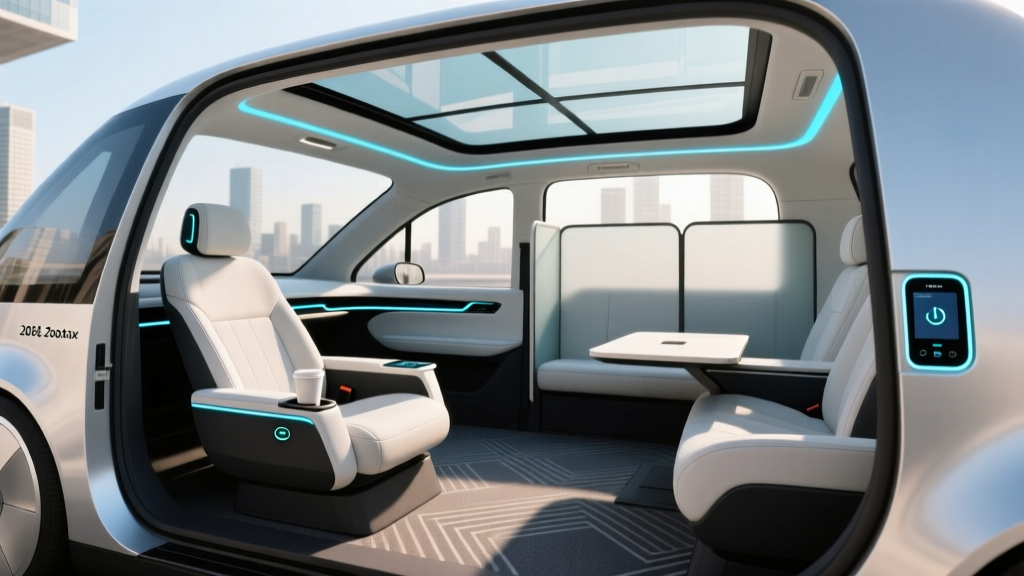
The Zoox robotaxi doesn't have a steering wheel, pedals, or a driver's seat. That absence defines everything about the Zoox interior — a symmetrical, face-to-face cabin built from the ground up for Level 4 autonomous operation. Unlike Waymo's retrofitted Jaguar I-PACE or Cruise's modified Chevrolet Bolt, the Zoox vehicle is a purpose-built carriage-style pod where every square inch serves the rider, not a human operator.
As of early 2026, Zoox has been operating its custom vehicle in limited commercial service in Las Vegas and has expanded testing in the San Francisco Bay Area and other cities. The interior reflects a philosophy that robotaxi passengers need a fundamentally different environment than car drivers — one optimized for conversation, accessibility, and trust in a vehicle that has no one behind the wheel.
The Zoox robotaxi operates at SAE Level 4 within its approved geofenced operational design domain (ODD). This means the vehicle handles all driving tasks — steering, braking, navigation, hazard response — without any human intervention in defined conditions. There is no driver seat, no steering wheel, and no expectation that a rider will take control. This is categorically different from Level 2 systems like Tesla Autopilot, GM Super Cruise, or Ford BlueCruise, which require an attentive human driver at all times. Zoox is driverless, not driver-assist.
Zoox Interior Layout and Dimensions
The Zoox vehicle is compact by traditional automotive standards — roughly the footprint of a Toyota Prius — but the interior volume tells a different story. Without a dashboard, steering column, front trunk, or driver controls, the entire cabin is passenger space.
| Attribute | Specification |
|---|---|
| Seating Capacity | 4 passengers (2 facing forward, 2 facing rearward) |
| Seating Configuration | Face-to-face bench seats |
| Entry/Exit | Sliding doors on both sides |
| Vehicle Length (approx.) | ~140 inches (compact footprint) |
| Battery Capacity | ~73 kWh (estimated, LFP chemistry) |
| Drive System | Dual-motor AWD, bidirectional (symmetrical) |
| Top Speed | 75 mph |
| Bidirectional Driving | Yes — vehicle can drive equally in either direction |
The face-to-face seating is the defining feature of the Zoox interior. Two bench seats face each other across a central open area, creating a lounge-like environment more reminiscent of a train compartment or airport shuttle than a traditional car. This layout encourages conversation between riders and eliminates the "backseat isolation" feeling common in rideshare vehicles where passengers stare at the back of a driver's headrest.
Bidirectional Symmetry
One of the most distinctive engineering choices in the Zoox vehicle is its bidirectional capability. The vehicle is perfectly symmetrical front-to-back — it has no defined "front" or "rear." This means it can pull out of a dead-end street by simply driving backward out of it, eliminating three-point turns and complex maneuvers in tight urban spaces. For the interior, this symmetry means both bench seats offer an identical forward-facing experience depending on the direction of travel. There is no "bad seat" in a Zoox.
The Rider Experience: Screens, Controls, and Accessibility
Without a driver to manage the trip, Zoox has placed the rider interface at the center of the interior experience. Each seating position has access to a personal screen panel integrated into the cabin walls. These screens display:
- Trip routing: A real-time map showing the planned route, current position, and estimated arrival time
- Climate controls: Individual temperature adjustment for each passenger zone
- Music and media: Bluetooth audio pairing and curated playlists
- Emergency communication: A direct button to connect with Zoox's remote guidance team
- Trip status: Door lock status, ride progress, and vehicle state
The cabin features integrated speakers positioned near each seating area for spatial audio, and the climate system uses multiple zones so that passengers can set their own comfort level without affecting others.
Accessibility Considerations
The Zoox interior was designed with wheelchair accessibility in mind from the earliest concept stages. The sliding doors open wide, the floor is flat and low to the ground, and the absence of a B-pillar obstruction (enabled by the vehicle's structural design) creates a wide entry aperture. However, as of early 2026, the production vehicles in commercial service accommodate seated passengers only — wheelchair-accessible variants have been announced but are not yet deployed in the active fleet. Zoox has stated that ADA-compliant accessibility is a priority for future fleet iterations.
Technology Stack: What Powers the Zoox Robotaxi
Zoox Sensor and Compute Architecture
The Zoox vehicle uses a multi-modal sensor suite — not a camera-only approach like Tesla's FSD. The perception stack includes:
- LiDAR: Multiple solid-state and spinning LiDAR units providing 360° 3D point-cloud mapping out to 200+ meters
- Cameras: A surround-view camera array covering all directions with overlapping fields of view for redundancy
- Radar: Multiple radar units for velocity detection and performance in rain, fog, and low-visibility conditions where cameras and LiDAR degrade
- Compute: Custom onboard computing platform processing sensor fusion, prediction, and planning in real time — estimated at several hundred TOPS (trillions of operations per second)
This redundant sensor approach means that if one modality is degraded (e.g., heavy rain scattering LiDAR returns), the others compensate. This is a fundamentally different philosophy from camera-only systems and is standard across Level 4 robotaxi operators including Waymo and the former Cruise fleet.
The vehicle operates within a high-definition geofenced map — it does not navigate purely by real-time perception. The HD map provides centimeter-level road geometry, lane markings, traffic signal positions, and speed limit data. The onboard perception system then reconciles the map with real-world conditions (construction zones, temporary obstacles, pedestrians) to plan safe trajectories. This geofencing is both a strength (extremely reliable in mapped areas) and a limitation (the vehicle cannot operate outside its approved zones).
Where Can You Ride a Zoox Robotaxi Right Now?
| City | Status | Vehicle Type | Public Access |
|---|---|---|---|
| Las Vegas, NV | Commercial service (limited) | Purpose-built Zoox vehicle | Invite-based / early rider program |
| San Francisco, CA | Testing with safety drivers; custom vehicle testing | Toyota Highlander (test) + Zoox vehicle (limited) | Not publicly available |
| Foster City, CA | Testing | Toyota Highlander (test fleet) | Not publicly available |
| Austin, TX | Testing (announced expansion) | Testing fleet | Not publicly available |
| Atlanta, GA | Testing (announced) | Testing fleet | Not publicly available |
| Miami, FL | Testing (announced) | Testing fleet | Not publicly available |
As of early 2026, the only city where members of the public can ride in the purpose-built Zoox vehicle is Las Vegas, and even there access is limited to an invite-based early rider program — not an open app-based hail like Uber or Waymo's public service in Phoenix and San Francisco. Zoox has been gradually expanding its rider pool in Las Vegas, with employees, partners, and selected members of the public completing rides on the Las Vegas Strip corridor and surrounding areas.
The testing fleet in California and other cities primarily uses Toyota Highlander SUVs equipped with Zoox's sensor suite and software. These test vehicles have a safety driver behind the wheel and do not represent the production rider experience. The purpose-built Zoox vehicle — the one with the distinctive interior described above — is currently deployed in limited numbers.
Zoox Pricing: How Does It Compare to Uber and Lyft?
| Service | Base Fare (est.) | Per-Mile Rate | 3-Mile Trip (est.) | Notes |
|---|---|---|---|---|
| Zoox (Las Vegas, early rider) | Free (promotional) | N/A yet | $0 | Currently free during early rider program |
| Waymo One (Phoenix/SF) | ~$2.50 | ~$1.25–$1.75 | ~$8–$12 | Comparable to UberX, surge-free |
| UberX (national avg.) | ~$2.50 | ~$1.50–$2.00 | ~$9–$14 | Subject to surge pricing |
| Lyft (national avg.) | ~$2.00 | ~$1.30–$1.80 | ~$8–$13 | Subject to surge pricing |
Zoox has not published commercial pricing because the service is not yet in paid operation. During the Las Vegas early rider program, rides are offered free of charge to participants. When Zoox does launch paid service, industry analysts expect pricing to be competitive with UberX and Lyft — likely in the $1.00–$1.75 per mile range — with the long-term goal of undercutting human-driven rideshare by eliminating driver compensation (which typically represents 60–75% of a rideshare fare).
For context, Zoox began offering free rides to invited riders in Las Vegas in mid-2025, marking the first time the public could experience the purpose-built vehicle. The transition to paid commercial service will require regulatory approval from the Nevada Public Utilities Commission and the National Highway Traffic Safety Administration (NHTSA), which has been reviewing Zoox's petition for exemptions from certain Federal Motor Vehicle Safety Standards (FMVSS) that assume a human driver (e.g., requirements for a steering wheel and rearview mirrors).
Safety Record and Data
Zoox Safety Data — What We Know (Early 2026)
- Test fleet miles: Zoox has logged millions of autonomous miles across its Highlander test fleet in San Francisco, Foster City, Las Vegas, and other cities. Exact cumulative mileage figures have not been publicly disclosed as of early 2026.
- Purpose-built vehicle miles: The custom Zoox vehicle has accumulated fewer public-road miles than the test fleet, with most commercial-riding miles occurring in the controlled Las Vegas environment.
- Disengagement reports: In California, Zoox is required to file annual disengagement reports with the California DMV. Zoox's disengagement rates (instances where a safety driver must take manual control) have shown year-over-year improvement but remain higher than Waymo's, reflecting Zoox's more aggressive testing in complex urban scenarios.
- Notable incidents: Zoox's test fleet has been involved in minor contact incidents typical of urban autonomous testing. No serious injuries or fatalities have been publicly reported in Zoox operations as of early 2026.
- NHTSA standing: Zoox is subject to NHTSA's Standing General Order requiring crash reporting for vehicles operating with Level 2+ or higher automation. The company has complied with reporting requirements.
Comparing robotaxi safety records is difficult because operators define and report metrics differently. Waymo, with over 30 million driverless miles logged across Phoenix, San Francisco, and Los Angeles, has published peer-reviewed data showing its vehicles are involved in police-reported crashes at roughly 0.4x the rate of human benchmark drivers for injury-causing crashes. Zoox has not yet published equivalent peer-reviewed safety studies, partly because its commercial driverless mileage is significantly lower.
The key safety advantage of the Zoox purpose-built vehicle is its sensor placement. With sensors mounted at the roof corners and integrated into the body panels (rather than retrofitted onto an existing vehicle), the Zoox has optimized sightlines and reduced blind spots. The vehicle's compact size and bidirectional capability also allow it to avoid complex maneuvers like U-turns that increase exposure to risk.
Current Limitations: Where Zoox Cannot Operate
Operational Limitations — Early 2026
- Geofenced zones only: The Zoox vehicle operates exclusively within pre-mapped geofenced areas. It cannot accept a ride request to a destination outside its approved ODD (Operational Design Domain).
- Weather constraints: Heavy rain, fog, and snow degrade LiDAR and camera performance. Zoox vehicles may reduce speed, increase following distance, or suspend service in severe weather — similar to Waymo's approach.
- Construction zones: Unmapped road changes, temporary lane shifts, and construction barriers present edge cases. Zoox's remote guidance team can assist the vehicle through novel scenarios, but persistent construction may cause the vehicle to reroute or decline a trip.
- No highway operation: The Zoox vehicle's 75 mph top speed and urban-focused design mean it is not intended for interstate highway travel. It is optimized for surface streets and urban corridors.
- Limited fleet size: The purpose-built vehicle fleet remains small — estimated in the low hundreds — compared to Waymo's 1,000+ vehicle fleet. This limits availability and wait times.
- No wheelchair access (yet): The current production vehicles do not accommodate wheelchair users, a significant accessibility gap that Zoox has acknowledged and plans to address in future vehicle iterations.
- Regulatory approval pending: Full commercial deployment requires FMVSS exemptions from NHTSA (the vehicle lacks a steering wheel, mirrors, and other driver-oriented equipment mandated by current standards) and state-level operating permits.
Regulatory Landscape: Who Approves Zoox Operations?
Robotaxi regulation in the United States is a patchwork of federal and state authority:
- Federal (NHTSA): Sets vehicle safety standards (FMVSS). Because the Zoox vehicle lacks a steering wheel, pedals, and mirrors, it requires an exemption from certain FMVSS requirements. Zoox has petitioned NHTSA for these exemptions, and the agency has been reviewing the petition. NHTSA also oversees crash reporting through its Standing General Order for automated vehicles.
- State — California (DMV + CPUC): The California DMV issues testing and deployment permits for autonomous vehicles. The California Public Utilities Commission (CPUC) regulates commercial passenger service. Zoox holds a DMV testing permit with a safety driver and has applied for driverless deployment permits.
- State — Nevada: Nevada was one of the first states to pass autonomous vehicle legislation. The Nevada Public Utilities Commission and the Nevada DMV oversee testing and commercial operations. Las Vegas has been welcoming to robotaxi testing, which is why Zoox chose it for its first public rider program.
- Local (city/county): Municipal governments can influence robotaxi operations through permitting, curb management, and coordination with local emergency services. San Francisco's Board of Supervisors and the SFMTA have at times restricted robotaxi expansion due to incidents involving Waymo and Cruise vehicles blocking emergency responders.
The regulatory path for Zoox is more complex than for Waymo because of the vehicle's unconventional design. A retrofitted Jaguar I-PACE or Hyundai Ioniq 5 already complies with FMVSS because it retains all standard driver controls. The Zoox vehicle's exemption request is a precedent-setting process that will shape how future purpose-built autonomous vehicles are certified.
Zoox Interior vs. Waymo and Cruise: A Cabin Comparison
| Feature | Zoox (Purpose-Built) | Waymo (Jaguar I-PACE) | Cruise (Chevrolet Origin)* |
|---|---|---|---|
| Steering Wheel | None | Yes (no driver present) | None |
| Seating | Face-to-face benches (4) | Standard 2-row (3 rear passengers) | Face-to-face benches (4–6) |
| Passenger Screens | Per-seat integrated screens | Rear-seat screen | Central display |
| Climate Zones | Per-passenger zones | Single cabin zone (rider adjustable) | Multi-zone |
| Bidirectional | Yes | No | No |
| Wheelchair Access | Not yet | WAV available in some markets | Designed for future access |
| Status (Early 2026) | Limited early rider (Las Vegas) | Commercial service (Phoenix, SF, LA) | Suspended* (post-Oct 2023 incident) |
*Cruise suspended all operations nationwide in October 2023 after a pedestrian-dragging incident in San Francisco. As of early 2026, GM has relaunched Cruise operations in a limited capacity in Phoenix with human safety drivers, and the Origin vehicle program has been restructured.
Frequently Asked Questions
Where can I ride in a Zoox robotaxi right now?
As of early 2026, the only opportunity to ride in Zoox's purpose-built vehicle is through its invite-based early rider program in Las Vegas, Nevada. You cannot hail a Zoox on demand through an app like Uber or Waymo One. Zoox is expanding testing in San Francisco, Austin, Atlanta, and Miami, but these cities use the Highlander test fleet with safety drivers and are not open to public riders.
How much does a Zoox ride cost compared to Uber or Lyft?
Zoox rides are currently free during the early rider program in Las Vegas. When paid commercial service launches, pricing is expected to be in the range of $1.00–$1.75 per mile, competitive with or slightly below UberX and Lyft. The long-term economic thesis of robotaxis is that removing the driver (who earns 60–75% of each fare) allows operators to offer significantly lower prices while maintaining profitability. However, this has yet to be proven at scale by any operator.
Is the Zoox robotaxi truly self-driving, or is there a remote human controlling it?
The Zoox vehicle is genuinely driverless — there is no human in the vehicle, no steering wheel, and no pedals. It operates at SAE Level 4 within its geofenced area. However, Zoox employs a remote guidance team that can assist the vehicle's AI when it encounters novel or ambiguous situations (e.g., a police officer directing traffic with hand signals, an unusual construction zone). Remote guidance does not mean a human is "driving" the car by joystick — rather, the remote operator can approve a path or provide high-level direction that the vehicle's onboard system then executes. This is standard practice across Level 4 operators including Waymo.
How safe are Zoox robotaxis compared to human drivers?
Zoox has not yet published peer-reviewed safety data comparing its crash rates to human benchmarks, primarily because its commercial driverless mileage is still relatively low. For context, Waymo has published data showing its vehicles are involved in injury-causing crashes at approximately 0.4x the rate of human drivers in comparable urban environments. Zoox's test fleet has been involved in minor contact incidents typical of urban AV testing, but no serious injuries or fatalities have been publicly reported. The NHTSA Standing General Order requires all AV operators to report crashes, providing a baseline of transparency.
What happens if the Zoox vehicle encounters a situation it can't handle?
The vehicle is designed to enter a "minimal risk condition" — it will slow down, pull to the side of the road, and stop if it encounters a scenario it cannot resolve. Riders can use the in-cabin emergency button to connect directly with Zoox's remote guidance team, who can assess the situation and either provide the vehicle with a path forward or dispatch roadside assistance. This is analogous to pulling over and calling for help, but automated.
Can the Zoox vehicle drive on highways?
The Zoox vehicle has a top speed of 75 mph, which technically allows highway operation, but its current operational design domain (ODD) is focused on urban surface streets. Highway driving presents different challenges — higher speeds, less time to react, complex merge scenarios — and Zoox has prioritized dense urban environments where its compact size, bidirectional capability, and sensor suite provide the most value.
What is the Zoox vehicle's battery and range?
The Zoox vehicle is estimated to use a ~73 kWh battery pack with LFP (lithium iron phosphate) chemistry, chosen for its longevity and thermal stability in a high-utilization fleet application. Exact EPA range figures have not been published, but the vehicle is designed for continuous urban operation with periodic fast-charging breaks. For a robotaxi, total daily range matters less than the ability to charge quickly between rides — LFP batteries tolerate frequent charging to 100% better than NMC chemistries, making them well-suited for fleet duty cycles.
The Bottom Line: A Glimpse at the Robotaxi Cabin of the Future
The Zoox interior represents a genuine rethinking of what a car cabin can be when you remove the driver entirely. The face-to-face seating, per-passenger screens, bidirectional symmetry, and purpose-built sensor integration create an experience that no retrofitted vehicle can match. The tradeoff is that this bespoke approach takes longer to scale — Waymo, using existing vehicle platforms, has thousands of cars in commercial service across multiple cities while Zoox is still ramping its early rider program in one.
For riders in Las Vegas who can secure an invite, the Zoox interior offers the most forward-looking robotaxi experience available in 2026. For everyone else, it is a preview of what purpose-built autonomous vehicles will look like as the technology matures, regulations catch up, and fleet economics allow operators to deploy at the scale needed to make robotaxis a genuine alternative to car ownership.