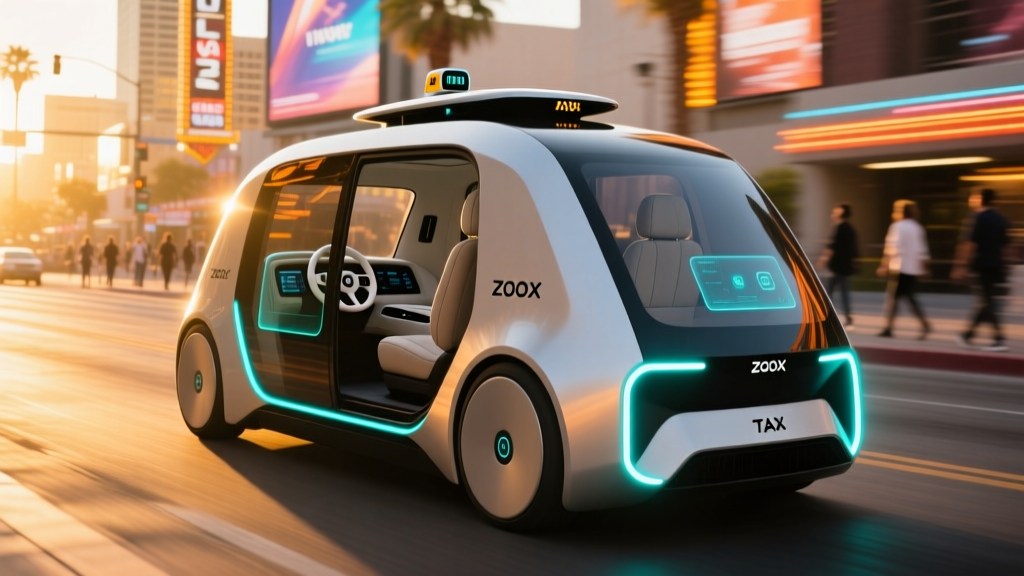
Las Vegas has become one of the most important proving grounds for autonomous mobility in the United States, and Zoox — Amazon's fully owned robotaxi subsidiary — is operating its purpose-built, steering-wheel-free vehicles on the Strip and surrounding corridors. If you have searched for zoox in vegas and wondered whether you can actually hail one, what it costs, and how safe the experience really is, this guide covers the operational reality as of early 2026.
Unlike Tesla's Full Self-Driving (Supervised), which remains a Level 2 driver-assist system requiring constant human attention, Zoox operates at SAE Level 4 within its geofenced service area. There is no driver. There is no steering wheel. The vehicle handles the entire driving task within its approved operational design domain (ODD), and if it encounters a scenario it cannot resolve, it pulls over safely rather than handing control to a passenger.
Where Can You Ride Zoox in Las Vegas Right Now?
Zoox launched its commercial robotaxi service in Las Vegas after an extended testing period that began in 2023. As of 2026, the service operates within a defined geofence covering key destinations along and near the Las Vegas Strip corridor.
| Zone | Status | Key Destinations |
|---|---|---|
| Las Vegas Strip Corridor | Live — Commercial Service | Major resort hotels, casinos, convention center |
| Downtown Las Vegas / Fremont | Limited Expansion Zone | Fremont Street Experience, Arts District |
| Harry Reid International Airport (LAS) | Testing / Limited Access | Airport pickup/dropoff under evaluation |
| Suburban Henderson / Summerlin | Not Available | Outside current geofence |
The geofence is not the entire metro area. Zoox carefully maps and validates every street within its operational domain before allowing rider-only (no safety driver) service. If your pickup or dropoff falls outside the geofence, the app will not let you book the ride. This is a deliberate safety constraint, not a software limitation that an OTA update will fix overnight — each new zone requires regulatory approval, HD mapping, and validation driving.
Zoox also operates in the San Francisco Bay Area (its headquarters region) and has been expanding to additional cities. But Las Vegas remains the most accessible market for visitors wanting to experience a truly driverless robotaxi without being a beta tester in a residential neighborhood.
The Zoox Vehicle: A Purpose-Built Robotaxi, Not a Retrofit
What sets Zoox apart from competitors like Waymo (which retrofits Jaguar I-PACEs and Zeekr minivans) is its ground-up vehicle design. The Zoox robotaxi has no steering wheel, no pedals, and no driver's seat. It is a symmetric, bidirectional carriage-style vehicle where all four passengers face each other in a booth configuration.
Technology Stack Overview
| Component | Zoox Specification |
|---|---|
| Primary Perception | 360° LiDAR array (multiple roof- and corner-mounted units) |
| Secondary Sensors | Overlapping camera suite + radar for redundancy |
| Compute | Custom high-performance AI inference platform (redundant) |
| Localization | HD maps + real-time sensor fusion + GNSS/IMU |
| V2X Communication | Cellular + remote assistance (teleoperations support) |
| Vehicle Architecture | Purpose-built, bidirectional, no manual controls |
| Top Speed | 75 mph (capable, geofence-limited in practice) |
| Battery | All-electric, sized for continuous urban duty cycles |
The multi-sensor approach — LiDAR plus cameras plus radar — is a deliberate contrast to Tesla's camera-only FSD architecture. LiDAR provides precise, lighting-independent 3D depth data, which is critical for a vehicle with no human fallback. Radar adds velocity detection for moving objects in conditions where cameras and LiDAR may degrade (heavy rain, direct sun glare). The redundancy philosophy is simple: if one sensor modality is compromised, the others maintain safe perception.
The bidirectional design means the vehicle does not need to perform three-point turns or back up in complex scenarios — it simply drives the other direction. This simplifies the driving task in tight urban environments and alleyways common in older parts of Las Vegas.
SAE Automation Level: Why Zoox Is Level 4, Not Level 2
| Level | Name | Who Drives? | Example |
|---|---|---|---|
| Level 0 | No Automation | Human | Basic cruise control |
| Level 1 | Driver Assistance | Human (system assists one axis) | Adaptive cruise OR lane-keep |
| Level 2 | Partial Automation | Human (must supervise at all times) | Tesla Autopilot/FSD, GM Super Cruise, Ford BlueCruise |
| Level 3 | Conditional Automation | System (human must take over on request) | Mercedes Drive Pilot (limited markets, low speed) |
| Level 4 | High Automation | System (no human needed within ODD) | Zoox, Waymo in geofenced areas |
| Level 5 | Full Automation | System (everywhere, all conditions) | Does not exist commercially |
This distinction matters enormously. When you ride in a Zoox in Vegas, no one is driving. The system is fully responsible for the dynamic driving task within its operational design domain. If something goes wrong — a construction zone appears, a pedestrian steps into the road, an emergency vehicle approaches — the Zoox system must handle it or execute a minimal-risk maneuver (typically a controlled pullover). It will never ask you to grab a wheel, because there is no wheel to grab.
Contrast this with Tesla FSD (Supervised), which despite its name remains Level 2. The driver is legally and practically responsible for every moment of the trip. The system assists; the human supervises. Zoox does not require supervision. That is the fundamental gap between Level 2 and Level 4.
How to Use Zoox in Vegas and What It Costs
Riding Zoox in Las Vegas follows a familiar rideshare pattern, with a few robotaxi-specific differences:
- Download the Zoox app (iOS/Android) and create an account.
- Verify you are within the Las Vegas service area. The app shows the live geofence boundary.
- Enter your pickup and dropoff. Both must fall inside the geofence. The app suggests the nearest approved pickup point if you are slightly outside a designated zone.
- Confirm your ride. Wait times vary by demand and vehicle repositioning — typically 3–10 minutes on the Strip corridor.
- Board the vehicle. The Zoox app identifies the vehicle by color and ID. Doors unlock automatically when you approach.
- Ride. Interior screens display the route, speed, and what the vehicle's sensors are detecting in real time. Music and climate controls are passenger-adjustable.
- Arrive and exit. The ride ends automatically at your dropoff.
Pricing: Zoox vs. Uber and Lyft in Las Vegas
During its initial commercial phase, Zoox has offered rides at introductory promotional pricing — often free or heavily discounted — to build ridership data and public familiarity. As of 2026, Zoox has been transitioning toward standard per-ride pricing competitive with UberX and Lyft in the Las Vegas market.
| Service | Base Fare | Per Mile | Per Minute | Typical 3-Mile Strip Ride |
|---|---|---|---|---|
| Zoox | Promotional / Variable | Competitive with rideshare | Competitive with rideshare | $8–$15 (estimated, varies by promo) |
| UberX | ~$2.50 | ~$1.25 | ~$0.30 | $10–$18 |
| Lyft Standard | ~$2.25 | ~$1.20 | ~$0.28 | $9–$17 |
| Waymo (where available) | Comparable to UberX | Comparable to UberX | Comparable to UberX | $10–$18 |
Zoox's long-term pricing strategy is to undercut traditional rideshare by eliminating the driver cost (which represents roughly 60–75% of a typical UberX fare). However, early-stage robotaxi economics — fleet maintenance, remote assistance staffing, sensor replacement, HD map updates — mean that consumer pricing is not yet dramatically cheaper than a human-driven Lyft. Expect pricing to converge closer to $0.50–$0.80/mile as fleet utilization improves over the coming years.
Safety Record: What the Data Actually Shows
Zoox Safety Data Snapshot
- Testing and operational miles: Zoox has accumulated millions of autonomous miles across its test and commercial fleets in Las Vegas, the Bay Area, and other validation cities. Exact cumulative figures are reported to NHTSA and the California DMV (for California operations).
- Disengagement rate: In California DMV disengagement reports, Zoox has shown progressive improvement in miles between required human interventions during testing phases. As a Level 4 commercial service with no in-vehicle driver, "disengagements" in live service are handled via remote assistance rather than a steering-wheel takeover.
- At-fault collisions: Zoox's safety record in commercial operations has been strong relative to human-driver baselines, though the fleet size is still small compared to Waymo's multi-city deployment. The National Highway Traffic Safety Administration (NHTSA) requires Standing General Order crash reporting for all ADS-equipped vehicles.
- Remote assistance: Zoox employs teleoperations specialists who can provide high-level guidance to vehicles encountering novel scenarios — but they do not joystick-drive the vehicle in real time. The vehicle's AI executes all driving maneuvers.
Context matters. A robotaxi fleet operating at 40 mph on mapped urban streets with redundant sensors and no texting, no impairment, and no fatigue will, by physics and statistics, avoid many of the crash categories that dominate human injury data (distracted driving, DUI, speeding). The IIHS (iihs.org) has noted that the potential safety benefit of removing human error is enormous — but only if the automation system performs reliably across edge cases.
Zoox's approach to safety validation includes simulation billions of virtual miles, closed-course testing at its own facilities, and phased on-road deployment. The company was the first to receive a crashworthiness exemption from NHTSA for its steering-wheel-free design, which required demonstrating equivalent or superior occupant protection compared to conventional vehicles.
Regulatory Landscape: Who Approves Robotaxi Operations?
Robotaxi operations in the United States are governed by a patchwork of state and local regulations, not a single federal framework. Here is how it works for Zoox in Nevada:
- Nevada DMV / NDOT: Nevada was one of the first states to pass autonomous vehicle legislation (AB 511, 2011, updated since). The Nevada Department of Motor Vehicles issues autonomous vehicle testing and deployment permits. Zoox holds the required state authorization for commercial driverless operations.
- NHTSA (Federal): The National Highway Traffic Safety Administration (nhtsa.gov) sets vehicle safety standards (FMVSS) and requires crash reporting via Standing General Order for all ADS-equipped vehicles. Zoox received an FMVSS exemption for its purpose-built vehicle design (no steering wheel, no mirrors in the traditional sense).
- Local jurisdictions: Clark County and the City of Las Vegas coordinate on operational details such as pickup/dropoff zones, traffic management, and emergency response protocols for driverless vehicles.
This regulatory fragmentation means that Zoox's ability to expand to new cities depends on each state's legal framework. Some states (Arizona, California, Nevada, Texas) have permissive AV laws. Others effectively ban driverless commercial operations. There is no national "robotaxi license" — each market requires separate approval.
Current Limitations: What Zoox Cannot Do Yet
Level 4 autonomy is powerful within its domain, but the domain is bounded. Here are the real, practical limitations of riding Zoox in Vegas today:
- Geofence boundaries: You cannot ride to suburbs like Summerlin, Henderson, or Boulder City. If your destination is outside the mapped and approved zone, the service is unavailable.
- Airport access: Harry Reid International Airport (LAS) is a high-demand destination, but airport pickup/dropoff involves complex regulatory negotiations and dedicated infrastructure. Full airport service is not yet universally available.
- Severe weather: While Las Vegas rarely sees heavy rain or snow, monsoon-season dust storms and flash-flood conditions can trigger service suspensions. The sensor suite handles normal rain, but visibility-degrading events may cause the vehicle to pull over safely and wait.
- Construction zones: Major, unmapped road construction can challenge the HD-map-dependent navigation system. Zoox handles many construction scenarios, but novel, rapidly changing work zones may require remote assistance or rerouting.
- Special events: Massive crowd events (New Year's Eve on the Strip, major conventions, race weekends) create pedestrian-density scenarios that may trigger temporary geofence restrictions or longer wait times.
- No intercity travel: Zoox is an urban robotaxi. You cannot take it from Las Vegas to Los Angeles, the Grand Canyon, or even to Red Rock Canyon. It operates within its city geofence only.
- Accessibility: The Zoox vehicle is designed with ADA considerations, but riders with specific mobility device requirements should verify compatibility through the app before booking.
These limitations are not unique to Zoox — Waymo faces similar geofence and weather constraints in its markets. The gap between Level 4 (driverless within a defined domain) and Level 5 (driverless everywhere, in all conditions) remains substantial, and no company has bridged it.
Frequently Asked Questions
Is Zoox truly self-driving, or is there a hidden driver?
Zoox is genuinely driverless — SAE Level 4. There is no steering wheel, no pedals, and no human driver in the vehicle. The AI system handles all driving within the approved geofence. This is fundamentally different from Level 2 systems like Tesla Autopilot or FSD (Supervised), which require a licensed, attentive driver behind the wheel at all times.
How much does a Zoox ride cost compared to Uber or Lyft?
Zoox pricing is designed to be competitive with UberX and Lyft, with the long-term goal of undercutting them by eliminating driver costs. During promotional periods, rides have been free or deeply discounted. Standard pricing for a typical 3-mile Strip ride falls in the $8–$15 range, comparable to or slightly below standard rideshare fares in the same corridor.
Is Zoox available 24/7 in Las Vegas?
Service hours have expanded as the fleet and operational validation have grown, but Zoox may not operate around the clock in all zones. Check the app for real-time availability — service windows can vary by zone and by demand patterns.
What happens if the Zoox vehicle encounters something it can't handle?
The vehicle is programmed to execute a minimal-risk maneuver — typically a controlled stop or pullover — rather than proceeding unsafely. Remote assistance specialists can provide high-level guidance (e.g., confirming a safe path through a novel scenario), but they do not directly steer or control the vehicle. The on-board AI executes all driving actions.
Can I take a Zoox from the Las Vegas airport to my hotel?
Airport service is one of the most requested features, but full Harry Reid International Airport (LAS) access involves regulatory and infrastructure coordination that has been phased in gradually. Check the Zoox app for current airport availability — it may be limited or in testing as of early 2026.
How does Zoox compare to Waymo?
Both are Level 4 robotaxi services with no in-vehicle driver. Key differences: Zoox uses a purpose-built vehicle (no steering wheel, bidirectional, booth seating), while Waymo retrofits production vehicles (Jaguar I-PACE, Zeekr). Waymo has a larger multi-city deployment (Phoenix, San Francisco, Los Angeles, Austin) and more cumulative commercial miles. Zoox's Las Vegas presence and unique vehicle design make it a distinct experience, particularly for visitors to the Strip.
Is the Zoox vehicle electric?
Yes. The Zoox robotaxi is a fully battery-electric vehicle, consistent with the broader industry trend of pairing autonomous driving systems with electric powertrains for lower operating costs, instant torque for smooth urban driving, and zero tailpipe emissions in dense pedestrian environments.