Zoox, the Amazon-owned autonomous vehicle company, has been quietly expanding its purpose-built robotaxi footprint across the San Francisco Bay Area. For residents of and visitors to Hayward, CA — a city of roughly 160,000 in Alameda County — the question is practical: Can you actually hail a Zoox ride today, what does it cost, and how does the technology stack up against Waymo and Cruise's successors? This guide breaks down the Zoox Hayward, CA robotaxi service with the exact data you need.
Zoox operates as a Level 4 autonomous vehicle within its geofenced service area. This means the vehicle handles all driving tasks — steering, braking, navigation, obstacle avoidance — without any human driver present. There is no steering wheel or pedals. This is fundamentally different from Level 2 driver-assist systems like Tesla Autopilot or Ford BlueCruise, which require an attentive human driver at all times. When you ride in a Zoox, you are a passenger, not a driver.
Where Can You Use the Zoox Robotaxi Right Now?
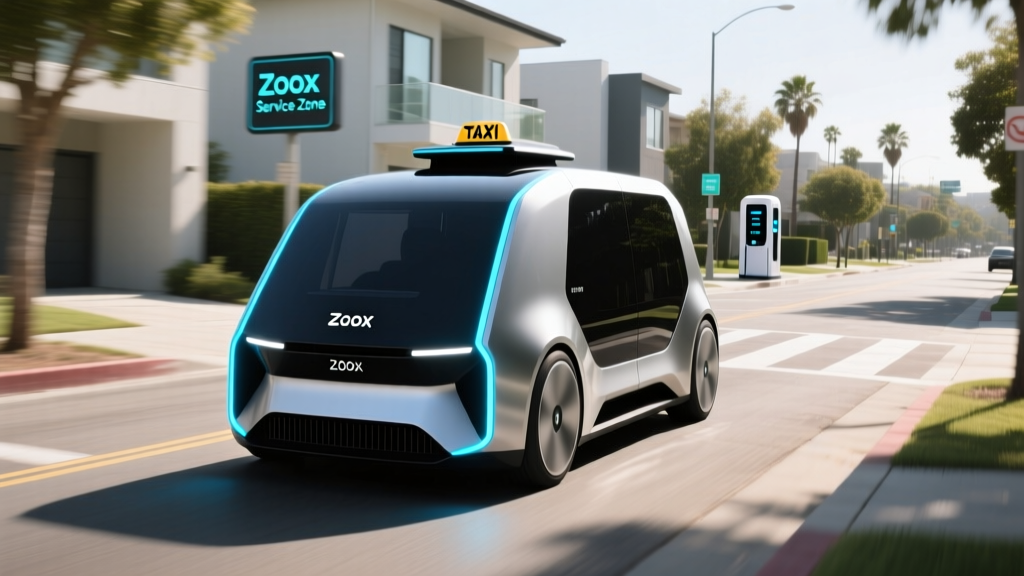
Zoox's commercial robotaxi service has been in phased rollout across the Bay Area. As of early 2026, the company operates its purpose-built bidirectional vehicle — a carriage-style pod with facing seats and no driver controls — in select geofenced zones. Hayward, CA sits within Zoox's broader East Bay expansion corridor, though coverage is not yet citywide.
| Zone | Status | Coverage Notes |
|---|---|---|
| San Francisco (core) | ✅ Live — open to public | SoMa, Mission, Financial District, expanded zones |
| Foster City / Peninsula | ✅ Live — open to public | Initial testing zone, now commercial service |
| Hayward, CA | ⚠️ Expanding — limited access | Select corridors; Zoox has testing & development presence in Hayward. Full public ride-hail availability varies by neighborhood within the geofence. |
| Las Vegas, NV | ✅ Live — limited public | Las Vegas Strip corridor and surrounding zones |
Zoox's connection to Hayward is not incidental. The company has maintained a physical presence in the city — including development and testing facilities — and the area's mix of suburban arterial roads, shopping centers, and BART-adjacent transit hubs makes it a logical expansion target. However, riders should check the Zoox app for their specific pickup location, as the geofence may not cover all of Hayward's neighborhoods simultaneously.
Zoox Pricing: How Does It Compare to Uber and Lyft?
Zoox has positioned its robotaxi fares competitively with traditional rideshare, and in some promotional periods has offered free or heavily discounted rides to build ridership. Here is a realistic pricing comparison for a typical 3–5 mile trip in the Bay Area:
| Service | Estimated Fare | Surge Pricing? | Tip Expected? |
|---|---|---|---|
| Zoox Robotaxi | $8–$14 | No dynamic surge (currently) | No (no driver) |
| UberX | $12–$20 | Yes — can 1.5–3x | Yes (15–20% typical) |
| Lyft Standard | $11–$19 | Yes — Prime Time pricing | Yes (15–20% typical) |
| Waymo One | $10–$18 | Limited dynamic pricing | No (no driver) |
The economics of robotaxi rides are still being subsidized in many markets. Zoox, backed by Amazon's capital, has used introductory pricing to attract riders. Over time, the absence of a human driver is the core economic thesis: no driver payout means the platform retains the full fare, potentially allowing lower prices while maintaining margins. For now, expect Zoox fares to be at or slightly below UberX/Lyft levels, with the added benefit of zero surge pricing and no tipping obligation.
How to Ride: The Zoox App and Experience
Booking a Zoox ride follows a familiar rideshare pattern, with a few differences unique to the driverless format:
- Download the Zoox app (iOS/Android) and create an account. You may need to be in a waitlist queue depending on your zone — Zoox has gradually opened access rather than launching fully public on day one.
- Set your pickup and dropoff within the active geofence. The app will confirm whether your requested route is serviceable.
- The vehicle arrives — a compact, symmetrical pod that can drive equally well in either direction. There are no headlights or taillights in the traditional sense; the vehicle uses external lighting signatures to communicate intent to pedestrians.
- Unlock via the app. There's no driver to greet you. Doors open, you select your pre-assigned seat, and the ride begins.
- In-ride experience: facing seats, a screen showing the vehicle's perception of the environment (detected objects, planned route), and a "stop ride" button for emergencies. Speeds are generally capped around 35–45 mph in current deployments.
Zoox Technology Stack: Sensors, Compute, and the Purpose-Built Vehicle
What Powers the Zoox Robotaxi
Zoox's approach differs fundamentally from Tesla's camera-only strategy and aligns more closely with Waymo's multi-sensor redundancy philosophy.
- LiDAR: Multiple solid-state and spinning LiDAR units provide a 360° point cloud of the vehicle's surroundings, accurate to centimeter-level resolution at distances exceeding 150 meters.
- Cameras: A suite of high-resolution cameras covers all directions, enabling traffic-light recognition, sign reading, lane-marking detection, and object classification.
- Radar: Millimeter-wave radar supplements LiDAR for velocity detection of moving objects and performance in rain or fog where LiDAR can degrade.
- Compute: Custom onboard computers process sensor fusion in real time — Zoox designs both the vehicle and the AI stack in-house, unlike companies retrofitting existing car platforms.
- HD Mapping + Geofencing: The vehicle operates only within pre-mapped zones. Every intersection, crosswalk, and lane configuration is known in advance. The AI navigates within this constrained environment rather than attempting generalized driving anywhere.
The purpose-built vehicle itself is a key differentiator. Because Zoox designed the carriage from scratch for autonomous operation, it features four-wheel steering (enabling tight turns and lateral moves), bidirectional driving capability (no designated "front" or "back"), and redundant braking and steering systems so that a single-point failure doesn't strand passengers.
Safety Data: What the Numbers Actually Show
Autonomous vehicle safety data in California is reported to the California DMV via mandatory disengagement reports, and to NHTSA under a Standing General Order requiring crash reporting for Level 2–5 vehicles.
Key data points for robotaxi operations in California:
- Waymo (the largest operator) reported over 7.1 million autonomous miles driven in California between late 2022 and mid-2024, with a contact rate (police-reportable incidents per million miles) significantly lower than human benchmarks for the same urban environments.
- Zoox has accumulated hundreds of thousands of driverless miles across its Bay Area and Las Vegas operations. The company reported to NHTSA a small number of minor incidents — predominantly low-speed contacts where the Zoox vehicle was stationary or near-stationary and was struck by another road user.
- Cruise's suspension (October 2023, following a pedestrian-dragging incident in San Francisco) remains a cautionary benchmark. Cruise's permit was revoked by the California DMV, and the company underwent a lengthy restart process. This incident underscored that Level 4 operations carry real risk at edge cases, even with extensive testing.
Zoox has not experienced a comparable high-profile incident. However, the sample size of Zoox's public operations remains smaller than Waymo's, making direct statistical comparison premature. The honest assessment: Level 4 robotaxis have demonstrated strong safety performance in geofenced urban settings, but the total miles driven across the industry remain in the low tens of millions — far below the trillions of human-driven miles that establish baseline risk.
Regulatory Landscape: Who Approves Robotaxi Operations?
Operating a driverless taxi service in California requires navigating a layered regulatory framework:
- California DMV: Issues testing permits and autonomous vehicle deployment permits. Companies must submit disengagement reports and maintain minimum insurance coverage ($5 million for bodily injury/property damage).
- California Public Utilities Commission (CPUC): Regulates commercial passenger service. A separate CPUC permit is required to charge fares and operate as a transportation network company (TNC) with driverless vehicles.
- NHTSA (Federal): Sets vehicle safety standards (FMVSS). Zoox received a notable exemption from certain FMVSS requirements — such as the mandate for a steering wheel and mirrors — because its purpose-built vehicle doesn't have traditional driving controls. This NHTSA exemption was a significant regulatory milestone.
- City/County Level: Local jurisdictions like the City of Hayward may impose operational conditions, including speed limits, restricted zones (school zones, construction areas), and first-responder interaction protocols.
Zoox holds both DMV and CPUC permits for commercial operations in California. The company's gradual geographic expansion reflects the need to map, test, and gain regulatory comfort in each new zone before opening it to paying passengers.
Current Limitations: Where Robotaxis Still Fall Short
What Zoox Robotaxis Cannot Do (Yet)
- Geofence boundaries: You cannot hail a Zoox from Hayward to Oakland Airport if the route crosses outside the mapped zone. Trips are limited to pre-approved corridors.
- Heavy weather degradation: While the Bay Area rarely sees snow, heavy rain and fog can reduce LiDAR and camera effectiveness. Zoox vehicles may pull over or decline rides during severe weather — a limitation shared across the industry.
- Construction zones: Rapidly changing lane configurations, temporary barriers, and flagger-directed traffic remain challenging edge cases. Geofenced zones may be temporarily shrunk around major construction.
- Speed limitations: Current Zoox deployments are optimized for urban and suburban streets (typically ≤45 mph). Highway-speed operation is not yet part of the commercial service.
- No intercity trips: A Hayward-to-San-Jose trip is not possible. This is a local urban mobility service, not a long-distance alternative.
- Accessibility constraints: While the Zoox vehicle is designed with a low floor and wide doors, wheelchair accommodation and specific ADA compliance details vary — riders with mobility needs should confirm via the app before booking.
- Limited hours: Service may not operate 24/7 in all zones. Late-night availability depends on the specific geofence and regulatory permit conditions.
Zoox in the Context of the Broader Robotaxi Market
Zoox occupies a distinct position in the autonomous vehicle landscape. Unlike Waymo, which retrofits existing vehicle platforms (Jaguar I-PACE, Zeekr), Zoox builds its own vehicle from the ground up — a capital-intensive strategy that only Amazon's backing makes viable. Unlike Tesla's FSD Supervised (a Level 2 system requiring driver engagement), Zoox is genuinely driverless within its zone.
For Hayward residents, the practical question is timing. Zoox's East Bay expansion suggests broader Hayward coverage is coming, but "coming" in autonomous vehicle timelines has historically meant years, not months. The company's testing presence in the city is a positive signal, but full open-access service across all of Hayward's neighborhoods — from the downtown BART station to Southland Mall to the Cal State East Bay campus — will require further mapping, regulatory approval, and fleet scaling.
Frequently Asked Questions
Is the Zoox robotaxi truly self-driving, or is there a remote operator?
Zoox vehicles operate at SAE Level 4 — there is no human driver in the vehicle. The vehicles drive autonomously within their geofence. However, remote assistance exists: if the AI encounters an ambiguous situation (e.g., an unusual construction setup), a remote operator can provide guidance. This is not the same as remote driving — the operator typically confirms a path or provides high-level direction rather than steering the vehicle in real time.
How much does a Zoox ride cost compared to Uber or Lyft in Hayward?
Based on Bay Area pricing patterns, expect Zoox fares in the $8–$14 range for a typical 3–5 mile trip — competitive with or slightly below UberX ($12–$20) and without surge pricing or tipping. Promotional periods may offer free or discounted rides. Exact pricing depends on distance, time of day, and current Zoox promotional strategy.
Is Zoox available everywhere in Hayward, CA?
Not yet. Zoox's service in the Hayward area is expanding but geofenced to specific corridors. Coverage may include major arterials and commercial zones while excluding some residential neighborhoods. Check the Zoox app for your exact pickup/dropoff eligibility.
How safe is the Zoox robotaxi compared to a human driver?
Available data from California DMV and NHTSA reporting suggests that Level 4 robotaxis (Waymo, Zoox) have lower police-reportable contact rates per million miles than human drivers in comparable urban environments. However, total autonomous miles remain in the millions, not billions, so statistical confidence is still building. Zoox has not been involved in a high-profile serious-injury incident as of early 2026.
Can I use a Zoox robotaxi to get to Oakland Airport or San Francisco from Hayward?
Likely not, unless the entire route falls within Zoox's active geofence. Robotaxi services are designed for intra-zone trips, not intercity travel. For airport runs that cross multiple jurisdictions and highways, Uber/Lyft or BART remain the practical options.
What happens if the Zoox vehicle gets confused or encounters an emergency?
The vehicle is designed to execute a "minimal risk condition" — typically pulling over safely and stopping. Passengers have a stop-ride button inside the cabin. Remote assistance can be summoned, and the vehicle's redundant systems (dual braking, dual steering) are designed to handle single-point failures without endangering occupants.