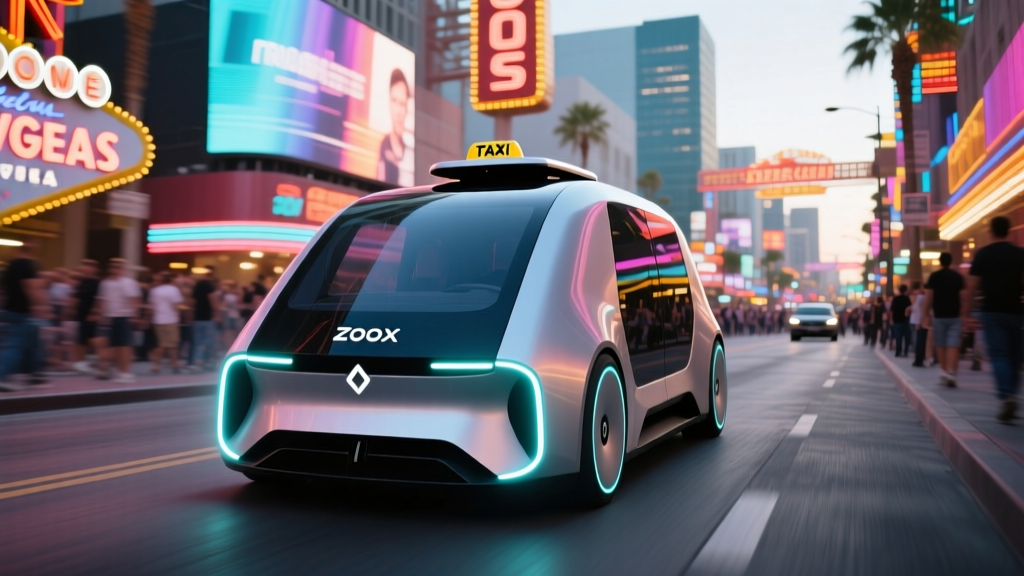
If you have been tracking autonomous vehicle deployments, you have likely seen Zoox's purpose-built, carriage-style robotaxis navigating Las Vegas streets. But for visitors planning a trip to downtown Las Vegas, one question dominates: does Zoox go to Fremont Street? The short answer as of early 2026 is no — Fremont Street and the surrounding pedestrian mall sit outside Zoox's current geofenced service area. However, Zoox's operational footprint in Las Vegas has expanded significantly since its initial pilot, and understanding exactly where you can hail a ride, what it costs, and how the technology works is essential before you plan your itinerary around it.
This guide breaks down Zoox's live service map, its SAE Level 4 autonomy stack, real safety data, pricing versus Uber and Lyft, and the regulatory framework governing robotaxi operations in Nevada.
Where Zoox Operates in Las Vegas Right Now
Zoox launched its first commercial robotaxi service in Las Vegas in mid-2024 after years of testing on public roads. As of 2026, the service area covers a defined geofenced zone that includes:
- The Las Vegas Strip corridor — from roughly Mandalay Bay in the south to the Wynn/Encore properties in the north
- Select downtown-adjacent zones — portions of Las Vegas Boulevard north of the Strip, extending toward the Arts District
- Harry Reid International Airport (LAS) — designated pickup/dropoff zones at the airport
- Portions of Paradise Road and Harmon Avenue — connecting major hotel properties east of the Strip
Fremont Street Experience — the famous pedestrian mall anchored by the Golden Nugget, Four Queens, and Binion's — remains outside the current operational boundary. Zoox's geofencing restricts vehicles to mapped, pre-approved road segments, and the dense pedestrian traffic, narrow streets, and event-driven road closures around Fremont Street make it a challenging environment for the current deployment phase.
| City | Status | Service Area Notes |
|---|---|---|
| Las Vegas, NV | Live — commercial rides | Strip corridor, airport, select downtown-adjacent zones |
| San Francisco, CA | Live — commercial rides | Expanded geofence covering most of SF proper |
| Foster City, CA | Live — employee/invite rides | Suburban testing zone near Zoox HQ |
| Austin, TX | Testing — no public rides | Mapping and validation phase |
| Atlanta, GA | Announced — not yet live | Expected future expansion, no public date |
If Fremont Street access is a priority, your best bet in 2026 remains a traditional rideshare (Uber/Lyft) or the Downtown Loop, a free city bus service that connects the Strip to downtown Las Vegas.
How to Ride Zoox and What It Costs vs. Uber and Lyft
Zoox operates through its proprietary mobile app, available on iOS and Android. The process is straightforward:
- Download the Zoox app and create an account
- Enter your pickup location (must be within the geofenced zone)
- Confirm your destination (also within the zone)
- Wait for vehicle dispatch — typical wait times range from 3 to 8 minutes in the Strip corridor
- The vehicle arrives, verifies your identity via the app, and unlocks the doors
- Enjoy the ride — there is no steering wheel, no pedals, and no human driver
During its initial launch phase, Zoox offered free rides to build ridership and gather operational data. As of 2026, Zoox has transitioned to a paid model in Las Vegas, though pricing remains competitive with — and in some cases below — traditional rideshare.
| Service | Estimated Fare (3 mi) | Wait Time | Notes |
|---|---|---|---|
| Zoox Robotaxi | $8–$12 | 3–8 min | Fixed pricing, no surge; geofence restricted |
| UberX | $10–$18 | 2–5 min | Surge pricing during peak hours/events |
| Lyft Standard | $10–$17 | 2–6 min | Surge pricing during peak hours/events |
| Waymo One (SF only) | N/A in Vegas | N/A | Not available in Las Vegas as of 2026 |
Zoox's pricing advantage comes partly from the absence of a human driver's earnings cut. However, the trade-off is geographic flexibility — you cannot ride Zoox to destinations outside its geofence, whereas Uber and Lyft cover the entire Las Vegas metropolitan area including Fremont Street, Henderson, and Summerlin.
Is Zoox Truly Self-Driving? Understanding SAE Level 4
This is where consumer confusion runs deepest. Zoox's robotaxi is classified as SAE Level 4 — high automation within a defined operational design domain (ODD). This is fundamentally different from the Level 2 systems you find in consumer vehicles like Tesla's Autopilot or Ford's BlueCruise.
| Level | Name | Driver Required? | Example |
|---|---|---|---|
| Level 0 | No Automation | Full-time | Basic cruise control |
| Level 1 | Driver Assistance | Full-time | Adaptive cruise OR lane-keep |
| Level 2 | Partial Automation | Full-time, hands on or eyes on | Tesla Autopilot, GM Super Cruise, Ford BlueCruise |
| Level 3 | Conditional Automation | On standby, can disengage eyes | Mercedes Drive Pilot (limited conditions) |
| Level 4 | High Automation | No — vehicle handles all driving in ODD | Zoox, Waymo, Cruise (pre-suspension) |
| Level 5 | Full Automation | No — anywhere, any condition | Does not yet exist commercially |
When you ride in a Zoox vehicle, there is no human in the driver's seat. The vehicle navigates, makes lane changes, handles intersections, and responds to pedestrians and cyclists entirely on its own — but only within its pre-mapped geofence and under weather and road conditions it has been validated for. If the vehicle encounters a scenario it cannot handle, it is designed to pull over safely and request remote assistance rather than hand control to a non-existent driver.
This is a critical distinction from Level 2 systems like Tesla's Full Self-Driving (Supervised), which require continuous driver attention and can be used on any road but are not autonomous. Zoox is genuinely driverless — just not everywhere.
Zoox Technology Stack: Sensors, Compute, and the Purpose-Built Vehicle
Zoox takes a sensor-fusion approach that stands in contrast to Tesla's camera-only philosophy. The Zoox robotaxi vehicle — a compact, bidirectional carriage with no steering wheel — integrates a redundant suite of perception hardware:
- LiDAR: Multiple solid-state and spinning LiDAR units provide a 360-degree, high-resolution 3D point cloud of the vehicle's surroundings, effective to roughly 150+ meters
- Cameras: A network of high-dynamic-range cameras covers all angles, providing color, texture, and signage/traffic-light recognition
- Radar: Millimeter-wave radar units supplement LiDAR for velocity detection of moving objects and performance in rain or fog
- Ultrasonic sensors: Short-range sensors for close-proximity maneuvering and low-speed obstacle detection
- Redundant compute: Dual independent computing platforms ensure that a single hardware failure does not compromise vehicle control
The vehicle itself is purpose-built for autonomy — not a retrofitted consumer car. It features four-wheel steering for tight urban maneuvering, bidirectional driving capability (it can travel forward or backward with equal ease), and a symmetrical interior where all four passengers face each other. The design eliminates the need for a driver's cockpit entirely, maximizing interior space within a compact footprint.
Zoox also relies heavily on HD mapping. Before the vehicle operates in any area, Zoox creates centimeter-precision 3D maps of the road network, including lane markings, curb geometry, traffic signal locations, and permanent infrastructure. The vehicle localizes itself against these maps in real time, layering live sensor data on top to detect dynamic objects like other cars, pedestrians, and construction zones.
Safety Record: What the Data Actually Shows
Robotaxi safety is the most scrutinized — and most politicized — topic in autonomous driving. Here is what we know about Zoox's safety performance based on available data and regulatory filings.
- Total autonomous miles driven: Estimated 1M+ miles across all test and commercial operations (Zoox does not publish a live counter as Waymo does via NHTSA filings)
- At-fault collisions: Zero reported severe or fatal collisions involving a Zoox robotaxi in autonomous mode as of early 2026
- Minor contact incidents: A small number of low-speed contacts have been reported during testing phases, consistent with industry norms for urban driving
- Disengagement rate: Zoox has reported improving intervention rates year-over-year, though exact figures per 1,000 miles are less publicly documented than Waymo's
Sources: NHTSA AV Safety Reporting, California DMV Disengagement Reports
For context, Waymo — the most data-transparent robotaxi operator — has published peer-reviewed research showing its vehicles are involved in roughly 85% fewer injury-causing crashes per million miles compared to human drivers in comparable urban environments. Zoox has not published equivalent peer-reviewed analysis, which is a notable gap in public transparency.
It is also important to understand what safety data does not capture. Most robotaxi incidents that make headlines involve edge cases — a vehicle stopping unexpectedly in an intersection, failing to navigate around a double-parked delivery truck, or hesitating at an unprotected left turn. These are rarely dangerous but can cause traffic disruption and erode public trust.
Zoox's safety approach benefits from its purpose-built vehicle design. Because the vehicle was engineered from the ground up without a human driver, safety systems — including redundant braking, steering, and power — are integrated natively rather than bolted onto a conventional car platform. The vehicle also features an advanced restraint system and airbag configuration designed for its face-to-face seating layout.
Current Limitations: Where Robotaxis Still Fall Short
Level 4 autonomy is impressive engineering, but it operates within strict boundaries. Here are the practical limitations you will encounter with Zoox in 2026:
- Geofence restrictions: The vehicle will not travel outside its mapped operational zone. Fremont Street, most residential neighborhoods, and suburban areas are inaccessible.
- Weather constraints: Heavy rain, fog, or dust storms can degrade LiDAR and camera performance. Zoox may suspend service or reduce its operational area during adverse conditions.
- Construction zones: While Zoox can handle some temporary lane shifts, major unanticipated construction may cause the vehicle to reroute or pull over and request remote guidance.
- Event-driven road closures: Parades, marathons, or emergency closures that are not pre-mapped can disrupt service. The vehicle will not attempt to navigate an unmapped detour.
- No highway driving: Zoox's current ODD is limited to urban surface streets. You cannot take a Zoox from Las Vegas to Henderson or Boulder City.
- Limited cargo and accessibility: The vehicle's compact design means limited trunk space. Wheelchair accessibility varies by market and vehicle configuration.
- No multi-stop trips: You cannot add intermediate stops (e.g., pick up a friend, stop at a pharmacy) the way you can with Uber or Lyft.
These limitations are not unique to Zoox — they apply broadly to all current Level 4 robotaxi services, including Waymo. The technology excels in predictable, well-mapped urban environments but is not a replacement for the geographic flexibility of a human-driven rideshare.
The Regulatory Landscape: Who Approves Robotaxi Operations?
Robotaxi deployment in the United States is governed by a patchwork of state and local regulations. There is no single federal license for autonomous vehicle operations.
In Nevada, the Department of Motor Vehicles and the Public Utilities Commission oversee autonomous vehicle testing and commercial deployment. Nevada was an early mover in AV legislation, passing laws that explicitly permit driverless commercial passenger service. Zoox received its Nevada testing permits years before launching commercial rides, and the state's regulatory framework is generally considered permissive compared to California.
In California, the path is more complex. The California DMV issues testing permits, while the California Public Utilities Commission (CPUC) grants commercial deployment permits. San Francisco's robotaxi operations have been the subject of intense public debate, with incidents involving Cruise (GM's robotaxi subsidiary, which suspended operations in late 2023 after a serious pedestrian incident) prompting stricter oversight and phased re-entry requirements.
At the federal level, the National Highway Traffic Safety Administration (NHTSA) sets vehicle safety standards and has issued a Standing General Order requiring all companies testing or deploying automated driving systems to report crashes. However, NHTSA has not yet established comprehensive federal regulations specifically for Level 4 robotaxi operations — leaving much of the rulemaking to individual states.
This regulatory fragmentation means that Zoox's expansion to new cities is not simply a matter of deploying vehicles. Each market requires mapping, regulatory approval, local partnerships, and operational validation — a process that typically takes 12 to 24 months per city.
Will Zoox Expand to Fremont Street? What to Watch For
Zoox has not announced a specific timeline for extending its Las Vegas geofence to cover Fremont Street. However, several factors suggest it could happen eventually:
- Demand signal: Fremont Street draws millions of visitors annually, and tourist-heavy corridors are high-value for robotaxi services
- Mapping progress: Zoox has been steadily expanding its mapped road network in Las Vegas since launch
- Competitive pressure: As Waymo and other operators expand their footprints, covering more of Las Vegas becomes a strategic priority
That said, the challenges are real. Fremont Street's pedestrian mall creates complex interaction scenarios — crowds spilling into adjacent roadways, frequent event setups and teardowns, and dense valet/rideshare congestion. These are solvable engineering problems, but they require extensive validation before Zoox would extend its geofence into the area.
For now, visitors should plan to use Uber, Lyft, taxis, or the RTC transit system for trips to downtown Las Vegas and Fremont Street.
Frequently Asked Questions
Does Zoox go to Fremont Street in Las Vegas?
No. As of 2026, Fremont Street is outside Zoox's geofenced service area in Las Vegas. Zoox currently covers the Strip corridor, Harry Reid International Airport, and select adjacent zones. Use Uber, Lyft, or the Downtown Loop bus to reach Fremont Street.
How much does a Zoox ride cost compared to Uber or Lyft?
Zoox charges roughly $8–$12 for a typical 3-mile trip along the Las Vegas Strip, which is generally competitive with or slightly below UberX and Lyft Standard fares — especially during surge pricing periods. Zoox does not currently implement surge pricing.
Is Zoox really self-driving, or is there a hidden driver?
Zoox is SAE Level 4 — genuinely driverless within its operational zone. There is no steering wheel, no pedals, and no human driver in the vehicle. The vehicle handles all driving tasks autonomously. This is fundamentally different from Level 2 systems like Tesla Autopilot or Ford BlueCruise, which require continuous human supervision.
How safe are Zoox robotaxis?
Zoox has not reported any severe or fatal at-fault collisions in autonomous mode as of early 2026. The company has accumulated an estimated 1M+ autonomous miles. However, Zoox publishes less public safety data than competitor Waymo, which has released peer-reviewed research demonstrating significant safety improvements over human drivers.
Can I hail a Zoox from the Las Vegas airport?
Yes. Zoox includes Harry Reid International Airport (LAS) in its Las Vegas service area, with designated pickup and dropoff zones. Check the Zoox app for exact terminal pickup locations.
What cities does Zoox operate in besides Las Vegas?
Zoox also operates commercial robotaxi rides in San Francisco, California, and runs testing operations in Foster City, CA, and Austin, TX. Atlanta has been announced as a future expansion market but is not yet live.
What happens if the Zoox vehicle encounters a situation it cannot handle?
The vehicle is designed to come to a safe stop and request remote assistance from a Zoox operations center. A remote operator can assess the situation and provide guidance — such as authorizing a careful maneuver around an obstacle — but does not directly steer the vehicle in real time.