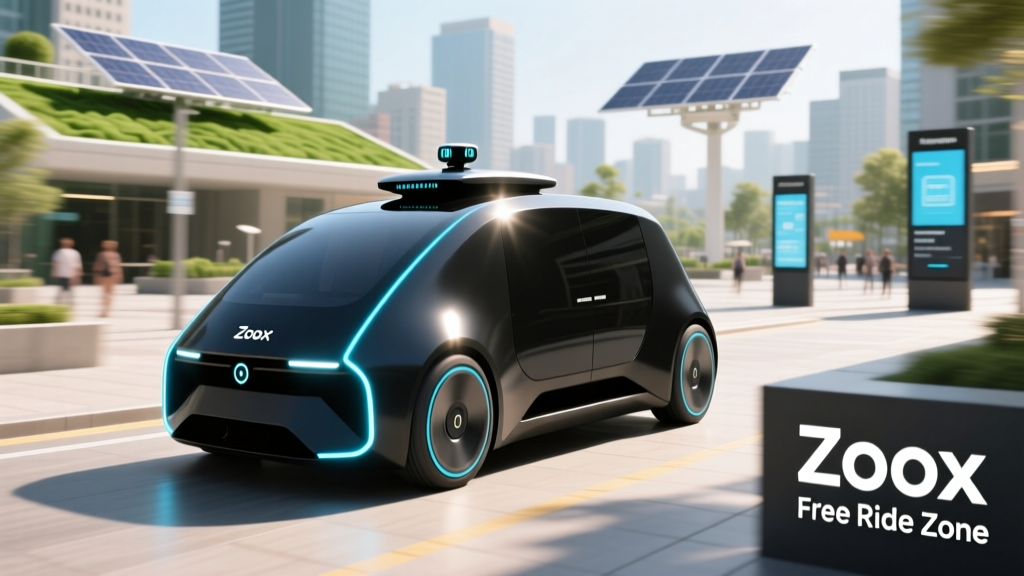
Amazon's Zoox has been quietly building one of the most unconventional robotaxi platforms in the autonomous-vehicle industry. Instead of retrofitting a consumer car with sensors, Zoox designed a purpose-built, bidirectional carriage-style vehicle with no steering wheel and no driver's seat. For early riders, the most appealing part has been the price: Zoox free rides have been the default since the service launched its limited public access program, with no fare charged during its initial operational phases.
As of 2026, Zoox continues to expand its testing footprint and refine its Level 4 autonomous system. But availability remains limited, the service operates within strict geofences, and the path to a paid, scaled commercial launch is still unfolding. Here's exactly where things stand — with real numbers, not marketing promises.
What Zoox Actually Is: SAE Level 4 Robotaxi, Not Driver-Assist
Before anything else, it's essential to distinguish Zoox from consumer driver-assistance systems. Tesla's FSD (Supervised), GM's Super Cruise, and Ford's BlueCruise are all SAE Level 2 systems — the driver must remain engaged and is legally responsible for the vehicle at all times. Zoox operates at SAE Level 4: the vehicle handles all driving tasks within its defined operational design domain (ODD) with no human driver present and no expectation of human intervention.
| Level | Name | Who Drives | Example |
|---|---|---|---|
| 0 | No Automation | Human | Any conventional car |
| 1 | Driver Assistance | Human + system assists | Adaptive cruise control |
| 2 | Partial Automation | Human (must supervise) | Tesla FSD Supervised, BlueCruise |
| 3 | Conditional Automation | System (human on standby) | Mercedes Drive Pilot (limited) |
| 4 | High Automation | System (no human needed in ODD) | Zoox, Waymo |
| 5 | Full Automation | System (everywhere, all conditions) | Does not yet exist |
The practical difference: when you step into a Zoox vehicle, there is no steering wheel, no pedals, and no driver. The vehicle navigates urban streets, handles intersections, manages lane changes, and responds to pedestrians and cyclists entirely on its own — within its approved geofence.
Where Can You Get Zoox Free Rides Right Now?
Zoox has been methodical about geographic expansion, prioritizing dense urban environments where its sensor suite and mapping data are most mature. As of early 2026, the service operates or tests in the following locations:
| City | Status | Public Access | Notes |
|---|---|---|---|
| Foster City, CA | Active operations | Invite-only public riders | Primary Bay Area operations zone; headquarters adjacent |
| Las Vegas, NV | Active operations | Limited public access | Las Vegas Strip corridor and downtown areas |
| Seattle, WA | Testing | Employees + invited testers | Expansion market; mapping and validation phase |
| Atlanta, GA | Testing | Employees + invited testers | Announced expansion market |
Access is not open to the general public on demand. In Foster City and Las Vegas, Zoox has operated an early rider program where participants apply or receive invitations. Riders are typically required to be 18 or older, agree to terms of service, and provide feedback after trips. Check the Zoox ride page for the most current signup process.
If you're outside these metro areas, Zoox is not yet available. The company has not announced a 2026 timeline for paid commercial launch in new cities beyond its current testing footprint.
The Zoox Vehicle: Purpose-Built, Bidirectional, All-Electric
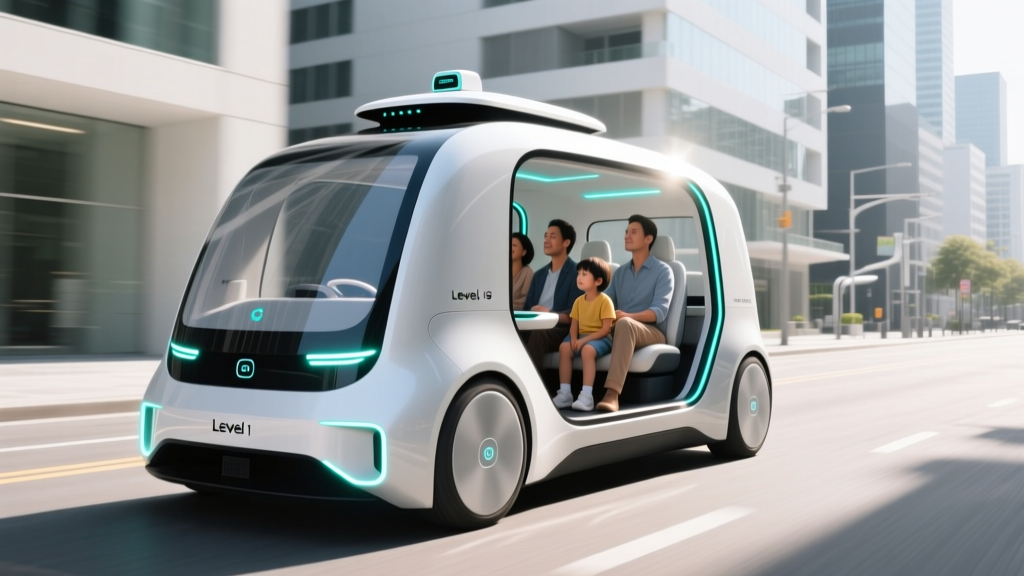
Unlike Waymo, which retrofits the Jaguar I-PACE with its sensor suite, Zoox engineered its vehicle from scratch specifically for autonomous ride-hailing. The result is a symmetrical, carriage-style pod that can drive equally well in either direction — no traditional "front" or "back."
| Passenger capacity | 4 riders (facing each other, no driver seat) |
| Powertrain | All-electric, dual-motor AWD |
| Battery | ~133 kWh (estimated usable), NMC chemistry |
| Top speed | 75 mph |
| Steering | Four-wheel steering (bidirectional operation) |
| Sensors | Lidar, radar, cameras (360° coverage, redundant) |
| Controls | No steering wheel, no pedals — fully autonomous |
The bidirectional design is not just a gimmick. It allows the vehicle to exit dead-end streets, U-turn in tight spaces, and reposition without traditional three-point turns — a meaningful advantage in dense urban grids. Four-wheel steering gives it a remarkably tight turning radius.
Technology Stack: Lidar-First, Multi-Sensor Redundancy
Zoox takes a fundamentally different approach to perception than Tesla's camera-only FSD system. The Zoox vehicle uses a multi-sensor fusion stack combining lidar, radar, and cameras — each providing overlapping, redundant coverage of the vehicle's surroundings.
- Lidar: Multiple units providing high-resolution 3D point clouds for object detection and depth perception, effective in low-light conditions
- Cameras: Array of high-resolution cameras for traffic-light recognition, sign reading, lane detection, and semantic understanding
- Radar: Long-range and short-range radar for velocity detection, adverse-weather performance, and redundancy
- Compute: Custom onboard computing platform processing sensor data in real time, with redundant systems for fail-safe operation
- HD Mapping: Pre-built centimeter-accurate maps of operational areas, continuously updated
- Geofencing: Operations restricted to pre-mapped, validated zones approved by regulators
This lidar-first approach is shared by Waymo and most other Level 4 operators. The industry consensus among robotaxi developers (outside Tesla) is that lidar provides essential depth accuracy and redundancy that cameras alone cannot reliably deliver, particularly in challenging lighting — dawn glare, nighttime urban canyons, and rain-reflected surfaces.
Zoox also relies on HD mapping and strict geofencing. The vehicle only operates in areas that have been thoroughly mapped and validated. If the vehicle detects it is approaching the boundary of its operational domain, it will safely pull over or reroute rather than attempt to navigate unmapped territory.
How Safe Are Zoox Robotaxis? Real Data and Context
Safety is the single most scrutinized aspect of any robotaxi service. Zoox, like all autonomous vehicle operators in California, is required to report disengagement data and collision reports to the California DMV. The National Highway Traffic Safety Administration (NHTSA) also requires standing general orders for crash reporting from ADS-equipped vehicles.
- Operational model: Fully driverless (no safety operator in the vehicle) during public rider operations in Foster City and Las Vegas
- Speed environment: Primarily urban streets at 25-35 mph speed limits, reducing collision severity potential
- Collision reporting: Zoox is subject to NHTSA Standing General Order requiring crash reporting for ADS vehicles; California DMV requires OL316 collision reports
- Disengagement data: Zoox reports disengagement metrics to the CA DMV, though its purpose-built vehicle's metrics differ from retrofitted platforms (no human driver seat means disengagements are handled via remote assistance rather than a takeover)
- Remote assistance: Zoox uses a remote-guidance model where fleet operators can assist the vehicle in novel scenarios without directly driving it — the vehicle still executes all physical driving actions
A critical distinction in Zoox's safety model: because the vehicle has no steering wheel or driver's seat, there is no human fallback driver inside the vehicle. When the system encounters a scenario it cannot resolve autonomously, it contacts a remote assistance operator who can provide high-level guidance (e.g., confirming it's safe to proceed around a construction zone), but the vehicle's AI still controls all steering, braking, and acceleration.
For context on the broader robotaxi safety landscape, Waymo — the most mature Level 4 operator — has published peer-reviewed research showing its vehicles were involved in 85% fewer injury-causing crashes per million miles compared to human benchmark data, based on over 25 million miles of driverless operations. Zoox's smaller operational scale means its dataset is not yet large enough for statistically comparable published studies, which is why regulatory oversight and transparent reporting remain essential.
Zoox Free Rides vs. Uber, Lyft, and Waymo: Pricing and Experience
During its early rider program, Zoox has charged $0 per ride. This is a deliberate strategy: Zoox is collecting rider experience data, testing its service model, and building public familiarity before transitioning to a paid service. There is no published fare structure yet.
| Service | Current Rider Cost | Availability | Autonomy Level |
|---|---|---|---|
| Zoox | Free (early rider program) | Foster City, CA; Las Vegas, NV (invite-only) | Level 4 — no driver |
| Waymo One | Comparable to Uber/Lyft (~$1.50-$3.00/mile depending on city and demand) | Phoenix, San Francisco, Los Angeles, Austin | Level 4 — no driver |
| Uber / Lyft | Variable (~$1.00-$3.50/mile + surge) | Nationwide | Human driver |
| Cruise (GM) | Suspended / limited restart | Limited Phoenix operations post-2023 suspension | Level 4 — no driver |
When Zoox eventually introduces fares, industry analysts expect pricing competitive with Waymo One — roughly on par with Uber/Lyft in the same market, with the long-term advantage of no driver compensation costs. Amazon's ownership of Zoox also raises the possibility of integration with Amazon's logistics ecosystem, potentially subsidizing rider costs or bundling rides with Prime membership, though nothing has been announced.
The rider experience itself is fundamentally different from a conventional rideshare. You enter a compact, lounge-like cabin with four seats facing each other, climate control, and a touchscreen interface for trip information and support. There's no small talk with a driver, no wrong turns, and no concern about the driver's attention — but there's also no human to negotiate with if you need an unscheduled stop.
Regulatory Landscape: Who Approves Robotaxi Operations?
Robotaxi deployment in the United States is governed by a patchwork of state and local regulations. There is no single federal license for autonomous ride-hailing. Here's how the framework operates:
- State level: Each state sets its own rules for ADS (Automated Driving System) testing and deployment. California requires permits from the DMV for testing and from the California Public Utilities Commission (CPUC) for commercial passenger service. Nevada has its own permitting framework through the Nevada DMV and state legislature.
- Federal level: NHTSA oversees vehicle safety standards. Zoox received the first-ever NHTSA exemption for a vehicle without traditional manual controls (steering wheel, pedals, mirrors), allowing its purpose-built vehicle to operate on public roads under specific conditions.
- Local level: City governments and transportation authorities often negotiate operational agreements covering pickup/dropoff zones, traffic coordination, and emergency response protocols.
Zoox's NHTSA exemption was a significant regulatory milestone. Standard Federal Motor Vehicle Safety Standards (FMVSS) assume a human driver — they require steering wheels, mirrors, and pedals. Zoox petitioned for and received an exemption allowing its driverless vehicle to operate, setting a precedent for purpose-built autonomous vehicles.
Current Limitations: What Zoox Cannot Do (Yet)
- Geofencing: The vehicle operates only within pre-mapped, approved zones. You cannot hail a Zoox to a destination outside its operational domain.
- Weather: Heavy rain, fog, and other low-visibility conditions may cause the service to suspend operations or restrict routes. Lidar and camera performance degrades in precipitation.
- Highway driving: Current operations focus on urban streets at moderate speeds (typically under 45 mph). Highway merging and high-speed driving are not part of the current service profile.
- Accessibility: The current Zoox vehicle is a compact pod. Wheelchair-accessible configurations and accommodation for mobility devices are not yet part of the active fleet.
- No scheduled stops: Unlike a human-driven rideshare, you cannot ask the vehicle to stop at a convenience store or make an unscheduled detour mid-trip.
- Limited availability: Service hours and vehicle availability are constrained by fleet size and operational parameters. You cannot currently summon a Zoox on demand at any hour.
- No children unaccompanied: Riders must meet minimum age requirements (typically 18+), and the service is not designed for unaccompanied minors.
These limitations are not unique to Zoox — they apply broadly to all current Level 4 robotaxi services, including Waymo. The "Level 4" designation specifically means the system is fully autonomous within its operational design domain. Outside that domain — whether due to weather, geography, or road type — the system is not designed to operate.
What's Next for Zoox: Scaling Beyond Free Rides
Zoox's path forward depends on several factors: proving safety at increasing scale, expanding geofences, obtaining commercial service permits in additional states, and eventually introducing a paid fare model. Amazon's deep pockets provide a long runway — Zoox was acquired for approximately $1.3 billion in 2020, and Amazon has continued to fund its development.
The competitive landscape is also evolving. Waymo is significantly ahead in terms of commercial scale, operating thousands of paid rides daily across multiple cities. Cruise, after its high-profile 2023 safety incident in San Francisco, has been rebuilding its operations at a much smaller scale. Zoox's purpose-built vehicle gives it a potential long-term cost advantage — no retrofitting expenses, purpose-designed maintenance intervals, and a cabin optimized for riders rather than a driver — but it needs to reach commercial scale to realize that advantage.
Frequently Asked Questions
How do I sign up for Zoox free rides?
Visit the Zoox ride page and check if early rider access is available in your city. As of 2026, access is limited to invited participants in Foster City, CA, and Las Vegas, NV. You'll need to be 18+, agree to service terms, and be in the operational geofence.
Is Zoox really self-driving, or is there a hidden driver?
Zoox is genuinely self-driving within its operational domain — SAE Level 4. The vehicle has no steering wheel, no pedals, and no driver's seat. There is no human in the vehicle. Remote assistance operators can provide guidance in complex scenarios, but the AI controls all driving functions.
How does Zoox compare to Waymo?
Waymo is currently far more mature commercially, with paid service across Phoenix, San Francisco, Los Angeles, and Austin. Zoox is still in its early rider (free) phase with a smaller geographic footprint. However, Zoox's purpose-built vehicle — designed from scratch for autonomy — may offer long-term advantages in cost efficiency and rider experience over Waymo's retrofitted Jaguar I-PACE platform.
What happens if the Zoox vehicle encounters an emergency?
The vehicle is equipped with redundant systems and is designed to execute a safe stop (pull over, activate hazards) if it detects a system fault or encounters an unresolvable scenario. Riders have access to in-cabin support via touchscreen and can communicate with Zoox's operations center. Emergency services can be contacted through the vehicle's interface.
Will Zoox eventually charge for rides?
Almost certainly, yes. The free-ride model is a data-collection and public-familiarity strategy during the early deployment phase. Once Zoox obtains commercial service permits and scales its fleet, a paid fare model will be introduced. Pricing has not been announced but is expected to be competitive with Waymo One and traditional rideshare services.
Can I use Zoox if I use a wheelchair?
The current Zoox vehicle is a compact pod that does not accommodate standard wheelchairs. Accessibility compliance with the Americans with Disabilities Act (ADA) will be a requirement for broad commercial deployment, and Zoox has acknowledged the need for accessible vehicle designs, but no accessible variant has been publicly detailed as of 2026.