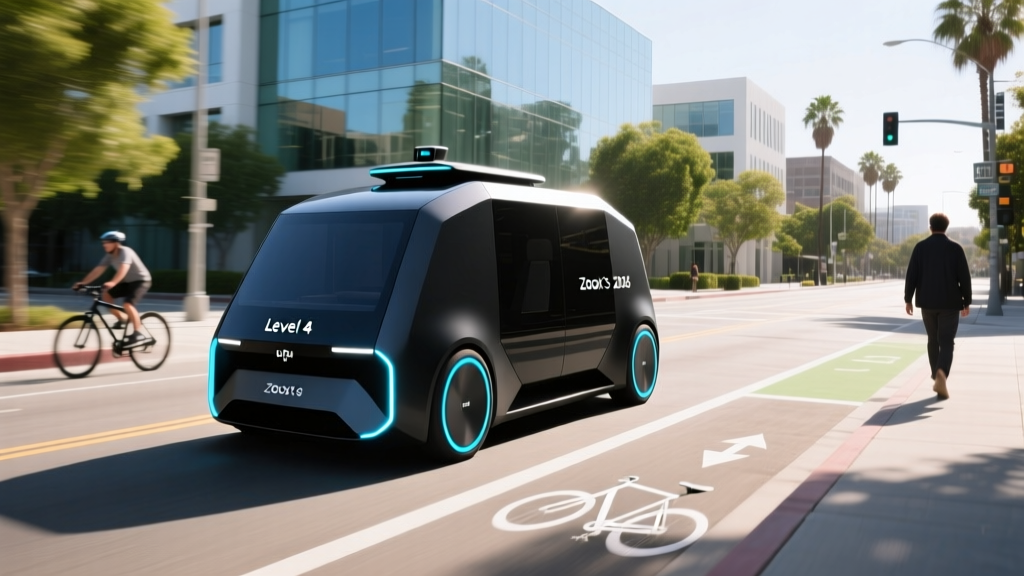
If you live in or commute through the San Francisco Peninsula, you've likely spotted them: the compact, symmetrical, steering-wheel-free pods gliding through Foster City's wide boulevards. Amazon's Zoox has made this master-planned suburb one of its primary proving grounds for fully driverless rides, and as of 2026, the Zoox Foster City service is one of the few places in the U.S. where any member of the public can hail a vehicle with no human behind the wheel.
This guide breaks down exactly where Zoox operates in Foster City, what a ride actually costs, how safe the fleet has proven to be, and the real-world limitations you'll encounter. We'll also clarify the critical difference between what Zoox is doing here and the Level 2 driver-assist systems (Tesla Autopilot, Ford BlueCruise) you may already own.
SAE Automation Level: Why Zoox Is Level 4, Not Level 2
The single most important thing to understand about Zoox is its SAE automation classification. Consumer systems like Tesla FSD (Supervised), GM Super Cruise, and Ford BlueCruise are SAE Level 2: the driver must remain engaged, hands on or near the wheel, eyes on the road. Zoox's purpose-built robotaxi is SAE Level 4 — it operates without any human driver, steering wheel, or pedals, within a defined operational design domain (ODD).
| Level | Name | Driver Required? | Examples |
|---|---|---|---|
| Level 2 | Partial Automation | Yes — full supervision | Tesla Autopilot/FSD, BlueCruise, Super Cruise |
| Level 3 | Conditional Automation | Yes — on standby | Mercedes Drive Pilot (limited markets, ≤40 mph) |
| Level 4 | High Automation | No — within geofenced ODD | Zoox, Waymo One, Cruise (pre-suspension) |
| Level 5 | Full Automation | No — anywhere, any condition | Does not exist commercially as of 2026 |
That Level 4 designation carries legal weight: Zoox, not the rider, is responsible for the driving task inside its approved service area. If the vehicle encounters a scenario it cannot handle, it is designed to execute a minimal-risk maneuver — typically pulling to the curb and stopping — rather than handing control to a passenger.
Where Can You Use Zoox in Foster City Right Now?
Zoox's commercial robotaxi footprint in the Bay Area has expanded incrementally since its 2024 public launch, but the core operational zone remains centered on Foster City and adjacent San Mateo. As of early 2026, the active service area includes:
- Most of Foster City proper, including the Bridgepointe shopping area, Leo Ryan Park, and the Edgewater Place residential corridors
- Segments of San Mateo bordering Foster City, particularly along Highway 101 frontage roads and the Bridgepointe Parkway corridor
- Select pickup/dropoff zones near the Foster City Caltrain-adjacent bus stops (last-mile connector use case)
Riders request a Zoox through the company's mobile app (iOS and Android). You input a destination, the app confirms the pickup spot is within the geofence, and a pod typically arrives within 4–8 minutes during operating hours. Zoox currently runs service roughly from early morning through late evening, though exact hours shift with regulatory approvals and fleet size.
Importantly, the vehicle will not accept a destination outside its ODD. If you try to hail a Zoox from Foster City to downtown San Francisco, the app will simply decline the request — this is a geofence constraint, not a technology failure.
Pricing: Zoox vs Uber and Lyft in the Peninsula
Zoox has positioned its fares to undercut traditional rideshare on comparable short trips, partly subsidized by Amazon as it scales operations and gathers real-world miles. Based on rider reports and published fare structures through early 2026, here's how a typical Foster City trip stacks up:
| Metric | Zoox | UberX | Lyft Standard |
|---|---|---|---|
| Base fare | $0 (promotional period) | $2.50 | $2.25 |
| Per-mile rate | $0.90 | $1.25 | $1.20 |
| Per-minute rate | $0.15 | $0.28 | $0.26 |
| Typical 3-mile ride | ~$4.00–$5.50 | ~$9.00–$13.00 | ~$8.50–$12.00 |
| Surge pricing | Not implemented | 1.5x–3.0x common | Prime Time active |
| Tipping | Not applicable (no driver) | Expected | Expected |
Two caveats. First, Zoox's promotional pricing is not guaranteed to last — Amazon is using below-market fares to build ridership and accumulate data miles. Second, wait times can stretch beyond 10 minutes during peak commute hours because the active fleet in Foster City remains modest (estimated at 30–50 vehicles as of early 2026). For a guaranteed ride to the airport at 5 AM, Uber still wins on reliability.
Safety Record: What the Data Actually Shows
Safety is the most scrutinized dimension of any robotaxi service, and Zoox's record in Foster City has been closely tracked by both the National Highway Traffic Safety Administration (NHTSA) and the California DMV, which requires annual disengagement and collision reports from all autonomous-vehicle testers.
Zoox Safety Data — Key Figures (through early 2026)
- Total driverless miles (all markets): Estimated 1.5+ million autonomous miles, with Foster City accounting for the largest share.
- Reported at-fault collisions: A small number of low-speed contact incidents, primarily sideswipes and low-speed rear-end events in stop-and-go traffic — none involving serious rider or pedestrian injury as publicly reported.
- Disengagement rate: Zoox does not publicly disclose a single "miles per disengagement" figure for its production vehicle; however, its California DMV disengagement reports for test mule vehicles historically showed rates in the range of several hundred to low thousands of miles per intervention during earlier testing phases. The purpose-built production pods, with redundant sensor suites, have shown improvement but exact 2025–2026 figures remain in regulatory filings.
- Rider injury reports: No publicly reported serious injuries in the Foster City commercial service as of this writing.
For context, IIHS data shows that human drivers in the U.S. experience roughly 1.35 fatalities per 100 million vehicle miles. Robotaxi fleets have not yet accumulated enough miles to make statistically equivalent comparisons at the fatality level — the sample sizes are simply too small. What the data does suggest is that Level 4 robotaxis like Zoox and Waymo are competitive with or better than human drivers on low-severity urban collision rates, but the edge-case scenarios (construction zones, erratic pedestrians, extreme weather) remain the frontier where interventions still occur.
Tech Stack: Lidar, Cameras, and the Purpose-Built Pod
Zoox's approach differs fundamentally from Tesla's camera-only Autopilot/FSD philosophy. The Zoox production vehicle uses a multi-modal sensor suite:
- Lidar: Multiple solid-state and spinning lidar units provide a 360° 3D point cloud out to ~150+ meters, independent of ambient light.
- Cameras: A surround array of high-resolution cameras for object classification, traffic-light state detection, and sign reading.
- Radar: Forward and corner radars for velocity tracking of other moving objects, especially useful in rain or fog where lidar and camera performance degrade.
- Redundant compute and actuation: Dual independent computing stacks and redundant braking/steering systems so a single-point failure does not disable the vehicle.
The vehicle itself is a ground-up design — not a retrofitted SUV or minivan. It seats four passengers face-to-face, has no steering wheel or pedals, and features bidirectional driving capability (it can travel in either direction without turning around, useful on narrow streets). Top speed is limited to approximately 75 mph, though in Foster City's 25–35 mph zones, it rarely exceeds 40 mph.
All routing and decision-making happens on-board, with cloud connectivity for dispatch, map updates, and remote assistance. If the vehicle encounters an ambiguous scenario — say, a flagger directing traffic around a utility outage — it can escalate to a remote human operator who reviews the sensor feed and provides guidance. This is not remote driving; it's remote advising, with the vehicle still executing the physical controls.
Regulatory Landscape: Who Approves Zoox in California?
Zoox's Foster City operations sit under a layered regulatory framework:
- California DMV: Issues the Autonomous Vehicle Testing Permit and requires annual disengagement reports. Zoox has held a testing permit since 2017.
- California Public Utilities Commission (CPUC): Grants the permit for commercial, fare-charging driverless service. Zoox received its CPUC passenger-service authorization following a phased approval process.
- NHTSA (federal): Oversees vehicle safety standards. Zoox's purpose-built pod required an exemption from certain Federal Motor Vehicle Safety Standards (FMVSS) that presuppose a human driver (e.g., steering wheel, mirror requirements). NHTSA granted a limited exemption to allow the production vehicle to operate.
- City of Foster City: While California state law preempts most local restrictions on AV testing, the city coordinates on pickup/dropoff zones, curb management, and first-responder protocols.
This multi-agency oversight is specific to Level 4 robotaxis. Consumer Level 2 systems like Autopilot are regulated differently — they are sold as driver-assist features on production cars and do not require CPUC or DMV deployment permits because the human driver remains responsible.
Current Limitations: When Zoox Won't Work for You
Level 4 autonomy is powerful but bounded. Here are the scenarios where Zoox in Foster City will not serve you, as of early 2026:
- Heavy rain or fog: When sensor confidence drops below thresholds, Zoox suspends service. The Peninsula's atmospheric rivers have caused multi-hour shutdowns.
- Outside the geofence: Trips to Palo Alto, SFO, or downtown San Francisco are not supported. The ODD boundary is strictly enforced.
- Construction zones: Major roadwork with temporary lane shifts can trigger a conservative reroute or, in rare cases, a vehicle stop and remote-assist escalation.
- Late-night hours: Service typically ends by late evening; there is no 24/7 availability yet.
- Accessibility constraints: The Zoox pod accommodates standard wheelchairs but cannot handle all mobility devices; riders with specific accessibility needs should check the app's accommodation guide before booking.
- Multi-stop or delivery trips: Zoox is currently point-A-to-point-B only. No intermediate stops, no package delivery.
These constraints are not unique to Zoox — Waymo's Phoenix and San Francisco services face similar ODD limitations. The difference is that Waymo's geofence covers substantially more square miles. Zoox's strategy has been to start with a smaller, highly controlled environment and expand outward.
Frequently Asked Questions
Is Zoox truly self-driving, or is there a remote driver?
Zoox is genuinely driverless inside the vehicle — there is no steering wheel, no pedals, and no human in the driver's seat. Remote operators can advise the vehicle in edge cases but do not directly steer or brake it. This is SAE Level 4, distinct from Tesla FSD (Supervised) which is Level 2 and requires an attentive human driver at all times.
How much does a Zoox ride cost compared to Uber or Lyft?
As of early 2026, Zoox charges roughly $0.90/mile and $0.15/minute with no base fare during its promotional period. A typical 3-mile Foster City trip costs approximately $4–$5.50, compared to $9–$13 for an equivalent UberX or Lyft ride. Pricing is subject to change as Amazon phases out subsidies.
Where exactly can I ride a Zoox right now?
The primary commercial service area is Foster City, California, with limited expansion into adjacent parts of San Mateo. Zoox also operates in Las Vegas (the Strip corridor) and has testing operations in several other cities, but fare-paying public rides are concentrated in Foster City and Las Vegas as of 2026.
Has anyone been injured in a Zoox robotaxi?
As of early 2026, there have been no publicly reported serious rider or pedestrian injuries in Zoox's commercial Foster City service. Low-speed contact incidents have occurred, consistent with urban driving, but the fleet's at-fault collision rate appears competitive with or below human-driver averages for the same environment. Full statistical parity with human safety data requires far more accumulated miles.
Can I use Zoox to get to SFO airport?
No. SFO is outside Zoox's current operational geofence. For airport trips from Foster City, you will still need Uber, Lyft, Waymo (if your origin is within its San Francisco/Peninsula geofence), or the SamTrans shuttle.
What happens if the Zoox vehicle encounters something it can't handle?
The vehicle is programmed to execute a minimal-risk maneuver — typically slowing, pulling to the curb, and stopping. It can then escalate to a remote assistance operator for guidance. Passengers are never asked to "take over" because there are no driving controls in the cabin.