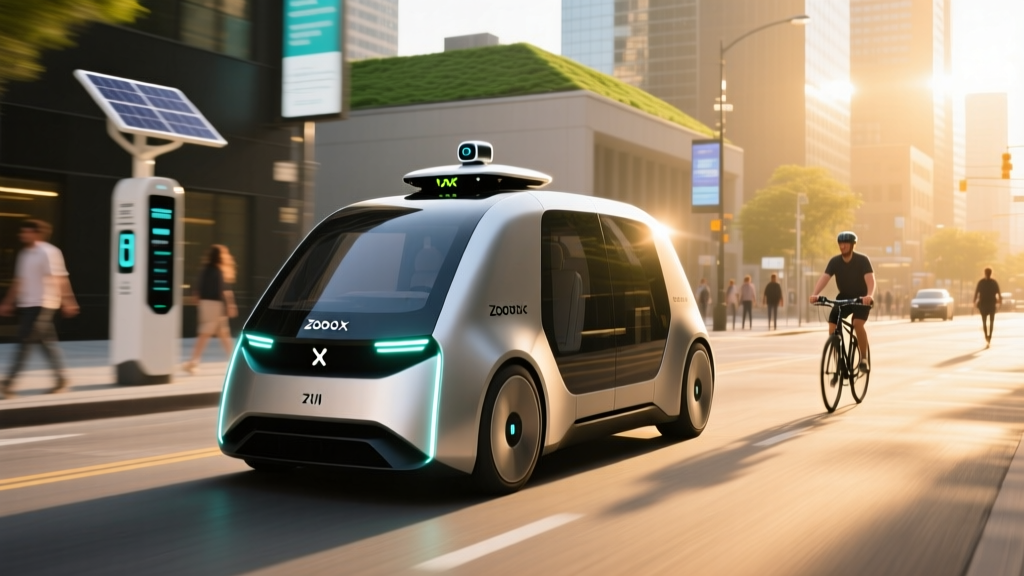
The Zoox Explorer Program is Amazon-backed Zoox's public-facing robotaxi service, operating its purpose-built, carriage-style autonomous vehicle (no steering wheel, no pedals) on public roads. Unlike Tesla's FSD Supervised or GM's Super Cruise—both SAE Level 2 systems that require an attentive driver—the Zoox Explorer Program runs at SAE Level 4 within geofenced urban zones, meaning the vehicle handles the entire driving task without any human behind the wheel.
This guide breaks down exactly where the Explorer Program operates as of 2026, what a ride actually costs, the safety record backed by regulator-reported data, the sensor suite that makes driverless operation possible, and the hard limitations you should understand before hailing one.
Where the Zoox Explorer Program Operates Right Now
Zoox rolls out in tightly controlled geofences, not city-wide. The Explorer Program expanded gradually through 2025 and into 2026, but coverage remains neighborhood-specific rather than metro-wide. Below is the current operational footprint based on Zoox's public service map and CPUC/NHTSA filings.
| City | Zone Coverage | Hours | Status |
|---|---|---|---|
| San Francisco, CA | SoMa, Mission Bay, Embarcadero, parts of Downtown | ~6 AM – midnight, 7 days | Live — fare-charging |
| Las Vegas, NV | Las Vegas Strip corridor, Convention Center area | ~8 AM – 2 AM, 7 days | Live — fare-charging |
| Foster City, CA | Limited suburban zone near Zoox HQ | Daytime hours | Live — testing/early access |
| Seattle, WA | Announced pilot zone (South Lake Union area) | TBD | Announced — not yet public |
| Austin, TX | Preliminary mapping/testing | TBD | Pre-launch testing |
The critical detail: a Zoox ride is only available if both your pickup and drop-off fall within the geofence. You cannot hail one from the Sunset District to SFO, for example. The vehicle will simply not accept the request if either endpoint sits outside its approved operational design domain (ODD).
How to Ride: Access, App, and Pricing vs. Uber/Lyft
Riders request a Zoox through the official Zoox app (iOS/Android). Unlike Waymo One, which opened to the general public in its core cities, Zoox has historically managed access through a waitlist and invitation model tied to the Explorer Program. As of 2026, San Francisco and Las Vegas rides are open to most users in those geofences, though peak-hour availability can still be constrained by fleet size.
Zoox launched with promotional free and heavily discounted rides during its early-access phase. Pricing has since normalized to compete directly with UberX and Lyft in the same corridors.
| Trip Type | Zoox (est.) | UberX (est.) | Lyft (est.) |
|---|---|---|---|
| Short urban (~2 mi) | $8 – $13 | $10 – $16 | $9 – $15 |
| Medium (~5 mi) | $15 – $22 | $18 – $28 | $16 – $25 |
| Strip corridor (LV, ~3 mi) | $12 – $18 | $14 – $22 | $12 – $20 |
| Surge pricing behavior | Limited/none (fleet-capped) | 1.5x – 3x typical | 1.3x – 2.5x typical |
Because Zoox controls a fixed fleet and doesn't rely on independent drivers, it doesn't surge the way Uber and Lyft do during demand spikes. The trade-off: during busy periods, wait times can stretch to 15–25 minutes or the app may simply show no vehicles available, rather than raising prices to attract more supply.
SAE Level 4: What "Truly Self-Driving" Actually Means Here
This is where precision matters, because the industry has blurred these terms for marketing purposes. The Zoox vehicle in the Explorer Program operates at SAE Level 4—high automation—within its defined ODD. That means:
- There is no driver in the vehicle. No steering wheel, no brake pedal, no human ready to take over.
- The automated driving system (ADS) performs the entire dynamic driving task: steering, acceleration, braking, lane changes, intersection negotiation, and parking.
- If the system encounters a scenario it cannot handle, it is designed to execute a minimal-risk maneuver (typically a controlled pull-over) rather than handing control to a passenger.
- Level 4 is geofence-limited. Outside its approved ODD—in unmapped areas, severe weather, or certain road-construction scenarios—the vehicle will not operate.
- Level 2 (Tesla Autopilot, FSD Supervised, GM Super Cruise, Ford BlueCruise): Driver-assist. Human must monitor at all times. Not self-driving.
- Level 3 (Mercedes Drive Pilot, limited markets): Conditional automation. Driver can disengage under narrow conditions but must resume when requested.
- Level 4 (Zoox Explorer Program, Waymo One): High automation. Fully driverless within a defined ODD. No human intervention required in-zone.
- Level 5: Full automation everywhere, any condition. Does not exist in production today.
The distinction is not semantic—it determines legal liability, insurance structure, and what you, as a rider, are responsible for. In a Zoox, you are a passenger, not a driver.
The Technology Stack: Sensors, Compute, and Geofencing
Zoox's purpose-built vehicle (the "Gen 5" carriage-style robotaxi) uses a redundant, multi-modal sensor architecture. This is not a camera-only approach like Tesla's vision-based FSD. Zoox fuses three sensor classes for overlapping coverage:
- LiDAR: Multiple solid-state and spinning units providing a 360° 3D point cloud out to ~150+ meters. LiDAR gives precise depth data independent of lighting, critical for night and low-contrast scenes.
- Cameras: High-resolution surround cameras for object classification, traffic-light state detection, signage reading, and lane-marking interpretation.
- Radar: Forward and corner radars for velocity measurement of moving objects (other vehicles, cyclists), especially useful in rain and fog where LiDAR and cameras degrade.
Onboard compute runs a custom high-performance stack (multiple NVIDIA-class GPUs per vehicle) handling perception, prediction, and planning in real time. The vehicle also maintains a continuous cellular and redundant connectivity link to Zoox's remote-assistance operations center. If the ADS encounters ambiguity—say, a construction zone with a flagger using non-standard hand signals—a remote operator can provide high-level guidance (not real-time joystick driving) to help the vehicle resolve the scenario.
Geofencing is enforced through HD maps updated regularly. The vehicle knows, at centimeter-level precision, where it is allowed to operate, where curb cuts exist, where bike lanes merge, and which intersections have protected-left phases. This is both a strength (high reliability within the zone) and a limitation (the vehicle is functionally useless outside it).
Safety Record: What the Data Actually Shows
Safety is the most scrutinized and most misrepresented aspect of robotaxi operations. Zoox, like all ADS-equipped vehicle operators in California, reports disengagement and collision data to the California DMV and, under newer federal rules, reports certain crashes to NHTSA via the Standing General Order.
- Autonomous miles accumulated: Several million driverless miles across SF, Las Vegas, and Foster City combined (exact cumulative figure varies by filing quarter).
- Collision rate: Zoox has reported low-severity contact incidents at a rate broadly comparable to, or below, human-driver benchmarks for dense urban driving. Most reported incidents involve low-speed rear-end contacts where another (human-driven) vehicle struck the Zoox from behind—a common urban crash pattern.
- Disengagement rate: Because Zoox runs Level 4 with no driver, traditional DMV "disengagement" metrics (designed for Level 2/3 test vehicles) don't apply directly. Instead, Zoox tracks remote-assistance requests per 1,000 miles, which have trended downward as the ODD and software have matured.
- No reported serious-injury or fatal collisions involving Zoox vehicles in driverless operation as of the most recent public filings.
Source: CA DMV Autonomous Vehicle Disengagement Reports, NHTSA Standing General Order data.
For context, the IIHS and NHTSA data consistently show that the vast majority of urban collisions are human-error-driven (distraction, impairment, speed). A well-tuned Level 4 system that never texts, never drinks, and never fatigues has a structural advantage in common urban crash scenarios. However, robotaxis face edge cases humans handle intuitively—unusual construction layouts, aggressive human drivers testing the robot's conservatism, and sensor degradation in heavy rain—where they can behave more cautiously or conservatively than expected.
Current Limitations: Weather, Geofence, and Edge Cases
Level 4 autonomy is impressive within its envelope, but the envelope is smaller than most riders assume. Here are the hard constraints of the Zoox Explorer Program as of 2026:
- Geofence rigidity: Pickup and drop-off must both be inside the approved zone. No exceptions, no "just outside the boundary" rides.
- Weather ceiling: Heavy rain, dense fog, and any snow/ice operation typically triggers service suspension or refusal. LiDAR backscatter in heavy precipitation and reduced camera contrast degrade the perception stack below the safety threshold Zoox requires for driverless operation.
- Speed envelope: Zoox vehicles currently operate on roads with posted speed limits generally at or below 45 mph. No highway/freeway operation.
- Airport and venue gaps: SFO, OAK, and Las Vegas Harry Reid airport pickups are not available unless the airport curb falls within the current geofence and has been mapped/approved. Most major venues and stadiums remain outside the zone.
- Accessibility: The carriage-style vehicle is designed for seated passengers; wheelchair-accessible variants and accommodations for mobility devices have been a known area of regulatory discussion. Confirm accessibility options in-app before relying on the service.
- Edge-case conservatism: Expect the vehicle to pause, pull over, or request remote assistance when encountering unmapped construction, a police officer directing traffic with non-standard gestures, or unusual road debris. This is safe behavior, but it can add minutes to a trip.
Regulatory Landscape: Who Approves Zoox to Operate
Robotaxi operations in the U.S. are governed by a patchwork of state and federal authorities, not a single national permit.
- California (CPUC + DMV): The California Public Utilities Commission issues the permits that allow Zoox to charge fares for passenger service. The CA DMV separately issues testing and deployment permits for the ADS itself. San Francisco operations require both.
- Nevada (NDOT + state regulators): Nevada has a permissive autonomous-vehicle framework, and Las Vegas operations are authorized through state-level testing and deployment approvals coordinated with the Nevada Department of Transportation and local authorities.
- Federal (NHTSA): NHTSA does not "approve" ADS software, but it sets Federal Motor Vehicle Safety Standards (FMVSS). Zoox received a notable FMVSS exemption for its purpose-built vehicle, which lacks traditional controls (steering wheel, mirrors, pedals) that FMVSS historically required. NHTSA also collects crash data under the Standing General Order.
- Other states: Expansion into Seattle, Austin, or other markets requires separate state and often municipal approvals. Announced cities are not live cities—regulatory timelines frequently slip.
Zoox Explorer Program FAQ
Is the Zoox Explorer Program really self-driving, or is there a safety driver?
In the live public service in SF and Las Vegas, the Zoox vehicle is fully driverless—no human safety operator onboard. This is SAE Level 4 within its geofence. You are a passenger, not a driver.
How much does a Zoox ride cost compared to Uber or Lyft?
Pricing is in the same range as UberX/Lyft for comparable urban trips (roughly $8–$22 depending on distance). Zoox does not typically surge during peak demand, but vehicle availability may be limited, leading to longer wait times instead of higher fares.
Can I take a Zoox to the airport?
Generally no, unless the airport curb is inside the active geofence and has been mapped/approved. As of 2026, SFO and Las Vegas Harry Reid airport trips are not standard Zoox routes.
What happens if the Zoox vehicle encounters a situation it can't handle?
The ADS will either wait for the scenario to clear, request high-level guidance from a remote-assistance operator, or execute a minimal-risk maneuver (controlled pull-over). It does not hand control to a passenger, because there are no passenger controls.
How does Zoox compare to Waymo One?
Waymo One operates a larger fleet across broader geofences in San Francisco, Phoenix, Los Angeles, and additional markets, with more accumulated public rider miles. Zoox differentiates on its purpose-built vehicle (four facing-in seats, no driver controls) and its Amazon-backed logistics. Both are Level 4, both are sensor-fusion-based (LiDAR + cameras + radar), and both are geofence-limited.
Does Zoox operate in rain or bad weather?
Light rain is generally manageable. Heavy rain, dense fog, and any snow/ice will typically cause the service to suspend operations in the affected zone until conditions improve. This is a known limitation of current Level 4 perception stacks across the industry.
Where can I track Zoox's expansion and safety filings?
The California DMV Autonomous Vehicle program page publishes disengagement and incident reports. NHTSA's Standing General Order crash data covers ADS-equipped vehicles nationwide. Zoox's own newsroom also publishes service expansion announcements.