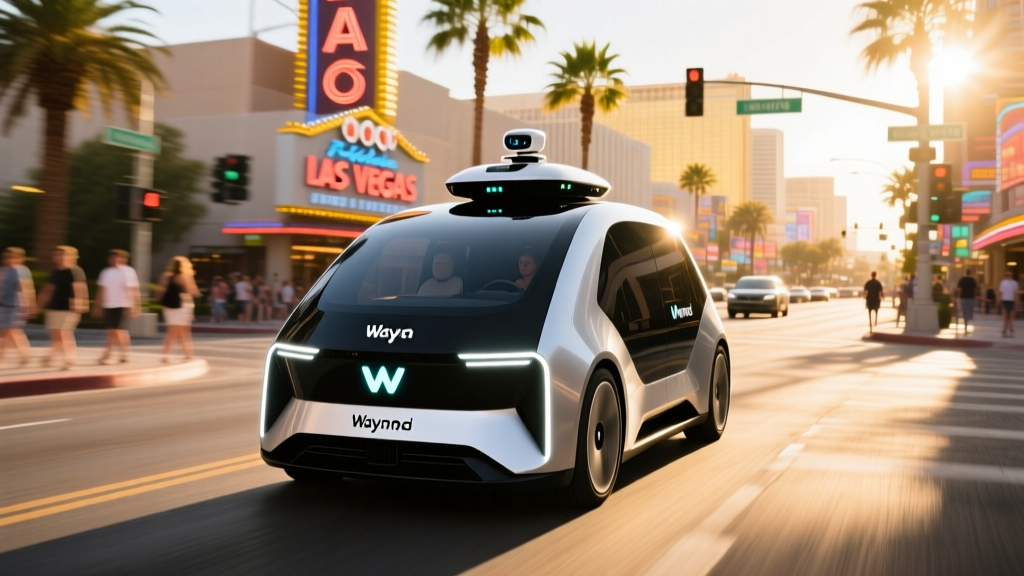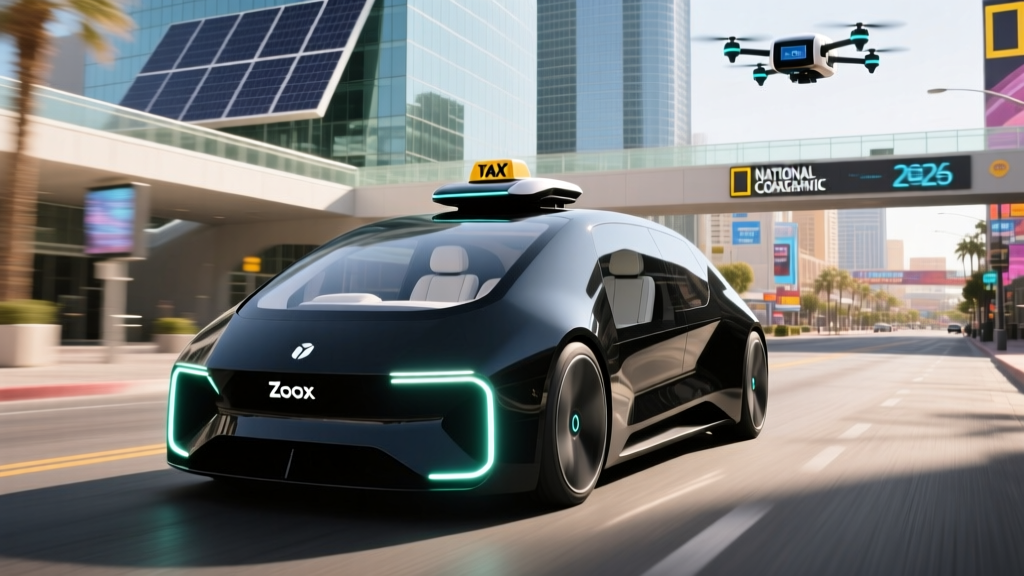
If you have spent any time near the Las Vegas Strip in the past year, you have likely spotted a boxy, symmetrical vehicle with no visible steering wheel gliding through traffic. That is the Zoox robotaxi — Amazon's autonomous driving subsidiary — and it represents one of only a handful of true driverless services operating on public roads in the United States. Unlike the driver-assist systems in consumer EVs, the Zoox vehicle has no driver seat, no steering wheel, and no pedals. It is SAE Level 4 autonomy in commercial operation, and Las Vegas is one of its primary proving grounds.
This guide breaks down exactly what riding in a Zoox driverless car in Las Vegas looks like in 2026: where the service operates, what it costs, how safe it is, the technology under the skin, and the limitations you should understand before summoning one.
What Zoox Actually Is — and What SAE Level 4 Means
Zoox was founded in 2014 and acquired by Amazon in 2020 for approximately $1.3 billion. Unlike Waymo, which retrofits existing vehicles (currently the Jaguar I-PACE and Zeekr RT) with autonomous hardware, Zoox designed its robotaxi from the ground up as a purpose-built, bidirectional electric vehicle. The vehicle is compact — roughly the footprint of a Toyota Prius — with four-wheel steering, a top speed of 75 mph, and dual electric motors providing all-wheel drive.
SAE Automation Level: Level 4 (High Automation)
What this means: The Zoox vehicle operates without any human driver, but only within a defined Operational Design Domain (ODD) — specific geofenced areas under certain conditions. If the system encounters a scenario it cannot handle, it will pull over safely rather than hand control to a passenger.
How this differs from consumer EVs: Tesla Autopilot, FSD (Supervised), GM Super Cruise, and Ford BlueCruise are all SAE Level 2 systems. They require an attentive human driver at all times. Zoox is a fundamentally different category — there is no human driver to fall back on, and no steering controls for a passenger to use.
| Level | Name | Driver Required? | Examples |
|---|---|---|---|
| 0 | No Automation | Full-time human driver | Traditional vehicles |
| 1 | Driver Assistance | Yes — hands on or eyes on | Adaptive cruise, lane-keep |
| 2 | Partial Automation | Yes — must supervise | Tesla FSD (Supervised), Super Cruise, BlueCruise |
| 3 | Conditional Automation | Sometimes — must be ready to take over | Mercedes DRIVE PILOT (limited markets/conditions) |
| 4 | High Automation | No — within geofenced ODD | Zoox (Las Vegas, SF), Waymo (Phoenix, SF, LA) |
| 5 | Full Automation | No — anywhere, any condition | Does not exist commercially |
Where Can You Ride Zoox Driverless Cars in Las Vegas?
Zoox launched its public rider program in Las Vegas in mid-2024 and has progressively expanded its operational footprint through 2025 and into 2026. The service is not available everywhere in the metro area — it operates within a defined geofence that prioritizes high-density, high-demand corridors.
| Zone | Status | Key Landmarks / Coverage |
|---|---|---|
| Las Vegas Strip corridor | Active | Mandalay Bay to The Strat; major resort pickups |
| Downtown / Fremont Street | Active | Fremont Street Experience, Arts District |
| Convention Center district | Active | LVCC, Westgate, surrounding hotels |
| Airport (Harry Reid / LAS) | Limited / Expanding | Select terminal pickup zones; not all terminals |
| Summerlin / Suburbs | Not yet available | Outside current geofence |
| Henderson / North Las Vegas | Not yet available | Outside current geofence |
How to use the service: Download the Zoox app (available on iOS and Android), create an account, and request a ride much like you would with Uber or Lyft. The app shows the geofenced service boundary, estimated wait time, and pickup/dropoff points. Zoox uses designated pickup zones rather than door-to-door service in some high-traffic areas — similar to how Uber/Lyft operate at airports and large venues.
As of early 2026, Zoox also operates a public rider program in San Francisco (primarily the SoMa and Mission districts) and has been conducting testing operations in the San Francisco Bay Area, Austin, Texas, and Atlanta, Georgia. However, Las Vegas and San Francisco remain the primary cities where members of the general public can hail a driverless ride.
Zoox Robotaxi Pricing vs. Uber and Lyft in Las Vegas
During its initial public launch phase, Zoox offered free rides to build its rider base and gather real-world operational data. Through 2025, the company began transitioning to a paid model, and as of 2026, Zoox charges for rides in Las Vegas — though pricing remains competitive with, and often below, traditional rideshare.
| Service | Base Fare | Per-Mile Rate | Typical 3-Mile Strip Ride | Surge Pricing? |
|---|---|---|---|---|
| Zoox | ~$2.50 | ~$1.10/mi | $6–$9 | No (fixed pricing model) |
| UberX | ~$3.00 | ~$1.50/mi | $9–$18 | Yes (frequent on Strip) |
| Lyft | ~$2.80 | ~$1.40/mi | $8–$16 | Yes |
| Waymo One | ~$2.75 | ~$1.25/mi | $7–$12 | Limited surge |
Key pricing advantage: Zoox does not currently implement surge pricing, which is where traditional rideshare costs spike dramatically during conventions, weekends, and major events on the Strip. A 3-mile ride that might cost $25+ on UberX during CES or a Saturday night could remain under $10 on Zoox — if the vehicle is available within the geofence.
Key pricing limitation: Zoox vehicles seat a maximum of four passengers (facing each other in a carriage-style layout), and there is no option for larger vehicles, shared rides, or premium tiers. For groups of five or more, or for airport runs with heavy luggage, traditional rideshare remains necessary.
How Safe Are Zoox Driverless Cars? The Data
Safety is the most scrutinized aspect of any robotaxi operation. Zoox, like Waymo and Cruise before it, is required to report disengagement data and collision reports to the National Highway Traffic Safety Administration (NHTSA) and to the California DMV (for testing operations in that state). Nevada's regulatory framework, managed through the Nevada DMV and the Nevada Department of Transportation, also requires operational safety reporting.
Zoox Safety Record — Key Data Points
- Autonomous miles driven (cumulative, all markets): Estimated 2+ million driverless miles as of early 2026 (Zoox does not publish a live counter; this is based on regulatory filings and operational timelines).
- Reported collisions: A small number of minor-contact incidents reported to NHTSA, predominantly low-speed rear-end events where the Zoox vehicle was stopped or decelerating and was struck by a human-driven vehicle. No reported fatalities or serious injuries attributable to the Zoox system as of this writing.
- Disengagement rate: Zoox does not publicly report miles-per-disengagement in the same format as California DMV filings (those apply to testing, not commercial operations). Internal remote-assistance intervention rates are understood to be in the range of one per several thousand miles, decreasing as the system matures.
- Vehicle design safety: The Zoox vehicle includes over 100 safety innovations not found in retrofitted vehicles, including a symmetric crash structure, airbag systems designed for the facing-seat configuration, and a low center of gravity from the skateboard-style battery pack.
Sources: NHTSA Standing General Order crash reports, Zoox safety framework publications, Nevada DMV autonomous vehicle testing permits.
Context matters: The vast majority of robotaxi collisions involve the autonomous vehicle being struck by a human driver — typically rear-end incidents at stops or low-speed intersections. The Zoox vehicle's sensor suite and cautious driving behavior mean it stops more conservatively than many human drivers expect, which can lead to being rear-ended. This is a known industry-wide pattern, not unique to Zoox.
For comparison, Waymo — which has logged over 30 million driverless miles across Phoenix, San Francisco, and Los Angeles — reports a collision rate significantly lower than human benchmarks for comparable urban driving. Zoox's smaller operational scale means less cumulative data, but the safety trajectory follows a similar pattern.
The Technology Stack: How the Zoox Vehicle Sees the Road
The Zoox robotaxi uses a sensor-fusion approach that combines multiple perception modalities — a deliberate contrast to Tesla's camera-only strategy for FSD. Here is what is onboard:
Zoox Sensor and Compute Architecture
| Component | Specification | Purpose |
|---|---|---|
| LiDAR | Multiple solid-state and spinning units, 360° coverage | Precise 3D mapping of surroundings; works in darkness, rain, glare |
| Cameras | High-resolution surround-view array (8+ cameras) | Traffic light/color detection, sign reading, lane markings, object classification |
| Radar | Multiple radar units (long-range and short-range) | Velocity detection of moving objects; performs well in fog and precipitation |
| Ultrasonic sensors | Short-range proximity array | Low-speed maneuvering, close-object detection at curbside |
| Compute | Custom high-performance compute platform (dual redundant) | Real-time sensor fusion, prediction, planning; redundant for fail-safe operation |
| HD Maps | Pre-built centimeter-accurate maps of operational area | Localization within geofence; supplements real-time perception |
| V2I capability | Vehicle-to-infrastructure communication (where supported) | Traffic signal phase and timing data in equipped corridors |
Why LiDAR matters: The inclusion of LiDAR gives the Zoox system a depth-perception advantage that camera-only systems must infer computationally. At night on the Strip — where neon lights, LED billboards, and pedestrian chaos create visual noise — LiDAR provides reliable distance measurements independent of lighting conditions. This is one reason robotaxi companies (Waymo, Zoox, Aurora) universally rely on LiDAR, while Tesla's FSD (Supervised) remains camera-only.
Bidirectional driving: The Zoox vehicle is symmetrical — it has no designated "front" or "back." Both ends are identical, with the same sensor suite on each side. This allows the vehicle to reverse direction without performing a three-point turn, which is useful in dead-end streets and loading zones common in Las Vegas hotel districts.
Battery and powertrain: The Zoox vehicle uses a lithium-ion battery pack (estimated ~75 kWh usable capacity based on vehicle size and duty cycle) mounted in a skateboard configuration. The dual electric motors provide all-wheel drive with four-wheel steering, enabling a tight turning radius critical for urban navigation. The vehicle is designed to operate continuously, returning to a depot for charging between ride cycles.
Regulatory Landscape: Who Approves Zoox Operations?
Robotaxi operations in the United States are governed by a patchwork of state and local regulations — there is no single federal permit that authorizes nationwide driverless service.
Nevada: Nevada was one of the first states to legislate autonomous vehicle operations (AB 511, 2011, and subsequent amendments). The Nevada DMV issues testing and deployment permits, and the Nevada Department of Transportation oversees operational safety on public roads. Zoox holds a deployment permit allowing driverless commercial operations within approved zones in Las Vegas.
California: The California DMV issues testing permits (with and without safety drivers), while the California Public Utilities Commission (CPUC) issues the permits required for commercial passenger service (driverless deployment permits). Zoox holds CPUC authorization for its San Francisco operations.
Federal role: NHTSA does not "approve" robotaxi services but does regulate vehicle safety standards. The Zoox purpose-built vehicle received a notable regulatory milestone: in 2023, NHTSA granted Zoox's petition to operate a vehicle that does not meet certain Federal Motor Vehicle Safety Standards (FMVSS) designed for human-driven vehicles — such as requirements for a steering wheel, mirrors, and a traditional windshield. This exemption was critical to allowing the Zoox vehicle's unconventional design to reach public roads.
Local coordination: In Las Vegas, Zoox coordinates with Clark County, the City of Las Vegas, and major resort operators for pickup/dropoff zone designations. The Las Vegas Convention and Visitors Authority (LVCVA) has also been involved in facilitating autonomous vehicle operations as part of the city's smart-mobility initiatives.
Current Limitations: What Zoox Cannot Do
Despite its Level 4 capability, the Zoox robotaxi has significant operational constraints that riders should understand:
Known Limitations of Zoox Service in Las Vegas (2026)
- Geofence boundaries: The vehicle will not travel outside its mapped operational area. If your destination falls outside the geofence, the app will not allow you to request the ride. Suburban areas like Summerlin, Henderson, and most residential zones are excluded.
- Weather restrictions: While Las Vegas rarely sees severe weather, the Zoox system will reduce service or pause operations during heavy rain, flooding, or visibility-reducing dust storms (haboobs). The vehicle's sensor suite handles light rain and nighttime conditions well, but extreme weather triggers a conservative operational pause.
- No highway driving (limited): The Zoox vehicle is capable of speeds up to 75 mph, but current Las Vegas operations focus on surface streets and the Strip corridor. Extended freeway routing (e.g., I-15 between downtown and the south Strip) may be limited or avoided in favor of surface-street routing.
- Pickup/dropoff precision: In high-density areas, Zoox uses designated pickup zones rather than exact GPS pin-to-door service. You may need to walk a short distance to a marked pickup point, particularly near large resorts and the convention center.
- Wait times: Fleet size in Las Vegas is smaller than Uber/Lyft's driver pool. During peak demand (Friday/Saturday nights, major conventions), wait times of 10–20 minutes are possible, and the app may show no available vehicles.
- Passenger capacity: Maximum of 4 passengers per vehicle. No child seats, no wheelchair-accessible configuration currently available, and limited cargo space (the carriage-style seating leaves modest room for luggage).
- No multi-stop trips: Unlike Uber/Lyft, you generally cannot add intermediate stops. The ride is point A to point B within the geofence.
- Edge cases: Construction zones, temporary road closures, and special-event traffic management (e.g., F1 Las Vegas Grand Prix route closures) can cause the vehicle to reroute, delay, or in rare cases, pull over and end the trip early with remote-assistance intervention.
The Zoox Riding Experience: What It Actually Feels Like
Stepping into a Zoox vehicle for the first time is genuinely disorienting if you are accustomed to traditional cars. There is no driver's seat, no dashboard, no steering wheel. The interior features two bench seats facing each other (carriage-style), with a small central display showing the route and vehicle status. The cabin is compact but comfortable for four adults, with climate control and ambient lighting.
The ride itself is smooth and deliberate. The Zoox vehicle accelerates and brakes conservatively — noticeably more cautiously than an average human driver or an aggressive Uber driver. Lane changes are methodical, with ample signaling and gap-checking. The vehicle will sometimes pause at complex intersections for longer than a human driver would, waiting for high confidence before proceeding. This is by design: the system prioritizes safety over speed.
For Las Vegas visitors, the experience doubles as a novelty. Riding in a vehicle with no driver through the neon-lit chaos of the Strip is a conversation starter, and Zoox has leaned into this — the service is as much a tourist attraction as it is a transportation option. In-car screens provide information about what the vehicle's sensors are seeing, which adds an educational dimension to the ride.
Frequently Asked Questions
Is Zoox truly self-driving, or is there a remote human controlling it?
Zoox is genuinely self-driving (SAE Level 4) within its operational domain. There is no human driver in the vehicle, and no remote operator steering it in real time. However, Zoox employs remote fleet assistants who can provide guidance to the vehicle in unusual situations — for example, if construction blocks the planned route, a remote assistant can authorize an alternative path. The vehicle still executes all driving maneuvers autonomously; the remote assistant provides high-level guidance, not direct control.
How much does a Zoox ride cost compared to Uber or Lyft on the Las Vegas Strip?
Zoox pricing is generally lower than Uber/Lyft for comparable distances within its geofence, primarily because Zoox does not implement surge pricing. A typical 3-mile Strip ride costs approximately $6–$9 on Zoox versus $9–$18+ on UberX (with surge). However, Zoox availability is more limited, and wait times can be longer during peak demand.
Can I take a Zoox from the Las Vegas airport (Harry Reid / LAS)?
Airport service is in limited operation as of 2026, with select pickup zones. Full terminal coverage is not yet available. Check the Zoox app for current airport pickup availability — it is expanding but not yet equivalent to Uber/Lyft airport service.
What happens if the Zoox vehicle encounters a situation it cannot handle?
The vehicle is designed to achieve a "minimal risk condition" — meaning it will safely pull over to the side of the road or stop in place, activate hazard lights, and contact a remote fleet assistant for guidance. It will not hand control to a passenger (there are no controls to hand over). In the rare event of a system fault, redundant compute and braking systems allow the vehicle to stop safely.
How does Zoox compare to Waymo?
Both are Level 4 robotaxi services, but they differ in approach. Waymo retrofits existing production vehicles (Jaguar I-PACE, Zeekr RT) with its sensor suite and has a larger operational footprint (Phoenix, San Francisco, Los Angeles, with Austin expanding). Zoox designed its own purpose-built vehicle with bidirectional driving and a carriage-style interior. Zoox's fleet and service area are smaller, but the vehicle experience is more distinctive. Both use LiDAR + camera + radar sensor fusion.
Is the Zoox vehicle electric? What is its range?
Yes, the Zoox vehicle is a battery-electric vehicle (BEV) with a lithium-ion battery pack in a skateboard configuration. Exact EPA range figures are not published since the vehicle is not sold to consumers, but the vehicle is designed for continuous urban operation with periodic depot charging. Its estimated 75 kWh battery and urban duty cycle suggest a practical operating range of 120–160 miles between charges, though the vehicle returns to charging depots well before reaching that threshold.
Can I ride Zoox if I am visiting Las Vegas, or is it invite-only?
As of 2026, the Zoox rider program in Las Vegas is open to the general public through the Zoox app. You do not need a special invitation — simply download the app, create an account, and request a ride within the service area. This is a change from the earlier invite-only beta phase.
The Bottom Line on Zoox in Las Vegas
Zoox driverless cars in Las Vegas represent one of the most tangible examples of Level 4 autonomous transportation available to the public anywhere in the world. The service is real, the vehicles are purpose-built, the pricing undercuts rideshare during surge periods, and the safety record — while still accumulating miles — shows no systemic failures.
The limitations are equally real: a restricted geofence, limited fleet availability during peak demand, no airport parity, and weather/edge-case constraints. Zoox is not a replacement for Uber/Lyft across all Las Vegas transportation needs — it is a complementary option that works well for Strip-to-Strip, downtown, and convention-center trips when vehicles are available.
For EV enthusiasts and autonomous-driving followers, riding in a Zoox vehicle is a must-do experience when visiting Las Vegas. It is the closest most people can get to experiencing what a Level 4, no-steering-wheel, purpose-built electric robotaxi actually feels like on public roads — today, not in some future concept video.