The Real Zoox Cost Per Ride: What Riders Actually Pay
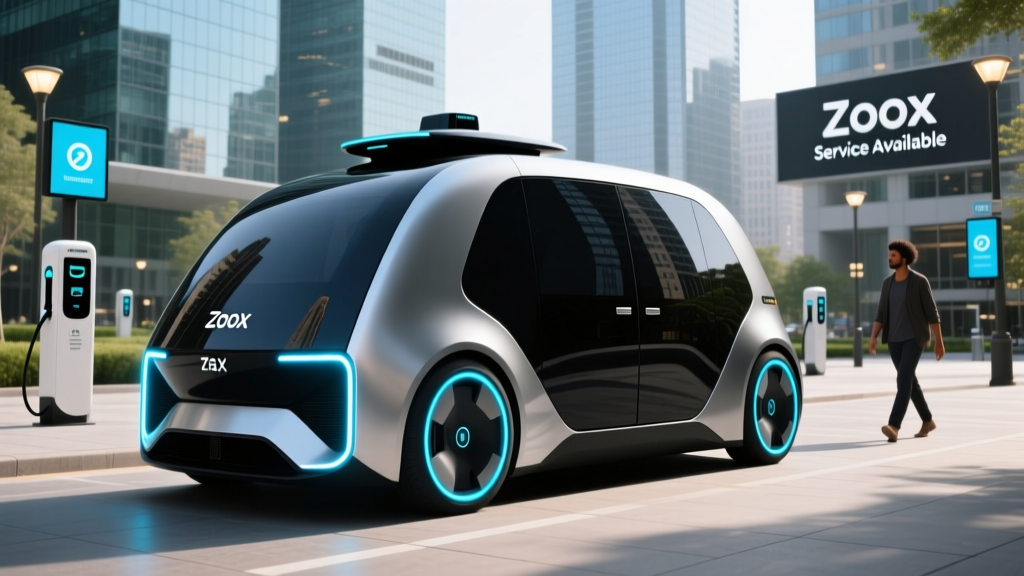
Amazon-backed Zoox operates a purpose-built, bidirectional robotaxi — a carriage-style vehicle with no steering wheel, no pedals, and four inward-facing seats. Unlike retrofitted rideshare cars, Zoox designed its vehicle from the ground up for autonomous passenger service. For riders, the burning question is straightforward: how much does a Zoox ride actually cost, and how does it compare to Uber or Lyft?
Zoox launched its initial rider program in Foster City, California, and has since expanded limited operations to Las Vegas, Nevada, with additional testing in San Francisco and the Seattle area. Pricing has evolved as the service scaled from invite-only previews to broader public access. Here's what you need to know about the economics of riding in a Zoox.
Zoox operates at SAE Level 4 within its defined operational design domain (ODD). This means the vehicle handles all driving tasks without any human intervention within its geofenced service area. There is no driver in the vehicle, no steering wheel, and no expectation that a passenger will take control. This is fundamentally different from Level 2 driver-assist systems like Tesla Autopilot or GM Super Cruise, which require an attentive human driver at all times.
Zoox Pricing Breakdown vs. Uber and Lyft
Zoox has historically offered rides at promotional or subsidized rates as it builds ridership and collects real-world operational data. As of early 2026, here is how Zoox pricing compares to traditional rideshare services on common urban routes:
| Route Type | Zoox | UberX | Lyft Standard |
|---|---|---|---|
| Short trip (2-3 miles) | $5–$8 | $8–$13 | $8–$12 |
| Medium trip (5-7 miles) | $9–$15 | $14–$22 | $13–$20 |
| Longer trip (10+ miles) | $16–$25* | $22–$35 | $20–$32 |
| Surge pricing | None currently | 1.5x–3.0x | 1.3x–2.5x |
| Tip expected | No | Yes (15-20%) | Yes (15-20%) |
*Zoox trips are limited to its geofenced service area, so very long cross-city trips may not be available.
The Zoox cost per mile generally works out to $1.50–$2.50 per mile for most trips, compared to $2.00–$3.50 per mile for UberX and Lyft Standard before tips and surge. The absence of surge pricing and tipping expectations makes Zoox's total cost meaningfully lower on most comparable routes — particularly during peak demand periods when rideshare prices spike.
It's worth noting that Zoox's current pricing likely reflects introductory subsidies. Amazon has deep pockets and is investing heavily in scaling the service, but long-term pricing will need to cover vehicle depreciation, sensor maintenance, remote fleet operations, insurance, and electricity costs. Industry analysts estimate that robotaxi services need to reach roughly $0.70–$1.00 per mile in operating cost to achieve profitability at scale — a target Zoox is working toward but has not yet publicly confirmed achieving.
Where Can I Ride a Zoox Robotaxi Right Now?
Zoox's service footprint is expanding but remains limited to specific geofenced zones. Here's the current operational status by city:
| City | Status | Access Type | Service Area Notes |
|---|---|---|---|
| Foster City, CA | Active | Public (app-based) | Primary commercial service zone; expanded geofence since 2024 launch |
| Las Vegas, NV | Active | Public (app-based) | Las Vegas Strip corridor and surrounding areas; popular tourist route |
| San Francisco, CA | Testing / Limited | Invite-only / employee | Active testing with safety validation; not yet open to general public |
| Seattle, WA | Testing | Internal / R&D | Mapping and validation; no public rides available |
To request a Zoox ride in an active service city, download the Zoox app (iOS and Android), create an account, and request a ride within the designated service zone. The app shows the geofenced boundary clearly — you cannot request pickup or dropoff outside this area. Wait times vary but typically fall in the 3–8 minute range during operating hours in Foster City and Las Vegas.
Zoox Safety Record: What the Data Shows
Safety is the single biggest question for prospective robotaxi riders. Zoox, like all autonomous vehicle operators in California, is required to report disengagement data and collision reports to the California DMV. In Nevada, the Nevada DMV and state regulators oversee autonomous testing and deployment permits.
- Testing miles accumulated: Zoox has logged hundreds of thousands of autonomous miles across its test fleet, though exact cumulative figures are reported through DMV filings and are updated annually.
- Vehicle design: The Zoox purpose-built vehicle features a symmetric, bidirectional design with four-wheel steering, crumple zones on all sides, and a reinforced battery structure beneath the floor. It is designed to travel at speeds up to 75 mph but typically operates at 35-45 mph in urban service zones.
- Collision reports: Like all AV operators, Zoox files collision reports with the NHTSA under the Standing General Order for autonomous vehicles. Most reported incidents in the industry involve other human-driven vehicles striking the robotaxi at low speed — not the robotaxi initiating contact.
- Remote assistance: Zoox employs remote fleet operators who can provide guidance to vehicles encountering ambiguous scenarios (construction zones, unusual obstacles). The vehicle does not hand control to a remote driver — rather, the remote operator approves a path or resolution that the vehicle then executes autonomously.
For context, NHTSA data consistently shows that approximately 94% of motor vehicle crashes involve human error — distraction, impairment, speeding, or fatigue. Robotaxis eliminate those specific failure modes but introduce new edge-case risks around sensor limitations, software decision-making, and novel traffic scenarios. The net safety comparison remains an evolving dataset as robotaxi fleets scale to millions of rider miles.
Technology Stack: How the Zoox Vehicle Sees the Road
Zoox takes a fundamentally different approach to perception than camera-centric systems like Tesla's FSD. The Zoox vehicle uses a multi-modal sensor suite that combines three complementary technologies:
| Sensor Type | Function | Zoox Implementation |
|---|---|---|
| LiDAR | Precise 3D depth mapping; works in darkness | Multiple roof-mounted units providing 360° coverage with range beyond 150 meters |
| Cameras | Color, texture, traffic light/sign recognition | High-resolution camera array covering full surround; redundant fields of view |
| Radar | Velocity detection; works in rain/fog | Supplemental radar units for object speed and adverse-weather perception |
This sensor redundancy means the vehicle can cross-validate what it "sees" — if a camera is blinded by sun glare, LiDAR and radar still detect the object ahead. This is a key differentiator from camera-only approaches, which rely on neural network inference from 2D image data alone.
The Zoox vehicle also features four-wheel steering, enabling it to navigate tight urban spaces, execute U-turns in narrow streets, and maneuver bidirectionally without a traditional "front" or "back." The battery pack is a structurally integrated unit, though Zoox has not published detailed kWh capacity figures — the vehicle is designed for continuous urban duty cycles with opportunistic charging between ride blocks.
Regulatory Landscape: Who Approves Robotaxi Operations?
Robotaxi deployment in the United States involves a patchwork of state and federal oversight:
- Federal (NHTSA): The National Highway Traffic Safety Administration sets vehicle safety standards (FMVSS) and collects incident reports. Zoox received a NHTSA exemption to deploy its purpose-built vehicle, which does not meet certain traditional FMVSS requirements designed for human-driven cars (e.g., steering wheel, mirrors).
- California (DMV + CPUC): The California DMV issues testing and deployment permits. The California Public Utilities Commission (CPUC) regulates commercial passenger service, including fare structures and insurance requirements. Zoox holds permits for both testing and limited commercial deployment.
- Nevada (DMV + state legislature): Nevada was an early adopter of autonomous vehicle legislation. Operators must obtain a state-issued autonomous vehicle license and maintain specific insurance coverage levels.
- Insurance: Zoox carries commercial liability insurance covering passengers and third parties. Riders are not required to carry additional coverage for a Zoox trip.
Current Limitations: What Zoox Cannot Do (Yet)
Level 4 autonomy is powerful but bounded. Zoox's operational design domain (ODD) has specific constraints that riders should understand before booking:
- Geofencing: Zoox operates only within pre-mapped, approved zones. You cannot request a ride to a destination outside the geofence — even if it's only a mile beyond the boundary.
- Weather constraints: Heavy rain, fog, or flooding may cause the service to pause or reduce its operational area. LiDAR performance degrades in heavy precipitation, and the system is designed to be conservative rather than risk unsafe operation.
- Construction and detours: Major road construction or unexpected detours outside the pre-mapped environment may trigger remote assistance or route cancellation. The vehicle will pull over safely rather than attempt an unmapped path.
- No highway operation (current): While the vehicle is capable of 75 mph, current service zones are urban and suburban corridors — not freeways or interstates.
- Accessibility: The Zoox vehicle is designed with ADA accessibility in mind, including wheelchair accommodation, but riders should verify specific accessibility features through the app before booking.
- Luggage and cargo: The carriage-style seating layout prioritizes passengers over cargo. Large suitcases or bulky items may not fit comfortably — this is a people mover, not an airport shuttle with a trunk.
Is This Truly Self-Driving or Driver-Assist?
Zoox is true Level 4 self-driving within its service area. There is no human driver in the vehicle, no steering wheel, no pedals, and no expectation of passenger intervention. This places Zoox in the same SAE automation category as Waymo's driverless service — and fundamentally apart from consumer driver-assist systems.
For comparison:
- Tesla FSD (Supervised): SAE Level 2 — driver must remain attentive and is legally responsible for the vehicle at all times.
- GM Super Cruise / Ford BlueCruise: SAE Level 2 — hands-free on pre-mapped highways, but driver must remain engaged and eyes-on (or eyes-available).
- Waymo One: SAE Level 4 — fully driverless within geofenced zones (Phoenix, San Francisco, Los Angeles, Austin).
- Zoox: SAE Level 4 — fully driverless within geofenced zones (Foster City, Las Vegas).
The distinction matters enormously for liability, insurance, and rider expectations. In a Level 4 robotaxi, the company — not the passenger — bears responsibility for the driving task.
Frequently Asked Questions
How do I download the Zoox app and request a ride?
Search for "Zoox" in the Apple App Store or Google Play Store. Create an account, verify your identity, and you'll see the service map if you're within or near an active service zone. Request a ride just as you would with Uber or Lyft — set your pickup and dropoff within the geofenced area, and a vehicle will be dispatched to you.
Is Zoox cheaper than Uber for airport trips?
Currently, Zoox service zones do not typically include airport routes. The geofenced areas in Foster City and Las Vegas cover urban and suburban corridors, but major airport transfers may fall outside the operational boundary. For airport trips, Uber and Lyft remain the standard option. If Zoox expands its geofence to include airport corridors, the per-mile cost advantage could make it competitive for those routes.
How fast does the Zoox vehicle go?
The Zoox vehicle has a top speed capability of 75 mph, but in practice it operates at or near posted speed limits in its urban service zones — typically 25–45 mph. The ride experience is deliberate and smooth, optimized for passenger comfort rather than aggressive urban driving.
What happens if the Zoox vehicle encounters an emergency?
The vehicle is designed to execute a safe stop — pulling to the side of the road or stopping in place — if it encounters a scenario it cannot resolve autonomously. Remote fleet operators can provide high-level guidance (approving a path around an obstacle, for example), and emergency services can be dispatched through the vehicle's communication systems. Each seat area includes passenger communication interfaces for contacting support.
Will Zoox pricing increase as the service matures?
Current pricing likely reflects introductory rates subsidized by Amazon's investment. As Zoox scales and moves toward profitability, fares may increase to reflect true operating costs. However, the structural cost advantage of removing the human driver (who represents roughly 60–70% of rideshare fare costs) gives robotaxi services a long-term pricing ceiling well below traditional rideshare — assuming vehicle and fleet costs continue to decline with scale.
Can I ride Zoox if I use a wheelchair?
Zoox has stated that its purpose-built vehicle was designed with ADA accessibility as a core requirement, including wheelchair-accessible entry. However, specific accommodation details and availability should be confirmed through the Zoox app or customer support before booking, as not all vehicles in the fleet may be identically configured for all accessibility needs.