What the Zoox Car Actually Is — and What It Isn't
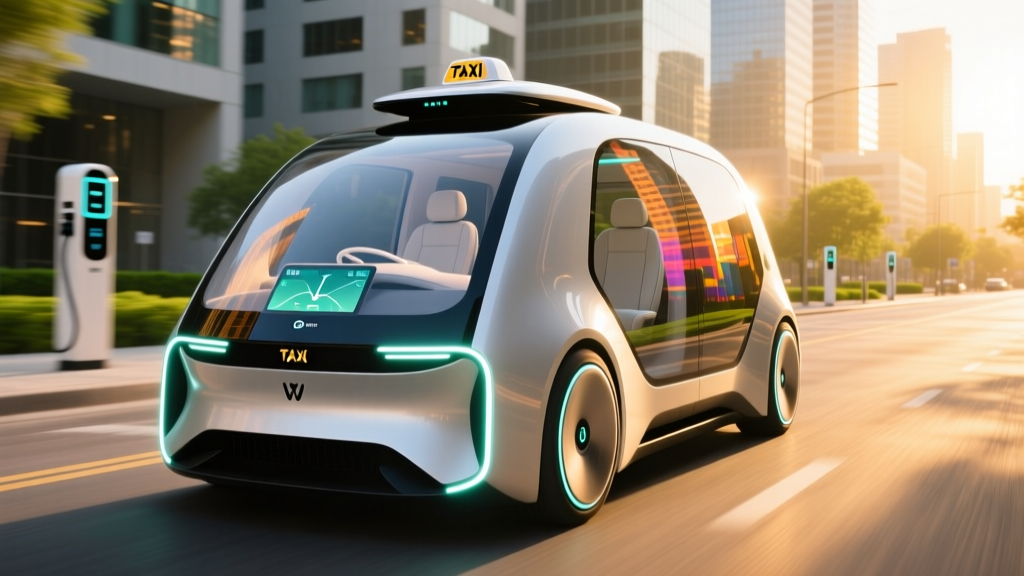
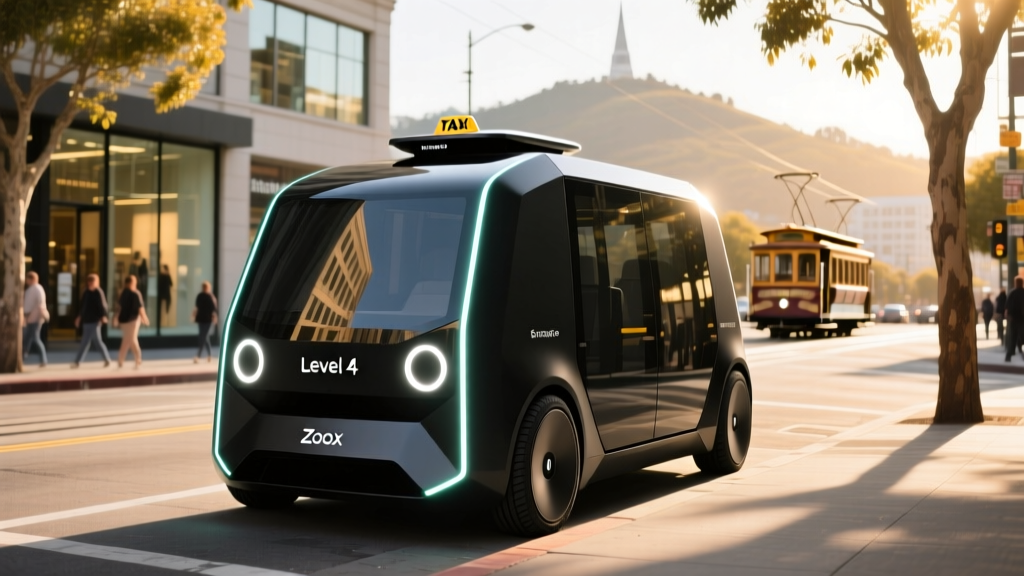
If you've spotted a compact, symmetrical pod vehicle navigating SoMa or the Embarcadero without anyone in the driver's seat, you've seen the Zoox robotaxi. Amazon's autonomous vehicle subsidiary has been operating its purpose-built, bidirectional Zoox car in San Francisco since late 2024, making it one of only two Level 4 driverless services commercially available to the public in the city (alongside Waymo). Unlike retrofitted consumer EVs, the Zoox vehicle was engineered from the ground up for autonomous ride-hailing — no steering wheel, no pedals, no driver.
The Zoox car operates at SAE Level 4 within its approved geofenced operational design domain (ODD). This means the vehicle performs all driving tasks — steering, braking, navigation, hazard response — without any human driver present or required. This is fundamentally different from Level 2 driver-assist systems like Tesla Autopilot, GM Super Cruise, or Ford BlueCruise, which require a licensed, attentive human driver behind the wheel at all times. Level 4 does not mean "drives everywhere in all conditions" — it means "drives without a human, but only within defined boundaries."
The distinction matters enormously. Consumer vehicles with Level 2 systems (even those marketed as "full self-driving") still place legal and operational responsibility on the human driver. Zoox's Level 4 service places that responsibility on the company — and regulators hold them to a correspondingly higher standard before granting deployment permits.
Where Can I Ride the Zoox Car in San Francisco Right Now?
As of early 2026, Zoox operates its commercial robotaxi service within a defined geofence covering much of central and eastern San Francisco. The service area has expanded incrementally since launch, but it does not cover the entire city.
| City / Region | Status | Service Area Notes |
|---|---|---|
| San Francisco (SoMa, Mission Bay, Embarcadero, Financial District, Dogpatch) | Live — Commercial | Core operational zone; available to public via Zoox app |
| San Francisco (Sunset, Richmond, parts of Bayview) | Outside geofence | Not yet available for pickup/dropoff |
| Foster City, CA | Live — Testing / Limited | Earlier testing zone; limited rider access |
| Las Vegas, NV | Live — Testing | Employee and invited-rider operations on the Strip corridor |
| Austin, TX | Announced / Testing | Mapping and validation phase; no public rides yet |
| Atlanta, GA | Announced / Testing | Early-stage operations; no public access |
To request a ride, download the Zoox app (iOS/Android), create an account, and enter your pickup and dropoff locations. If both points fall within the active geofence and the service is operating (hours are typically daytime through early evening, not 24/7), you'll be matched with a nearby Zoox vehicle. There's no option to request a specific route — the system plans the path autonomously.
Zoox Pricing vs. Uber and Lyft: What Does a Robotaxi Ride Cost?
Zoox has positioned its commercial service aggressively on price during its expansion phase. Here's how typical fares compare in San Francisco for early 2026:
| Service | ~3-Mile Trip | ~7-Mile Trip | Surge Pricing? | Tipping |
|---|---|---|---|---|
| Zoox Robotaxi | $8 – $13 | $15 – $22 | No surge currently | Not applicable |
| UberX | $12 – $18 | $20 – $32 | Yes, frequent | Expected (15-20%) |
| Lyft Standard | $11 – $17 | $19 – $30 | Yes, frequent | Expected (15-20%) |
| Waymo One | $10 – $15 | $18 – $26 | Limited surge | Not applicable |
Zoox's pricing currently undercuts traditional rideshare on most routes within its geofence, largely because there's no driver to pay and the company is subsidizing fares to build ridership. Whether this pricing persists as the fleet scales is an open question — Amazon has the capital to sustain below-market fares longer than most competitors, but long-term unit economics will need to improve. For now, riders benefit.
Zoox Safety Record: What the Data Actually Shows
Autonomous vehicle safety is the most scrutinized — and most misunderstood — aspect of robotaxi deployment. Here's what we know from publicly reported data and regulatory filings as of early 2026:
- Commercial driverless miles in SF: Estimated 500,000+ autonomous miles on public roads (combined testing and commercial operations across all cities)
- Reported contact incidents: A small number of minor contact events reported to the California DMV and NHTSA Standing General Order, consistent with low-speed urban operation
- Disengagement rate: Zoox reports remote-assistance interventions averaging fewer than 1 per several hundred miles during early commercial deployment — improving steadily with software updates
- Injury incidents: No reported serious injuries to passengers or other road users attributable to Zoox autonomous operation as of last public filing
For context, the National Highway Traffic Safety Administration (NHTSA) requires all operators of Level 4 vehicles to report crashes under the Standing General Order. Zoox has complied, and its incident reports have largely involved low-speed contact with stationary objects or other vehicles in complex urban scenarios — the kind of fender-benders that are extremely common in San Francisco traffic regardless of who's driving.
How does this compare to human drivers? The human crash rate in urban San Francisco is roughly 300-400 police-reported crashes per 100 million miles driven. Robotaxi operators report incidents at a much lower threshold (any contact, regardless of severity), which makes direct numerical comparison misleading. What the data does suggest is that Level 4 robotaxis in geofenced urban areas are not exhibiting dramatically higher crash rates than attentive human drivers — but the sample sizes are still too small for definitive statistical claims.
The California DMV and the California Public Utilities Commission (CPUC) jointly oversee robotaxi operations in the state. The CPUC granted Zoox its commercial deployment permit after reviewing safety cases, insurance coverage, and accessibility plans.
Under the Hood: Zoox's Level 4 Technology Stack
The Zoox vehicle is a ground-up design, not a retrofitted consumer car. This gives it sensor placement and redundancy advantages that bolt-on autonomous systems can't match.
Sensor Suite
- LiDAR: Multiple solid-state and spinning LiDAR units providing 360° 3D point-cloud mapping out to ~150+ meters. LiDAR is Zoox's primary depth-perception layer and operates independently of lighting conditions.
- Cameras: High-resolution camera arrays covering all directions, used for object classification, traffic-light state detection, signage reading, and lane-marking identification.
- Radar: Long-range and short-range radar units for velocity detection of moving objects, particularly in conditions where LiDAR or cameras may degrade (heavy rain, fog).
- Microphones: External audio sensors to detect emergency vehicle sirens and trigger appropriate pull-over behavior.
Compute & Redundancy
- Dual-redundant compute platforms — if one fails, the backup can safely bring the vehicle to a controlled stop.
- Redundant braking, steering, and power systems (no single point of failure can strand or endanger the vehicle).
- Cellular connectivity for remote assistance — a human operator can provide high-level guidance (not remote driving) when the vehicle encounters an ambiguous scenario.
Geofencing & HD Maps
- Operates only within pre-mapped zones using centimeter-accurate HD maps.
- Geofence boundaries are hard-coded: the vehicle will not attempt to drive outside its approved ODD.
- Maps are continuously updated to reflect construction, lane changes, and temporary closures.
The multi-sensor approach (LiDAR + camera + radar) contrasts with Tesla's camera-only FSD strategy. Zoox, like Waymo, treats LiDAR as essential for reliable depth perception and redundancy. In practice, this means the Zoox car can detect a pedestrian stepping off a curb at night in a poorly lit area with more confidence than a camera-only system — though at significantly higher hardware cost per vehicle.
Current Limitations: What Zoox Can't Do Yet
Level 4 autonomy within a geofence is a remarkable engineering achievement, but it comes with real operational boundaries that riders should understand before booking:
Known Operational Limitations
- Geofence restriction: Pickup and dropoff must both fall within the approved San Francisco service area. You cannot ride to the airport (SFO), across the Golden Gate Bridge, or to Oakland.
- Weather constraints: Heavy fog, torrential rain, or unusual road conditions may trigger service suspension in parts of the geofence. The vehicle may pull over safely and wait if sensor confidence drops below threshold.
- No highway driving: Zoox operates on surface streets only within its urban ODD. Freeway on-ramps and highway segments are excluded.
- Operating hours: Service is not 24/7. Hours are typically early morning through late evening; overnight rides are unavailable.
- Passenger capacity: The Zoox vehicle seats up to 4 passengers in a face-to-face configuration. No wheelchair-accessible variant is currently in commercial service (though Zoox has committed to ADA-accessible vehicles in future fleet expansions).
- No stops or multi-destination trips: You request a single point-to-point ride. No intermediate stops, no "wait for me" functionality.
- Edge-case delays: Construction zones, double-parked delivery trucks, or unusual road configurations may cause the vehicle to pause, reroute, or request remote assistance — adding minutes to your trip.
- No pets or large cargo: Standard ride-hailing restrictions apply; the vehicle interior is compact.
These limitations are not unique to Zoox — Waymo's San Francisco service has comparable constraints. They reflect the current state of Level 4 autonomy: extraordinarily capable within defined parameters, but not a replacement for a human driver in arbitrary conditions.
The Regulatory Landscape: Who Approves Robotaxis?
Robotaxi operations in California require approval from multiple agencies, and understanding this framework helps explain why expansion is deliberate rather than rapid:
- California DMV: Issues autonomous vehicle testing and deployment permits. Requires annual disengagement reports and crash reporting. Zoox holds a valid deployment permit.
- California Public Utilities Commission (CPUC): Regulates commercial passenger service (the "ride-hailing" side). The CPUC's Driverless Pilot Program and subsequent permanent rules established the framework for fare-charging robotaxi service. Zoox received CPUC authorization for commercial operations in San Francisco.
- NHTSA (Federal): The National Highway Traffic Safety Administration sets Federal Motor Vehicle Safety Standards (FMVSS). Zoox received a limited FMVSS exemption for its purpose-built vehicle, which lacks traditional controls like a steering wheel. NHTSA also mandates crash reporting via the Standing General Order for all Level 4 operators.
- San Francisco Municipal Authorities: SFMTA (San Francisco Municipal Transportation Agency) and the Board of Supervisors have been active stakeholders, particularly after high-profile incidents involving other operators (notably Cruise's October 2023 pedestrian dragging incident). Local authorities can request operational modifications or service restrictions.
The regulatory environment in San Francisco is among the most stringent in the country for robotaxi deployment. This is a feature, not a bug: it means that services operating there have been vetted more thoroughly than in most other markets.
Frequently Asked Questions
Is the Zoox car truly self-driving, or is there a remote human driving it?
The Zoox car drives itself autonomously within its geofenced service area — there is no human driver inside the vehicle, and no human remotely piloting it in real time. Remote assistance operators provide high-level guidance in edge cases (e.g., confirming whether a construction-zone flagger is directing traffic), but they do not steer or brake the vehicle. This is the defining characteristic of SAE Level 4.
How much does a Zoox ride cost compared to Uber or Lyft?
As of early 2026, Zoox fares typically run 20-40% below comparable UberX or Lyft Standard rides within its San Francisco geofence, with a ~3-mile trip costing $8-$13. There is currently no surge pricing and no tipping. Pricing is subject to change as the service scales.
How safe are Zoox robotaxis based on real data?
Zoox reports crash and incident data to the California DMV and NHTSA as required. Publicly available data through late 2025 shows a small number of low-speed contact incidents across hundreds of thousands of autonomous miles, with no reported serious injuries. The data set is still too small for definitive statistical comparison to human drivers, but early indicators are consistent with Waymo's published safety outcomes — broadly comparable to or better than attentive human driving in dense urban environments.
Can I take a Zoox car to SFO Airport or across the Bay Bridge?
No. The Zoox geofence currently covers central and eastern San Francisco surface streets only. SFO, the Bay Bridge, Oakland, and most of the Sunset and Richmond districts are outside the operational area. Highway driving is not part of the current ODD.
What happens if the Zoox car encounters something it can't handle?
The vehicle will slow down or pull to a safe stop and request remote assistance. A human operator reviews the situation via the vehicle's sensor feeds and provides guidance. If the issue can't be resolved, Zoox dispatches roadside support. Passengers are never expected to intervene or take control.
How is Zoox different from Waymo?
Both operate Level 4 driverless robotaxis in San Francisco. The key differences: Zoox uses a purpose-built, bidirectional vehicle with no steering wheel (seats 4, face-to-face), while Waymo retrofits the Jaguar I-PACE with its sensor suite. Zoox is backed by Amazon; Waymo by Alphabet. Service areas, pricing, and wait times differ, so it's worth checking both apps for your specific route.