What the Zoox Robotaxi Actually Is — and Why Las Vegas Matters
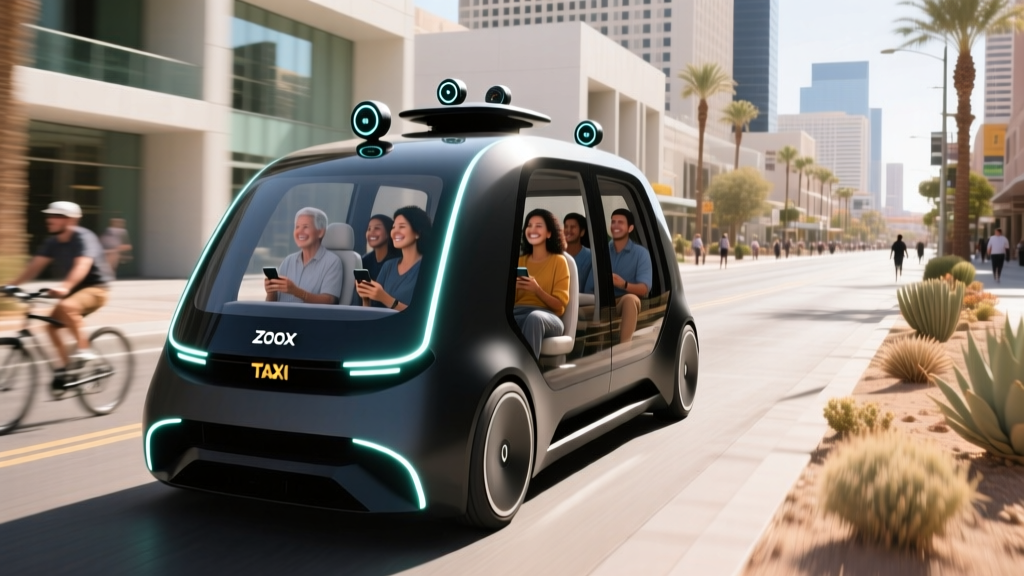
If you have spent any time near the Las Vegas Strip or the Fremont Street district, you may have spotted a compact, boxy vehicle gliding through traffic with no one in the driver's seat. That is the Zoox robotaxi — a purpose-built, fully autonomous vehicle developed by Zoox, the Amazon-owned autonomous-vehicle company headquartered in Foster City, California. Unlike retrofitted SUVs bolted with aftermarket sensor arrays, the Zoox vehicle was designed from the ground up as a driverless mobility platform: bidirectional (it drives equally well in either direction), symmetrical, and built around a 360-degree sensor suite.
Las Vegas has emerged as one of Zoox's primary proving grounds and commercial-launch cities, alongside the San Francisco Bay Area. The city's relatively predictable grid layout, dry climate, and supportive regulatory environment under Nevada's autonomous-vehicle framework make it a logical deployment zone. As of early 2026, Zoox has been offering ride-hail service to members of the public in defined Las Vegas geofences — no safety driver behind the wheel.
The Zoox robotaxi operates at SAE Level 4 within its approved operational design domain (ODD). This means the vehicle handles all driving tasks — steering, braking, navigation, obstacle avoidance — without any human intervention within its geofenced service area. There is no steering wheel, no pedals, and no expectation that a passenger will take over. This is fundamentally different from Level 2 driver-assist systems like Tesla Autopilot, GM Super Cruise, or Ford BlueCruise, which require continuous driver supervision. At Level 4, the system is the driver.
Where Can You Ride the Zoox Car in Las Vegas Right Now?
Zoox does not operate everywhere in the Las Vegas valley. The service is geofenced — meaning the vehicle is approved to drive autonomously only within a mapped and validated zone. As of 2026, the primary service area covers a corridor connecting key destinations:
| Zone | Coverage | Status |
|---|---|---|
| Las Vegas Strip Corridor | Select hotels, casinos, and convention centers along S. Las Vegas Blvd | Active — public rides |
| Downtown / Fremont Area | Fremont Street Experience vicinity, select downtown hotels | Active — public rides |
| Suburban Henderson / Summerlin | Residential and retail corridors | Testing — not open to public |
| Harry Reid International Airport | Airport pickups/dropoffs | Not yet available |
How to request a ride: Zoox operates through its own mobile app (available on iOS and Android). You set a pickup and dropoff within the geofenced zone, and the system dispatches the nearest available vehicle. There is no option to hail one on the street. Wait times vary but typically run 3–8 minutes within the core service area during daytime hours.
Zoox Pricing vs. Uber and Lyft in Las Vegas
One of the most common questions from first-time riders: how much does a Zoox robotaxi ride actually cost compared to conventional rideshare? During its initial public-launch phase, Zoox has offered rides at competitive or subsidized rates to build ridership and gather real-world operational data. Pricing is dynamic but here is a representative comparison for a typical 3-mile trip along the Strip corridor:
| Service | Base Fare | Per Mile | ~3-Mile Trip | Surge Pricing |
|---|---|---|---|---|
| Zoox | $0–$2 | $1.00–$1.50 | $3–$7 | Not currently applied |
| UberX | $2.50 | $1.75–$2.25 | $8–$12 | 1.2x–2.5x common on Strip |
| Lyft Standard | $2.00 | $1.60–$2.10 | $7–$11 | 1.3x–2.0x common |
| Waymo One (where available) | $3.00 | $1.80–$2.50 | $9–$13 | Limited surge |
Key takeaway: Zoox rides are currently cheaper than Uber or Lyft for comparable trips, largely because the company is subsidizing fares during its growth phase. Long-term pricing is expected to rise as the service scales, but Zoox's economic thesis — no driver to pay — suggests eventual per-mile costs below human-driven rideshare. Tipping is not expected (there is no driver), though the app provides an option to rate and provide feedback.
The Technology Stack: Lidar, Cameras, and Redundant Systems
The Zoox vehicle is not a modified production car. It is a ground-up design — roughly the footprint of a Toyota Prius but taller and wider to accommodate passengers in a face-to-face seating arrangement for up to four riders. There is no driver's compartment, no steering wheel, no brake pedal accessible to occupants. Every control decision is made by the onboard autonomy system.
Zoox Sensor and Compute Architecture
- Lidar: Multiple solid-state and spinning lidar units provide a 360-degree, high-resolution 3D point cloud of the vehicle's surroundings out to ~150+ meters. Lidar works independently of ambient light — critical for nighttime and tunnel driving on the Strip.
- Cameras: A surround-camera array (visible-spectrum and near-infrared) handles lane detection, traffic-light state recognition, signage reading, and pedestrian intent classification.
- Radar: Forward and corner radar units provide velocity data on moving objects and perform reliably in rain, dust, or fog — conditions where lidar and cameras can degrade.
- Ultrasonic sensors: Short-range proximity detection for low-speed maneuvering, curb alignment, and close-quarter object avoidance.
- Compute: Custom Zoox-designed compute platform with redundant processing paths. If one compute module fails, a secondary system can bring the vehicle to a safe stop.
- HD Mapping: The vehicle operates on centimeter-precision maps of its geofenced zone, updated regularly. These maps provide lane geometry, speed limits, traffic signal locations, and known construction zones.
This sensor-fusion approach — combining lidar, cameras, and radar — stands in contrast to Tesla's camera-only FSD architecture. Zoox's position, shared by Waymo and most other Level 4 operators, is that sensor redundancy is essential for safety-critical driverless operation. If a camera is blinded by direct sun glare, lidar still sees the pedestrian. If rain scatters lidar returns, radar still tracks the vehicle ahead.
Safety Record: What the Data Actually Shows
Safety is the most scrutinized aspect of any robotaxi service, and rightfully so. Zoox, like all autonomous-vehicle operators in Nevada and California, is required to report disengagement data, collision reports, and operational metrics to state regulators. Here is what is publicly available as of early 2026:
Zoox Safety Metrics — Reported Data
- Total autonomous miles driven (all markets): Estimated 1.5+ million driverless miles as of late 2025 (NHTSA AV reporting).
- Reported at-fault collisions: Zoox has reported a small number of minor-contact incidents to the NHTSA Standing General Order, predominantly low-speed rear-end or sideswipe events in dense urban traffic. No reported fatalities or serious injuries attributed to the Zoox system as of this writing.
- Disengagement rate: In California DMV disengagement reports, Zoox has shown progressive improvement year-over-year, with intervention rates declining as the system's software stack matures. Exact per-thousand-mile figures vary by reporting period and operational domain.
- Remote assistance: When the vehicle encounters an ambiguous scenario (e.g., an unmarked construction zone or an unusual road closure), it can pull to a safe stop and request guidance from a remote operations team. This is not remote driving — the remote operator provides high-level routing advice, and the vehicle executes the maneuver autonomously.
Sources: NHTSA AV Safety Data, California DMV Autonomous Vehicle Disengagement Reports, Nevada DMV AV program.
For context, the human-driven fatality rate in the United States is approximately 1.35 deaths per 100 million vehicle miles traveled (NHTSA, 2022 data). Robotaxi operators, including Zoox and Waymo, have collectively logged tens of millions of driverless miles with zero confirmed at-fault fatalities — a sample size that is growing but still too small to declare definitive statistical superiority. What the data does suggest is that Level 4 robotaxis, within their validated ODD, are performing at or above human safety baselines in urban environments.
Regulatory Landscape: Who Approves Zoox Operations?
Autonomous-vehicle regulation in the United States is a patchwork of federal and state authority. Here is how it works for Zoox in Las Vegas:
- Federal (NHTSA): The National Highway Traffic Safety Administration sets vehicle safety standards (FMVSS). Zoox received a notable exemption from NHTSA in 2024 allowing its purpose-built vehicle — which lacks a steering wheel, mirrors, and traditional controls — to operate on public roads. This exemption was a significant milestone, as standard FMVSS rules assume a human driver.
- State of Nevada: Nevada was one of the first states to pass autonomous-vehicle legislation (AB 511, 2011, subsequently updated). The Nevada DMV issues autonomous-vehicle testing and deployment permits. Zoox holds a valid Nevada deployment permit for commercial passenger service within approved geofences. The state requires insurance minimums, incident reporting, and vehicle registration as autonomous vehicles.
- Local (Clark County / City of Las Vegas): Local jurisdictions have input on road access, curb management, and pickup/dropoff zones but generally defer to state-level AV permits.
This regulatory framework means Zoox cannot simply expand its geofence at will. Each new zone requires mapping, validation, and regulatory approval — a deliberate process that prioritizes safety over speed of expansion.
Current Limitations: What Zoox Cannot Do (Yet)
Level 4 autonomy is impressive, but it is bounded by real constraints. Here are the current limitations of the Zoox robotaxi in Las Vegas as of 2026:
Operational Limitations
- Geofence boundaries: The vehicle will not travel outside its approved zone. If your destination falls outside the geofence, the app will not let you book the ride. You cannot ask the vehicle to deviate from its mapped area.
- Weather constraints: While Las Vegas is mostly dry, the rare heavy monsoon rain or dust storm can trigger the vehicle to pull over and wait, or cancel a ride. The system is calibrated for conditions within its ODD — heavy precipitation, flooding, or zero-visibility events are no-go scenarios.
- Highway driving: The Zoox vehicle is designed for urban and suburban surface streets, not freeway speeds. It will not merge onto I-15 or US-95 at 70 mph. This limits its utility for airport runs or long-distance suburban trips.
- Construction zones: While the system handles minor lane shifts and temporary signals, major unanticipated construction can cause the vehicle to stop and request remote assistance, adding delay.
- No manual override: There is no steering wheel or brake pedal for passengers. If you feel uncomfortable, you can request the vehicle to pull over via the in-app interface or the in-cabin help button, but you cannot "take over" driving.
- Accessibility: The current Zoox vehicle accommodates standard wheelchair dimensions, but very large motorized chairs or non-standard mobility devices may not fit. Zoox has stated future vehicle iterations will address broader ADA compliance.
- Night and tunnel performance: The lidar-heavy sensor suite performs well at night and in the short tunnels along the Strip, but certain poorly lit or unmapped underpasses may still trigger conservative routing.
The Zoox Vehicle: Specs and Passenger Experience
Riding in a Zoox robotaxi is a distinct experience compared to a Waymo (a retrofitted Jaguar I-PACE) or a Cruise vehicle. Here is what you are actually stepping into:
| Specification | Detail |
|---|---|
| Vehicle Type | Purpose-built autonomous carriage (no driver controls) |
| Seating | 4 passengers, face-to-face bench configuration |
| Drivetrain | All-electric, dual-motor AWD, bidirectional (equal capability in both directions) |
| Battery (estimated) | ~133 kWh usable (NMC chemistry), supporting full-day operation |
| Top Speed | 75 mph (electronically limited; operates well below this in urban zones) |
| Dimensions (approx.) | Length: ~174 in / Width: ~78 in / Height: ~75 in |
| Autonomy Level | SAE Level 4 (geofenced) |
| Climate Control | Individual passenger zone HVAC |
| In-Cabin Features | Touchscreen ride info, help button, USB-C charging, ambient lighting |
The bidirectional design is one of the Zoox vehicle's most distinctive engineering choices. Because the vehicle is symmetrical — identical front and rear — it can exit a dead-end street by simply reversing its driving direction rather than performing a multi-point turn. This is a practical advantage in dense urban environments with narrow service roads and alleyways.
Inside, the experience is closer to a small lounge than a car. You sit facing your fellow passengers (or an empty bench if riding solo), with a central screen showing your route, estimated arrival time, and current speed. The ride quality is smooth — electric powertrain with no gear shifts, and the driving algorithm prioritizes gradual acceleration and braking over aggressive maneuvering.
Zoox vs. Waymo: How Las Vegas Robotaxis Compare
Las Vegas is one of the few U.S. cities where multiple robotaxi services are either operational or testing. Here is how Zoox stacks up against the primary competitor, Waymo (Alphabet's autonomous-vehicle subsidiary):
| Attribute | Zoox | Waymo One |
|---|---|---|
| Vehicle | Purpose-built Zoox carriage | Jaguar I-PACE (retrofitted) |
| SAE Level | Level 4 | Level 4 |
| Las Vegas Status (2026) | Public rides in Strip/Downtown geofence | Testing / limited deployment |
| Primary Market | Las Vegas, San Francisco Bay Area | Phoenix, San Francisco, Los Angeles, Austin |
| Seating Capacity | 4 passengers | Up to 3 passengers (front seat blocked) |
| Driver Controls | None (no steering wheel) | Present but inaccessible to riders |
| Sensor Stack | Lidar + cameras + radar + ultrasonic | Lidar + cameras + radar |
| Parent Company | Amazon | Alphabet (Google) |
Waymo has a larger cumulative operational footprint — with millions more paid rides completed across Phoenix, San Francisco, and Los Angeles. Zoox is earlier in its commercial rollout but benefits from a purpose-built vehicle that is arguably better optimized for the passenger experience. Both companies are well-funded and committed to long-term Level 4 deployment.
Frequently Asked Questions
Is the Zoox car truly self-driving, or is there a remote driver?
The Zoox robotaxi is genuinely driverless — there is no human behind the wheel, no remote joystick operator controlling the vehicle in real time. The onboard AI system makes all driving decisions. A remote operations team monitors the fleet and can provide high-level routing guidance if the vehicle encounters an unusual scenario, but they do not "drive" the car. This is SAE Level 4 autonomy.
How much does a Zoox ride cost compared to Uber or Lyft?
As of 2026, Zoox rides in Las Vegas are typically $3–$7 for a 3-mile trip within the geofenced zone — generally cheaper than comparable Uber or Lyft rides, which run $8–$12 for similar distances. Zoox is currently subsidizing fares to build ridership; prices may increase as the service matures.
Can I ride Zoox from the Las Vegas airport?
Not yet. Harry Reid International Airport is outside the current Zoox geofence. Airport service would require separate regulatory agreements with the airport authority and Clark County. Zoox has signaled interest in airport connectivity, but no timeline has been announced.
What happens if the Zoox vehicle gets into an accident?
Zoox carries commercial liability insurance as required by Nevada AV regulations. In the event of a collision, the vehicle's systems automatically notify Zoox operations and emergency services if needed. Passengers can use the in-cabin help button to contact support immediately. Zoox reports all incidents to NHTSA under the Standing General Order for automated driving systems.
Is the Zoox vehicle electric?
Yes. The Zoox robotaxi is fully battery-electric, with an estimated ~133 kWh battery pack (NMC chemistry) designed to support a full day of urban operation. The vehicle charges at Zoox depot facilities between shifts. Passengers do not interact with charging in any way.
How does Zoox handle bad weather in Las Vegas?
Las Vegas rarely sees heavy rain, but when monsoon storms or dust events occur, the Zoox system may delay or cancel rides if conditions fall outside its validated operational design domain. The vehicle is equipped to handle light rain and nighttime driving, but zero-visibility events, flooded roads, or severe wind-blown dust are scenarios where the system will pull over safely and wait or reroute.
Can I bring luggage or a stroller in the Zoox car?
The Zoox vehicle has limited cargo space — it is optimized for passenger seating, not trunk volume. A small backpack, purse, or carry-on bag fits on the seat beside you, but large suitcases or full-size strollers are unlikely to fit comfortably. This makes it better suited for point-to-point urban trips than airport runs with heavy luggage.
What's Next for Zoox in Las Vegas and Beyond
Zoox's Las Vegas deployment represents one of the earliest commercial-scale Level 4 robotaxi services in the United States. The company has indicated plans to expand its geofence within the Las Vegas valley — potentially reaching suburban retail corridors and, eventually, airport connectivity — but each expansion requires regulatory approval and thorough validation. Zoox is also operating in the San Francisco Bay Area and has signaled intentions to enter additional U.S. cities, though specific timelines remain unannounced.
For Las Vegas visitors and residents, the Zoox robotaxi offers a tangible, accessible experience of what Level 4 autonomy looks like in practice: no steering wheel, no driver, no tips — just a quiet electric carriage navigating the Strip with a sensor suite that never blinks. The technology is real, the safety record is encouraging, and the pricing is competitive. The constraints — geofence boundaries, weather limits, no highway driving — are equally real and worth understanding before you book your first ride.