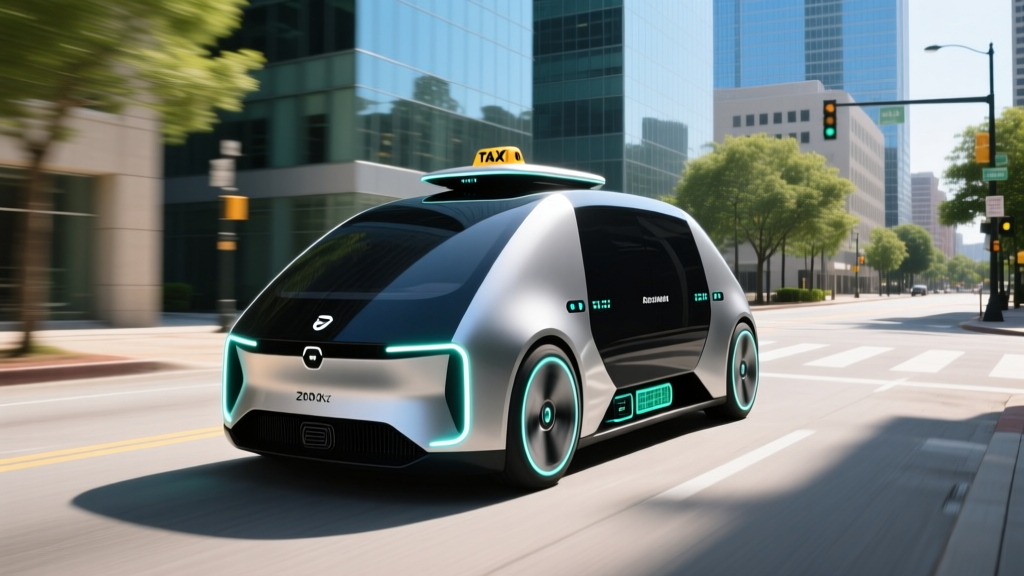
If you've been searching for information on a Zoox car Atlanta launch, you're not alone. The Amazon-backed autonomous vehicle company has been steadily expanding its driverless ride-hail footprint, and Atlanta has emerged as one of its key target markets. But what can riders actually expect from Zoox's purpose-built robotaxi in the Peach State? This guide covers the real-world details: where it operates, what it costs, the safety data behind it, and the hard limitations you need to know before summoning your first ride.
What Is the Zoox Robotaxi — and Is It Truly Self-Driving?
The Zoox vehicle is not a retrofitted consumer car with sensors bolted on. It's a purpose-built, bidirectional electric shuttle designed from the ground up for autonomous ride-hailing. There's no steering wheel, no pedals, and no driver's seat. Passengers sit in a four-across, carriage-style cabin facing each other.
Zoox operates at SAE Level 4 within its approved operational design domain (ODD). This means the vehicle handles all driving tasks — steering, braking, navigation, obstacle avoidance — without any human intervention within its geofenced service area. This is fundamentally different from Level 2 driver-assist systems like Tesla Autopilot, GM Super Cruise, or Ford BlueCruise, which require continuous driver supervision. There is no human behind the wheel in a Zoox robotaxi.
The distinction matters because consumers frequently conflate advanced driver-assist features with full autonomy. When you ride in a Zoox, no one is monitoring the road for the car. The car is entirely responsible for its own operation within the boundaries where it's permitted to run.
Where Can You Use a Zoox Car in Atlanta Right Now?
Zoox began its Atlanta operations with a phased rollout. As of early 2026, the service is active in specific geofenced zones rather than across the entire metro area. Here's what the current service footprint looks like:
| Zone | Coverage | Status |
|---|---|---|
| Downtown / Centennial District | Core business district, Mercedes-Benz Stadium area | Active — rider-only |
| Midtown | Piedmont Park corridor, Tech Square, Atlantic Station | Active — rider-only |
| West Midtown / Howell Mill | Mixed commercial and residential corridors | Active — limited hours |
| Buckhead | Lenox Square perimeter, Peachtree Road | Testing phase (employees + invited riders) |
| Airport (ATL) / College Park | Hartsfield-Jackson connection | Not yet available |
Zoox's geofencing means the app will only allow you to set pickup and dropoff points within the approved service area. If your destination falls outside the boundary, the ride simply won't be offered. This is a hard constraint of Level 4 operation — the vehicle's ODD must be pre-mapped and approved.
Zoox also operates in Las Vegas (its longest-running public market), San Francisco, and has announced testing in additional cities. Atlanta represents one of its most significant East Coast/Southeast expansions. For the latest city-by-city status, check the Zoox official locations page.
How to Ride and What It Costs vs. Uber and Lyft
Booking a Zoox ride is straightforward: download the Zoox app, enter your pickup and destination (both must fall within the geofence), and request a ride. Wait times in active Atlanta zones typically run 3–8 minutes depending on fleet density and time of day.
Zoox has positioned its pricing aggressively to build ridership. Here's how a typical trip compares:
| Trip Scenario | Zoox | UberX | Lyft Standard |
|---|---|---|---|
| Short trip (~2 miles, Midtown) | $5–$8 | $9–$13 | $9–$12 |
| Medium trip (~5 miles, Downtown to Buckhead border) | $10–$15 | $16–$22 | $15–$21 |
| Surge pricing (Friday night, event area) | $12–$18 | $25–$40 | $22–$38 |
Zoox's pricing advantage comes from eliminating driver compensation — the single largest cost in rideshare economics. However, this pricing is partly subsidized during the growth phase. Zoox has not published a long-term fare structure, and prices may adjust as the service scales beyond its introductory period.
One practical difference: Zoox vehicles seat up to four passengers, but you cannot request a larger vehicle for groups beyond that. There is no Zoox XL equivalent. The cabin also has limited cargo space — think backpacks and grocery bags, not airport luggage for a family.
The Zoox Tech Stack: Sensors, Computing, and Why It Matters
Unlike Tesla's camera-only approach, Zoox employs a multi-sensor redundancy stack that is standard among Level 4 operators like Waymo. Here's what's onboard:
- LiDAR: Multiple roof-mounted and corner-mounted solid-state LiDAR units providing 360° point-cloud mapping out to ~150+ meters. LiDAR operates independently of lighting conditions.
- Cameras: High-resolution camera arrays covering all directions for object classification, traffic signal recognition, and lane detection.
- Radar: Forward and corner radar for velocity detection of moving objects, particularly useful in rain and fog where LiDAR and cameras degrade.
- Compute: Custom high-performance computing platform processing sensor fusion in real time — Zoox has not disclosed exact TOPS figures, but the architecture supports full redundancy (if one compute path fails, a backup can execute a safe stop).
- HD Mapping: Pre-built centimeter-accuracy maps of every road in the geofenced zone. The vehicle localizes itself against these maps in real time.
- V2I (Vehicle-to-Infrastructure): Limited integration — Zoox primarily relies on onboard perception rather than infrastructure communication.
The vehicle itself is a battery-electric platform with a ~75 kWh usable battery pack (NMC chemistry), providing enough range for a full day of urban ride-hailing before returning to a depot for charging. The bidirectional design — it can drive equally well in either direction — eliminates the need for three-point turns and simplifies routing in tight urban environments. Top speed is electronically limited to approximately 75 mph, though in practice Atlanta urban trips rarely exceed 35–45 mph.
Safety Record: What the Data Actually Shows
Autonomous vehicle safety is the most scrutinized — and most misunderstood — aspect of the robotaxi industry. Here's what we know from available data:
- Total autonomous miles driven (all cities): Zoox has accumulated several million driverless miles across Las Vegas, San Francisco, and early Atlanta operations. Exact cumulative figures are reported to NHTSA under the Standing General Order for crash reporting.
- Disengagement rate: Unlike Waymo and Cruise, which publish California DMV disengagement reports, Zoox's California testing data has been reported but the company's purpose-built vehicle has had fewer public disengagement disclosures since it entered driverless service (disengagements are more relevant to testing with safety drivers).
- Reported collisions: Zoox has reported a small number of low-speed contact incidents to NHTSA — predominantly other vehicles striking the stationary or slow-moving Zoox at intersections, consistent with the broader robotaxi pattern where conventional drivers are the primary collision initiators.
- No reported serious injuries or fatalities involving Zoox robotaxi passengers as of the latest available NHTSA filings.
For context, the National Highway Traffic Safety Administration (NHTSA) requires all Level 4 operators to report crashes within 24 hours under the Standing General Order. This data is publicly searchable. The Insurance Institute for Highway Safety (IIHS) has noted that robotaxi collision rates per million miles are broadly comparable to or lower than human drivers in similar urban environments, though the operational contexts differ significantly (geofenced, lower-speed, mapped roads vs. unrestricted driving).
It's important to understand what this data does not prove: it does not mean robotaxis are infallible. It means that within their constrained operating domains, they have not demonstrated a pattern of at-fault serious incidents. Edge cases remain the frontier challenge.
Current Limitations: Where Zoox Cannot Go and Why
Level 4 autonomy is powerful within its domain but rigid outside it. Here are the real constraints you'll encounter with a Zoox car in Atlanta:
- Geofencing: The vehicle will not operate outside its pre-mapped, regulator-approved zone. No impromptu trips to the suburbs, no highway driving on I-75 or I-85.
- Weather restrictions: Heavy rain, fog, and ice can cause service suspensions. Atlanta's occasional winter ice storms will shut down operations entirely — LiDAR and camera performance degrade significantly in precipitation, and road-surface friction modeling is unreliable on ice.
- Construction zones: Unmapped lane closures or major roadwork can trigger a remote-assist pause or a reroute. The vehicle cannot improvise through an unmapped detour the way a human driver can.
- Night operations: Zoox does operate at night, but certain poorly lit or unmapped areas may have reduced availability.
- No highway driving: The 75 mph speed limiter and ODD restrictions mean Zoox does not serve freeway routes. Don't expect a Zoox from Midtown to Perimeter Mall via GA-400.
- Accessibility: The Zoox vehicle has been designed with wheelchair accessibility in mind, but real-world curb conditions and pickup-spot infrastructure in Atlanta vary. Confirm accessibility options in the app before booking.
- No stops mid-route: You cannot ask the vehicle to stop at a drive-through or wait while you run an errand. It's point A to point B.
Regulatory Landscape: Who Approves Zoox in Georgia?
Unlike California, where the CPUC and DMV jointly regulate autonomous vehicle testing and commercial deployment, Georgia's regulatory framework has been comparatively permissive. Georgia passed autonomous vehicle legislation (HB 472, signed in 2017) that allows Level 4 and Level 5 vehicles to operate on public roads provided they comply with standard vehicle registration, insurance, and traffic laws. There is no separate state-level permitting body equivalent to the California DMV's AV testing program.
At the federal level, NHTSA oversees vehicle safety standards. Zoox received a notable exemption from NHTSA in 2022 for its purpose-built vehicle, which does not include traditional manual controls (steering wheel, pedals, mirrors) that Federal Motor Vehicle Safety Standards (FMVSS) normally require. This exemption was critical — without it, the vehicle could not legally be sold or operated on public roads.
Atlanta's city government has been cooperative with Zoox's deployment, viewing it as a transit complement and economic development signal. However, local jurisdictions retain authority over curb management, pickup/dropoff zones, and traffic enforcement — all of which affect day-to-day operations.
Zoox vs. Waymo: How Atlanta's Robotaxi Options Compare
Waymo (Alphabet's autonomous driving unit) also operates in Atlanta in a limited capacity, primarily through its partnership with Uber for ride-hail integration. Here's how the two services stack up for an Atlanta rider:
| Attribute | Zoox | Waymo (via Uber) |
|---|---|---|
| Vehicle type | Purpose-built bidirectional shuttle | Jaguar I-PACE (retrofitted SUV) |
| Seating | 4 passengers, facing | Up to 4 passengers, forward-facing |
| Booking | Zoox standalone app | Uber app (Waymo option) |
| Atlanta coverage | Downtown, Midtown, West Midtown | Limited — expanding |
| Highway capable | No | Yes (in approved markets) |
| Relative pricing | Generally lower (subsidized growth phase) | Comparable to UberX or slight premium |
For Atlanta riders, the practical takeaway: Zoox offers a more novel experience in a purpose-built cabin at competitive pricing, but within a tighter geographic box. Waymo's retrofitted I-PACE platform has a more mature operational history (tens of millions of paid driverless miles, primarily in Phoenix and San Francisco) and highway capability, but Atlanta availability remains more limited as of early 2026.
Frequently Asked Questions
Where can I use the Zoox car in Atlanta right now?
Zoox is currently active in Downtown Atlanta (Centennial District), Midtown (Piedmont Park corridor, Tech Square), and parts of West Midtown. Buckhead is in testing. Airport service is not yet available. Always check the Zoox app for real-time zone availability.
How much does a Zoox ride cost compared to Uber or Lyft?
Zoox fares in Atlanta typically run 30–50% below comparable UberX or Lyft Standard fares for the same route. A 2-mile Midtown trip costs roughly $5–$8 with Zoox versus $9–$13 with traditional rideshare. This pricing may adjust as Zoox moves beyond its subsidized growth phase.
Is the Zoox robotaxi truly self-driving, or is there a human driver?
The Zoox vehicle is SAE Level 4 — fully driverless within its approved zone. There is no steering wheel, no pedals, and no human driver onboard. The vehicle handles all driving tasks autonomously. This is categorically different from Level 2 systems like Tesla Autopilot or Ford BlueCruise, which require a human driver to remain engaged.
How safe are Zoox robotaxis based on real data?
Zoox reports crash data to NHTSA under the Standing General Order. Available data shows a small number of low-speed incidents (predominantly other vehicles striking the Zoox), with no reported serious passenger injuries or fatalities as of early 2026. Robotaxi safety data is still accumulating — total miles driven are a fraction of human-driven miles nationally — but within their geofenced urban domains, Zoox and competitors have not demonstrated a pattern of at-fault serious collisions.
Can I take a Zoox to the airport or on the highway?
No. Zoox vehicles are speed-limited to approximately 75 mph and their operational design domain excludes highways and freeways. You cannot currently take a Zoox to Hartsfield-Jackson Atlanta International Airport or travel on I-75, I-85, or GA-400.
What happens if it rains or snows in Atlanta?
Zoox may suspend or limit service during heavy rain, ice, or snow events. Atlanta's occasional winter ice storms will almost certainly trigger a full service pause. The vehicle's LiDAR, camera, and radar systems perform best in clear conditions, and road-surface friction modeling on ice is beyond current Level 4 ODD parameters.
Do I need a special account or invitation to ride Zoox in Atlanta?
Zoox has been moving from invite-only testing toward open public access in Atlanta. As of 2026, riders in active zones can generally book through the Zoox app without a special invitation, though capacity constraints during peak hours may affect availability. Download the app and check your address to confirm access.