Zoox in San Francisco: The Quick Answer for 2026
Yes, Zoox is available in San Francisco — but with important geographic and operational caveats that determine whether it's practical for your specific trip. Amazon's autonomous vehicle subsidiary has operated its purpose-built robotaxi on public roads in San Francisco since mid-2023, and as of early 2026, the service has expanded its geofenced coverage area while remaining invite-only through its rider program. Unlike Waymo One, which any user can hail through an app in designated zones, Zoox still controls access through a waitlist-based early rider program, meaning availability is real but not yet open to the general public on demand.
This guide breaks down exactly where Zoox operates in the Bay Area, what the vehicle and technology stack actually look like, how safety data stacks up against human drivers and competitors, what a ride costs (currently free), and the hard limitations you'll face as a rider. If you're evaluating whether to sign up for the waitlist or comparing robotaxi options for your commute, here are the specifics you need.
Where Can You Actually Ride Zoox Right Now?
Zoox's operational footprint in San Francisco is defined by a geofence — a digitally mapped boundary within which the vehicle is permitted to navigate autonomously. As of 2026, the active service area covers much of central and eastern San Francisco, including neighborhoods like SoMa, the Financial District, Mission Bay, the Embarcadero corridor, and portions of the Mission District. The geofence has expanded incrementally since the program's launch, but it does not yet cover the entirety of the city — notably excluding steep-hill areas in the western and southern reaches, as well as highway driving.
| City / Region | Status (2026) | Service Type | Access Model |
|---|---|---|---|
| San Francisco, CA (central/east) | Active | Driverless robotaxi | Invite-only rider program |
| Foster City, CA | Active | Driverless robotaxi | Invite-only rider program |
| Las Vegas, NV (Strip corridor) | Active | Driverless robotaxi | Invite-only rider program |
| Seattle, WA | Testing (no public riders) | Development fleet | Not available |
| Austin, TX | Testing (no public riders) | Development fleet | Not available |
| Atlanta, GA | Announced / Testing | Development fleet | Not available |
Outside San Francisco, Zoox has opened its rider program in Foster City (near its headquarters) and Las Vegas, where the service operates along a defined corridor near the Strip. Seattle, Austin, and Atlanta have seen Zoox test vehicles on public roads, but these cities do not yet have public-facing rider programs. Any announced expansion cities should be treated as preliminary until Zoox formally opens a rider waitlist there.
To get access in San Francisco, you apply through the Zoox website for their early rider program. Acceptance is not guaranteed and wait times vary — some applicants report being approved within weeks, while others wait months. Once accepted, you download the Zoox app and can request rides within the geofenced zone during operating hours.
SAE Automation Level: This Is True Level 4, Not Driver-Assist
Understanding the distinction between driver-assist and driverless is critical when evaluating any autonomous vehicle service. Zoox operates at SAE Level 4 — meaning the vehicle performs all driving tasks within its defined operational design domain (ODD) without any human driver present, and no rider intervention is expected or possible. There is no steering wheel, no pedals, and no driver's seat inside the Zoox vehicle.
| SAE Level | Definition | Human Role | Example |
|---|---|---|---|
| Level 2 | Partial automation — steering + acceleration assisted | Driver must monitor and intervene | Tesla Autopilot, GM Super Cruise, Ford BlueCruise |
| Level 3 | Conditional automation — system drives in specific conditions | Driver must be ready to take over when requested | Mercedes Drive Pilot (limited deployment) |
| Level 4 | High automation — full self-driving in defined ODD | No driver required within geofence/conditions | Waymo One, Zoox robotaxi, Cruise (prior to suspension) |
| Level 5 | Full automation — any condition, any location | No driver needed anywhere | Not commercially deployed anywhere |
This is fundamentally different from Tesla's Full Self-Driving (Supervised), GM's Super Cruise, or Ford's BlueCruise, which are all SAE Level 2 systems requiring an attentive, licensed driver behind the wheel at all times. When Zoox says "no driver," they mean it literally — the vehicle is designed from the ground up as a passenger-only carriage. The same applies to Waymo's Jaguar I-PACE and minivan fleet.
The Level 4 designation also means Zoox accepts full liability for the vehicle's driving decisions within its ODD. If the vehicle causes a collision while operating autonomously, Zoox (and by extension Amazon) bears responsibility — a significant legal and insurance distinction from Level 2 systems where the human driver remains liable.
What Does a Zoox Ride Actually Cost?
As of early 2026, Zoox rides are free for accepted riders in the early rider program. The company has not yet announced a public pricing structure, as it has not transitioned to a fully commercial, open-access service the way Waymo One has. This is a deliberate strategy: Zoox is still accumulating rider data, refining the passenger experience, and scaling its fleet before introducing per-ride charges.
| Service | Base Fare | Per-Mile Rate (approx.) | Per-Minute Rate (approx.) | Typical 5-Mile SF Trip |
|---|---|---|---|---|
| Zoox (early rider) | $0.00 | $0.00 | $0.00 | Free |
| Waymo One (SF) | ~$2.50 | ~$1.50/mi | ~$0.30/min | $12–$18 |
| UberX (SF) | ~$3.00 | ~$1.75/mi | ~$0.40/min | $14–$22 |
| Lyft (SF) | ~$2.80 | ~$1.60/mi | ~$0.35/min | $13–$20 |
When Zoox eventually introduces commercial pricing, industry analysts expect it to undercut traditional rideshare on a per-mile basis — the economics of removing the driver (who typically earns 60–75% of a rideshare fare) make this structurally possible. However, Zoox's custom-built vehicle is significantly more expensive per unit than a retrofit Waymo I-PACE, which could moderate how aggressively they price. Expect eventual pricing to land somewhere between Waymo One and UberX for comparable trips, at least initially.
One practical note: because Zoox currently operates free rides as part of a research program, tipping is not available or expected in the app. When commercial service launches, tipping policy will likely follow the no-tip model established by Waymo, since there is no driver to tip.
Zoox Safety Record: What the Data Shows
Zoox has published safety data through California's DMV disengagement reports and its own voluntary safety disclosures, but interpreting these numbers requires context. As of the most recent reporting periods, Zoox has accumulated millions of autonomous miles across its test and rider-program fleets in California and Nevada.
| Metric | Zoox (approx. 2024–2025 data) | Context |
|---|---|---|
| Total autonomous miles driven | ~2+ million (CA + NV combined) | Smaller fleet than Waymo; growing |
| DMV-reported disengagements | Low single digits per 1,000 miles (improving) | Self-reported; methodology varies by company |
| At-fault collisions (public roads) | Very few publicly reported; minor incidents | No fatal or serious-injury incidents reported as of early 2026 |
| NHTSA Standing General Order incidents | Filed per federal requirement | Available via NHTSA database |
Zoox's safety record through early 2026 has been notably clean compared to the broader robotaxi industry, which experienced significant scrutiny following Cruise's October 2023 pedestrian-dragging incident in San Francisco. Zoox has not been involved in a comparable high-profile safety failure, though its smaller fleet size and more conservative geofencing mean it has faced fewer edge-case scenarios than Waymo's larger, more expansive operation.
It is important to contextualize robotaxi safety data honestly. According to NHTSA data, human drivers in the U.S. experience approximately 1.35 fatalities per 100 million vehicle miles traveled. Robotaxi fleets have not yet accumulated enough miles to make statistically rigorous fatality-rate comparisons — Waymo, the largest operator, has logged roughly 30+ million autonomous miles, which is significant but still a fraction of the billions of miles needed for actuarial-level confidence. Zoox's smaller mileage base makes definitive safety claims premature, but the absence of serious incidents across its operational history is an encouraging signal.
The California DMV requires all autonomous vehicle operators to report "disengagements" — instances where a human safety operator (if present) or remote assistance took over control. Zoox, like all operators, files these reports annually. However, disengagement metrics are imperfect comparisons: companies define reportable disengagements differently, and a lower disengagement rate doesn't necessarily mean better driving — it may reflect a simpler geofenced environment. For the most current and detailed data, review filings at the California DMV autonomous vehicle program page.
Inside the Zoox Vehicle: Purpose-Built, Not a Retrofit
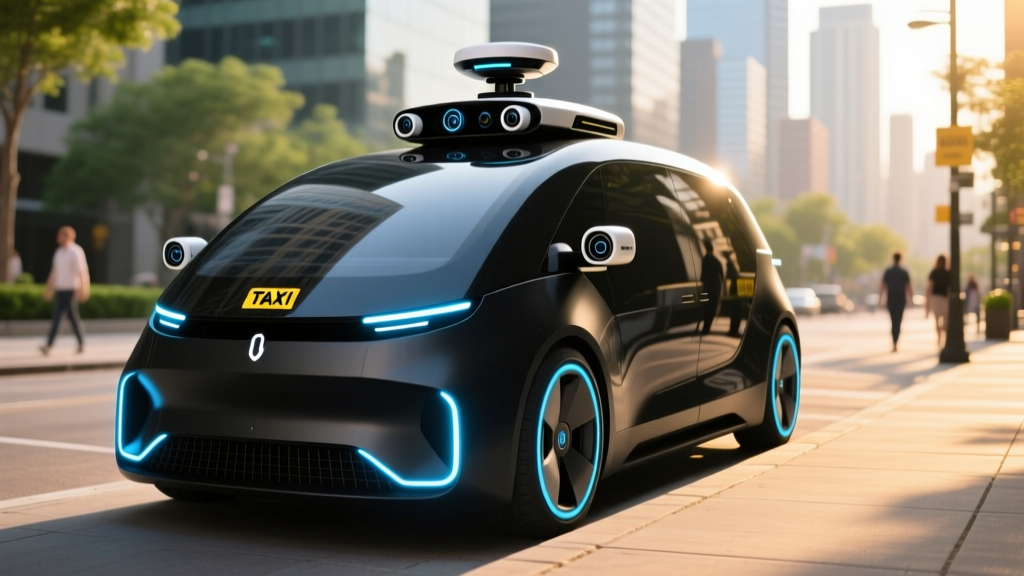
The Zoox vehicle is the most visually distinctive robotaxi on the road — a symmetrical, carriage-style pod with no front or rear, no hood, and no trunk. This isn't a modified consumer vehicle with bolted-on sensors; it was designed from scratch as an autonomous passenger shuttle, and that architectural decision affects everything from sensor placement to rider experience.
| Technology Component | Zoox Specification | Notes |
|---|---|---|
| Primary perception | Lidar (multiple units, 360° coverage) | Not camera-only like Tesla FSD |
| Cameras | Multi-spectrum camera array (visible + IR) | Redundant perception layer |
| Radar | Multiple radar units | Effective in rain/fog where lidar degrades |
| Compute | Custom high-performance onboard computer | Processes sensor fusion in real time |
| Connectivity | Cellular (redundant carriers) + remote assistance | Can escalate to human remote operator |
| Vehicle platform | Purpose-built, bidirectional (no front/back) | Seats 4 passengers face-to-face |
| Top speed | ~75 mph (limited) | Designed for urban, not highway |
| Battery / powertrain | Full electric, estimated ~75–100 kWh pack | Exact kWh not publicly disclosed |
The sensor suite is a lidar-camera-radar fusion approach — a deliberate contrast to Tesla's camera-only FSD system. Lidar provides precise depth mapping regardless of lighting conditions, which is critical for detecting pedestrians, cyclists, and obstacles at night or in high-contrast scenarios (e.g., exiting a tunnel into bright sunlight). Radar adds robustness in precipitation where lidar scattering can reduce range. The redundancy across three sensor modalities is a design philosophy shared with Waymo and Cruise, reflecting the industry consensus (outside Tesla) that camera-only perception introduces unnecessary risk for Level 4 operations where no human backup exists.
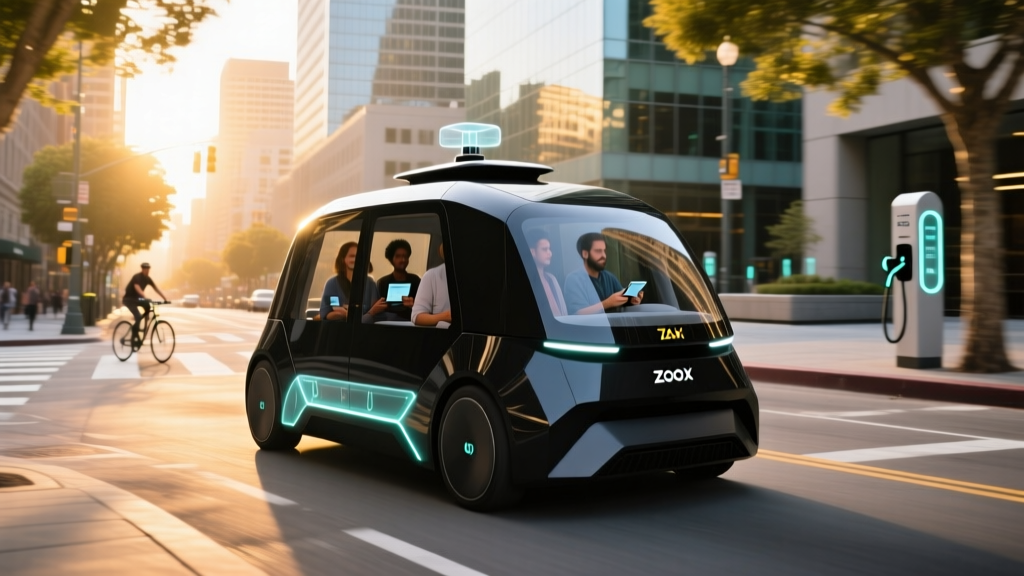
The vehicle's bidirectional design means it can travel forward or backward with equal capability — useful for dead-end streets, narrow alleys, and situations where a three-point turn would be impractical. Inside, four passengers sit face-to-face on bench-style seats, with no steering wheel, pedals, or driver controls of any kind. Climate control, music, and ride information are managed through screens mounted on the interior walls.
The Regulatory Landscape: Who Permits Zoox to Operate?
Robotaxi operations in the United States are governed by a patchwork of state and local regulations, not a unified federal framework. In California, three agencies play distinct roles in permitting Zoox and other operators:
- California DMV: Issues autonomous vehicle testing permits and requires annual disengagement reports. Zoox holds an active testing permit with a driverless option, allowing it to operate without a human safety operator in the vehicle.
- California Public Utilities Commission (CPUC): Regulates passenger-carrying commercial services. Zoox operates under the CPUC's autonomous vehicle pilot program, which allows limited commercial or pre-commercial passenger service under specific conditions.
- San Francisco Municipal Transportation Agency (SFMTA): Manages local street operations, parking, and traffic flow. SFMTA has been an active stakeholder in robotaxi oversight, particularly after the Cruise incident prompted the city to impose operational restrictions that affected all operators.
At the federal level, NHTSA oversees vehicle safety standards. Zoox's purpose-built vehicle required exemptions from certain Federal Motor Vehicle Safety Standards (FMVSS) that assume a human driver — for example, requirements for steering wheels, mirrors, and manual brake controls. NHTSA granted Zoox specific exemptions to allow its driverless vehicle design, a regulatory milestone that differentiates Zoox from operators using modified production vehicles.
In Nevada, the Department of Motor Vehicles and the state legislature have established a separate permitting framework under which Zoox operates its Las Vegas service. Nevada's regulatory environment has generally been more permissive for autonomous vehicle testing and deployment than California's post-Cruise environment.
Current Limitations: What Zoox Cannot Do
For all its technological sophistication, the Zoox robotaxi has hard operational constraints that define where, when, and how it can serve you. Understanding these limitations prevents frustration and sets realistic expectations.
- Geofence boundaries: The vehicle will not travel outside its mapped operational zone. If your destination falls outside the geofence, the app will not allow you to request the ride. The zone covers central/eastern SF but not the full city.
- No highway driving: Zoox is designed for urban surface streets. It does not merge onto freeways or operate at sustained speeds above ~45 mph in practice.
- Weather restrictions: Heavy rain, fog, or unusual weather conditions may trigger service suspension. Lidar performance degrades in heavy precipitation, and Zoox takes a conservative approach to weather-related operational pauses.
- Limited operating hours: The rider program does not operate 24/7. Service hours are defined by Zoox and may not cover late-night or very early-morning trips.
- Accessibility constraints: While the vehicle is designed with a low floor for easier entry, it may not accommodate all wheelchair configurations or mobility devices. Zoox has stated commitment to ADA compliance, but the current vehicle form factor has physical limitations.
- No stops en route: You cannot add intermediate stops (e.g., pick up a friend, stop at a store). The ride goes from origin to destination within the geofence.
- Wait times: With a limited fleet, wait times can be 10–20+ minutes during peak demand — significantly longer than Uber/Lyft in dense urban areas.
- Edge-case delays: Construction zones, double-parked delivery trucks, and unmapped road changes can cause the vehicle to stop and request remote assistance, adding minutes to your trip.
The weather limitation deserves specific attention. San Francisco's microclimate — including dense fog (Karl the Fog, as locals call it) and sudden downpours — can challenge lidar-based perception systems. When Zoox determines that sensor confidence has dropped below its safety threshold, it will either delay the ride, reroute, or in some cases pull over safely and end the trip. This conservative behavior is a safety feature, not a bug, but it does mean reliability is weather-dependent in a way that human-driven rideshare is not.
Zoox vs. Waymo: Which Robotaxi Should You Actually Use?
If you're in San Francisco and have access to both services, the practical differences are meaningful:
| Factor | Zoox | Waymo One |
|---|---|---|
| Access | Invite-only waitlist | Open to public via app |
| Cost (2026) | Free (rider program) | Market-rate pricing (~$12–$18 for 5 mi) |
| Geofence size (SF) | Central/east SF, smaller zone | Larger zone, covers most of SF |
| Vehicle | Purpose-built carriage (no driver controls) | Modified Jaguar I-PACE / Zeekr (retrofit) |
| Wait times | Often longer (smaller fleet) | Typically 3–8 min in core zones |
| Highway capability | No | Limited (some highway segments in Phoenix) |
| Rider experience | Face-to-face seating, no front/back | Traditional car seating, front-facing |
For daily transportation needs, Waymo One is the more practical option today — it's open, widely available, and reasonably priced. Zoox's rider program is better understood as an early-access experience: you're participating in the development of a new vehicle platform, getting free rides in exchange for your patience with a smaller geofence and longer wait times. If you value the novelty of riding in a truly purpose-built autonomous vehicle and don't mind the limitations, the Zoox waitlist is worth joining.
Frequently Asked Questions
Is Zoox available in San Francisco right now?
Yes. Zoox operates its driverless robotaxi in a geofenced area covering central and eastern San Francisco, including SoMa, the Financial District, Mission Bay, and parts of the Embarcadero and Mission. Access is through an invite-only rider program — you must apply and be accepted before you can request rides.
How much does a Zoox ride cost compared to Uber or Lyft?
Currently, Zoox rides are free for accepted riders in the early rider program. When commercial pricing launches, it is expected to be competitive with or slightly below Waymo One, which charges roughly $12–$18 for a typical 5-mile San Francisco trip. UberX and Lyft charge $13–$22 for comparable trips in the city.
Is Zoox truly self-driving, or is there a human driver?
Zoox is SAE Level 4 — fully driverless within its operational design domain. There is no human driver in the vehicle, no steering wheel, and no pedals. The vehicle handles all driving tasks autonomously, with remote assistance available for edge cases. This is fundamentally different from Level 2 systems like Tesla Autopilot or GM Super Cruise, which require an attentive human driver.
How safe is Zoox compared to human drivers?
Zoox has not reported any fatal or serious-injury incidents as of early 2026 across its operational history in California and Nevada. However, its fleet has accumulated fewer autonomous miles than Waymo, making definitive statistical comparisons to human driver fatality rates (1.35 per 100 million miles nationally) premature. The safety record is encouraging but still building its data foundation. Review NHTSA's Standing General Order reports for the latest incident data.
What happens if the Zoox vehicle encounters a situation it can't handle?
The vehicle will come to a safe stop and can escalate to a remote assistance operator — a trained human who can assess the situation and provide guidance or a path forward. This is a standard practice across Level 4 operators and is designed to handle edge cases like unusual construction zones, fallen trees, or ambiguous traffic-control scenarios.
Can I use Zoox for airport trips from SFO or OAK?
As of 2026, Zoox does not serve San Francisco International Airport (SFO) or Oakland International Airport (OAK). The geofence does not extend to airport areas, and the vehicle does not operate on highways. Use Waymo One, Uber, or Lyft for airport trips.
When will Zoox be open to the general public without a waitlist?
Zoox has not announced a specific date for open commercial launch. Amazon, which acquired Zoox in 2020 for approximately $1.2 billion, has signaled patience with the development timeline. Industry expectations point to a phased commercial rollout potentially beginning in late 2026 or 2027, but this is speculative and subject to regulatory approval, fleet scaling, and safety performance. Any announced dates should be treated as targets, not guarantees.