Zoox, the Amazon-backed autonomous vehicle company, has been methodically expanding its purpose-built robotaxi beyond its initial launch markets. For Atlanta residents and visitors tracking the keyword zoox atlanta, the question is practical: can you actually hail one today, how does it compare to a standard rideshare, and what are the real limitations on the ground? This guide breaks down Zoox's Atlanta footprint with concrete data on service area, technology, safety record, and pricing — separating live operations from announced plans.
Is Zoox Truly Self-Driving? Understanding SAE Level 4
Before evaluating any robotaxi service, it is critical to distinguish between consumer driver-assist systems and true driverless operations. Zoox operates at SAE Level 4 — high automation — within its defined operational design domain (ODD). This is fundamentally different from the Level 2 systems found in consumer vehicles.
SAE Automation Levels: Where Zoox Sits
| Level | Name | Driver Required? | Example |
|---|---|---|---|
| Level 0 | No Automation | Full-time | Conventional vehicles |
| Level 1 | Driver Assistance | Full-time | Adaptive cruise control |
| Level 2 | Partial Automation | Full-time, hands on/near wheel | Tesla Autopilot, GM Super Cruise, Ford BlueCruise |
| Level 3 | Conditional Automation | Situational (must take over on request) | Mercedes Drive Pilot (limited markets) |
| Level 4 | High Automation | No driver needed within ODD | Zoox, Waymo One (geofenced areas) |
| Level 5 | Full Automation | No driver needed anywhere | Does not exist commercially |
Source: SAE International J3016
The distinction matters enormously. When you ride in a Zoox vehicle, there is no human behind the wheel, no steering wheel, and no pedals. The vehicle handles all driving tasks within its approved geofenced zone. If the system encounters a scenario it cannot handle, it executes a minimal risk condition — typically pulling over safely — rather than handing control to a passenger.
This is categorically different from Tesla's FSD (Supervised), which despite its name remains a Level 2 system requiring continuous driver engagement and oversight. Zoox does not sell vehicles to consumers; it operates a mobility-as-a-service fleet.
Where Can You Use Zoox in Atlanta Right Now?
Zoox's expansion strategy has prioritized controlled, phased rollouts over rapid geographic sprawl. The company initially launched its commercial robotaxi service in Las Vegas and the San Francisco Bay Area (including Foster City and parts of the Peninsula), with Atlanta named as a key expansion market.
Zoox Service Availability by Market (2026)
| Market | Status | Service Area | Notes |
|---|---|---|---|
| Las Vegas, NV | Live — Commercial | Las Vegas Strip corridor, downtown, select suburban zones | Primary market; longest operational history |
| San Francisco Bay Area, CA | Live — Commercial | Foster City, portions of SF, expanding Peninsula coverage | Initial testing and launch market |
| Atlanta, GA | Testing / Phased Rollout | Select geofenced zones (see below) | Public availability expanding through 2026; check Zoox app for live zones |
| Other U.S. cities | Announced / Future | TBD | Zoox has signaled multi-city expansion but has not confirmed additional live markets |
For Atlanta specifically, Zoox has conducted mapping, testing, and limited ride programs in designated areas. The company typically begins with employee-only and invited-rider phases before opening service to the general public through its app. Atlanta's relatively flat terrain, wide road infrastructure, and favorable regulatory environment at the state level have made it an attractive expansion target.
How to check live availability: Download the Zoox app (available on iOS and Android), create an account, and enter your pickup location. The app will confirm whether your origin and destination fall within the active geofence. Service areas are updated as Zoox receives additional regulatory approvals and completes mapping of new corridors.
The Zoox Vehicle and Technology Stack
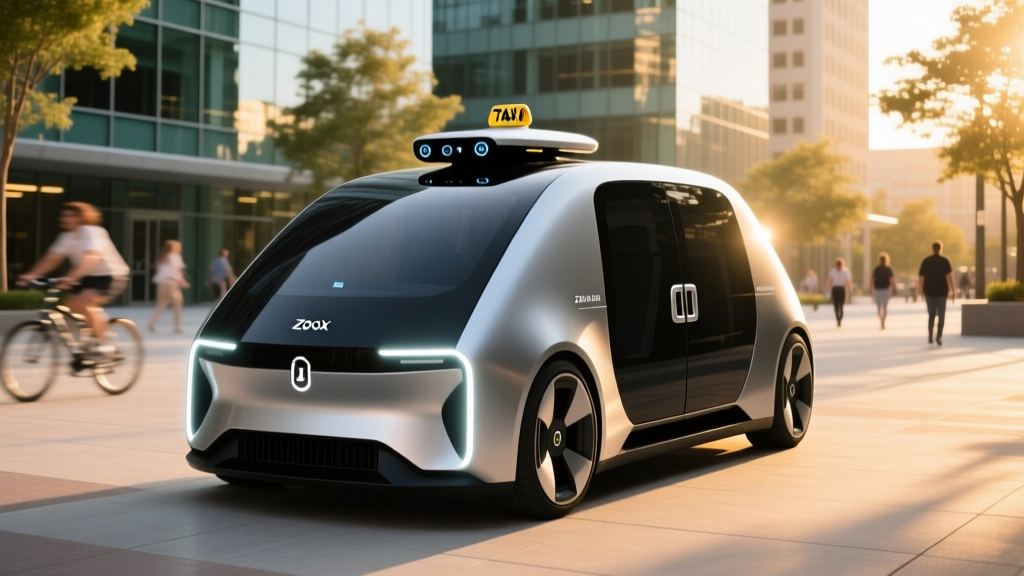
Zoox's robotaxi is not a retrofitted consumer car — it is a purpose-built, bidirectional vehicle designed from the ground up for autonomous mobility. This gives it a distinct hardware and software profile compared to competitors who adapt existing vehicle platforms.
Zoox Sensor and Compute Architecture
| Component | Specification | Purpose |
|---|---|---|
| LiDAR | Multiple solid-state and spinning units, 360° coverage | High-resolution 3D point cloud for object detection, distance measurement, and mapping; operates in darkness and most weather |
| Cameras | Multi-spectral array (visible + IR), redundant fields of view | Traffic signal recognition, lane marking detection, sign reading, pedestrian intent classification |
| Radar | Long-range and short-range units | Velocity measurement of moving objects, performance in rain/fog where LiDAR can degrade |
| Compute | Custom high-performance AI inference platform, redundant systems | Real-time sensor fusion, path planning, prediction of other road users' behavior |
| Vehicle Design | Bidirectional (no designated front/rear), no steering wheel or pedals, 4 passengers face each other | Eliminates need for three-point turns; maximizes interior space; purpose-built for Level 4 |
| Battery | High-capacity pack supporting all-day operation with opportunity charging | Enables extended service hours without mid-shift depot returns |
Zoox uses a LiDAR-first sensor fusion approach, which contrasts with Tesla's camera-only strategy for its FSD system. The redundancy across LiDAR, cameras, and radar means the vehicle can cross-validate detections — if one sensor modality is compromised (e.g., camera washout from sun glare), the others maintain environmental awareness.
The vehicle is fully bidirectional: it can drive equally well in either direction, which eliminates complex maneuvers like three-point turns in narrow urban streets. All four passengers sit facing each other in a carriage-style configuration, with no driver's seat, steering wheel, or pedals anywhere in the cabin.
Pricing: Zoox vs. Uber and Lyft in Atlanta
Robotaxi economics are still evolving. Zoox has generally offered free or heavily subsidized rides during its initial market expansion phases to build ridership data and public familiarity. This is a deliberate strategy shared by Waymo in its early market entries.
Estimated Ride Cost Comparison — Atlanta (2026)
| Service | Base Fare | Per-Mile Rate | Per-Minute Rate | Typical 5-Mile Ride | Surge Pricing? |
|---|---|---|---|---|---|
| Zoox (current promotional period) | $0–$2.50 | $0.00–$0.75 | $0.00–$0.15 | $0–$8 (often free during expansion) | No |
| UberX (Atlanta avg.) | $2.50 | $1.10–$1.40 | $0.18–$0.25 | $12–$18 | Yes (1.2x–3x+ common) |
| Lyft Standard (Atlanta avg.) | $2.50 | $1.05–$1.35 | $0.17–$0.24 | $11–$17 | Yes (Prime Time pricing) |
| Waymo One (where available) | $2.00–$3.50 | $1.00–$1.30 | $0.15–$0.22 | $10–$16 | Rare; limited surge |
Rideshare pricing varies by time of day, demand, and route. Zoox promotional pricing is expected to normalize as service matures. Check the Zoox app for real-time fare estimates.
Key pricing takeaways:
- During Zoox's Atlanta expansion phase, rides are typically free or nominal — a significant cost advantage over Uber/Lyft.
- Zoox does not implement surge pricing, which means fares remain predictable even during peak demand periods like concerts, sports events, or rush hour.
- Long-term, as Zoox scales and moves past its promotional period, industry analysts expect robotaxi pricing to converge near or slightly below traditional rideshare rates — the value proposition being consistent pricing without surge multipliers and no human driver tip expectation.
Safety Record: What the Data Shows
Safety is the single most scrutinized aspect of robotaxi operations. Zoox, like all Level 4 operators, is required to report disengagement data, collision reports, and operational metrics to state and federal regulators.
Zoox and Robotaxi Safety: Key Data Points
- Zoox operational miles: Zoox has accumulated millions of autonomous miles across its test and commercial fleets in Las Vegas, the Bay Area, and expansion markets. The company reports its disengagement and incident data to the National Highway Traffic Safety Administration (NHTSA) as required.
- Disengagement rates: In California DMV disengagement reports (the most transparent public dataset for autonomous vehicle performance), leading robotaxi operators have demonstrated disengagement rates on the order of one human intervention per 5,000–30,000+ autonomous miles, with improvement year-over-year. Zoox's specific figures are reported in its annual filings.
- Collision context: Robotaxi collisions that have been publicly reported across the industry are predominantly low-speed, rear-end incidents where the robotaxi was stopped or slowing and was struck by a human-driven vehicle — consistent with NHTSA data showing rear-end collisions as the most common crash type in urban driving.
- NHTSA Standing General Order: Since June 2022, NHTSA has required all ADS-equipped vehicle operators to report crashes within one day. This Standing General Order provides the most comprehensive public crash dataset for autonomous vehicles.
- No occupant injuries reported in Zoox commercial operations as of the most recent public disclosures, though the company's commercial fleet size and total ride count remain smaller than Waymo's.
Source: NHTSA Standing General Order, California DMV Autonomous Vehicle Disengagement Reports
It is important to contextualize these numbers. Human drivers in the U.S. experience approximately 1.5–2.0 police-reported crashes per million vehicle miles (IIHS/NHTSA data). Robotaxi operators aim to demonstrate meaningfully lower rates, though direct comparison is complicated by the fact that robotaxis currently operate in geofenced, mapped, and generally lower-complexity environments — not on rural highways or unmapped roads.
Regulatory Landscape: Who Approves Robotaxi Operations?
Robotaxi deployment in the United States involves a layered regulatory framework spanning federal, state, and local authorities.
Federal Level
NHTSA sets Federal Motor Vehicle Safety Standards (FMVSS) that all vehicles must meet. Zoox received a notable exemption from NHTSA allowing its purpose-built vehicle — which lacks a steering wheel, mirrors, and other traditional controls — to operate on public roads. This FMVSS exemption was a critical regulatory milestone, as the vehicle's design does not conform to several standards written with human-driven cars in mind.
State Level — Georgia
Georgia has been relatively permissive toward autonomous vehicle testing and deployment. State law permits the operation of fully autonomous vehicles (no human driver required) provided the vehicle is properly registered, insured, and compliant with applicable traffic laws. The Georgia Department of Public Safety and the state legislature have established frameworks that do not require a human safety operator in Level 4 vehicles — a key enabler for Zoox's Atlanta operations.
Local Level — Atlanta
The City of Atlanta and its Department of Transportation coordinate with robotaxi operators on geofencing boundaries, curb management, pickup/dropoff zones, and integration with the city's transportation network. Local approval often governs the pace of geographic expansion within a metro area.
Current Limitations: What Zoox Cannot Do Yet
Level 4 autonomy is powerful but bounded. Zoox's operational design domain (ODD) defines the specific conditions under which the vehicle can operate without a human driver. Outside that ODD, the vehicle will not operate.
Zoox Robotaxi Limitations — Atlanta and All Markets
- Geofencing: Zoox vehicles operate only within pre-mapped, approved zones. If your trip origin or destination falls outside the geofence, the app will not allow the booking. In Atlanta, this means coverage is limited to specific neighborhoods and corridors — not the entire metro area.
- Weather restrictions: Heavy rain, fog, ice, or snow can degrade LiDAR and camera performance. Zoox may suspend service or restrict operations during severe weather events. Atlanta's occasional ice storms and heavy thunderstorms can trigger service pauses.
- Construction zones: Major road construction with lane shifts, temporary barriers, or flaggers can exceed the system's ODD. Zoox vehicles may reroute or decline trips through active construction areas until updated mapping is deployed.
- Highway driving: Most robotaxi services, including Zoox, are optimized for urban and suburban surface streets. Highway operation at 65–75 mph involves different risk profiles and sensor requirements. Zoox has demonstrated highway-capable speeds, but commercial service focuses on lower-speed urban corridors.
- No intercity trips: You cannot use Zoox to travel from Atlanta to, for example, Athens or Macon. The service is designed for point-to-point trips within the geofenced metro zone.
- Limited cargo and accessibility: The purpose-built vehicle seats four passengers with limited trunk space. Large items like luggage for airport trips, bicycles, or mobility devices beyond standard wheelchair accommodation may not fit.
- No food delivery or freight: Unlike some Waymo partnerships, Zoox's current service model is passenger-only.
- Wait times: Fleet density in expansion markets like Atlanta is lower than in mature markets. Expect longer wait times (potentially 10–20+ minutes) compared to Uber/Lyft, especially during early rollout phases.
How to Ride: Practical Steps for Atlanta Users
- Download the Zoox app from the Apple App Store or Google Play Store.
- Create an account with your phone number, payment method, and basic profile information.
- Enter your pickup and dropoff locations. The app will confirm whether both points fall within the active Atlanta geofence.
- Request a ride. The app provides an estimated wait time and fare (which may be $0 during promotional periods).
- Meet the vehicle at the designated pickup point. The Zoox vehicle will arrive at the curb. Verify the vehicle identity via the app (license plate or vehicle ID displayed on the exterior screen).
- Board and buckle. Open the door using the app or exterior handle, select your seat, and fasten your seatbelt. The ride begins automatically once all passengers are secured.
- In-ride experience: The cabin features screens showing the vehicle's perception of its surroundings (detected objects, planned route). You can communicate with Zoox's remote guidance team via an in-cabin button if needed — though this is for assistance, not driving control.
Frequently Asked Questions
Where can I use the Zoox robotaxi service right now in Atlanta?
Zoox is in a phased rollout in Atlanta with service available in select geofenced zones. The exact coverage area expands over time as mapping and regulatory approvals progress. Use the Zoox app to check real-time availability for your specific pickup and dropoff locations. Full metro-wide coverage is not yet available.
How much does a Zoox ride cost compared to Uber or Lyft?
During Zoox's Atlanta expansion phase, rides are typically free or nominally priced (under $5–$8 for typical urban trips). A comparable UberX or Lyft ride in Atlanta costs approximately $11–$18 for a 5-mile trip. Zoox does not use surge pricing. Long-term pricing after the promotional period is expected to be competitive with or slightly below traditional rideshare rates.
How safe are Zoox robotaxis? Is there real data?
Zoox reports safety data to NHTSA under the Standing General Order for crash reporting and to state regulators as required. Across the robotaxi industry, reported collisions have been predominantly low-speed incidents where the autonomous vehicle was struck by a human-driven car. Zoox has not reported occupant injuries in its commercial operations as of the latest public disclosures. For the most current data, refer to NHTSA's crash reporting database and California DMV disengagement reports.
What are the current limitations of Zoox in Atlanta?
Key limitations include geofenced service area (not all Atlanta neighborhoods are covered), weather-related service suspensions during heavy rain or ice, avoidance of active construction zones, no highway or intercity trips, limited cargo space, and potentially longer wait times during the early rollout phase due to smaller fleet size.
Is Zoox truly self-driving, or is it like Tesla Autopilot?
Zoox is a true SAE Level 4 driverless system — there is no human driver, no steering wheel, and no pedals. The vehicle handles all driving tasks within its operational domain. This is fundamentally different from Tesla Autopilot or FSD (Supervised), which are Level 2 driver-assist systems requiring the human driver to remain fully engaged and responsible for the vehicle at all times. Zoox is self-driving within its geofence; consumer ADAS systems are not.
Can I use Zoox for airport trips in Atlanta?
This depends on whether Hartsfield-Jackson Atlanta International Airport (ATL) falls within Zoox's active geofence and whether airport pickup/dropoff agreements are in place. During early rollout phases, airport service may not be available. Check the app for your specific route.
Does Zoox operate 24/7 in Atlanta?
Zoox's operational hours vary by market and expansion phase. In mature markets like Las Vegas, the company has offered extended-hour service. In Atlanta during initial rollout, service hours may be limited to daytime and evening hours. The app displays available service windows.
The Bottom Line for Atlanta Riders
Zoox's Atlanta robotaxi service represents one of the most anticipated Level 4 autonomous vehicle deployments in the Southeast. The purpose-built vehicle design, LiDAR-centric sensor fusion, and Amazon-backed resources position Zoox as a serious competitor to Waymo in the robotaxi space. For Atlanta riders, the current reality is a phased rollout with limited but expanding geofenced coverage, promotional or free pricing, and the genuine novelty of riding in a vehicle with no driver and no steering wheel.
The technology is real and operational — not a concept car or a future promise. But it is also bounded: geofencing, weather limitations, and fleet density mean Zoox complements rather than replaces Uber, Lyft, and MARTA for most Atlantans in 2026. As coverage expands and fleet size grows, the practical utility of the service will increase substantially. For now, downloading the app and checking your zone is the fastest way to determine whether you can experience Level 4 autonomy on your next trip across town.