If you have searched for zoox app las vegas hoping to hail a driverless ride down the Strip, you are not alone. Amazon-backed Zoox has been operating its purpose-built robotaxi in Las Vegas longer than in any other city, making it one of the most accessible Level 4 autonomous ride-hailing experiences available to the public in the United States. But availability does not mean universal coverage, and the Zoox service operates under strict geofencing, regulatory oversight, and technology constraints that every prospective rider should understand before tapping "Request Ride."
This guide breaks down exactly where Zoox operates in Las Vegas, what the ride experience costs, how the vehicle's sensor suite works, what the safety data actually shows, and where the hard limits of today's Level 4 autonomy still apply.
SAE Automation Level: Why Zoox Is Not the Same as Tesla FSD
Before downloading the app, it is critical to understand what Zoox actually is — and what it is not. Zoox vehicles operate at SAE Level 4 (High Automation) within their defined operational design domain (ODD). This means the vehicle handles all driving tasks — steering, braking, acceleration, lane changes, navigation — without any human driver behind the wheel. There is no steering wheel, no pedals, and no expectation that a passenger will intervene.
| Level | Name | Who Drives | Examples |
|---|---|---|---|
| Level 2 | Partial Automation | Human (must supervise at all times) | Tesla Autopilot/FSD Supervised, GM Super Cruise, Ford BlueCruise |
| Level 3 | Conditional Automation | System (human must take over on request) | Mercedes Drive Pilot (limited markets) |
| Level 4 | High Automation | System (no human driver needed in ODD) | Zoox, Waymo (in geofenced zones) |
| Level 5 | Full Automation | System (all conditions, all locations) | Does not exist commercially |
Consumer vehicles with Autopilot, FSD Supervised, BlueCruise, or Super Cruise are Level 2 — the driver must remain engaged and is legally responsible. Zoox and Waymo robotaxis are Level 4 — no driver, but only within approved geofenced areas under specific conditions.
This distinction matters because marketing language around "self-driving" gets applied loosely to Level 2 driver-assistance systems. Zoox is genuinely driverless within its service area. No one is sitting in the front seat ready to grab a wheel.
Where Can You Use the Zoox App in Las Vegas Right Now?
Zoox launched its Las Vegas operations in 2022 and has gradually expanded its geofenced service area. As of 2026, the Zoox robotaxi operates in a defined zone covering parts of the Las Vegas Strip corridor, downtown Las Vegas, and surrounding commercial districts. The service area is not the entire metropolitan region — it is a carefully mapped zone where Zoox has validated its autonomous driving system against local road geometry, traffic patterns, and infrastructure.
| City | Status | Service Area Notes |
|---|---|---|
| Las Vegas, NV | Active — Public Rides | Strip corridor, downtown, select commercial zones. Geofenced. App required. |
| Foster City / San Francisco Bay Area, CA | Active — Public Rides | Limited zones in Foster City and parts of San Francisco. Expanded gradually. |
| Other cities | Testing / Announced | Zoox has tested in additional markets, but public ride-hailing availability outside Las Vegas and the Bay Area remains limited as of 2026. |
Service areas expand over time. Always check the Zoox app for your current location's availability. Announced expansions are not live until rides are bookable in-app.
To use the service, you need the Zoox app (available on iOS and Android), a verified account, and you must be physically within the geofenced service area when you request a ride. If your pickup or dropoff falls outside the zone, the app will not let you complete the request.
How to Request a Ride and What It Costs vs. Uber and Lyft
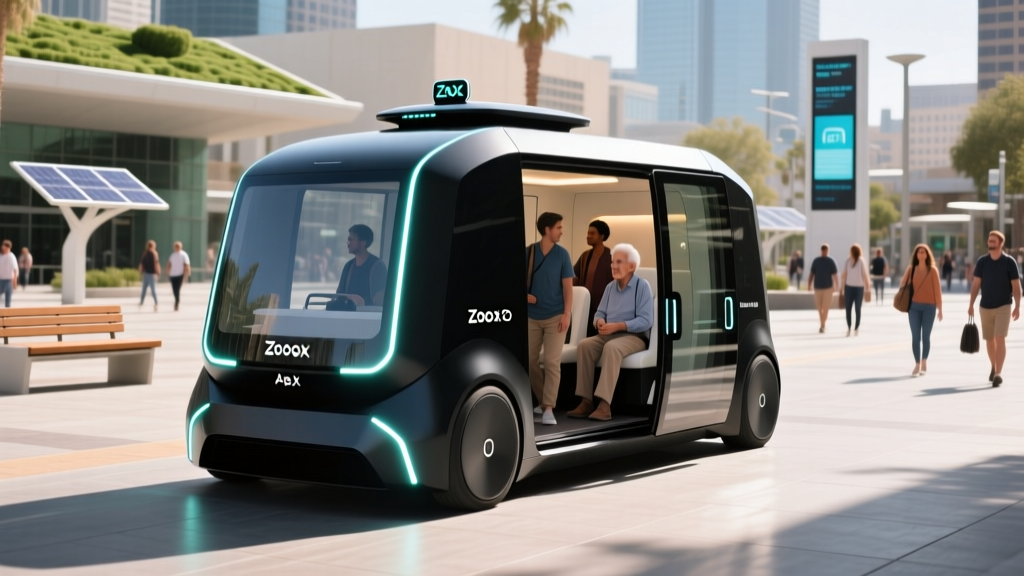
The Zoox app experience is intentionally similar to Uber or Lyft: set your pickup location, confirm your destination, and wait for the vehicle to arrive. The key difference is that no driver will be inside when the vehicle pulls up. The Zoox vehicle is a purpose-built, symmetrical carriage-style pod with facing bench seats — no front cabin, no steering wheel, no driver partition.
| Service | Base Fare (Typical) | Per-Mile Rate | Surge Pricing | Notes |
|---|---|---|---|---|
| Zoox | Often promotional / free during early access | Competitive with rideshare when priced | Limited — fleet size constrains supply | Pricing model evolving; promotional fares common in Las Vegas |
| UberX (Las Vegas) | ~$2.50–$3.50 | ~$1.10–$1.50/mi | Yes — frequent on Strip, weekends | Human driver, wide coverage area |
| Lyft (Las Vegas) | ~$2.00–$3.00 | ~$1.00–$1.40/mi | Yes — peak demand periods | Human driver, wide coverage area |
| Waymo One (where available) | ~$3.00–$5.00 | ~$1.25–$1.75/mi | Occasional | Level 4, Jaguar I-PACE based, larger fleet |
Rideshare pricing fluctuates by time, demand, and location. Zoox promotional pricing may change as the service scales. Waymo One is not currently available in Las Vegas as a public service.
During its expansion phases, Zoox has frequently offered rides at no cost or at heavily subsidized rates to build ridership data and public familiarity. When standard pricing is in effect, Zoox aims to be competitive with Uber and Lyft — the long-term business model depends on undercutting human-driven rideshare by eliminating the driver's share of each fare, which typically represents 60–75% of the cost.
The Zoox Vehicle: Technology Stack and Sensor Suite
Zoox does not retrofit existing production vehicles with aftermarket autonomy hardware the way Waymo equips Jaguar I-PACE SUVs or the way early Cruise vehicles were modified Chevrolet Bolts. Zoox designed its vehicle from the ground up as a robotaxi — a bidirectional, carriage-style pod with four-wheel steering and a battery-electric powertrain.
- LiDAR: Multiple solid-state and spinning LiDAR units providing 360-degree 3D point-cloud mapping. LiDAR gives precise depth perception independent of lighting conditions — a critical advantage over camera-only systems in low-light or high-glare scenarios.
- Cameras: A surround-camera array covering all directions for object classification, lane detection, traffic signal recognition, and semantic understanding of the driving environment.
- Radar: Multiple radar units for velocity detection of moving objects and performance in adverse weather where LiDAR and camera performance degrade.
- Compute: Onboard high-performance computing platform processing sensor fusion in real time, running Zoox's proprietary perception, prediction, and planning stack.
- HD Maps + Geofencing: The vehicle operates only within pre-mapped zones where every intersection, lane marking, speed limit, and construction zone has been cataloged. The geofence is a hard boundary — the vehicle will not operate outside it.
This multi-sensor approach (LiDAR + camera + radar) differs fundamentally from Tesla's camera-only FSD strategy. The redundancy allows the system to cross-validate detections — if one sensor type is degraded (e.g., camera washout from sun glare), others maintain perception capability.
The Zoox vehicle's battery-electric powertrain uses a pack sized for urban duty cycles rather than long-range highway driving. The vehicle is designed for stop-and-go city routes at moderate speeds, not interstate travel. Its bidirectional capability — it can drive equally well in either direction — simplifies maneuvers like U-turns and three-point turns in tight urban environments.
Safety Record: What the Data Actually Shows
Safety is the single most scrutinized aspect of robotaxi operations, and for good reason. Zoox, like Waymo and Cruise before it, is required to report disengagement data and collision incidents to state regulators in jurisdictions where it operates.
- Disengagement reports: California DMV requires annual disengagement reports from all autonomous vehicle testers. A disengagement occurs when a safety driver (in testing) or remote operator takes control. Lower disengagement rates per 1,000 miles generally indicate system maturity, but reporting methodologies vary between companies, making direct comparisons unreliable.
- Cruise suspension precedent (2023–2024): California DMV suspended Cruise's deployment permit in October 2023 following a serious pedestrian incident in San Francisco. This demonstrated that regulators will act decisively when safety concerns emerge. Cruise subsequently restructured operations and resumed limited testing with safety drivers before gradual redeployment.
- Zoox incident record: As a smaller fleet operator with more constrained geofencing, Zoox has had fewer reported incidents than Waymo or Cruise. The NHTSA Standing General Order requires all ADS-equipped vehicles to report crashes. Zoox has complied with reporting requirements.
- Waymo comparison data: Waymo published analysis in 2024 claiming its Level 4 fleet had a lower injury-causing crash rate than human benchmarks in comparable urban environments, based on millions of driverless miles. Zoox has not published comparable fleet-wide safety statistics at the same scale, largely because its operational fleet and mileage totals are smaller.
No robotaxi fleet has achieved zero incidents. The meaningful metric is the rate per million autonomous miles compared to human drivers in equivalent environments. For current data, check NHTSA's automated vehicle resources and state DMV disengagement reports.
It is important to evaluate robotaxi safety with nuance. Urban driving at 25–40 mph in a geofenced, pre-mapped zone is a fundamentally different risk profile than highway driving at 75 mph in variable conditions. Zoox's constrained ODD reduces exposure to the most dangerous driving scenarios, which is a deliberate engineering choice, not a limitation to be ashamed of.
Regulatory Landscape: Who Approves Robotaxi Operations?
Robotaxi deployment in the United States involves a layered regulatory framework with no single federal authority granting blanket approval:
- NHTSA (federal): Sets vehicle safety standards (FMVSS) and investigates crashes via the Standing General Order. Zoox received an NHTSA exemption to deploy its purpose-built vehicle, which does not meet certain FMVSS requirements designed for human-driven vehicles (e.g., steering wheel, mirrors, manual controls). This exemption process is essential for vehicles that lack traditional driver interfaces.
- State DMVs and PUCs: In California, the DMV issues testing permits and the California Public Utilities Commission (CPUC) issues deployment permits for commercial passenger service. Nevada's regulatory framework is distinct — the Nevada DMV and state legislature created early autonomous vehicle testing frameworks, and Las Vegas has been comparatively welcoming to robotaxi operations.
- Local/municipal: City governments and local transportation authorities influence where robotaxis can operate through permitting, curb-access rules, and coordination with emergency services.
The patchwork nature of regulation means Zoox must negotiate approval in each jurisdiction separately. A permit to operate in Las Vegas does not transfer to Phoenix, Miami, or any other city. This is why expansion is slow and deliberate rather than rapid.
Current Limitations: What Zoox Cannot Do
Level 4 autonomy within a geofenced zone is an extraordinary engineering achievement, but it is not equivalent to a human driver's flexibility. Understanding the hard boundaries of the system is essential for setting realistic expectations:
| Limitation | Detail |
|---|---|
| Geofence boundary | The vehicle will not operate outside its pre-mapped zone. If your destination falls outside the boundary, you cannot book the ride. The zone covers select areas — not all of Las Vegas. |
| Weather constraints | Heavy rain, fog, or dust storms can degrade LiDAR and camera performance. While Las Vegas is mostly dry, monsoon-season storms can trigger service suspensions or route restrictions. |
| Speed and road type | Zoox vehicles are designed for urban surface streets. They do not operate on highways or freeways. Maximum operational speeds are well below interstate limits. |
| Construction zones | Unexpected road closures, lane shifts, or construction zones that differ from the HD map can cause the vehicle to stop and request remote assistance. Las Vegas's constant construction can trigger these edge cases. |
| Passenger capacity | The Zoox vehicle seats up to 4 passengers. It cannot accommodate large groups, excessive luggage, or wheelchair access in its current configuration. |
| No highway airport runs | Depending on the geofence boundary relative to Harry Reid International Airport, direct airport pickups may or may not be available. Check the app for current coverage. |
These limitations are not bugs — they are the boundaries of the operational design domain within which Zoox has validated its system to operate safely. Expanding the ODD requires additional testing, mapping, regulatory approval, and system validation for each new scenario.
Zoox App Las Vegas: Frequently Asked Questions
Is the Zoox ride truly self-driving, or is there a remote driver?
There is no driver inside the vehicle — no steering wheel, no pedals, no human controls. The vehicle operates autonomously at SAE Level 4 within its geofenced zone. Zoox does employ remote fleet monitors who can observe vehicle status and provide high-level guidance in unusual situations, but they do not "joystick" the vehicle in real time the way a remote driver would. The onboard AI handles all real-time driving decisions.
How much does a Zoox ride cost compared to Uber or Lyft?
Zoox has frequently offered promotional or free rides during its expansion phases. When standard pricing is active, fares are designed to be competitive with Uber and Lyft. The long-term economic model eliminates the driver's share of the fare (typically 60–75%), which theoretically allows lower per-mile pricing. Actual pricing varies — check the Zoox app for current rates in your area.
Can I use Zoox to get to the Las Vegas airport?
Airport access depends on whether Harry Reid International Airport falls within the current Zoox geofence and whether airport pickup/dropoff has been permitted by local authorities. Geofence boundaries change as Zoox expands, so check the app for real-time availability. If the airport is outside the zone, you will need to use a traditional rideshare or taxi for that leg.
How safe are Zoox robotaxis compared to human drivers?
Zoox operates within a constrained urban environment at moderate speeds, which inherently reduces risk exposure compared to highway driving. The fleet has had fewer publicly reported incidents than larger operators like Cruise or Waymo, partly because its fleet size and total autonomous mileage are smaller. NHTSA requires crash reporting from all ADS operators. For the latest safety data, consult NHTSA's automated vehicle safety page. No robotaxi operator has published data demonstrating zero incidents across all operating conditions.
What happens if the Zoox vehicle encounters a situation it cannot handle?
The vehicle is designed to execute a minimal risk condition (MRC) — typically pulling to the side of the road and stopping safely — when it encounters a scenario outside its capability. Remote fleet support can then assess the situation and either provide updated routing guidance or dispatch assistance. The vehicle will not attempt maneuvers it cannot confidently execute.
How do I download and set up the Zoox app?
The Zoox app is available on the Apple App Store and Google Play Store. You will need to create an account, verify your identity, and agree to the rider terms. Once set up, the app shows your current service area and allows you to request rides when you are physically within the geofenced zone. Wait times depend on fleet availability and demand.
Does Zoox operate in cities other than Las Vegas?
Zoox also operates in the San Francisco Bay Area (Foster City and parts of San Francisco). Expansion to additional cities has been announced or is in testing phases, but public ride-hailing availability outside Las Vegas and the Bay Area remains limited as of 2026. Always verify current service areas in the app rather than relying on announced expansion timelines.
Bottom Line: Is Zoox in Las Vegas Worth Trying?
If you are visiting Las Vegas and fall within the Zoox geofence, the experience is genuinely novel — a fully driverless, purpose-built electric vehicle navigating urban traffic with no human intervention. The technology is real, the SAE Level 4 classification is legitimate, and the safety engineering reflects years of validated testing in constrained environments.
But manage your expectations: the service area is limited, the vehicle does not go on highways, weather or construction can interrupt service, and pricing may shift as promotional phases end. Zoox is not a replacement for Uber or Lyft across all of Las Vegas — it is a glimpse of what urban autonomous mobility looks like within the boundaries of what is currently safe, legal, and technically achievable.
For the latest operational details, check the Zoox official site and download the app directly to see real-time service availability in your location.