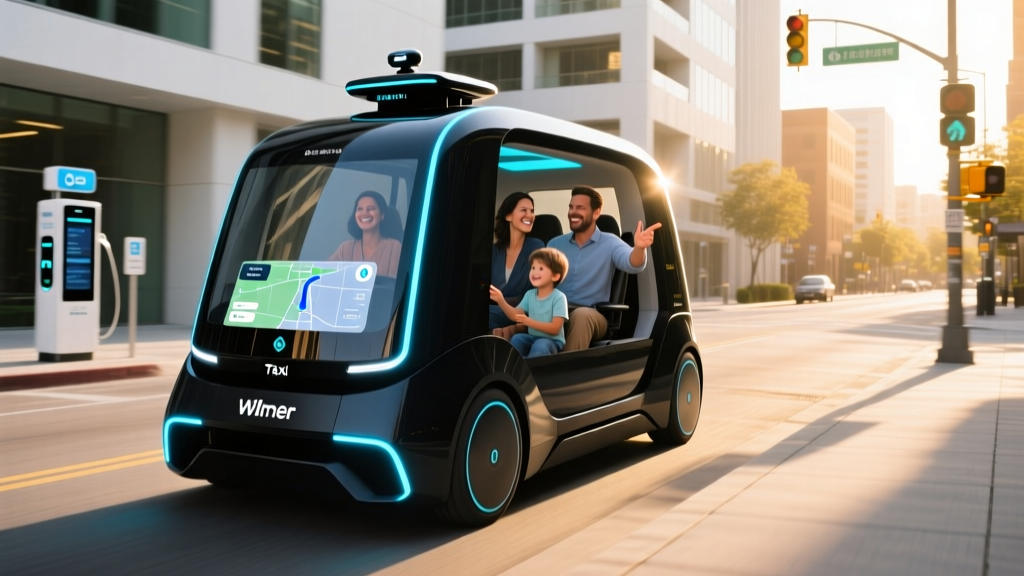
If you've searched for "Wilmer self driving robot" and landed here, you're likely trying to figure out whether this is a real robotaxi service, a consumer vehicle feature, or something else entirely. The short answer: as of early 2026, there is no widely recognized commercial robotaxi service or autonomous vehicle platform operating under the name "Wilmer."
However, the robotaxi space is expanding rapidly, and new pilots, regional services, and branded autonomous shuttles launch frequently. This guide breaks down exactly how Level 4 robotaxi services work in the U.S. right now — the technology, safety data, pricing, cities where you can hail one, and the limitations you should expect — so you can evaluate any robotaxi offering, including emerging brands you may encounter.
Is This Truly Self-Driving or Just Driver-Assist?
The single most important distinction in autonomous vehicles is the gap between consumer driver-assist systems and true robotaxi services. They are not the same product, and conflating them leads to dangerous misunderstandings.
| SAE Level | Who Drives | Examples |
|---|---|---|
| Level 0–1 | Human (with alerts or single-axis assist) | Cruise control, lane-departure warning |
| Level 2 | Human (must supervise at all times) | Tesla Autopilot/FSD Supervised, GM Super Cruise, Ford BlueCruise |
| Level 3 | System in limited conditions; human must take over on request | Mercedes Drive Pilot (limited markets, low speed) |
| Level 4 | System handles everything within its geofenced ODD — no human driver needed | Waymo One, Zoox, Cruise (paused), Motional pilots |
| Level 5 | System drives everywhere, all conditions | Does not exist commercially |
Consumer EVs with Autopilot, FSD Supervised, or BlueCruise are Level 2. The human driver is legally and operationally responsible. Robotaxi services like Waymo One operate at Level 4 within defined geofenced areas — there is no human driver, and the company assumes operational responsibility.
If a service or product marketed as a "self-driving robot" is actually a Level 2 driver-assist system, it is not a robotaxi. Always verify the SAE level before trusting any autonomy claim.
Where Can I Use a Robotaxi Service Right Now?
As of 2026, fully driverless Level 4 robotaxi services in the United States are concentrated in a handful of cities. Availability is tightly controlled by geofencing — the vehicle will only operate within a pre-mapped zone, and it cannot deviate outside that boundary.
| Service | Live Cities (2026) | Status | Access |
|---|---|---|---|
| Waymo One | Phoenix (metro), San Francisco, Los Angeles, Austin | Fully driverless, commercial | Open to public via Waymo app |
| Zoox | Las Vegas (limited zone), Foster City, CA (testing) | Driverless, limited commercial pilot | Invite-only / employee programs |
| Cruise | No live commercial service | Suspended after Oct 2023 incident; slow phased re-entry with safety drivers in Phoenix, Dallas, Houston | Not available to public as driverless |
| Motional | Las Vegas (via Uber/Lyft partnerships) | Driverless pilot, limited hours | Available through Uber/Lyft in designated zones |
If you're outside these metros, you cannot currently hail a Level 4 robotaxi. Announced expansions (new cities, wider geofences) are frequently reported in the press but should not be treated as live service areas until rides are bookable through the official app.
How Much Does a Robotaxi Cost vs. Uber or Lyft?
Robotaxi pricing is competitive with — and sometimes slightly below — comparable rideshare fares, but the economics depend heavily on time of day, distance, and market.
| Metric | Waymo One (Phoenix/SF) | UberX (Comparable) | Lyft Standard |
|---|---|---|---|
| Base fare | ~$5.00 | ~$3.50–$5.00 | ~$3.50–$5.00 |
| Per-mile rate | ~$1.25–$1.75 | ~$1.00–$1.50 | ~$1.00–$1.50 |
| Per-minute rate | ~$0.25–$0.40 | ~$0.20–$0.35 | ~$0.20–$0.35 |
| 5-mile trip (midday) | ~$12–$16 | ~$10–$15 | ~$10–$14 |
| Surge pricing | Rare (fleet-constrained, not demand-priced) | Common (1.5x–3x) | Common (1.5x–3x) |
| Tipping | Not expected (no driver) | Expected ($2–$5+) | Expected ($2–$5+) |
Key pricing insight: Robotaxi fares tend to be more predictable because there's no surge pricing mechanism and no tip expectation. A 5-mile Waymo ride in Phoenix at 2 p.m. on a Tuesday will cost roughly the same every time. The same UberX trip during a rainstorm or concert night could triple. Over a month of commuting, this predictability can make robotaxis cheaper even if the base per-mile rate is slightly higher.
How Safe Are Robotaxis? Real Data, Not Marketing
Safety is the most scrutinized — and most misunderstood — aspect of robotaxi operations. Here is what the data actually shows.
- Miles driven (driverless): Over 30 million fully autonomous miles as of late 2025, per Waymo's published safety reports.
- Injury-causing crash rate: Waymo's driverless fleet showed an injury-causing crash rate approximately 85% lower than the human benchmark in comparable urban environments, based on data shared with the NHTSA and published in peer-reviewed analysis.
- Contact rate: Police-contactable crashes occurred at roughly 57% lower rate than human drivers in the same operating domains.
- Context: Most robotaxi incidents at low speeds involve other human drivers rear-ending or side-swiping the robotaxi — not the robotaxi initiating the collision.
The Cruise suspension context: In October 2023, a Cruise robotaxi in San Francisco struck a pedestrian who had been thrown into its path by a human-driven vehicle, then dragged the pedestrian approximately 20 feet while pulling to the curb. The California DMV suspended Cruise's deployment permit, and the company paused all nationwide operations. Cruise has since been slowly re-entering markets with human safety drivers as of 2025–2026, but has not resumed fully driverless commercial service.
This incident illustrates a real limitation: robotaxis must handle adversarial edge cases — pedestrians in the roadway, erratic human drivers, emergency vehicles — and the standard for "safe enough" is still being defined by regulators and the public.
What Technology Powers a Level 4 Robotaxi?
Level 4 robotaxis rely on a dense, redundant sensor suite and high-definition pre-mapped routes. This is fundamentally different from the camera-centric approach used in consumer Level 2 systems like Tesla's Autopilot.
- LiDAR (Light Detection and Ranging): Multiple spinning or solid-state units providing 360° 3D point-cloud mapping at 10–20 Hz. Detects objects, pedestrians, and road geometry regardless of lighting. Primary sensors on Waymo's 5th-generation and 6th-generation hardware.
- Cameras: 8–20+ high-resolution cameras for lane detection, traffic signal recognition, construction-zone parsing, and redundancy.
- Radar: Forward and corner-mounted millimeter-wave or imaging radar for velocity detection of moving objects at distance, particularly in rain or fog where cameras degrade.
- HD Maps + Localization: Centimeter-accurate pre-built maps of every road in the geofence. The vehicle localizes itself within this map using LiDAR and GPS. This is why robotaxis cannot operate outside their mapped zone.
- Compute: Custom or NVIDIA-based onboard computers processing terabytes of sensor data per hour, running perception, prediction, and planning models simultaneously.
Camera-only vs. LiDAR debate: Tesla's consumer FSD system uses cameras exclusively (no LiDAR or radar). This is a deliberate engineering bet that neural networks can extract sufficient depth and velocity data from 2D images. Every commercial Level 4 robotaxi operator currently uses LiDAR as a primary sensor, arguing that redundancy is non-negotiable when there is no human fallback driver. The jury is still out on whether camera-only systems can eventually reach Level 4 reliability, but as of 2026, no camera-only system has achieved unsupervised commercial robotaxi deployment.
Who Regulates Robotaxis and How?
Robotaxi regulation in the U.S. is a patchwork of federal, state, and local oversight — and it's one of the most consequential factors determining where and how these services operate.
- NHTSA (National Highway Traffic Safety Administration): Sets federal vehicle safety standards (FMVSS). Currently, NHTSA has granted limited exemptions to companies like Zoox for vehicles without steering wheels or pedals. NHTSA also collects crash data through its Standing General Order, requiring automated driving system (ADS) operators to report crashes within 24 hours.
- State DMVs and PUCs: States like California (via the DMV and the California Public Utilities Commission, or CPUC) issue deployment permits. California's DMV can suspend permits — as it did with Cruise in 2023. Arizona takes a permissive approach with minimal state-level permitting. Texas falls in between.
- Local municipalities: Cities control street access, curb management, and emergency-response protocols. San Francisco's Board of Supervisors and the SFMTA have been vocal in pushing back on robotaxi expansion when incidents obstruct emergency vehicles or bus lanes.
There is no single federal "robotaxi license." Each operator must navigate state-by-state permitting, and a permit in Arizona does not transfer to California. This regulatory fragmentation is a primary reason robotaxi services expand slowly despite technical readiness.
Current Limitations of Robotaxi Services
- Operate outside the geofence: If your destination is beyond the mapped zone, the ride cannot be booked. There is no graceful degradation to human driving — the service simply won't dispatch.
- Handle severe weather: Heavy rain, snow, fog, and ice degrade LiDAR and camera performance. Waymo and others will suspend service or refuse rides in conditions beyond their validated operating domain.
- Navigate unmapped construction zones: While robotaxis can handle minor lane shifts, major unplanned roadwork can force the vehicle to stop, request remote assistance, or reroute — sometimes adding significant time.
- Pick up at arbitrary locations: Robotaxis use designated pickup/dropoff zones (often virtual stops on the app map). They cannot pull into private driveways, parking garages, or unmarked rural roads.
- Carry children unaccompanied: Most services require passengers to be 18+. Waymo's policy, for instance, restricts unaccompanied minors.
- Accept pets or excessive cargo: Policies vary, but service animals are generally accommodated while pets and oversized items may not be.
- Operate 24/7 in all markets: Some geofences have restricted operating hours, particularly in newer markets.
How to Use a Robotaxi: Step by Step
- Download the service app (e.g., Waymo One). Create an account with payment information.
- Enter your pickup and dropoff locations. The app will confirm whether both points fall within the active geofence.
- Walk to the designated pickup point. The app shows a pin — often a specific curb or corner. The vehicle will not enter private property or parking structures.
- Verify the vehicle using the license plate and car model shown in the app. Unlock via the app when the vehicle arrives.
- Buckle up and start the ride. There is no driver. An in-vehicle screen shows the route, and you can contact remote support at any time via a button or intercom.
- Exit at the dropoff point. Payment is automatic. No tip is expected.
The experience is remarkably close to a standard rideshare — the main difference is the empty driver's seat and the in-vehicle screen showing the vehicle's perception of the world (detected pedestrians, other cars, traffic signals) in real time.
Frequently Asked Questions
Is "Wilmer" a real robotaxi brand I can ride today?
As of early 2026, there is no verified commercial robotaxi service operating under the name "Wilmer" in the United States. If you encountered this name in a social media post, local pilot announcement, or shuttle program, it may refer to a small-scale test, a university project, or a branded shuttle that is not a Level 4 commercial service. Always verify the SAE autonomy level and the operating permit before assuming a service is driverless.
Can a robotaxi drive me anywhere in the city?
No. Robotaxis operate within strict geofences — pre-mapped zones typically covering dense urban cores and select suburbs. A Waymo in Phoenix, for example, covers a large portion of the East Valley but will not drive to Tucson or even to unmapped outskirts of metro Phoenix. Check the app for your specific coverage area.
What happens if a robotaxi gets confused or stuck?
When a Level 4 robotaxi encounters a scenario it cannot resolve (an unusual construction pattern, an obscured lane marking, a blocked route), it will typically come to a safe stop and contact a remote assistance operator. This human does not "drive" the car remotely but may confirm a path or authorize a maneuver. In rare cases, the vehicle may wait until the situation resolves or reroute. This can add 5–15 minutes to a trip.
Are robotaxis safer than human drivers?
Based on Waymo's published data covering over 30 million driverless miles, the injury-causing crash rate is approximately 85% lower than the human benchmark in comparable environments. However, this data reflects specific geofenced urban areas with favorable weather — not all driving conditions. The Cruise pedestrian incident in 2023 also demonstrates that edge-case failures, while rare, can have serious consequences. The data is promising but still limited in scope compared to the trillions of human-driven miles accumulated annually.
Will robotaxis replace Uber and Lyft?
Not in the near term. Robotaxi fleets are capital-intensive (each vehicle carries $100,000–$200,000+ in sensors and compute), geofence-limited, and weather-constrained. Uber and Lyft have massive driver networks that cover every city, rural road, and weather condition. The more likely outcome through 2028 is a hybrid model: robotaxis handle high-volume urban corridors, while human drivers cover everything else. Uber has already partnered with Waymo and Motional to integrate robotaxi rides into its app in select markets.
Sources: Waymo Safety Reports, NHTSA Automated Vehicle Safety, California DMV Autonomous Vehicle Program.