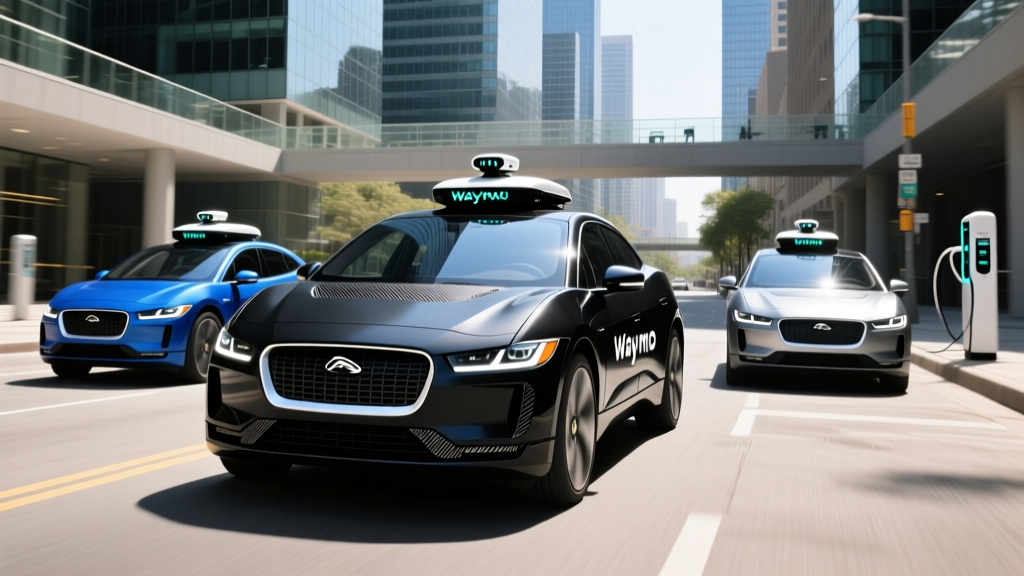
If you've hailed a Waymo One ride in Phoenix, San Francisco, or Los Angeles, you almost certainly climbed into the back of a Jaguar I-PACE. The pairing of a British luxury EV brand with Silicon Valley's most advanced robotaxi operator isn't random — it's the result of a purpose-built engineering partnership that dates back to 2018. Here's exactly why Waymo chose Jaguar, how the I-PACE platform supports Level 4 autonomy, and what it means for riders today.
Why Jaguar and Waymo Teamed Up
Waymo's autonomous driving stack — the hardware and software that replaces a human driver — requires specific vehicle capabilities that most production cars in the mid-2010s simply didn't offer. When Waymo began searching for an OEM partner to scale beyond its early Chrysler Pacifica minivan fleet, it needed:
- A fully electric powertrain — EVs provide the precise, low-latency drive-by-wire control that autonomous systems demand. Electric motors respond in milliseconds, compared to the slower throttle and transmission lag of internal combustion engines.
- Factory-integrated sensor mounting — Waymo needed a vehicle designed from the ground up to house its lidar, radar, and camera arrays, not a retrofit with bolted-on hardware.
- Redundant electrical architecture — Level 4 autonomy requires backup power and computing pathways so the vehicle can stop safely if a primary system fails.
- Scalable manufacturing — Waymo needed an OEM willing to produce thousands of purpose-built robotaxis, not just a few dozen prototypes.
Jaguar Land Rover (JLR) checked every box. In 2018, the two companies announced a partnership to co-develop a custom version of the Jaguar I-PACE specifically for Waymo's 5th-generation autonomous driving system. JLR invested in a dedicated production line at its facility in Graz, Austria (operated by Magna Steyr), where I-PACE vehicles are built with Waymo's sensor suite integrated during assembly rather than installed aftermarket.
By 2026, Waymo has deployed over 1,000 Jaguar I-PACE robotaxis across its commercial service areas, making it the largest Level 4 driverless fleet operating on public roads in the United States.
What SAE Automation Level Is Waymo?
This means the vehicle handles all driving tasks within its defined operational design domain (specific geofenced areas, approved weather conditions) with no human driver present. There is no steering wheel interaction required, no driver monitoring camera watching your eyes, and no request for you to take over. This is fundamentally different from Level 2 driver-assist systems like Tesla Autopilot, GM Super Cruise, or Ford BlueCruise, which require continuous driver supervision.
Waymo does not claim Level 5 (full automation everywhere in all conditions). Its vehicles are geofenced and will not operate outside mapped service areas or in severe weather conditions they haven't been validated for.
| SAE Level | Name | Driver Required? | Example |
|---|---|---|---|
| Level 2 | Partial Automation | Yes — full supervision | Tesla Autopilot, GM Super Cruise |
| Level 3 | Conditional Automation | Yes — must respond to takeover requests | Mercedes DRIVE PILOT (limited markets) |
| Level 4 | High Automation | No — within ODD | Waymo One, Zoox |
| Level 5 | Full Automation | No — anywhere, any condition | Does not exist commercially |
The Jaguar I-PACE: EV Specs That Matter for Robotaxis
The Jaguar I-PACE isn't just a luxury crossover repurposed for autonomy — its underlying EV architecture provides specific advantages for Waymo's computing and sensor demands.
| Specification | Jaguar I-PACE (Waymo Fleet) |
|---|---|
| Battery Capacity | 90 kWh (usable ~84 kWh), NMC chemistry |
| EPA Range (Stock) | 246 miles (stock I-PACE); ~180–210 miles effective with sensor power draw and stop-start robotaxi duty cycle |
| Powertrain | Dual-motor AWD, 394 hp, 512 lb-ft torque |
| 0–60 mph | 4.5 seconds (stock); Waymo drives conservatively |
| DC Fast Charging | Peak 100 kW, 10–80% in ~45 min (CCS1 connector) |
| Level 2 Charging | 11 kW onboard charger, ~9 hours 0–100% |
| Waymo Sensor Suite | 5th-gen: 5 lidar units, 6 cameras, 6 radar units, external audio sensors |
Two things stand out for robotaxi duty. First, the I-PACE's 90 kWh battery provides enough energy capacity to power both the vehicle's drivetrain and Waymo's compute-heavy sensor stack (which draws several hundred watts continuously) through a full shift. Second, the I-PACE's relatively flat floor and spacious cabin — a benefit of its dedicated EV platform — allows Waymo to package computing hardware without compromising passenger comfort.
The trade-off is charging speed. The I-PACE's peak 100 kW DC fast charging rate is modest by 2026 standards, where vehicles like the Hyundai Ioniq 5 and Porsche Taycan peak at 240–350 kW. For Waymo's fleet operations, this means longer downtime between shifts — a factor the company manages through depot-based charging and strategic shift scheduling rather than mid-day public fast charging.
Waymo's Autonomous Technology Stack
Waymo Driver (5th Generation)
Waymo's perception system fuses data from multiple sensor modalities — a fundamentally different approach from camera-only systems like Tesla's FSD.
- Lidar (5 units): Custom-built laser scanners providing high-resolution 3D point clouds. Roof-mounted unit delivers 360° coverage; additional units fill in close-range blind spots. Lidar works in darkness and is not fooled by shadows or glare, though performance can degrade in heavy rain or fog.
- Cameras (6 units): High-resolution image sensors for reading traffic lights, signs, lane markings, and detecting object color and text. Waymo uses a mix of narrow- and wide-field lenses.
- Radar (6 units): Millimeter-wave radar for measuring the speed and distance of other vehicles, particularly at highway speeds and in conditions where lidar scatters (rain, dust).
- External audio sensors: Microphones that detect sirens from emergency vehicles, enabling the car to pull over before the ambulance is in visual range.
- Compute: Custom-designed Waymo hardware running the "Waymo Driver" software stack, including perception, prediction, and planning modules that process sensor data in real time.
This sensor-redundant approach means the car can cross-validate what it sees. If fog scatters lidar returns, radar still tracks moving objects. If a camera is blinded by sun glare, lidar still maps the road geometry. This multi-modal redundancy is a key reason regulators have approved fully driverless operations.
Where Can You Ride a Waymo Jaguar Right Now?
As of early 2026, Waymo One — the company's commercial ride-hailing service — is available to the general public in several U.S. metropolitan areas. Service is geofenced, meaning rides must begin and end within Waymo's approved operating zones.
| City | Status | Coverage Area | Hours |
|---|---|---|---|
| Phoenix, AZ (East Valley) | Fully open — no waitlist | ~225 sq mi: Tempe, Scottsdale, Mesa, Chandler | 24/7 |
| San Francisco, CA | Fully open | Most of SF proper (excluding some steep hills and freeways) | 24/7 |
| Los Angeles, CA | Open — expanded zones | Santa Monica, Hollywood, Downtown LA, Beverly Hills, LAX airport | 24/7 |
| Austin, TX | Launched — expanding | Central Austin, Downtown, South Austin corridor | Limited hours initially |
| Mountain View, CA | Limited/testing | Select areas (employee/invite programs) | Varies |
Waymo has also announced planned expansion to additional cities, but those services are not yet live for public rides. Always check the Waymo One page for the latest service area maps.
How Much Does Waymo Cost vs. Uber and Lyft?
Waymo One uses the Waymo app (available on iOS and Android) to request rides, similar to Uber or Lyft. You enter your pickup and drop-off locations, receive an upfront price, and a driverless Jaguar I-PACE arrives.
| Scenario | Waymo One | UberX | Lyft Standard |
|---|---|---|---|
| 5-mile trip, midday, Phoenix | $10–$14 | $9–$13 | $9–$12 |
| 8-mile trip, evening, San Francisco | $18–$26 | $16–$24 | $15–$22 |
| LAX to Santa Monica (~14 mi) | $30–$42 | $28–$40 | $25–$38 |
| Surge pricing behavior | Moderate surge; no human-driver supply constraints | Can spike 2–4x during peak demand | Can spike 2–3x during peak demand |
Key pricing differences: Waymo's fares are generally competitive with Uber and Lyft for comparable distances, but Waymo doesn't experience the same extreme surge pricing because its fleet supply is algorithmically managed rather than dependent on gig workers deciding to log on. However, Waymo's fleet size is still limited — during peak hours, wait times can be 10–20 minutes versus 3–5 minutes for Uber/Lyft in well-served areas.
Waymo also offers Waymo One membership tiers and occasional promotional pricing, particularly for new users. Tipping is not expected (there's no driver), though the app does offer an option to leave a gratuity that goes toward Waymo's cleaning and support staff.
Waymo's Safety Record: What the Data Shows
Waymo Safety Data (as of early 2026)
- Total autonomous miles driven: Over 40 million fully driverless miles across all service areas (per Waymo's safety reports and California DMV disengagement filings).
- Injury-causing crash rate: Waymo's published analysis (peer-reviewed and submitted to NHTSA) found its vehicles were involved in injury-causing crashes at a rate approximately 85% lower than the human benchmark in comparable urban environments.
- Police-reported crash rate: Approximately 57% lower than the human benchmark for the same geographies.
- Contact rate: Waymo vehicles do make contact with objects occasionally — primarily low-speed incidents with other vehicles making errors (e.g., a car backing into a stationary Waymo). The vast majority cause no injury.
Note: Waymo publishes comparative safety data but exact methodology and benchmarks are subject to ongoing review by NHTSA and independent researchers. The company operates under California DMV and CPUC permits, as well as permits from the Arizona Department of Transportation.
For context, Waymo's vehicles have been involved in minor collisions — as any fleet operating millions of urban miles will be. The key distinction is severity: Waymo's sensor suite and conservative driving behavior (the cars obey speed limits, maintain large following distances, and stop for ambiguities a human might push through) mean most incidents are low-speed and non-injury.
Under NHTSA's Standing General Order, Waymo is required to report all crashes involving its Level 4 vehicles. These reports are publicly accessible and provide a transparency layer that doesn't exist for most human-driven rideshare trips.
Current Limitations of Waymo's Jaguar Fleet
What Waymo Cannot Do (Yet)
- Heavy rain and fog: Waymo vehicles will pull over or refuse to dispatch in conditions where lidar and camera performance degrades below safety thresholds. Phoenix's dry climate is ideal; San Francisco's fog can occasionally cause service interruptions.
- Unmapped areas: Waymo cannot drive outside its geofenced service zones. If you request a ride from a location outside the map, the app will not allow it. There is no "take me anywhere" capability.
- Freeways (limited): Waymo has been testing highway driving, but most commercial rides avoid freeways. Your 15-mile trip might take surface streets even when a freeway would be faster.
- Construction zones: While Waymo handles many construction scenarios, complex or newly changed lane configurations can cause the vehicle to stop and request remote guidance from Waymo's fleet response team.
- Emergency re-routing: If you need to change your destination mid-trip, options are limited compared to asking a human driver to "just pull over here."
- Accessibility: The I-PACE is a standard crossover — it cannot accommodate wheelchair users without a ramp-equipped vehicle. Waymo has acknowledged this gap and is testing accessible vehicle options.
- Vehicle choice: You get a Jaguar I-PACE. There is no option to request a larger vehicle, a minivan, or a different model. Zoox, by contrast, has designed a purpose-built carriage-style robotaxi, but its deployment scale remains smaller.
The Regulatory Landscape: Who Approves Waymo?
Operating a driverless commercial ride-hailing service in the U.S. requires navigating a patchwork of state and local regulations — there is no single federal "robotaxi license."
- California: Waymo holds permits from both the California DMV (for testing and deployment) and the California Public Utilities Commission (CPUC), which regulates commercial passenger service. The CPUC's "Driverless Pilot" program allows fare-charging robotaxi operations under specific safety and reporting requirements.
- Arizona: Arizona has taken a permissive regulatory approach since 2015, with executive orders enabling autonomous vehicle testing and commercial operation with minimal state-level restrictions. Waymo's Phoenix operations function primarily under standard business licensing and ADOT coordination.
- Texas: Texas passed autonomous vehicle legislation (HB 3026) requiring AV operators to maintain insurance, register with the state, and comply with traffic laws. Waymo's Austin expansion operates under this framework.
- Federal (NHTSA): NHTSA does not currently "approve" robotaxis for deployment but exercises oversight through the Standing General Order crash-reporting requirement and can issue recalls or investigations if safety defects are identified. NHTSA has investigated specific Waymo incidents but has not issued a blanket safety concern.
This state-by-state approach means Waymo's expansion timeline depends heavily on local regulatory willingness. Cities with supportive regulatory environments (Phoenix, Austin) have seen faster deployment than those with more complex approval processes.
Why Not Tesla, Rivian, or Another EV?
A common follow-up question: why didn't Waymo simply use a Tesla, a Ford Mustang Mach-E, or a cheaper EV platform? The answer comes down to the partnership model and engineering integration.
Tesla does not offer its vehicles for third-party autonomous system integration — Tesla's FSD (Supervised) is a Level 2 driver-assist system designed exclusively for Tesla's own camera-only stack. Waymo's lidar-dependent sensor suite requires physical mounting points, power distribution, and cooling that Tesla's production vehicles were not designed to accommodate.
Rivian and other startups lacked the manufacturing scale in 2018 when Waymo needed to commit to a production partner. The I-PACE, by contrast, was entering production at Magna Steyr's flexible facility in Graz, which could accommodate a custom robotaxi variant without disrupting Jaguar's consumer production.
Waymo has since expanded its hardware partnerships — it has announced integration with the Zeekr platform (a Geely-owned brand) for a next-generation, purpose-built robotaxi vehicle with a lower floor, sliding doors, and no front seats. But as of 2026, the Jaguar I-PACE remains the workhorse of the Waymo One fleet.
Frequently Asked Questions
Is Waymo truly self-driving, or is there a remote human driver?
Waymo One vehicles are genuinely driverless — there is no human behind the wheel, no remote joystick operator driving the car in real time. Waymo does employ a "fleet response" team that can provide high-level guidance (e.g., confirming it's safe to proceed past an unusual obstacle), but these remote operators do not steer, brake, or accelerate the vehicle. The car's AI makes all driving decisions.
Can I use Waymo if I'm visiting from out of town?
Yes. Waymo One is open to the general public in Phoenix, San Francisco, Los Angeles, and Austin. Download the Waymo app, create an account, and request a ride within the service area. No waitlist is required in most cities as of 2026.
How does Waymo handle emergencies or accidents?
If a Waymo vehicle is involved in a collision, it automatically contacts emergency services and Waymo's support team. The vehicle is designed to pull to a safe location if possible. Riders can also reach a live Waymo support agent at any time through the in-vehicle screen or app.
Why hasn't Waymo expanded to more cities faster?
Each new city requires extensive HD mapping, regulatory approval, fleet deployment, and validation driving before Waymo can remove the safety driver and open the service to the public. This process typically takes 12–24 months per metropolitan area. Waymo prioritizes safety validation over speed of expansion.
Will Waymo eventually use vehicles other than the Jaguar I-PACE?
Yes. Waymo has announced plans to integrate the Zeekr purpose-built robotaxi vehicle and has explored partnerships with other OEMs. The I-PACE is expected to remain in service for several more years, but future fleet vehicles will likely be designed from the ground up as robotaxis rather than adapted consumer EVs.
How does the I-PACE's range hold up under robotaxi duty?
While the stock I-PACE has an EPA-rated 246 miles of range, Waymo's sensor stack and computing hardware draw additional power, and the stop-and-go urban driving pattern typical of ride-hailing reduces efficiency. Real-world fleet range is estimated at 180–210 miles per charge, which is sufficient for a single shift before the vehicle returns to a depot for overnight Level 2 charging.