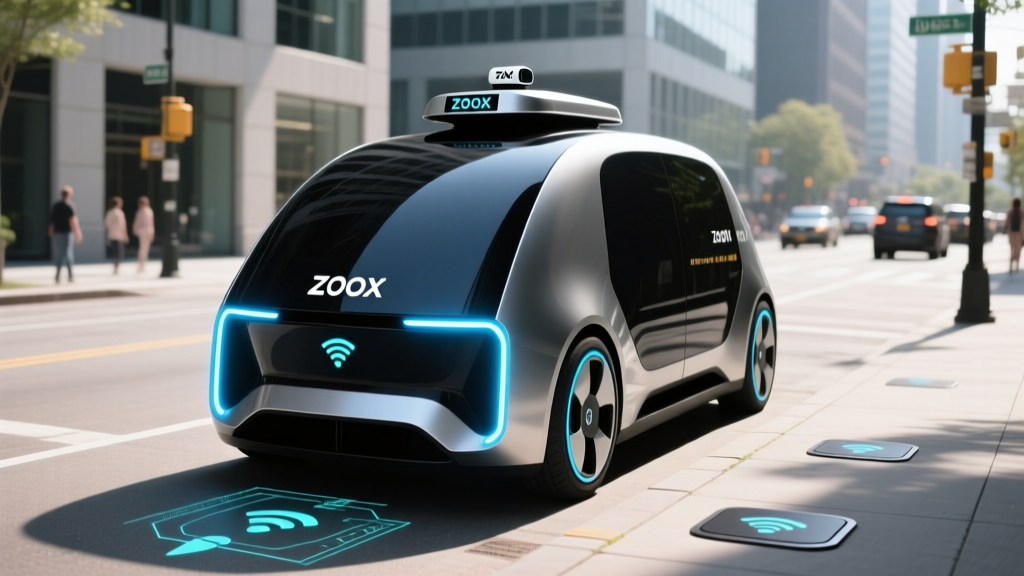
If you've seen social-media posts from riders in Las Vegas or Foster City stepping out of a carriage-style vehicle with no steering wheel and paying nothing, you've probably asked: why is Zoox free? The answer sits at the intersection of Amazon's deep pockets, a deliberate market-capture strategy, and the economics of removing a human driver from the rideshare equation.
Zoox, the autonomous-vehicle company Amazon acquired in 2020 for roughly $1.3 billion, operates a Level 4 driverless robotaxi service in select U.S. cities. Unlike Tesla's Full Self-Driving (Supervised) — which remains a Level 2 driver-assist system requiring constant human attention — Zoox vehicles have no steering wheel, no pedals, and no driver onboard. They are purpose-built to operate without any human intervention within their approved geofenced zones.
Below, we break down the real reasons Zoox rides are currently free (or heavily subsidized), where the service operates, what the safety data shows, and whether this zero-fare model can actually last.
SAE Automation Levels: Where Zoox Sits vs. Consumer ADAS
Understanding why Zoox matters — and why its pricing model works differently from Uber — requires a clear picture of SAE automation levels. Too many consumers conflate Level 2 driver-assist features with Level 4 robotaxis. They are fundamentally different categories.
| Level | Classification | Who Drives | Examples |
|---|---|---|---|
| Level 0 | No Automation | Human does everything | Basic cruise control |
| Level 1 | Driver Assistance | Human + one assist feature (steering OR speed) | Adaptive cruise, lane-keeping |
| Level 2 | Partial Automation | Human supervises combined steering + speed | Tesla Autopilot/FSD (Supervised), GM Super Cruise, Ford BlueCruise |
| Level 3 | Conditional Automation | System drives in specific conditions; human must take over when requested | Mercedes DRIVE PILOT (limited markets) |
| Level 4 | High Automation | System drives fully within defined ODD; no human needed | Waymo, Zoox, Cruise (pre-suspension) |
| Level 5 | Full Automation | System drives everywhere, all conditions | Does not yet exist commercially |
Zoox operates at SAE Level 4 — the vehicle handles all driving tasks within its operational design domain (geofenced urban areas, fair-weather conditions, mapped routes) with zero expectation of human takeover. This is a critical distinction from Tesla FSD (Supervised), which despite its name remains Level 2: the driver is legally and practically responsible at all times.
Where Can I Use Zoox Right Now?
Zoox has been methodically expanding its service footprint, but availability remains geographically constrained. The company uses geofencing to limit operations to pre-mapped, regulator-approved zones.
| City | Status | Service Area Notes |
|---|---|---|
| Las Vegas, NV | Active — public riders | Las Vegas Strip corridor, airport-adjacent zones, downtown; expanded geofence in 2025 |
| Foster City, CA | Active — public riders | San Francisco Peninsula; core testing and early public deployment zone |
| San Francisco, CA | Limited active service | Phased rollout in specific neighborhoods; not citywide |
| Phoenix, AZ | Testing / limited access | Primarily employee and invited-rider programs; public expansion anticipated |
| Atlanta, GA | Testing | Mapping and validation phase; no public ride-hailing yet |
If you're outside these metro areas, you cannot currently hail a Zoox. The company has not announced a nationwide rollout timeline, and each new city requires regulatory approval, mapping, and validation miles before public access opens.
Why Is Zoox Free? The Economics Behind Zero-Fare Rides
The short answer: Zoox is not permanently free — it's free right now as a strategic choice. Here's what's driving the zero-fare model:
1. Data Collection and Validation Miles
Every paid or unpaid ride generates terabytes of sensor data. Zoox needs millions of real-world miles with actual passengers to refine edge-case handling, improve route optimization, and build the safety case regulators require for expansion. Free rides maximize ridership volume, which maximizes data yield.
2. Amazon's Capital Backing
Zoox doesn't need to be profitable today. Amazon has the balance sheet to subsidize rides while the company scales. This is the same playbook used by Uber and Lyft in their early years — burn capital to build market share and operational experience, monetize later.
3. Removing the Driver Cost
In traditional rideshare, the driver takes roughly 55-75% of each fare. Even after Uber/Lyft's platform cut, insurance, and vehicle costs, the human driver is the single largest line item. Zoox eliminates that entirely. Once the fleet is amortized and operational costs stabilize, the per-ride economics can undercut human-driven rideshare significantly — even at a profit.
4. Building Public Trust
Autonomous vehicles still face public skepticism. Offering free rides lowers the barrier to trial, generates organic social-media content, and creates a base of riders who've had a positive experience — essential for eventual paid adoption.
| Service | Typical 5-Mile Ride | Surge Pricing | Driver Present |
|---|---|---|---|
| Zoox | $0 (promotional/free) | None currently | No — Level 4 autonomous |
| Waymo One | $8–$15 | Yes, during peak demand | No — Level 4 autonomous |
| UberX | $12–$20 | Yes, frequent | Yes — human driver |
| Lyft Standard | $11–$19 | Yes, frequent | Yes — human driver |
Will Zoox stay free? Almost certainly not. Industry analysts expect Zoox to introduce paid fares once it reaches sufficient operational scale — likely in the $6–$12 range for typical urban trips, undercutting human-driven rideshare by eliminating the driver cost. Amazon has not publicly stated a monetization timeline.
How to Use Zoox: Hailing Your First Driverless Ride
If you're in an active service zone, using Zoox is straightforward:
- Download the Zoox app (iOS/Android) and create an account.
- Verify your location is within the active geofence — the app shows the service boundary on a map.
- Enter your destination — it must also fall within the geofenced area.
- Request a ride — wait times vary but typically run 3–8 minutes in active zones.
- Board the vehicle — the Zoox carriage has facing bench seats for up to four passengers, no steering wheel or driver partition.
- Ride and exit — the app tracks your trip; you can stop the ride via an in-cabin button or the app if needed.
The Zoox vehicle is a custom-built, bidirectional carriage — it can drive equally well forward and backward, which simplifies tight urban maneuvers. Top speed is capped at 75 mph, though in-city operations rarely exceed 35-45 mph.
Zoox Safety Record: What the Data Shows
Safety is the most scrutinized aspect of any robotaxi service. Here's what we know about Zoox specifically, and the broader Level 4 robotaxi sector:
Zoox & Robotaxi Safety Data Points
- Zoox validation miles: Zoox has accumulated millions of autonomous miles across testing and public operations in Las Vegas and California, though the company does not publish a live mileage counter the way Waymo does.
- Waymo comparison (largest dataset): Waymo reported to NHTSA that across over 7.1 million fully autonomous miles in 2023–2024, its fleet experienced 85% fewer injury-causing crashes and 57% fewer property-damage-only crashes compared to human benchmark rates in the same cities.
- Cruise suspension precedent: In October 2023, California's DMV suspended Cruise's robotaxi permit after a pedestrian-dragging incident in San Francisco. Cruise resumed limited operations in 2024 under stricter oversight. This remains the clearest example of regulatory enforcement when safety data raises concerns.
- Zoox incident record: As of early 2026, Zoox has not been involved in a widely reported serious-injury incident during public operations. The company files required collision reports with NHTSA and state regulators under standing general-crash orders.
It's worth noting that robotaxi safety data is still maturing. Waymo's multi-million-mile dataset is the most robust available, and its results are encouraging — but the operational design domains (geofenced, mostly fair-weather, urban/suburban) are significantly less complex than unrestricted driving. Zoox operates under similar constraints.
Technology Stack: How Zoox Sees the World
Zoox uses a multi-sensor fusion approach — a fundamentally different philosophy from Tesla's camera-only ("Tesla Vision") strategy. The Zoox vehicle's sensor suite includes:
Zoox Sensor and Compute Architecture
- LiDAR: Multiple solid-state and spinning LiDAR units provide a 360-degree, high-resolution 3D point cloud of the vehicle's surroundings — effective to approximately 150+ meters. LiDAR works in darkness and is not confused by shadows or glare.
- Cameras: A surround-camera array provides color, texture, and semantic information — reading traffic signs, detecting signal lights, identifying pedestrian gestures.
- Radar: Long-range and short-range radar units add velocity data for moving objects and perform reliably in rain and fog where LiDAR and cameras degrade.
- Ultrasonic sensors: Close-range proximity detection for low-speed maneuvers, docking, and obstacle avoidance within a few meters.
- Redundant compute: Dual independent computing platforms — if one fails, the other can safely bring the vehicle to a controlled stop.
- HD mapping + geofencing: Zoox vehicles operate only within pre-mapped zones. The map provides centimeter-level road-geometry data, and the geofence prevents the vehicle from entering unapproved areas.
This sensor diversity gives Zoox redundancy that single-modality systems lack. If fog degrades camera performance, LiDAR and radar maintain environmental awareness. If a LiDAR unit fails, cameras and radar provide overlapping coverage. This redundancy is a core reason regulators have approved Level 4 operations for multi-sensor fleets like Zoox and Waymo.
Regulatory Landscape: Who Approves Robotaxi Operations?
Robotaxi deployment in the United States is governed by a patchwork of state and federal regulations — there is no single national robotaxi license.
- NHTSA (federal): Sets vehicle safety standards (FMVSS). Zoox received a notable exemption in 2022 from NHTSA to deploy its steering-wheel-less vehicle, since FMVSS historically required manual controls. NHTSA also mandates crash reporting via Standing General Order for all ADS-equipped vehicles.
- State DMVs and PUCs: Each state controls whether driverless testing and commercial operations are permitted on public roads. California's DMV issues testing permits; the California Public Utilities Commission (CPUC) approves commercial passenger service. Nevada has been more permissive, enabling Zoox's Las Vegas deployment.
- Local municipalities: Cities can impose additional restrictions on where robotaxis operate, speed limits, hours of operation, and reporting requirements.
This fragmented regulatory environment is a major reason robotaxi expansion is slow and city-by-city. A company like Zoox must separately negotiate approval in each jurisdiction — there's no "approved everywhere" status.
Current Limitations: What Zoox Cannot Do
Despite the impressive technology, Level 4 robotaxis have well-defined limitations. Understanding these is essential for setting realistic expectations:
- Geofence restriction: Zoox operates only within pre-mapped, approved zones. You cannot hail a ride to a destination outside the geofence — even if it's only a mile beyond the boundary.
- Weather limitations: Heavy rain, snow, ice, and dense fog degrade sensor performance. Zoox may suspend service or restrict operations during severe weather events. The service is primarily designed for fair-weather urban environments.
- No highway operations (typically): Zoox's current operational design domain focuses on urban and suburban roads at moderate speeds. Interstate highway driving at 70+ mph is not part of the standard service profile.
- Construction zones and unmapped changes: If road geometry changes significantly after mapping (long-term construction, new detours), the vehicle may reroute conservatively, pull over, or request remote-assistance guidance.
- Edge cases: Unusual scenarios — an officer directing traffic with hand signals, an oversized load blocking the road, a sinkhole — may exceed the system's decision-making capability, triggering a conservative stop and remote-human-assist protocol.
- Wait times and availability: Fleet sizes are still small relative to Uber/Lyft. During peak hours, wait times can stretch, and vehicle availability is not guaranteed.
- Accessibility gaps: The Zoox carriage accommodates up to four seated passengers but does not yet offer wheelchair-accessible vehicle configurations in all markets — an area where traditional rideshare (WAV options) currently leads.
Zoox vs. Waymo: How the Two Level 4 Services Compare
| Attribute | Zoox | Waymo One |
|---|---|---|
| Parent Company | Amazon | Alphabet (Google) |
| SAE Level | Level 4 | Level 4 |
| Vehicle | Purpose-built Zoox carriage (no steering wheel) | Jaguar I-PACE (modified), Zeekr RT (upcoming) |
| Primary Cities | Las Vegas, Foster City, San Francisco (limited) | Phoenix, San Francisco, Los Angeles, Austin |
| Pricing | Free (promotional period) | Paid — comparable to UberX, surge pricing applies |
| Autonomous Miles Driven | Millions (undisclosed exact figure) | 50+ million fully driverless miles (cumulative) |
| Sensor Suite | LiDAR + cameras + radar + ultrasonic | LiDAR + cameras + radar |
| Highway Capable | Not in current service profile | Limited highway segments in Phoenix |
| App Availability | Zoox app (invite/zone-dependent) | Waymo One app (public in active cities) |
Waymo is significantly further ahead in commercial scale, paid ridership, and accumulated driverless miles. Zoox's advantage is its purpose-built vehicle (designed from scratch for autonomy rather than retrofitted) and Amazon's distribution and logistics infrastructure — which could eventually integrate Zoox into delivery and last-mile services.
Frequently Asked Questions
Is Zoox truly self-driving, or is there a remote human driver?
Zoox vehicles are fully driverless — there is no human behind the wheel, and no steering wheel exists in the vehicle. The system operates at SAE Level 4 within its geofenced zone. Remote human operators can provide guidance in unusual situations (e.g., helping the vehicle interpret a complex construction zone), but they do not "drive" the vehicle in real time. The vehicle's onboard AI handles all dynamic driving tasks.
How much does Zoox cost compared to Uber or Lyft?
As of early 2026, Zoox rides are free during the company's promotional and data-collection phase. For comparison, a typical 5-mile UberX ride costs $12–$20, and Waymo One charges $8–$15 for similar distances. When Zoox eventually introduces paid fares, analysts expect pricing in the $6–$12 range — undercutting human-driven rideshare by eliminating the driver's share of each fare.
How safe are Zoox robotaxis?
Zoox has not been involved in a widely reported serious-injury incident during public operations as of early 2026. The broader robotaxi sector's best data comes from Waymo, which reported 85% fewer injury-causing crashes across 7.1+ million autonomous miles compared to human benchmarks. Zoox's multi-sensor fusion stack (LiDAR, cameras, radar) provides redundancy that enhances safety in edge cases. However, the total mileage dataset for Zoox specifically is smaller than Waymo's, and all Level 4 services operate under constrained conditions (geofenced, fair weather).
Can I use Zoox in bad weather?
Heavy rain, snow, and dense fog can degrade sensor performance. Zoox may restrict or suspend service during severe weather. The current operational design domain is optimized for the fair-weather conditions found in Las Vegas and the San Francisco Bay Area.
When will Zoox expand to my city?
Zoox has announced testing or limited operations in Las Vegas, Foster City, San Francisco, Phoenix, and Atlanta as of early 2026. The company has not published a public expansion timeline for additional cities. Each new market requires regulatory approval, HD mapping, and validation miles before public access opens.
What happens if the Zoox vehicle encounters something it can't handle?
The vehicle is programmed to execute a "minimal risk condition" — essentially pulling over safely or stopping in place — rather than attempting a maneuver it's uncertain about. Remote-assistance operators can then provide high-level guidance (e.g., confirming a route around an obstacle), after which the vehicle resumes autonomous driving.
Is Zoox the same as Tesla's Full Self-Driving?
No. They are fundamentally different categories. Tesla FSD (Supervised) is an SAE Level 2 driver-assist system: a human driver must remain attentive, hands available, and legally responsible at all times. Zoox is a Level 4 robotaxi: no driver is present, no human attention is required, and the system handles all driving tasks within its operational domain. Calling Level 2 systems "self-driving" is inaccurate and potentially dangerous — the driver remains responsible.
Sources: NHTSA Automated Vehicles Safety, California DMV Autonomous Vehicle Program, manufacturer disclosures.