The Short Answer: They're Here, But Not Everywhere
If you've been asking "when will we have autonomous cars," the honest 2026 answer is: you can hail one today — in a handful of cities, under specific conditions, and without anyone behind the wheel. But you can't buy one, and you can't summon one in most of the country. The gap between a Waymo pulling up to a Phoenix curb and a Tesla Model Y navigating a snow-covered rural road on Autopilot is the difference between a narrow, heavily validated commercial service and a consumer driver-assist system that still requires your full attention.
This guide separates the marketing from the mileage data. We'll map exactly where Level 4 robotaxis operate right now, what they cost, how safe they actually are (with numbers, not slogans), and why Level 5 — a car that drives anywhere a human can, in any condition — remains years away.
Understanding Autonomy: SAE Levels Explained
Much of the confusion around autonomous vehicles comes from mixing up very different technology tiers. The Society of Automotive Engineers defines six levels of driving automation, and the jump from Level 2 to Level 4 is not incremental — it's a fundamental shift in who is legally and operationally responsible for the vehicle.
| Level | Name | Who Drives | Example (2026) |
|---|---|---|---|
| 0 | No Automation | Human does everything | Any conventional car |
| 1 | Driver Assistance | Human + one assist (steering OR speed) | Adaptive cruise control |
| 2 | Partial Automation | Human + combined assist (steering AND speed) | Tesla Autopilot, GM Super Cruise, Ford BlueCruise |
| 3 | Conditional Automation | System drives; human takes over on request | Mercedes DRIVE PILOT (limited markets, ≤40 mph) |
| 4 | High Automation | System drives within defined ODD; no human needed | Waymo One, Zoox |
| 5 | Full Automation | System drives everywhere, all conditions | Does not exist commercially |
Where Can I Use a Robotaxi Right Now?
As of early 2026, fully driverless commercial robotaxi services (no safety operator in the vehicle) are operational in a limited but growing set of U.S. metro areas. Availability changes as regulators approve new zones, so always check the operator's app for live service boundaries.
| Operator | Cities | Service Area Notes |
|---|---|---|
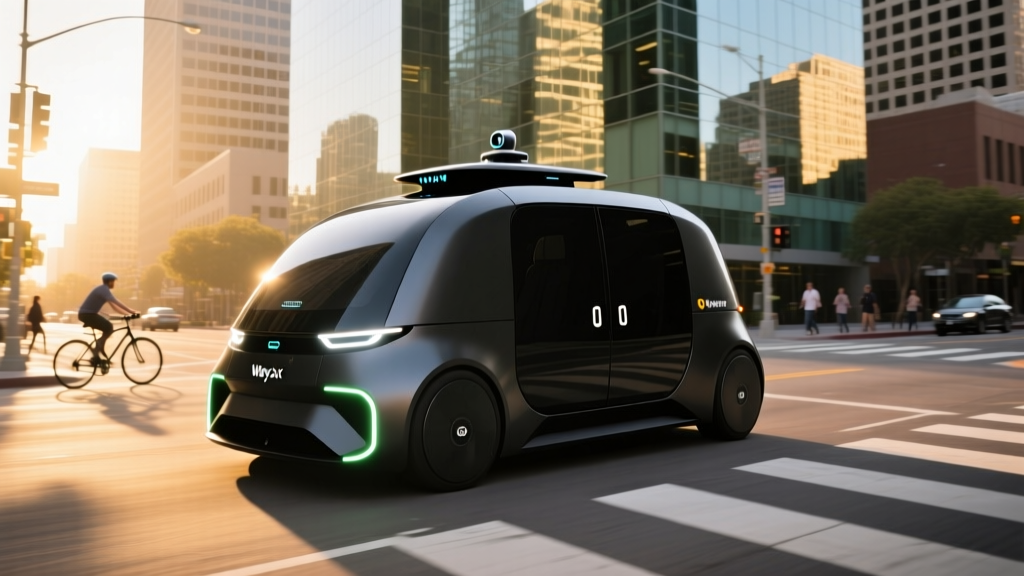
| Waymo One | Phoenix, AZ; San Francisco, CA; Los Angeles, CA; Austin, TX | Largest U.S. network. Phoenix is fully open 24/7; SF and LA have zone restrictions. Austin ramped up in late 2025. |
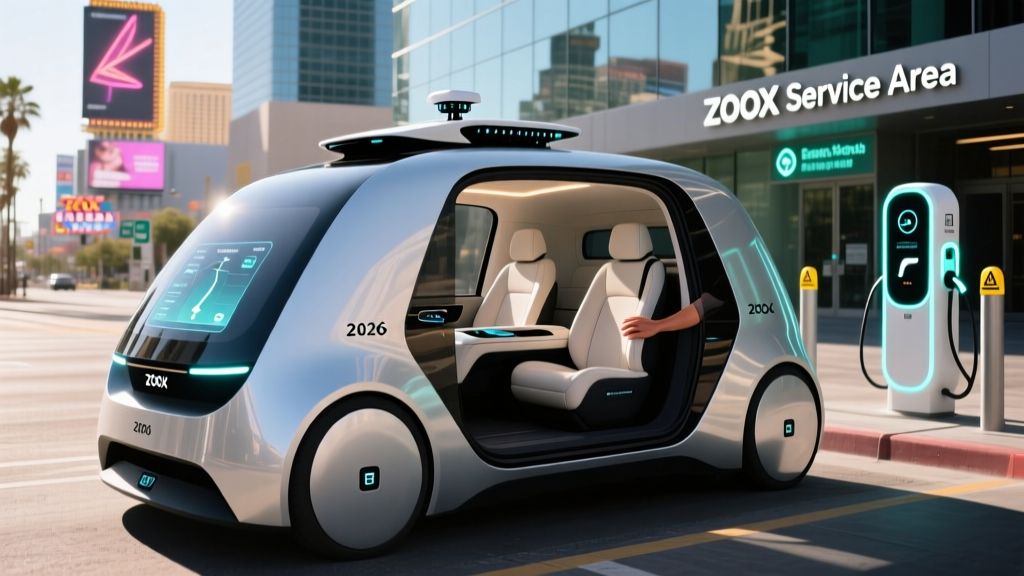
| Zoox | Las Vegas, NV; Foster City, CA (limited) | Purpose-built bidirectional vehicle. Vegas Strip corridor focus. Foster City testing with early rider access. |
| Cruise | Suspended / limited relaunch | Paused operations in late 2023 after a serious incident in San Francisco. Gradual, supervised return in select markets with safety operators as of 2025–2026. |
Outside these markets, you cannot hail a driverless vehicle. International services exist — notably Baidu's Apollo Go in Beijing, Wuhan, and several other Chinese cities, which operates the world's largest robotaxi fleet by ride volume — but those are not accessible to U.S. riders.
How to Use a Robotaxi Service
The experience is similar to Uber or Lyft, with a few differences:
- Download the operator's app (e.g., Waymo One). You may need to join a waitlist in newer markets.
- Enter your destination. The app confirms whether both pickup and drop-off are within the geofenced service area.
- The vehicle arrives driverless. You unlock it via the app — no driver to greet you.
- In-ride controls let you adjust climate, music, and route stops. A screen displays the vehicle's perception of surroundings.
- Support is available via in-app chat or a dedicated help button inside the vehicle for issues or emergencies.
How Much Does a Robotaxi Cost vs. Uber or Lyft?
Robotaxi pricing varies by market and time of day, but in general, Waymo One rides are priced competitively with UberX and Lyft — sometimes slightly cheaper, sometimes slightly more, depending on demand.
| Service | Base Fare | Per Mile | Per Minute | Avg. 5-Mile Ride |
|---|---|---|---|---|
| Waymo One (Phoenix) | ~$3.50 | ~$1.25 | ~$0.25 | $11–$14 |
| UberX (Phoenix avg.) | ~$2.50 | ~$1.40 | ~$0.30 | $11–$15 |
| Lyft (Phoenix avg.) | ~$2.50 | ~$1.35 | ~$0.28 | $10–$14 |
| Zoox (Las Vegas) | Promo / free rides during early access | — | — | Not yet commercially priced at scale |
Waymo has run aggressive promotions in newer markets (discounted first rides, referral credits) to build ridership. Surge pricing exists but tends to be less extreme than Uber/Lyft peaks, partly because Waymo controls its own fleet and doesn't rely on independent driver supply. Tipping is not expected — there's no driver — though the app offers an option.
How Safe Are Robotaxis? The Real Data
Safety is the most consequential and most misunderstood aspect of autonomous vehicles. Let's look at what the data actually shows, rather than anecdotes.
- 85% reduction in injury-causing crash rate vs. human drivers
- 57% reduction in police-reported crash rate vs. human drivers
- Zero fatalities in driverless operations as of early 2026
Context matters. Robotaxis operate primarily in urban environments at lower speeds (typically under 45 mph), in mapped areas, and in favorable weather. This is not directly comparable to highway driving or rural roads, where human crash dynamics differ. Additionally, robotaxis tend to drive more conservatively — slower acceleration, wider following distances, and a strong bias toward stopping rather than proceeding through ambiguous situations.
The Cruise Incident and What It Revealed
In October 2023, a Cruise robotaxi in San Francisco dragged a pedestrian who had been thrown into its path by a human-driven vehicle. The vehicle detected the impact and attempted to pull over, but did so while the pedestrian was still underneath. This incident led to Cruise's California permit suspension and a nationwide operational pause. It highlighted a specific edge case — post-impact response logic — that the industry has since addressed through updated perception and decision-making protocols. Cruise resumed limited supervised testing in 2024–2025 before a gradual return to driverless service.
The broader takeaway: robotaxis are statistically safer than human drivers in their operating domains, but edge cases — unusual accident geometries, erratic human behavior, sensor occlusion — remain the frontier where the technology is still maturing.
The Technology Stack: Lidar, Cameras, and Geofencing
Robotaxis don't rely on a single sensor. They fuse multiple inputs to build a real-time 3D model of their surroundings. Here's what's typically onboard a 2026 Waymo 6th-generation vehicle (based on the Zeekr-built platform):
- Lidar (multiple units): Provides precise 3D point-cloud mapping up to 200+ meters. Works in darkness. Primary sensor for object detection and distance measurement.
- Cameras (8–12+): Read traffic signals, signs, lane markings, and detect colors. Complement lidar with texture and semantic information.
- Radar (multiple units): Measures velocity of moving objects. Performs well in rain and fog where lidar and cameras degrade.
- IMU + GPS + HD Maps: Inertial measurement and centimeter-accurate positioning on pre-built high-definition maps. The vehicle knows the exact location of every curb, crosswalk, and signal in its ODD.
This multi-sensor approach contrasts with Tesla's camera-only ("Tesla Vision") strategy for its consumer FSD system. Tesla argues that cameras plus neural networks can replicate human vision. Waymo and most other Level 4 operators argue that lidar provides a critical redundant depth layer that cameras alone cannot reliably supply, especially in low-light or high-glare conditions.
Geofencing: The Invisible Boundary
Every current robotaxi operates within a geofenced Operational Design Domain — a digitally mapped area where the vehicle has been extensively tested and validated. If your requested route would exit the geofence, the app simply won't allow the booking. The vehicle won't drive into unmapped territory, construction zones it hasn't been trained on, or areas where its HD maps are outdated.
Current Limitations: What Robotaxis Cannot Do
Understanding what autonomous vehicles can't handle is just as important as knowing what they can. These limitations define why Level 5 — go-anywhere, any-condition autonomy — doesn't exist yet.
- Heavy weather: Torrential rain, dense fog, heavy snow, and ice degrade lidar and camera performance. Most services suspend or restrict operations in severe weather. Phoenix and LA are ideal markets partly because they rarely face these conditions.
- Unmapped or changed roadways: Major construction, new traffic patterns, or roads outside the HD map require the vehicle to either reroute or request remote assistance. It cannot improvise the way a human driver would.
- Complex edge cases: Unusual scenarios — a police officer directing traffic with hand signals, an overturned truck spilling irregular cargo, a pedestrian behaving unpredictably in ways not represented in training data — can cause the vehicle to stop and wait for remote guidance.
- No highway intercity travel: Current robotaxi services operate in urban cores at moderate speeds. You cannot hail a Waymo from San Francisco to Los Angeles. Highway-speed autonomous operation at Level 4 is not yet commercially deployed for ride-hailing.
- No rural or suburban coverage: If you live outside a major metro area with a robotaxi operator, the service is simply not available. Expansion is measured in city-by-city increments, not nationwide rollouts.
The Regulatory Landscape: Who Decides Where Robotaxis Can Operate?
Autonomous vehicle regulation in the U.S. is a patchwork of federal, state, and local authority — and it's one of the primary bottlenecks for expansion.
Federal level (NHTSA): The National Highway Traffic Safety Administration sets vehicle safety standards (FMVSS) but has not yet issued a comprehensive federal framework for driverless vehicle deployment. Current FMVSS rules assume a human driver (steering wheel, mirrors, pedals), which required exemptions for vehicles like the Zoox carriage that lack these controls. NHTSA's AV safety page outlines its evolving approach.
State level: States control where and how robotaxis can operate commercially. California's DMV and CPUC issue testing and deployment permits. Arizona has taken a permissive approach with minimal state-level barriers, which is why Phoenix became Waymo's first major market. Texas passed legislation in 2023 enabling AV operations, facilitating Austin's launch. Other states have restrictive or ambiguous laws that effectively block commercial driverless service.
Local level: Cities negotiate operating agreements covering pickup/drop-off zones, fleet size caps, equity requirements, and data sharing. San Francisco's Board of Supervisors has at times pushed back against expansion, citing concerns about traffic obstruction and emergency response interference.
The practical result: even if a robotaxi company has the technology ready, it cannot simply "turn on" a new city. Each market requires regulatory approval, community engagement, and local mapping — a process that takes months to years.
When Will Level 5 (True Full Autonomy) Arrive?
Level 5 — a vehicle that can drive anywhere a human can, in any weather, on any road, without a geofence — does not exist in 2026, and no credible operator claims it does. The engineering challenges are substantial:
- Long-tail edge cases: The final 1% of driving scenarios are exponentially harder than the first 99%. Unstructured environments (dirt roads, unmarked intersections, chaotic international traffic patterns) require generalization that current AI systems have not demonstrated.
- Weather robustness: Reliable perception in heavy snow, whiteout conditions, and ice-covered roads remains an unsolved problem for production deployment.
- Regulatory and liability frameworks: No jurisdiction has created a legal framework for a Level 5 vehicle that can operate without any geographic or conditional restriction.
Industry timelines for Level 5 have shifted repeatedly over the past decade. Predictions made in 2016–2018 of "millions of robotaxis by 2020" proved wildly optimistic. The current realistic trajectory is continued Level 4 expansion — more cities, larger geofences, better weather handling — for the foreseeable future. Level 5, if achievable at all, is likely a 2030s proposition at the earliest.
Frequently Asked Questions
Is Tesla FSD self-driving?
No. Tesla Full Self-Driving (Supervised) is an SAE Level 2 driver-assist system. It can steer, accelerate, and brake on highways and some surface streets, but the driver must remain fully attentive, keep hands available, and is legally responsible for the vehicle at all times. Tesla's own documentation and the system's name ("Supervised") confirm this. It is fundamentally different from a Waymo or Zoox Level 4 robotaxi, which operates without any human in the driver's seat.
Can I buy a self-driving car for personal use?
Not at Level 4 or above. You can purchase vehicles with advanced Level 2 systems (Tesla FSD, GM Super Cruise, Ford BlueCruise) or, in limited markets, Mercedes' Level 3 DRIVE PILOT (which allows hands-off, eyes-off driving under 40 mph on approved highways in specific conditions). But no consumer vehicle sold in the U.S. in 2026 can drive itself without a responsible human present.
Why did Cruise shut down, and is it back?
Cruise suspended all operations in October 2023 after a serious pedestrian incident in San Francisco and subsequent regulatory scrutiny over its response to the event. GM, Cruise's parent company, restructured the division, reduced spending, and began a phased return with safety operators in select cities in 2024–2025. As of early 2026, Cruise is conducting limited supervised operations but has not returned to fully driverless commercial service at its previous scale.
How many autonomous miles have been driven?
Waymo reported over 7.1 million fully driverless miles (no safety operator) through its U.S. operations by late 2025, with millions more in testing. Cruise accumulated over 2.6 million driverless miles before its 2023 suspension. Baidu's Apollo Go reports significantly higher volumes in China, though direct methodology comparisons are difficult due to differing reporting standards.
Will robotaxis replace Uber and Lyft drivers?
Not in the near term. Robotaxi fleets are small (Waymo operates roughly 1,000+ vehicles across its U.S. markets), geofenced to specific cities, and cannot yet handle the full range of conditions that human rideshare drivers manage daily. The long-term economic model suggests robotaxis will complement rather than immediately replace human drivers, initially covering high-volume urban corridors while human drivers serve suburbs, airports, and areas outside geofences.
What happens if a robotaxi gets into an accident?
The operating company (Waymo, Zoox, etc.) carries liability insurance and is responsible for incidents occurring during autonomous operation. Vehicles are equipped with multiple cameras recording all events. Passengers can contact support via in-vehicle buttons or the app. Accident data is reported to state regulators and, where required, to NHTSA. This is a significant difference from Level 2 systems, where the human driver bears liability.