Tesla FSD in 2026: Still Supervised, Still Level 2
Tesla's Full Self-Driving (FSD) capability — now branded as FSD (Supervised) — remains one of the most capable and most misunderstood driver-assistance systems on the road. Despite the name, every Tesla owner using FSD in 2026 is still required to keep their hands on or near the steering wheel, eyes on the road, and remain ready to intervene at any moment. The system is classified as SAE Level 2, the same automation tier as Ford BlueCruise, GM Super Cruise, and basic Autopilot.
The question many buyers and owners keep asking: when will FSD be unsupervised? The honest answer requires unpacking what Tesla has actually delivered, what regulators require for a true hands-off system, and the gap between impressive demo footage and a commercially available Level 4 product.
- Level 0: No automation. Warnings only (beeping, alerts).
- Level 1: Single-axis assist — adaptive cruise OR lane centering, not both simultaneously.
- Level 2: Combined lateral + longitudinal assist. Driver must supervise at all times. This is where FSD (Supervised), BlueCruise, and Super Cruise all live.
- Level 3: Conditional automation — the car handles driving in specific scenarios (e.g., traffic jams under 40 mph on highways), and the driver can legally look away but must be ready to resume within seconds. Currently limited to Mercedes DRIVE PILOT in Nevada/California under strict conditions.
- Level 4: High automation — no driver needed in a defined operational design domain (ODD). This is what Waymo and Zoox operate in geofenced urban areas.
- Level 5: Full automation everywhere, all conditions. Does not exist commercially.
What FSD (Supervised) Actually Does — and How
Tesla's FSD (Supervised) is a camera-only vision system. Since removing radar and ultrasonic sensors from vehicles built after mid-2022 (the "Tesla Vision" architecture), the system relies entirely on a suite of eight external cameras feeding into a neural network running on Tesla's in-house HW4 (Hardware 4) computer. There is no LiDAR, no radar redundancy, and no high-definition pre-mapped route data — Tesla's approach is fundamentally different from Waymo's sensor-fusion stack.
In practice, FSD (Supervised) can:
- Navigate highway on-ramps, interchanges, and off-ramps with minimal intervention
- Execute lane changes based on navigation routing or to pass slower traffic
- Stop at and proceed through traffic lights and stop signs
- Navigate many surface streets including unprotected left turns
- Perform Smart Summon (navigate a parking lot to the driver's location)
- Execute automated parking (parallel and perpendicular)
| Feature | Status (2026) | Notes |
|---|---|---|
| Highway navigation + lane changes | ✅ Active | Most reliable FSD use case; still requires supervision |
| City street navigation | ✅ Active | Improved significantly; edge cases remain at complex intersections |
| Traffic light/stop sign control | ✅ Active | Occasionally hesitates or misreads temporary signals |
| Smart Summon | ✅ Active | Low-speed; driver must monitor via phone app |
| Hands-off highway driving | ❌ Not available | Steering wheel torque or camera-based attention still required |
| Unsupervised point-A-to-B | ❌ Not available | Would require Level 4 regulatory approval — not achieved |
The Regulatory Wall: Why "Unsupervised" Is Not Just a Software Update
The most common misconception about FSD is that Tesla simply needs to push an over-the-air update to flip the system from supervised to unsupervised. The technical and regulatory realities are far more complex.
For a vehicle to operate without a supervising driver — even in limited conditions — it must be classified as SAE Level 4. That classification carries requirements that go well beyond neural network performance:
- Operational Design Domain (ODD) definition: The manufacturer must define and prove the exact conditions (geography, speed, weather, road type) where the system operates safely without a human fallback.
- Redundancy: Level 4 systems need redundant compute, redundant steering/braking actuation, and often redundant sensor modalities. Tesla's camera-only approach faces skepticism from safety regulators who favor LiDAR + camera + radar fusion for redundancy.
- Federal and state approval: The National Highway Traffic Safety Administration (NHTSA) oversees vehicle safety standards, while individual states control licensing and operational rules for driverless vehicles. Waymo currently holds permits in Arizona, California, and a handful of other states after years of documented safety data.
- Liability shift: At Level 2, the driver bears liability for crashes. At Level 4, the manufacturer assumes liability when the system is operating within its ODD. This is a massive legal and financial commitment that Tesla has not publicly accepted.
Tesla has filed no public applications with NHTSA or state DMVs for a Level 4 operational permit as of early 2026. By contrast, Waymo has logged over 50 million fully driverless miles and operates a commercial robotaxi service in Phoenix, San Francisco, Los Angeles, and Austin.
What It Would Take: Tesla's Path to Unsupervised FSD
Based on Tesla's public statements, patent filings, and the trajectory of FSD development, here is what would need to happen before any Tesla vehicle could legally drive without supervision:
- Validation at scale: Tesla would need to demonstrate, with statistically rigorous data, that FSD achieves a safety record meaningfully better than human drivers across diverse conditions. Tesla's safety reports claim ~5 million miles between accidents on FSD, but these figures are self-reported and not independently verified by NHTSA or the Insurance Institute for Highway Safety (IIHS).
- Hardware sufficiency: Tesla must confirm that HW4 (or a future HW5) provides adequate compute redundancy for fail-operational driving. Critics argue the camera-only stack lacks the sensor diversity that regulators will require for Level 4.
- Regulatory engagement: Tesla would need to formally petition state regulators (starting likely in Arizona or Texas, where AV regulations are more permissive) for a driverless testing or deployment permit.
- Insurance and liability framework: Tesla would need to establish a liability framework accepting manufacturer responsibility during unsupervised operation — a shift from the current terms of service that place all responsibility on the driver.
- Geofencing: Initial unsupervised deployment would almost certainly be limited to specific geofenced areas with favorable conditions — not the "anywhere, anytime" experience many FSD purchasers envision.
- You are the driver. Legally and practically, you are responsible for every action the vehicle takes while FSD is engaged.
- Weather degradation. Heavy rain, fog, snow, and direct sun glare can impair camera-only systems. FSD performance drops noticeably in these conditions.
- Construction zones. Temporary lane markings, shifted lanes, and flagger signals remain challenging edge cases.
- Faded or missing lane markings. Rural roads and older urban infrastructure without clear markings reduce system confidence.
- Unprotected left turns. While improved, these remain higher-intervention scenarios in heavy or ambiguous traffic.
- Phantom braking. The system occasionally brakes hard for non-existent obstacles — a known issue across Tesla Vision vehicles.
How FSD Compares to Other Advanced Driver-Assist Systems
FSD (Supervised) is often compared to other premium ADAS offerings. It's important to understand that all of the following consumer systems are SAE Level 2 — none are self-driving, and all require active driver supervision.
| System | Brand | SAE Level | Hands-Off? | Sensor Suite |
|---|---|---|---|---|
| FSD (Supervised) | Tesla | Level 2 | No | 8 cameras, HW4 compute, no LiDAR/radar |
| Super Cruise | GM (Cadillac, Chevy) | Level 2 | Yes (mapped highways only) | Cameras, radar, LiDAR-mapped roads, driver camera |
| BlueCruise | Ford / Lincoln | Level 2 | Yes (mapped highways only) | Cameras, radar, driver-facing camera |
| DRIVE PILOT | Mercedes-Benz | Level 3 | Yes (≤40 mph, specific highways, NV/CA) | LiDAR, cameras, radar, HD maps, redundancy |
| Autopilot (base) | Tesla | Level 2 | No | 8 cameras, HW4; traffic-aware cruise + lane centering |
Notable distinction: GM Super Cruise and Ford BlueCruise allow true hands-off driving on pre-mapped divided highways (over 750,000 and 130,000 miles of road respectively), but they use geofencing and driver-monitoring cameras to ensure you're still paying attention. Mercedes DRIVE PILOT is the only consumer system with SAE Level 3 certification in the U.S., but it operates only under 40 mph on specific highways in Nevada and California, and the manufacturer accepts liability during those narrow conditions.
FSD Pricing: What You'll Actually Pay
Tesla has adjusted FSD pricing multiple times. As of 2026, the current structure is:
| Option | Cost | Notes |
|---|---|---|
| One-time purchase | $8,000 | Transfers to the vehicle, not the owner; included at purchase or added later |
| Monthly subscription | $99/month | Can be cancelled anytime; best for testing before committing |
| Included (base Autopilot) | $0 | Traffic-aware cruise + lane centering on all new Teslas; no city streets, no auto lane changes |
The subscription model is genuinely useful: try FSD for a month on your typical commute before committing $8,000. The breakeven point for purchase vs. subscription is roughly 81 months — if you're uncertain about the system's future capabilities, the monthly plan reduces financial risk.
Important: FSD is not eligible for any federal tax credit or incentive. The IRS §30D clean vehicle credit applies to the vehicle purchase itself (subject to MSRP caps of $55,000 for sedans / $80,000 for SUVs and trucks, income limits, and battery sourcing requirements), not to software add-ons.
So When Will FSD Actually Be Unsupervised?
Based on available evidence as of 2026, here is a realistic assessment:
Near-term (2026–2027): FSD (Supervised) will continue to improve incrementally through OTA updates. Expect better city-street performance, fewer disengagements per mile, and expanded Smart Summon capabilities. The system will remain Level 2, requiring driver supervision.
Medium-term (2028–2030): Tesla may pursue limited Level 3 or Level 4 pilot programs in permissive regulatory environments (likely Texas or Arizona). These would be geofenced, limited to specific vehicle configurations, and require formal regulatory applications that have not yet been filed.
Long-term (2030+): Broad unsupervised FSD — where you can sleep, read, or leave the vehicle — would require not just technical maturity but an entirely new regulatory, insurance, and liability framework. This is the domain of companies like Waymo, which has spent over a decade and billions of dollars building this infrastructure.
Tesla CEO Elon Musk has predicted imminent unsupervised FSD annually since 2016. As of 2026, none of those timelines have materialized. Buyers should evaluate FSD (Supervised) for what it is today — a sophisticated but imperfect Level 2 driver-assist system — rather than what it might become.
Frequently Asked Questions
Is Tesla FSD actually self-driving?
No. Tesla FSD (Supervised) is an SAE Level 2 driver-assistance system. The driver must remain engaged, monitor the road, and be prepared to take over at any moment. Tesla's own documentation and the vehicle's user interface explicitly state this requirement. Calling it "self-driving" is factually incorrect and potentially dangerous.
Can I remove my hands from the wheel with FSD?
Tesla uses a camera-based driver monitoring system (and on older vehicles, steering wheel torque detection) to ensure attention. While some users report brief periods without intervention prompts, the system is designed to require ongoing engagement. Removing your hands and attention is a violation of Tesla's terms and traffic law in most jurisdictions.
How does FSD compare to Waymo?
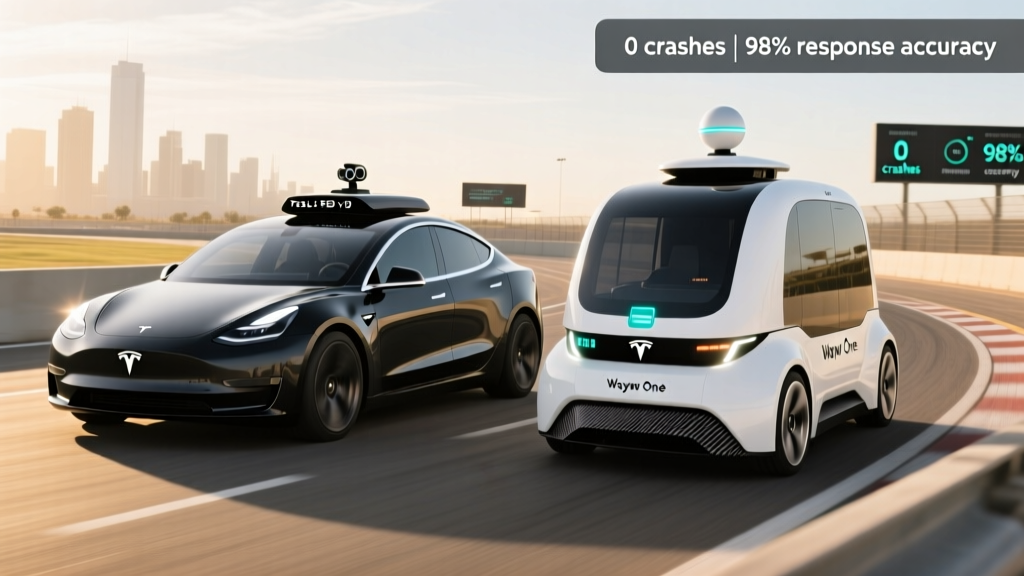
Waymo operates SAE Level 4 robotaxis in geofenced areas of Phoenix, San Francisco, Los Angeles, and Austin with no driver present. Waymo uses a sensor-fusion approach (LiDAR, radar, cameras) and has logged over 50 million driverless miles. Tesla FSD is Level 2, requires a supervising driver, and uses cameras only. They are fundamentally different products at different automation tiers.
Does FSD work in bad weather?
FSD's camera-only system is more susceptible to weather degradation than LiDAR-equipped competitors. Heavy rain, dense fog, snow, and direct low-angle sun glare can cause the system to reduce confidence, issue warnings, or disengage. Tesla's owner manual advises drivers to take over in adverse weather conditions.
If Tesla eventually achieves unsupervised FSD, will my current car get it?
This is uncertain. Tesla has stated that vehicles with HW3 (Hardware 3) may not support future unsupervised features, and the company has offered trade-in or hardware upgrade programs in the past. Vehicles with HW4 are better positioned, but Tesla has made no binding commitment that any existing consumer vehicle will receive unsupervised capability. If this matters to your purchase decision, factor in the possibility that today's FSD purchase may not carry forward to a future unsupervised system.