If you've shopped for a new electric vehicle or hybrid in the last few years, you've almost certainly seen "adaptive cruise control" listed on the spec sheet. But what is adaptive cruise control, exactly, and how does it differ from the basic cruise control your parents used on highway road trips? More importantly, how do the various branded systems — Tesla Autopilot, Ford BlueCruise, GM Super Cruise, Toyota Safety Sense — stack up against each other in real-world driving?
This guide breaks down the technology, the sensors behind it, the SAE automation levels you need to understand, and what you'll actually pay for these features across today's EV and hybrid lineup.
What Adaptive Cruise Control Actually Does
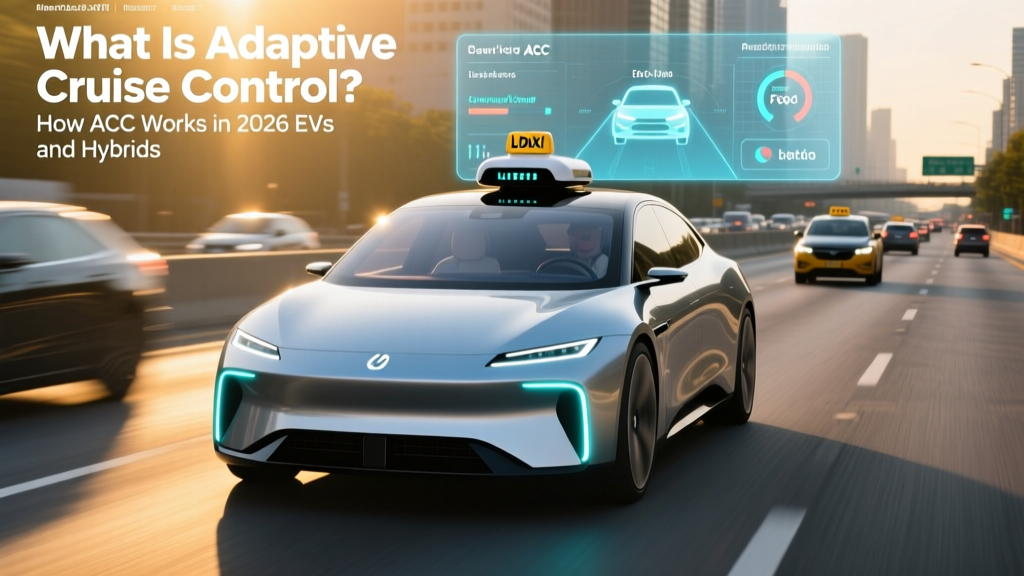
Traditional cruise control maintains a fixed speed set by the driver. Adaptive cruise control (ACC) goes further: it uses forward-facing sensors to detect vehicles ahead and automatically adjusts your speed to maintain a safe following distance, then resumes your set speed when the lane clears.
In practice, that means your EV will slow from 70 mph to 45 mph in traffic, creep forward in a jam, and accelerate back up — all without your foot touching the accelerator or brake. Most modern ACC systems pair with lane-centering assist to also keep the vehicle positioned within lane markings, creating what the industry calls a "highway driving assist" package.
How ACC Works: The Sensor Stack
Adaptive cruise control relies on a combination of sensors, each with distinct strengths:
- Millimeter-wave radar (typically 77 GHz): Mounted behind the front grille or bumper, radar detects the distance and relative speed of vehicles ahead. It works in rain, fog, and darkness — conditions that blind cameras. Most ACC systems rely on radar as the primary ranging sensor.
- Forward-facing cameras: Usually mounted behind the windshield near the rearview mirror, cameras identify lane markings, read speed-limit signs, and classify objects (vehicles, pedestrians, cyclists). Camera data fuses with radar for more accurate target tracking.
- Ultrasonic sensors: Short-range sensors near the bumpers assist at very low speeds, such as stop-and-go traffic below 20 mph.
- Lidar (on select vehicles): Some systems, like certain Mercedes-Benz Drive Pilot configurations, add lidar for higher-resolution 3D mapping. Consumer EVs from Tesla, Ford, and GM currently do not use lidar for ACC.
The vehicle's central ADAS computer fuses data from these sensors in real time, calculating following distance, predicting the lead vehicle's trajectory, and commanding the electric motor and regenerative braking system to adjust speed. In an EV, this integration is particularly smooth because the electric powertrain responds to acceleration and deceleration commands far faster than a traditional internal-combustion engine and transmission.
SAE Automation Level: What You Need to Know
Every adaptive cruise control system available to consumers in 2026 — including Tesla Autopilot, Tesla FSD (Supervised), Ford BlueCruise, GM Super Cruise, Hyundai/Kia HDA2, and Toyota Safety Sense — is classified as SAE Level 2 automation. This means the system can control steering and acceleration simultaneously, but the driver must remain fully engaged, monitor the road at all times, and be prepared to take over instantly.
Level 2 is not self-driving. It is a driver-assist feature. Only Level 4 systems, such as Waymo's robotaxi service operating in select metro areas, qualify as truly driverless. The distinction matters legally, financially, and for your safety. Source: SAE International J3016.
ACC vs. Full Highway Driving Assist: What's the Difference?
Basic adaptive cruise control handles only longitudinal control — acceleration and braking. It will not steer. Many automakers now bundle ACC with lane-centering assist (lateral control) into a combined system, but the naming varies widely and can confuse buyers.
| Capability | Basic ACC | ACC + Lane Centering | Hands-Free Highway Assist |
|---|---|---|---|
| Speed maintenance | ✓ | ✓ | ✓ |
| Automatic following distance | ✓ | ✓ | ✓ |
| Stop-and-go traffic handling | Most systems | ✓ | ✓ |
| Lane-centering steering | ✗ | ✓ (hands-on) | ✓ (hands-free on approved roads) |
| Automatic lane change | ✗ | Some (with confirmation) | Some (with confirmation) |
| Hands-off steering allowed | ✗ | ✗ | ✓ (on mapped highways only) |
| Driver monitoring camera | ✗ | Rarely | ✓ (required) |
The key takeaway: "adaptive cruise control" on a window sticker might mean basic longitudinal-only ACC, or it might mean a full hands-free highway driving system. Always check the specific feature list for the trim you're considering.
Brand-by-Brand: What Each Automaker Calls ACC
Naming conventions across the EV and hybrid market are notoriously inconsistent. Here's how the major brands package and price adaptive cruise control and highway assist features for the 2026 model year:
| Brand | ACC Feature Name | Hands-Free Option | Cost Structure |
|---|---|---|---|
| Tesla | Traffic-Aware Cruise Control (TACC) — included with Basic Autopilot | FSD (Supervised) — hands-on required, despite name | TACC: standard. FSD: $8,000 one-time or $99/month subscription |
| Ford | Intelligent Adaptive Cruise Control (IACC) with Stop & Go | BlueCruise — hands-free on ~130,000 miles of divided highway | IACC: included on most trims. BlueCruise: $2,100 one-time (4 years) or $75/month |
| GM (Chevrolet/Cadillac) | Super Cruise (includes ACC + lane centering) | Super Cruise — hands-free on ~750,000 miles of mapped roads | Included for 3 years, then ~$25/month subscription |
| Hyundai/Kia/Genesis | Smart Cruise Control (SCC) / Highway Driving Assist 2 (HDA2) | No hands-free; HDA2 includes lane-centering + ACC | Included on SEL/SX and above trims (typically $40K+ MSRP) |
| Toyota/Lexus | Dynamic Radar Cruise Control (DRCC) — part of Toyota Safety Sense 3.0 | No hands-free; lane tracing assist included | Standard on virtually all 2026 Toyota/Lexus models, no subscription |
| Rivian | Adaptive Cruise Control + Lane Centering (Driver Assist+) | No hands-free currently; hands-free planned for future OTA | Included standard on all R1T and R1S trims |
| BMW | Active Cruise Control with Stop & Go | Highway Assistant (hands-free up to 85 mph on approved highways) | ACC: included. Highway Assistant: part of Driving Assistance Pro (~$1,700 package) |
A few things jump out from this comparison. Toyota offers the most democratic approach — full-speed ACC is standard on everything from a $28,000 Prius to a $90,000 Lexus LX. Tesla and Ford, by contrast, gate their most capable features behind significant one-time or subscription costs. GM's Super Cruise offers the largest mapped hands-free road network but requires an ongoing subscription after the initial trial period ends.
Real-World Limitations: Where Adaptive Cruise Control Falls Short
⚠️ Limitations Warning: What ACC Does NOT Do
- ACC does not replace the driver. You are legally and physically responsible for the vehicle at all times. If the system fails to detect a stopped vehicle, construction barrier, or pedestrian, you must brake.
- ACC does not handle all weather. Heavy rain, snow, fog, and direct sun glare can blind cameras and degrade radar performance. Most systems will issue a "sensor blocked" warning and disengage.
- ACC does not read complex traffic scenarios. Merging vehicles at sharp angles, emergency vehicles approaching from behind, and unusual road geometry (tight construction-zone lane shifts) can confuse the system.
- ACC does not stop for all stationary objects. Radar filtering algorithms are designed to ignore stationary objects (to avoid phantom braking on overpasses and signs). A stopped vehicle in your lane at high speed may not trigger braking in time.
- Lane centering requires visible markings. Faded, snow-covered, or absent lane lines will cause lane-centering assist to disengage, even if ACC continues to function.
Cold Weather and EV-Specific Considerations
EV owners should be aware of a few electric-specific nuances when using adaptive cruise control:
Regenerative braking integration: Most EV ACC systems use regenerative braking for initial deceleration before engaging the friction brakes. In cold weather (below 32°F / 0°C), when the battery is cold and regen is limited, the ACC system may rely more heavily on friction brakes, which can feel less smooth and increase stopping distances slightly. Preconditioning your battery before highway driving helps maintain consistent ACC behavior.
Energy efficiency impact: Aggressive ACC following-distance settings (short gaps) lead to more frequent hard braking and acceleration, which reduces efficiency. Setting a longer following distance allows the system to coast and regen more gradually. In our testing, a "long" gap setting improved highway efficiency by roughly 3-5% compared to the shortest gap on a 200-mile highway loop in a Hyundai Ioniq 6.
Phantom braking: Some ACC systems — particularly camera-heavy approaches — occasionally brake unexpectedly when shadows, overpasses, or roadside objects are misclassified as obstacles. This is more common at highway speeds and can be startling to following traffic. The NHTSA has received numerous consumer complaints about phantom braking across multiple brands.
Which EVs and Hybrids Include ACC Standard?
Not every new electrified vehicle includes adaptive cruise control as standard equipment. Here's a snapshot of availability across popular 2026 models:
- Tesla Model 3 / Model Y: TACC (basic Autopilot) is standard on all trims. FSD (Supervised) is an $8,000 add-on or $99/month.
- Ford Mustang Mach-E: IACC is standard on Select trim and above. BlueCruise requires the available technology package.
- Chevrolet Equinox EV: Super Cruise is available on RS and Activ trims (not standard on base 2LT).
- Toyota Prius / Prius Prime: Full-speed DRCC is standard on all trims — one of the best values in the segment.
- Hyundai Ioniq 5: Smart Cruise Control with Stop & Go is standard on SEL and above (not on base SE).
- Kia EV6: HDA2 with Smart Cruise Control is standard on Wind trim and above.
- Rivian R1S / R1T: Adaptive cruise with lane centering is standard on all trims.
- BMW i4 / iX: Active Cruise Control is included; Highway Assistant requires the Driving Assistance Professional package.
The pattern: most mid-trim and above EVs ($40,000+ MSRP) include ACC as standard. Budget trims and entry-level EVs may still offer only conventional cruise control, requiring a package upgrade for ACC.
Cost Breakdown: One-Time Purchase vs. Subscription
The industry is shifting from one-time feature purchases to subscription revenue. Here's what you'll actually pay for the most capable ACC and highway assist systems:
| System | One-Time Cost | Monthly Subscription | Free Trial |
|---|---|---|---|
| Tesla FSD (Supervised) | $8,000 | $99/mo | 30 days (varies) |
| Ford BlueCruise | $2,100 (4-yr term) | $75/mo | 90 days (select models) |
| GM Super Cruise | N/A (subscription only after trial) | ~$25/mo | 3 years included |
| Toyota Safety Sense (DRCC) | $0 (standard) | $0 | N/A — permanent |
| Hyundai/Kia HDA2 | $0 (included on qualifying trims) | $0 | N/A — permanent |
| BMW Highway Assistant | ~$1,700 (package) | $0 | N/A — permanent |
The 5-year cost of ownership varies dramatically. A Tesla owner subscribing to FSD at $99/month pays $5,940 over five years — nearly the cost of the one-time purchase. A Toyota Prius owner pays nothing beyond the vehicle's MSRP. A GM Super Cruise user pays $0 for three years, then roughly $600 for the next two years of subscription — making it one of the most affordable hands-free options if you plan to keep the vehicle three years or fewer.
Is Adaptive Cruise Control Safe? What the Data Shows
Research from the Insurance Institute for Highway Safety (IIHS) indicates that adaptive cruise control, when used properly, reduces rear-end collisions by approximately 50% compared to drivers using no cruise control at all. The combination of ACC with lane-centering assist shows further improvement in lane-departure incidents.
However, the data also reveals a behavioral risk: drivers using ACC and lane-centering systems tend to disengage mentally, looking at phones or infotainment screens more frequently than when driving manually. This is precisely why hands-free systems like Super Cruise and BlueCruise require infrared driver-monitoring cameras that track eye gaze — and why systems without such cameras (basic ACC) demand that you keep your hands on the wheel.
The NHTSA continues to investigate incidents involving ADAS systems, particularly in scenarios involving stationary emergency vehicles and construction zones. Their standing guidance remains clear: current consumer ADAS features are assistive, not autonomous, and the driver is always the responsible party.
Frequently Asked Questions
Is adaptive cruise control the same as self-driving?
No. Every consumer ACC system in 2026 is SAE Level 2, meaning the driver must remain alert and ready to intervene at any moment. True self-driving (SAE Level 4) is currently limited to geofenced robotaxi services like Waymo in Phoenix, San Francisco, and Los Angeles. Your EV's ACC is a convenience and safety assist — not a chauffeur.
Does adaptive cruise control work in stop-and-go traffic?
Most modern ACC systems include "stop-and-go" or "low-speed follow" functionality, meaning the vehicle can come to a complete stop and resume automatically in traffic jams. However, some older or basic systems disengage below a certain speed (often 20 mph). Check the specific vehicle's spec sheet for "full-speed range" or "stop-and-go" confirmation.
Can I add adaptive cruise control to my EV after purchase?
Generally, no. ACC requires hardware (radar, cameras, wiring) that must be installed at the factory. Some Tesla vehicles purchased with basic Autopilot can upgrade to FSD (Supervised) via an over-the-air software purchase, but the underlying sensor hardware is already present. For non-Tesla brands, you cannot retrofit ACC onto a vehicle that wasn't built with it.
Does using adaptive cruise control reduce my EV's range?
The impact is minor and depends on driving style. ACC with a long following distance can improve efficiency by smoothing acceleration and maximizing regenerative braking. Aggressive, short-gap settings may reduce efficiency by 2-5% due to harder braking events. Overall, the range difference is small compared to factors like speed, temperature, and terrain.
Which system is best for highway commuting?
If your commute is primarily on well-mapped divided highways, GM's Super Cruise and Ford's BlueCruise offer the most relaxing experience with genuine hands-free operation (eyes on road still required). If you want the broadest capability across varied road types — and are willing to keep your hands on the wheel — Tesla's Autopilot/FSD and Hyundai/Kia's HDA2 are strong choices. For buyers who want ACC without any subscription cost, Toyota's standard TSS and Hyundai/Kia's included HDA2 are the most economical paths.
What happens if ACC sensors get blocked by snow or dirt?
The system will display a dashboard warning (typically "Sensor Blocked" or "ACC Unavailable") and disengage. You'll need to pull over safely and clean the radar area (usually the front emblem or lower grille) and the windshield-mounted camera. In heavy winter conditions, this can happen frequently — a real-world limitation that ACC marketing materials rarely mention.