The Waymo Via Robotaxi Partnership Explained
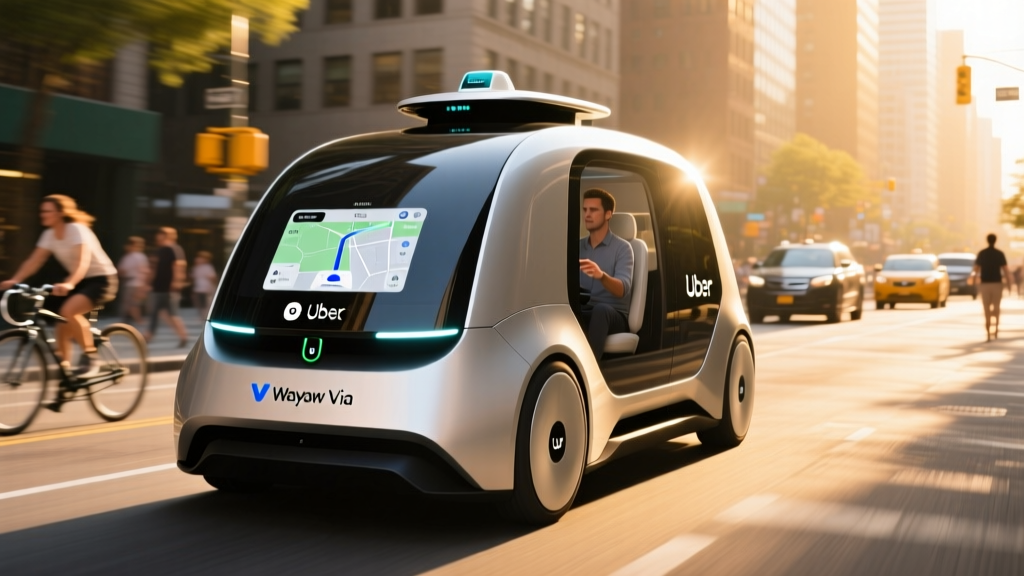
If you've opened the Uber app in Phoenix, San Francisco, or Los Angeles and spotted a "Waymo via Uber" option with no driver listed, you're looking at the most commercially significant Waymo via robotaxi partnership in the autonomous vehicle industry. Rather than forcing riders into a standalone app, Alphabet's Waymo has integrated its Level 4 driverless fleet directly into Uber's marketplace — letting millions of existing rideshare users hail a fully autonomous Jaguar I-PACE or Hyundai Ioniq 5 without creating a new account.
The partnership launched in late 2024 in Phoenix and expanded through 2025 into San Francisco and Los Angeles, with Austin added in early 2026. It represents a pragmatic bet: Waymo supplies the autonomy stack and vehicles; Uber supplies the demand, payment rails, and rider trust. For consumers, the result is robotaxi access with the friction of ordering an UberX.
SAE Automation Level: What "Level 4" Actually Means
Waymo's robotaxis operate at SAE Level 4 — high automation within a defined operational design domain (geofenced area, specific weather and road conditions). There is no human driver in the vehicle, no steering wheel intervention, and no expectation that a rider will take over. This is fundamentally different from SAE Level 2 systems like Tesla Autopilot, Ford BlueCruise, or GM Super Cruise, which require continuous driver supervision. Never conflate the two: a Waymo via Uber ride is driverless; a Level 2 car is driver-assist.
Where Can You Use Waymo via Uber Right Now?
As of mid-2026, the Waymo via robotaxi partnership is live in four U.S. metros, each with a specific geofenced service area. Rides outside the geofence are unavailable even if you're only a mile beyond the boundary.
| City | Service Area (approx.) | Hours | Launch Date |
|---|---|---|---|
| Phoenix, AZ | ~225 sq mi (Tempe, Scottsdale, Chandler, parts of downtown Phoenix) | 24/7 | Nov 2024 |
| San Francisco, CA | ~50 sq mi (most of SF proper, excluding some steep hill routes) | 24/7 | |
| Los Angeles, CA | ~80 sq mi (Santa Monica, Beverly Hills, West Hollywood, Downtown LA core) | 6 AM – 2 AM | |
| Austin, TX | ~45 sq mi (Downtown, South Congress, East Austin, Domain area) | 6 AM – 1 AM |
Expansion to additional cities has been announced but is not yet live. Waymo and Uber have confirmed Miami and Atlanta are in testing phases, but no public rider availability date has been committed. Treat any "coming soon" map as preliminary until official launch confirmation.
How to Hail a Waymo via Uber — and What It Costs
The rider experience mirrors a standard UberX request with one key difference: you cannot change the route mid-trip or add multiple stops the way you can with a human driver. The Waymo vehicle follows a pre-planned path within its operational design domain.
Step-by-Step: Requesting a Ride
- Open the Uber app and enter your destination within a supported city.
- If your pickup and dropoff are both inside the Waymo geofence, a "Waymo via Uber" option appears alongside UberX, Comfort, etc.
- Select the Waymo option. Pricing is shown upfront, identical in format to other tiers.
- The app displays the approaching vehicle (a white Jaguar I-PACE or Hyundai Ioniq 5 with Waymo branding and a visible lidar dome).
- At arrival, unlock the car using a PIN displayed in the app. The doors auto-unlock once you're verified.
- Start the ride via the in-seatback screen. There is no driver to greet you.
Pricing: Waymo via Uber vs. UberX vs. Lyft
Waymo via Uber rides are priced at or slightly above UberX in most markets, with no surge pricing applied during peak hours (a meaningful advantage during events or bad weather). Here's a representative comparison based on observed fares in Q1 2026:
| Service | Typical Fare (Phoenix) | Typical Fare (SF) | Surge Behavior |
|---|---|---|---|
| Waymo via Uber | $11–$15 | $16–$22 | No surge pricing |
| UberX | $10–$14 | $14–$20 | Surge applies (1.2x–2.5x common) |
| Lyft Standard | $10–$13 | $13–$19 | Surge applies |
| Waymo One (standalone app) | $11–$15 | $16–$22 | No surge pricing |
The no-surge policy is the partnership's most rider-friendly feature. During Phoenix's extreme heat events or SF rush hour, a Waymo via Uber ride can undercut a surging UberX by 20–40%. Tipping is not expected (no driver), though the app allows it.
Safety Record: What the Data Actually Shows
Safety is the most scrutinized aspect of any robotaxi service, and Waymo publishes more operational data than any competitor. As of early 2026, Waymo's fleet has logged over 35 million fully autonomous miles across its commercial services, with the Uber partnership accounting for an increasing share of that total.
Key Safety Metrics (Waymo Commercial Fleet, through Q4 2025)
- Total autonomous miles driven: 35+ million
- Injury-causing crash rate: ~85% lower than human benchmark for comparable urban driving, per NHTSA-referenced Waymo safety reports
- Police-reported crash rate: ~75% lower than human benchmark in same geographies
- Contactless remote assistance rate: Fewer than 1 intervention per 10,000 miles (vehicle requests remote guidance for ambiguous construction zones or unusual obstacles)
- Fatalities in commercial service: 0
Source: Waymo's publicly submitted safety data to NHTSA and the California DMV; independent analysis by the Insurance Institute for Highway Safety (IIHS) has reviewed Waymo's crash-avoidance performance favorably.
Context matters. Waymo's geofenced areas are mapped to the centimeter, and the vehicles do not operate in conditions they haven't been validated for. The comparison to human drivers is favorable but not apples-to-apples: Waymo avoids highways above 65 mph, construction-heavy corridors, and severe weather. Within its operational domain, the safety case is strong. Outside it, the system simply will not drive.
Technology Stack: Lidar, Cameras, and the Sensor Suite
The Waymo via Uber fleet uses a hardware-dense approach that contrasts sharply with Tesla's camera-only FSD philosophy. Waymo calls its current-generation platform the 6th-generation Waymo Driver, deployed on both the Jaguar I-PACE and the newer Hyundai Ioniq 5 robotaxi variant.
6th-Generation Waymo Driver — Hardware Summary
- Lidar: Multiple solid-state and spinning lidar units providing 360° 3D point-cloud mapping up to 500+ meters. Lidar operates independently of ambient light, giving strong night and low-sun performance.
- Cameras: High-resolution visual cameras covering all directions, used for traffic-light state detection, signage reading, lane marking, and object classification.
- Radar: Imaging radar for velocity detection of moving objects, functioning reliably in rain and fog where lidar and cameras degrade.
- Audio detection: External microphones detect sirens from emergency vehicles, triggering pull-over protocols.
- Compute: Custom onboard AI hardware processing sensor fusion in real time, with redundant systems for steering, braking, and power.
- HD Mapping: Every operational road is pre-mapped at centimeter precision. The vehicle localizes against this map continuously — it does not "figure out" unknown roads.
The redundancy is the point. If one sensor modality degrades (heavy rain scatters lidar returns, for example), radar and cameras compensate. If a camera is blinded by direct sun, lidar maintains spatial awareness. This multi-sensor approach is more expensive per vehicle than a camera-only system but provides the safety margin required for driverless operation without a fallback human.
The Hyundai Ioniq 5 robotaxi variant, which joined the Uber-integrated fleet in 2025, features a lower-profile sensor housing and improved integration compared to the I-PACE, but the underlying sensor philosophy is identical. The Ioniq 5's 77.4 kWh battery pack and ~300-mile EPA range allow for longer shifts between charging, improving fleet utilization.
Regulatory Landscape: Who Approves Robotaxi Operations?
Robotaxi deployment in the United States is governed by a patchwork of state and local authorities — there is no single federal license that permits nationwide operation.
Key Regulatory Bodies
- California Public Utilities Commission (CPUC): Issues permits for commercial passenger-carrying autonomous vehicle services in California. Waymo holds a statewide deployment permit, allowing it to charge fares in San Francisco, Los Angeles, and other CA cities.
- California DMV: Issues the underlying autonomous vehicle testing and deployment permits. Manufacturers must submit annual disengagement reports and collision data.
- Arizona: Has no specific AV operating permit requirement; Waymo operates under standard business licensing and vehicle registration. The state's permissive stance made Phoenix the first commercial robotaxi market.
- Texas (Austin): Autonomous vehicle operation is legal statewide under a 2017 law. Local municipalities can set operational rules for pickup/dropoff zones and curb management.
- NHTSA (Federal): Does not currently "approve" robotaxi services but has authority over vehicle safety standards and crash investigation. Waymo's modified vehicles (no steering wheel in some test configurations) have required NHTSA exemptions for specific hardware changes.
The IRS and federal tax-credit framework (§30D) do not apply to robotaxi fleet purchases — these vehicles are commercial assets, not consumer purchases. Waymo's fleet acquisition economics are driven by per-unit sensor cost amortization, not consumer incentives.
Current Limitations: Where the Waymo via Uber Service Falls Short
Level 4 autonomy is impressive within its domain, but that domain is tightly constrained. Riders should understand the limitations before relying on the service for critical trips.
Operational Limitations (2026)
- Geofence rigidity: Pickup and dropoff must both be inside the service area. You cannot request a Waymo from inside the geofence to a destination outside it, even if the drive is only 10 minutes.
- Weather restrictions: Service may be suspended or restricted during heavy rain, fog, or flooding. Phoenix operations pause during extreme haboob dust events. SF service reduces coverage during dense fog.
- No highway driving above 65 mph: Most Waymo geofenced routes use surface streets and low-speed arterials. You will not be routed on high-speed freeways in most markets.
- Construction zones: While Waymo handles minor construction with remote assistance, major road reconfigurations can cause the vehicle to pull over and wait, adding 5–15 minutes to a trip.
- No multi-stop trips: You cannot add a second destination or ask the car to wait at an intermediate stop.
- Luggage and large items: Trunk space is available but the vehicle cannot assist with loading. Oversized items (bikes, large furniture) are not practical.
- Accessibility: Current fleet vehicles are not wheelchair-accessible. Waymo has announced plans for accessible vehicle variants but they are not in commercial service as of 2026.
- Children: Unaccompanied minors cannot ride. Riders must be 18+ with a valid account.
These limitations are not bugs — they are the boundaries of the system's validated safety envelope. Waymo's approach is to expand the envelope incrementally (adding new neighborhoods, new weather conditions, new road types) rather than deploy broadly and hope for the best.
Waymo via Uber vs. Waymo One: Which App Should You Use?
Riders in Waymo cities now have two apps that can summon the same robotaxi: Uber (via the partnership) and Waymo's own Waymo One app. The ride experience is identical — same vehicles, same routing, same safety systems. The differences are in pricing mechanics and account integration.
| Feature | Waymo via Uber | Waymo One |
|---|---|---|
| Account needed | Existing Uber account | Separate Waymo account |
| Pricing | Comparable to Waymo One, no surge | No surge |
| Loyalty integration | Uber One benefits apply | Waymo-specific promotions |
| Wait times | Same fleet, same availability | Same fleet, same availability |
| Scheduled rides | Available (limited advance window) | Available (up to 7 days ahead) |
| Payment | Uber wallet, credit cards, Uber Cash | Credit card, Google Pay |
For most riders, the decision is simple: if you already use Uber, there is no reason to download a separate app. If you ride frequently and want advance scheduling beyond the Uber integration's current window, Waymo One offers slightly more flexibility.
The Broader Robotaxi Landscape: Waymo's Position
The Waymo via Uber partnership exists in a competitive landscape that has consolidated significantly since 2023. Cruise (GM's robotaxi division) suspended operations in late 2023 after a serious incident in San Francisco and has only partially resumed in limited markets. Zoox (Amazon) operates a purpose-built vehicle but is restricted to testing and limited commercial service in Las Vegas and Foster City, CA. Tesla's Cybercab remains announced but not commercially deployed as a robotaxi service.
Waymo is the only company operating a scaled, multi-city, fully driverless commercial robotaxi service in the United States as of 2026. The Uber partnership accelerates its reach by tapping into an existing rider base of over 150 million monthly active users globally, removing the customer-acquisition cost that limited Waymo One's growth as a standalone app.
Frequently Asked Questions
Is Waymo via Uber truly self-driving, or is there a remote driver?
There is no human driver in the vehicle — front seats are empty. The car drives itself using its onboard AI and sensor suite. Waymo does employ remote fleet assistants who can provide guidance to a vehicle encountering an unusual situation (like an unmapped construction zone), but these assistants do not "drive" the car in real time. They confirm a path or authorize a maneuver the vehicle has already identified. This is SAE Level 4: no driver, no takeover expectation.
How much does a Waymo via Uber ride cost compared to UberX?
Fares are typically within $1–$3 of UberX for the same route. The key advantage is that Waymo via Uber does not apply surge pricing, so during peak demand, it can be significantly cheaper than a surging UberX. A 5-mile ride in Phoenix typically costs $11–$15; in San Francisco, $16–$22.
What happens if the Waymo vehicle encounters an emergency?
The vehicle is programmed to pull over safely, activate hazard lights, and contact Waymo's roadside assistance team. In the event of a collision, airbags deploy as in any vehicle, and emergency services are contacted automatically. Riders can also press a "Help" button on the seatback screen at any time to reach a live support agent.
Can I use Waymo via Uber at the airport?
Airport service varies by city. In Phoenix, Waymo serves Phoenix Sky Harbor (PHX) with designated pickup areas. In San Francisco, SFO service is available with a specific geofenced pickup zone. LAX service in Los Angeles is not yet available as of mid-2026 — riders must use the Waymo geofence boundary near the airport and transfer to another service for the final leg.
What vehicles does the Waymo via Uber fleet use?
The fleet currently consists of the Jaguar I-PACE (all-electric, 90 kWh battery, ~234-mile EPA range) and the Hyundai Ioniq 5 robotaxi variant (77.4 kWh battery, ~300-mile EPA range in standard trim). Both are fully electric, producing zero tailpipe emissions. The Ioniq 5 variant is newer and features a more integrated sensor package with a lower-profile roof housing.
How does Waymo handle bad weather?
The sensor suite (lidar, radar, cameras) is designed for rain and low-light conditions. However, service may be reduced or suspended during heavy downpours, dense fog, or flooding. Waymo's approach is conservative: if conditions exceed the validated safety envelope, the fleet pauses rather than operating at degraded capability. Riders are notified in-app if service is unavailable due to weather.
Is the Waymo via Uber partnership available outside the United States?
No. As of 2026, all Waymo commercial robotaxi operations are within the United States. International expansion has not been announced. Uber operates globally, but the Waymo integration is U.S.-only in supported cities.
The Waymo via robotaxi partnership with Uber represents the most accessible entry point for everyday riders to experience Level 4 autonomy. It's not ubiquitous, it's not weather-proof, and it won't take you to a cabin in the mountains — but for routine urban trips within its geofenced domain, it delivers a genuinely driverless ride with a safety record that compares favorably to human-operated rideshare. As the geofence expands and new vehicle platforms join the fleet, the partnership's addressable market will grow. For now, if you're in Phoenix, SF, LA, or Austin, open Uber and see if the Waymo option appears. The future of urban mobility is already bookable — within its lane.