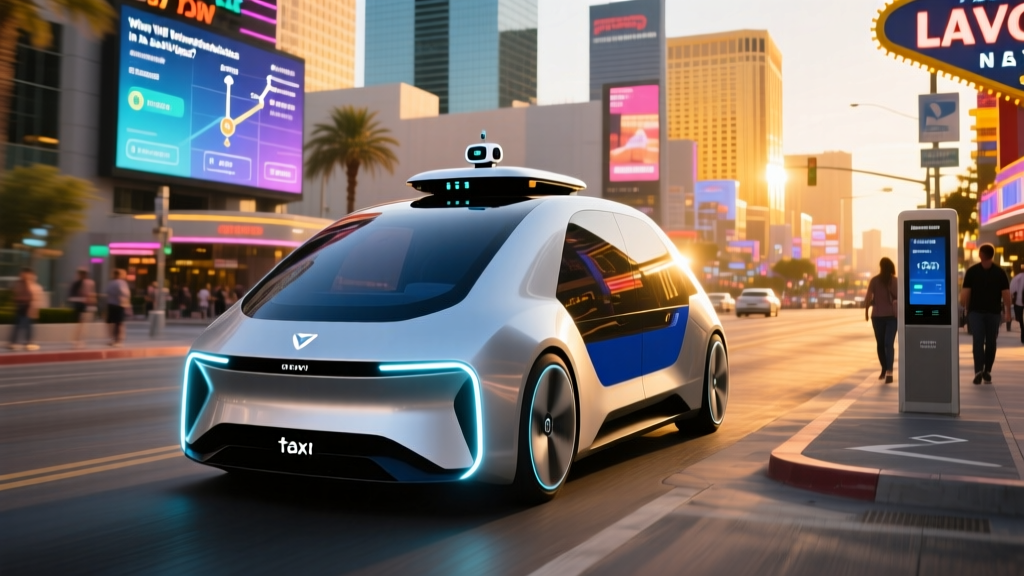
Las Vegas is one of the most ride-hail-heavy cities in the United States, with tens of millions of tourists flooding the Strip and downtown every year. Naturally, that makes it a prime target for robotaxi expansion. But if you have been searching for Waymo Vegas availability, here is the honest answer as of early 2026: Waymo has not yet launched a commercial driverless service in Las Vegas.
That does not mean it is not coming. Waymo (Alphabet's autonomous driving subsidiary) has been steadily expanding its Waymo One service across major U.S. metros, and Las Vegas has appeared in regulatory filings and industry discussions as a likely future market. Below, we break down exactly where Waymo operates today, what a Vegas launch would require, how robotaxi pricing compares to Uber and Lyft, and the real safety data behind Level 4 autonomy.
Where Can You Actually Use Waymo Right Now?
Before speculating about Las Vegas, it is worth grounding expectations in Waymo's current operational footprint. Waymo One — the company's commercial, fully driverless ride-hail service — is live in a limited number of U.S. cities. These are not pilot programs with safety drivers; these are SAE Level 4 operations where no human is behind the wheel.
| City | Status | Service Area Notes |
|---|---|---|
| Phoenix, AZ | Live (since 2020) | Largest geofenced area; covers much of the metro including suburbs and airport routes |
| San Francisco, CA | Live (since 2022) | City-wide coverage after initial limited rollout; expanded to highway-capable routes |
| Los Angeles, CA | Live (since 2024) | Covers central LA, Santa Monica, Hollywood, and expanding zones |
| Austin, TX | Live (since 2025) | Initial geofence covering downtown, South Austin, and airport corridor |
| Las Vegas, NV | Not yet launched | No commercial service; no confirmed public launch date |
Waymo has also been testing in additional cities, but testing with safety drivers is fundamentally different from the paid, driverless Waymo One product available to the public.
What SAE Automation Level Is Waymo — And Why It Matters
This distinction is critical because consumers frequently confuse driver-assist features with true autonomy. Here is how the SAE International automation levels break down for context:
| Level | Name | Who Drives? | Examples |
|---|---|---|---|
| 0 | No Automation | Human does everything | Basic cruise control, warnings only |
| 1 | Driver Assistance | Human drives; system assists steering OR speed | Adaptive cruise, lane-keeping assist |
| 2 | Partial Automation | Human drives; system assists steering AND speed | Tesla Autopilot, GM Super Cruise, Ford BlueCruise |
| 3 | Conditional Automation | System drives in specific conditions; human must take over when asked | Mercedes Drive Pilot (limited markets, low speed) |
| 4 | High Automation | System drives fully within its operational domain; no human needed | Waymo One, Zoox (geofenced areas) |
| 5 | Full Automation | System drives everywhere, all conditions | Does not exist commercially |
Waymo Vegas: What Would a Las Vegas Launch Require?
Las Vegas presents a unique set of opportunities and challenges for robotaxi deployment. The city's characteristics cut both ways:
In Waymo's favor:
- Predictable grid layout: Much of Las Vegas, especially around the Strip and downtown, follows a regular grid with wide, well-marked roads — ideal for mapping and navigation.
- Dry climate: Nevada's arid weather means minimal rain, no snow, and no ice — conditions that challenge lidar and camera systems in other markets.
- Massive ride-hail demand: The Las Vegas Convention and Visitors Authority reports over 40 million annual visitors, most of whom rely on taxis, Uber, and Lyft to move between hotels, the airport, and convention centers.
- Existing AV testing infrastructure: Nevada was one of the first states to pass autonomous vehicle legislation, and companies like Motional (Hyundai/Aptiv) have tested extensively on Las Vegas roads.
Challenges for a Vegas launch:
- Strip congestion and pedestrian chaos: Las Vegas Boulevard features extreme pedestrian density, jaywalking, double-parked vehicles, construction zones, and unpredictable tourist behavior — a stress test for any perception system.
- Regulatory approval process: Nevada's Department of Motor Vehicles and the Nevada Public Utilities Commission both have jurisdiction over commercial autonomous ride services. Waymo would need permits from both.
- Highway driving requirements: Many Vegas trips involve I-15 corridor travel between the airport, Strip, and suburban areas. Waymo has only recently begun adding highway-capable routes in select markets.
- Extreme summer heat: Ambient temperatures regularly exceed 110°F (43°C), which stresses vehicle thermal management systems and sensor calibration.
As of this writing, Waymo has not announced a specific launch date for Las Vegas. Industry analysts and regulatory filings suggest a 2026–2027 timeframe is plausible if Waymo follows its typical expansion pattern — testing first, then a limited trusted-tester program, then a full public launch — but this remains unconfirmed.
How Much Does Waymo Cost vs. Uber and Lyft?
One of the most common questions from potential robotaxi users is pricing. In markets where Waymo One is live, pricing is designed to be competitive with Uber and Lyft — not dramatically cheaper or more expensive. Here is a representative comparison based on observed pricing in active Waymo markets:
| Service | Typical Fare (5 mi) | Surge Pricing? | Tips Expected? |
|---|---|---|---|
| Waymo One | $12–$18 | Limited dynamic pricing; less volatile than rideshare | No (no driver) |
| UberX | $10–$22 | Yes; can 2–3x during peak | Yes (15–20% typical) |
| Lyft Standard | $10–$20 | Yes; similar surge mechanics | Yes (15–20% typical) |
A few things to note about Waymo pricing specifically:
- No tipping: Since there is no driver, there is no tip prompt. This alone can save $2–$4 per ride compared to rideshare.
- Less surge volatility: Waymo uses dynamic pricing, but because it controls its fleet size directly, it does not experience the same wild surge multipliers that Uber and Lyft deploy when driver supply drops.
- Promotional pricing: In new markets, Waymo has historically offered introductory discounts (e.g., first ride free, 50% off first five rides) to build adoption.
- Wait times: In mature markets like Phoenix, average Waymo pickup times are typically 3–7 minutes, comparable to Uber/Lyft in urban areas.
For Las Vegas specifically, if and when Waymo launches, expect airport-to-Strip trips (roughly 4–5 miles) to fall in the $15–$25 range, competitive with current Uber/Lyft fares for that route which typically run $12–$30 depending on demand.
How Safe Are Robotaxis? The Real Data
Safety is the single biggest question around autonomous vehicles, and it deserves a data-driven answer rather than marketing claims. Waymo has published safety reports and has been subject to scrutiny from the National Highway Traffic Safety Administration (NHTSA) and state regulators.
- Cumulative fully driverless miles: Over 10 million driverless miles across all active markets
- Contactable incidents: Waymo's published safety data shows a lower rate of police-reported crash-involved incidents per million miles compared to human driver benchmarks in the same cities
- Most common incident type: Low-speed contact events (typically under 10 mph), often involving other human-driven vehicles rear-ending or sideswiping the Waymo vehicle in stop-and-go traffic
- Fatality record: Zero passenger or pedestrian fatalities in Waymo One driverless operations as of this writing
- NHTSA Standing General Order: Waymo is required to report all crashes involving its ADS-equipped vehicles within specified timeframes; this data is publicly accessible through NHTSA's reporting portal
For context, the human driving fatality rate in the U.S. is approximately 1.35 deaths per 100 million vehicle miles traveled (per NHTSA data). Waymo's operational mileage is not yet large enough to make a statistically definitive comparison at the fatality level, but the available data on injury-involved and property-damage incidents suggests performance at or better than human benchmarks in the geofenced urban environments where it operates.
It is also worth noting that Waymo vehicles have been involved in some publicized incidents — including a 2024 event in San Francisco where a Waymo vehicle was vandalized and set on fire by a crowd, and various low-speed fender-benders. These are real limitations of operating in unpredictable urban environments, and they underscore that Level 4 autonomy is impressive but not infallible.
Waymo's Technology Stack: Lidar, Cameras, and Geofencing
Waymo's approach to autonomy differs fundamentally from Tesla's camera-centric strategy. Here is what powers the current-generation Waymo Driver (installed on Jaguar I-PACE vehicles and the upcoming Zeekr custom robotaxi):
| Sensor Type | Function | Advantage |
|---|---|---|
| Lidar (custom-built) | 360° 3D point cloud of surroundings; precise distance measurement | Works in darkness; centimeter-level accuracy; not fooled by lighting changes |
| Cameras (multiple) | Color imagery for object classification, traffic light state, sign reading | Rich semantic understanding; reads text and signal colors |
| Radar | Velocity detection of moving objects; all-weather penetration | Functions in rain and fog where lidar and cameras degrade |
| Audio sensors | Detects sirens from emergency vehicles | Enables proper yielding behavior before visual confirmation |
| HD Maps + GPS/IMU | Centimeter-precise localization within the geofenced area | Provides a prior expectation of road geometry, lane counts, speed limits |
Geofencing is the operational constraint that makes Level 4 possible. Waymo vehicles only operate within a pre-mapped, pre-approved zone. The system has already "seen" every intersection, crosswalk, and lane configuration in that zone thousands of times during mapping and testing. If a Waymo vehicle approaches the edge of its geofence, it will not proceed — it will pull over safely or reroute within bounds.
This is a key distinction from Tesla's approach. Tesla FSD (Supervised) attempts to drive anywhere using cameras and neural networks alone (no lidar, no HD maps), but it remains a Level 2 system requiring human oversight. Waymo trades geographic flexibility for a dramatically higher confidence level within its operational zone.
The Regulatory Landscape: Who Approves Robotaxi Operations?
Deploying a commercial driverless service in the U.S. is not a single-federal-approval process. It involves a patchwork of state and local authorities:
- State DMV or equivalent: Grants testing and deployment permits for autonomous vehicles on public roads. Requirements vary significantly — California's DMV has a detailed permitting framework, while Nevada's process is governed by Nevada DMV autonomous vehicle regulations established under NRS 482A.
- State public utilities commission: In many states, operating a for-hire transportation service requires approval from the utilities or transportation commission, which regulates fares, insurance, and service obligations.
- NHTSA (federal): Sets vehicle safety standards (FMVSS). Current standards assume a human driver (steering wheel, pedals, mirrors), which is why companies like Waymo and Zoox have sought and received limited exemptions for purpose-built driverless vehicles.
- Local municipalities: City councils and transportation departments can impose additional requirements around pickup/dropoff zones, data sharing, and equity of service coverage.
For a Waymo Vegas launch, the company would need to navigate Nevada's autonomous vehicle framework, which has been relatively AV-friendly since the state passed pioneering legislation in 2011. However, the regulatory process still takes months and requires demonstration of safety performance, insurance coverage, and emergency response protocols.
Current Limitations of Robotaxi Services
Even in cities where Waymo One is fully operational, there are significant constraints that users should understand:
- Geofencing: You cannot take a Waymo anywhere outside its approved zone. A trip from downtown San Francisco to Napa Valley? Not possible. In a future Vegas deployment, this likely means the Strip, downtown, and the airport would be covered, but suburban Henderson or Red Rock Canyon would not.
- Weather limitations: Heavy rain, fog, and snow degrade sensor performance. Waymo's current markets (Phoenix, LA, Austin) were partly chosen for their dry climates. Vegas would share this advantage, but monsoon-season dust storms could still trigger service pauses.
- No highway driving (in most markets): While Waymo has begun expanding to some highway routes, the majority of Waymo One trips are surface-street only. High-speed highway merging and lane changes at 70+ mph remain a frontier challenge.
- Accessibility: Current Waymo vehicles (Jaguar I-PACE) require passengers to enter and exit a standard vehicle. Wheelchair-accessible options are limited. The upcoming Zeekr custom robotaxi is designed with a low floor and wider door opening to address this, but it is not yet in wide deployment.
- Wait times at peak demand: Fleet sizes are limited. During major events (in Vegas, think CES, March Madness, New Year's Eve), wait times could stretch significantly, and dynamic pricing would increase.
- No stops or multi-destination trips: Currently, you request a ride from A to B. You cannot ask the car to stop at a drive-through, wait while you run an errand, or add a second stop mid-trip.
Frequently Asked Questions
Is Waymo available in Las Vegas right now?
No. As of early 2026, Waymo One is not commercially available in Las Vegas. Waymo's live driverless markets are Phoenix, San Francisco, Los Angeles, and Austin. Las Vegas is widely considered a likely future expansion city, but no public launch date has been confirmed.
How much would a Waymo ride cost on the Las Vegas Strip?
Based on pricing in existing Waymo markets, a Strip-to-airport trip (roughly 4–5 miles) would likely cost $15–$25, comparable to Uber and Lyft fares on the same route. Waymo does not charge tips, which provides a small cost advantage over traditional rideshare.
Is Waymo truly self-driving or does it have a safety driver?
Waymo One is a true SAE Level 4 driverless service. There is no human in the driver's seat and no remote operator controlling the vehicle in real time. The vehicle's onboard computer handles all driving tasks within its geofenced zone. This is fundamentally different from Level 2 driver-assist systems like Tesla Autopilot or GM Super Cruise, which require an attentive human driver.
What happens if a Waymo vehicle encounters a situation it cannot handle?
Waymo vehicles are programmed to pull over safely and stop if they encounter an scenario outside their operational capability — for example, an unmapped construction zone or a complete sensor obstruction. Remote support staff can provide high-level guidance (e.g., confirming it is safe to proceed), but they do not remotely steer or drive the vehicle.
Could Waymo partner with a Las Vegas casino or hotel for dedicated service?
This is plausible and has precedent. In other markets, Waymo has explored partnerships with hotels, airports, and event venues to provide dedicated pickup areas. A partnership with a major Strip resort or the Las Vegas Convention Center would be a logical go-to-market strategy, though nothing has been announced.
How does Waymo compare to other robotaxi services like Cruise or Zoox?
Cruise (majority-owned by GM) suspended operations in late 2023 after a serious incident in San Francisco and has been slowly resuming limited testing with safety drivers as of 2025, but has not returned to full commercial driverless service. Amazon's Zoox has been testing its purpose-built bidirectional robotaxi in Las Vegas and other cities but has not yet launched a broad commercial service. Waymo is currently the only company operating a scaled, paid, fully driverless robotaxi service in multiple U.S. cities.