Waymo has operated more commercial driverless rides than every other robotaxi company combined, and that scale is now being priced into its valuation. After raising capital at a reported $30 billion valuation in mid-2024 and expanding aggressively through 2025, Waymo entered 2026 with a private-market valuation that analysts and secondary-market reports place north of $50 billion — a figure that reflects not just technology leadership but the hardest problem in autonomous mobility: turning Level 4 robotaxis into a unit-economics-positive business.
This article breaks down what is actually behind the Waymo valuation number: the cities where cars run today, the SAE automation level involved, the technology stack, the safety data, and the regulatory and operational headwinds that will determine whether that valuation holds.
What Waymo Actually Is — and What SAE Level It Operates At
Waymo, the autonomous-driving subsidiary of Alphabet, runs a commercial robotaxi service called Waymo One. Unlike the Level 2 driver-assist features on consumer vehicles (Tesla Autopilot, Ford BlueCruise, GM Super Cruise), Waymo One vehicles operate with no human driver in the loop. The steering wheel turns itself; no one is watching the road.
Waymo One operates at SAE Level 4 — the vehicle performs all driving tasks within a defined Operational Design Domain (geofenced area, specific weather conditions) with no human intervention required. This is fundamentally different from Level 2 systems (Autopilot, FSD Supervised, BlueCruise), which require continuous driver engagement. Waymo is not "almost self-driving" — within its service area, the car is the driver.
| Level | Name | Driver Required? | Example |
|---|---|---|---|
| 2 | Partial Automation | Yes — always engaged | Tesla Autopilot/FSD Supervised, GM Super Cruise |
| 3 | Conditional Automation | On standby — must take over when asked | Mercedes DRIVE PILOT (limited conditions) |
| 4 | High Automation | No — within geofenced ODD | Waymo One, Zoox |
| 5 | Full Automation | No — anywhere, any condition | Does not yet exist commercially |
Where Can I Use Waymo Right Now? Service Availability by City
Waymo One is not available everywhere — it operates within geofenced zones in a growing but still limited set of metros. As of early 2026, these are the active commercial service areas:
| Metro Area | Status | Coverage Notes |
|---|---|---|
| Phoenix, AZ | Fully open to public | Largest service area; covers ~300+ sq mi including Chandler, Tempe, Mesa, Scottsdale, and airport runs |
| San Francisco, CA | Fully open to public | Citywide coverage after initial waitlist phase; 24/7 operation |
| Los Angeles, CA | Fully open to public | Expanded from initial downtown/Hollywood zone to Westside and Valley areas |
| Austin, TX | Launched / expanding | Initial service zone covering downtown and South Austin corridors |
| Mountain View, CA | Testing / limited access | Alphabet HQ area; employee and invited-rider programs |
Expansion is real but incremental. Waymo has announced testing in additional cities, but only the metros listed above offer rides you can book today through the Waymo One app. Expansion timelines depend on regulatory approval in each jurisdiction — there is no single federal license for robotaxi operation.
How to Use Waymo One — and What It Costs vs. Uber and Lyft
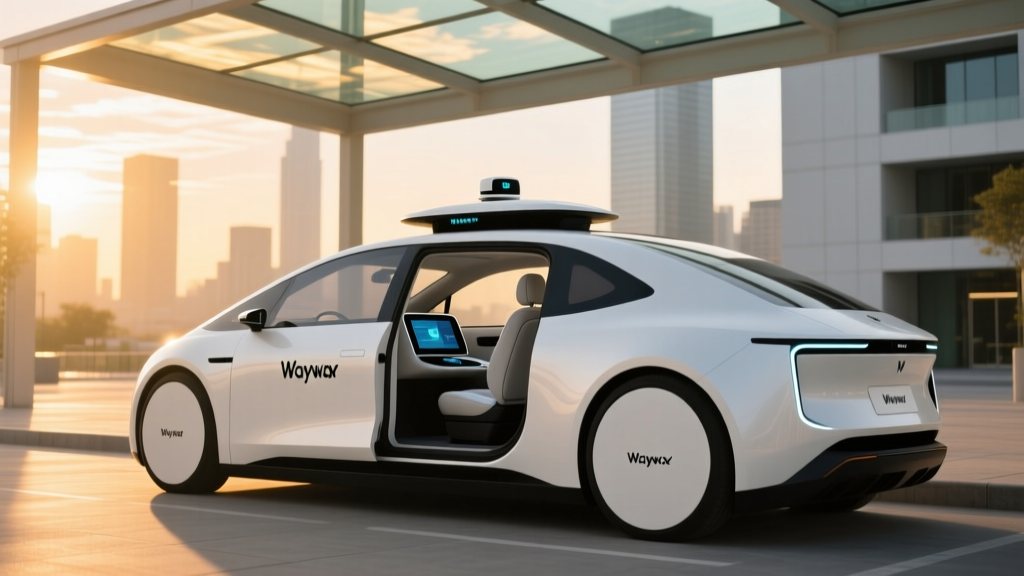
Booking a Waymo One ride works almost identically to a standard rideshare app: enter your pickup and drop-off, confirm the fare, and a Jaguar I-PACE (Waymo's current fleet vehicle, a battery-electric SUV with a 77.4 kWh NMC battery and ~234 miles of EPA range) arrives without a driver.
Typical pricing in the Phoenix and San Francisco markets has been positioned to compete directly with UberX and Lyft's standard tiers, generally ranging from $1.00 to $2.00 per mile depending on demand, time of day, and trip length. Waymo has used promotional pricing and loyalty programs to undercut rideshare during expansion phases.
| Service | Estimated Fare | Surge Pricing? | Wait Time |
|---|---|---|---|
| Waymo One | $7 – $12 | Limited / demand-based | 3–8 min (varies by city) |
| UberX | $8 – $15 | Yes — frequent | 2–6 min |
| Lyft Standard | $8 – $14 | Yes — frequent | 2–7 min |
The key differentiator isn't always price — it's price predictability. Waymo fares don't spike the way Uber and Lyft surge pricing does during peak hours, because Waymo controls fleet supply directly rather than relying on independent drivers deciding whether to log on.
How Safe Are Waymo Robotaxis? Real Data, Not Marketing
Safety is the single most scrutinized dimension of the Waymo valuation, because a serious at-fault incident can shut down operations across an entire city overnight — as Cruise demonstrated in San Francisco in late 2023.
- Cumulative fully-driverless miles: Over 30 million autonomous miles driven (as reported by Waymo through late 2025)
- Contact rate: Waymo's published analysis, peer-reviewed and submitted to NHTSA, showed a ~57% reduction in police-reported crash involvement rate compared to human baseline drivers in comparable urban environments
- Injury severity: Significantly lower rates of crashes involving any reported injury versus human benchmarks in Phoenix and San Francisco operating domains
- Disengagement model: At Level 4, there is no "driver disengagement" metric as there is for Level 2 — instead, Waymo tracks remote-assistance events, where a human specialist reviews a scenario the vehicle cannot resolve autonomously and provides guidance (the vehicle still executes the driving)
Waymo's safety methodology compares its crash rates against human benchmarks derived from NHTSA and insurance-industry data, adjusting for urban driving exposure. The data has been published in peer-reviewed form and shared with regulators. For more on how NHTSA tracks autonomous-vehicle incidents, see the agency's automated vehicle safety page.
The honest caveat: Waymo's operating domain is deliberately chosen to be less risky than average driving. Geofenced urban corridors in good weather are not the same as rural two-lane roads in a snowstorm. The safety numbers are real, but they reflect a constrained environment.
The Technology Stack: Lidar, Cameras, and Geofencing
Waymo's approach to autonomy is sensor-rich and fundamentally different from the camera-dominant strategy used by Tesla's FSD. The current 6th-generation Waymo Driver hardware suite includes:
- Lidar: Multiple high-resolution lidar units providing 360° 3D point-cloud mapping — the core sensor for object detection and distance measurement, unaffected by lighting conditions
- Cameras: High-dynamic-range cameras for lane detection, traffic-signal recognition, and semantic understanding of the driving scene
- Radar: Imaging radar for velocity measurement and redundancy in adverse weather (rain, fog) where lidar and camera performance degrade
- External audio sensors: Microphones to detect sirens from emergency vehicles
- HD mapping: Pre-built centimeter-accurate maps of every operational road — Waymo does not navigate unmapped territory
This multi-sensor fusion approach is more expensive per vehicle than a camera-only system — industry estimates place the Waymo Driver hardware cost at $100,000–$150,000 per vehicle in earlier generations, with the 6th-gen system targeting significant cost reduction. The trade-off is redundancy: if one sensor class is degraded (camera glare at sunset, lidar scatter in heavy rain), the others compensate.
Geofencing is the other critical technology layer. Every Waymo One ride operates within a pre-mapped, pre-approved Operational Design Domain (ODD). The vehicle will not accept a destination outside this boundary. This is what makes Level 4 achievable today — by limiting where the car drives, Waymo eliminates an enormous class of edge cases.
Regulatory Landscape: Who Actually Approves Robotaxi Operations
There is no single federal robotaxi license in the United States. Instead, Waymo navigates a patchwork of state and local approvals:
- California (CPUC + DMV): The California Public Utilities Commission issues permits for commercial passenger service; the DMV separately approves autonomous-vehicle testing and deployment. San Francisco and Los Angeles operations required approval from both bodies.
- Arizona: Arizona has taken a permissive regulatory stance since 2015, with no specific state-level robotaxi permit required beyond standard vehicle registration and insurance. This is why Phoenix was Waymo's first commercial market.
- Texas: Austin operations required coordination with city authorities and compliance with state autonomous-vehicle statutes passed in 2017.
- Federal (NHTSA): NHTSA does not "approve" robotaxi services but maintains authority over vehicle safety standards and can issue recalls or investigate incidents. NHTSA's Standing General Order requires reporting of crashes involving ADS-equipped vehicles.
Every new city requires its own regulatory engagement. This is a major factor in the Waymo valuation: the company has accumulated regulatory approvals and relationships that represent years of work and are difficult for competitors to replicate quickly.
Current Limitations — What Waymo Cannot Do
Understanding the Waymo valuation also means understanding what the technology cannot yet handle. These limitations are not secret — they are built into the system's design:
- Heavy rain and flooding: Service may be suspended or restricted during severe weather. Lidar and camera performance degrades significantly in heavy precipitation.
- Geofence boundary: You cannot book a ride from Phoenix to Tucson. The vehicle will not cross its mapped ODD boundary.
- Construction zones: While Waymo handles routine construction, complex or rapidly changing work zones may trigger remote-assistance pauses or route cancellations.
- No highway-only long-haul: Waymo One is an urban/suburban service. Interstate highway driving between cities is not part of the current offering.
- Pickup/drop-off precision: In dense urban areas, the vehicle may not pull up to the exact door — it uses pre-approved pull-over spots that may require a short walk.
- Accessibility: The current Jaguar I-PACE fleet requires passengers to enter a standard SUV. Wheelchair-accessible vehicles are in development but not yet in wide deployment.
- No food/item delivery (yet): While Waymo has explored partnerships, Waymo One is a passenger service — not a delivery platform at scale.
What Drives the Waymo Valuation — and What Could Undermine It
The reported $50B+ valuation rests on several pillars:
- First-mover operational data: Over 30 million driverless miles generate training data that no competitor currently matches at scale. This data advantage compounds — more miles → better edge-case handling → broader ODD → more riders → more revenue.
- Fleet and infrastructure investment: Thousands of sensor-equipped vehicles, charging infrastructure, remote-assistance operations centers, and maintenance facilities represent hundreds of millions in sunk capital.
- Regulatory moat: CPUC permits, DMV approvals, and city-level agreements in multiple major metros represent years of regulatory work that new entrants cannot shortcut.
- Alphabet backing: Waymo has been funded by Alphabet for over 15 years. This financial runway — combined with Alphabet's infrastructure and talent — gives Waymo a staying power that startups like Cruise (GM-funded but restructured) and Zoox (Amazon-acquired) approach differently.
- Revenue trajectory: With 100,000+ paid trips per week across its markets (as reported in late 2025), Waymo is generating real revenue — but profitability at the unit-economics level (fare per ride minus vehicle depreciation, charging, remote-assistance labor, and maintenance) remains the open question.
What could undermine the valuation: A serious at-fault fatality in a major market could trigger regulatory suspension (as happened to Cruise in California). Hardware cost per vehicle must continue to decline for fleet scaling to be capital-efficient. And competition from Tesla's planned robotaxi network (if it achieves regulatory approval for driverless operation) and from Chinese players like Baidu's Apollo Go (operating at massive scale in Beijing and Wuhan) could compress margins in markets where Waymo eventually expands.
Frequently Asked Questions
Is Waymo truly self-driving, or is there a human watching?
Waymo One operates at SAE Level 4 — there is no human driver in the vehicle. A remote-assistance team monitors fleet operations and can provide guidance when the vehicle encounters a scenario it cannot resolve, but the remote specialist does not "drive" the car in real time. The vehicle's ADS (Automated Driving System) handles all steering, braking, and navigation within its operational domain.
How much does a Waymo ride cost compared to Uber?
Waymo One fares are generally competitive with UberX and Lyft Standard, typically in the range of $1.00–$2.00 per mile depending on the city and time of day. Waymo's pricing tends to be more stable — it does not use the same aggressive surge-pricing model as Uber and Lyft, because fleet supply is controlled directly rather than dependent on gig-economy drivers.
Where is Waymo available in 2026?
Waymo One is currently available to the public in Phoenix (AZ), San Francisco (CA), Los Angeles (CA), and Austin (TX). Testing continues in additional cities, but commercial ride-hailing is limited to these markets. You can check availability and download the Waymo One app to see if your specific address falls within the geofenced service area.
How safe are Waymo robotaxis compared to human drivers?
Waymo's published, peer-reviewed safety data shows approximately a 57% reduction in police-reported crash involvement compared to human baseline drivers in comparable urban environments, based on over 30 million driverless miles. The data has been submitted to NHTSA. However, Waymo operates in geofenced, pre-mapped urban areas in generally favorable weather — a lower-risk environment than the full spectrum of human driving.
Can I use Waymo in heavy rain or snow?
Service may be suspended or restricted during heavy rain, flooding, or other severe weather conditions. Waymo's lidar and camera systems degrade in heavy precipitation. Snow operations are not currently part of Waymo One's service offering — Phoenix, San Francisco, Los Angeles, and Austin are markets chosen in part for their favorable weather profiles.
What vehicle does Waymo use?
Waymo One's current fleet consists of the Jaguar I-PACE, a battery-electric SUV with a 77.4 kWh NMC battery, approximately 234 miles of EPA range, and a 90 kW DC fast-charging capability. Waymo has also announced partnerships with Geely/Zeekr for a purpose-built robotaxi vehicle designed for future fleet deployment.