Waymo and Uber Are Bringing Driverless Rides to Atlanta
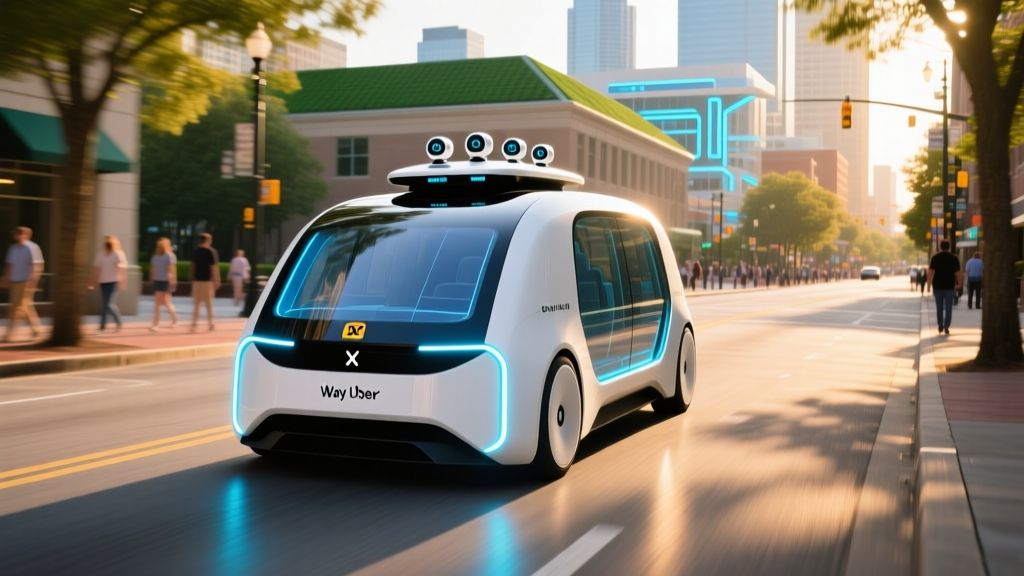
After years of operating exclusively in a handful of West Coast and Sun Belt metros, Waymo's driverless ride-hail service is arriving in Atlanta through a partnership with Uber. For riders in the ATL metro, the promise is straightforward: summon a fully autonomous vehicle through the Uber app, with no human behind the wheel. But the rollout comes with real geographic boundaries, pricing nuances, and weather limitations that buyers and riders need to understand before they tap "request ride."
This guide breaks down exactly where the Waymo Uber robotaxi Atlanta service operates, what it costs relative to standard Uber and Lyft rides, the safety data behind Waymo's Level 4 system, the sensor suite powering the Jaguar I-PACE fleet, and the regulatory framework that allowed it to launch in Georgia.
Is This Truly Self-Driving or Just Driver-Assist?
SAE Automation Level: Level 4 (High Automation)
Waymo's robotaxis operate at SAE Level 4 — meaning the vehicle handles all driving tasks within its defined operational design domain (ODD) with no human driver required. There is no steering wheel interaction, no "take over" request, and no passenger responsibility for driving. This is fundamentally different from consumer systems like Tesla FSD (Supervised), GM Super Cruise, or Ford BlueCruise, which are SAE Level 2 and require continuous driver engagement.
| SAE Level | Name | Who Drives? | Examples |
|---|---|---|---|
| Level 0 | No Automation | Human | Legacy vehicles |
| Level 1 | Driver Assistance | Human (one axis assisted) | Adaptive cruise OR lane-keep |
| Level 2 | Partial Automation | Human (must supervise) | Tesla Autopilot, FSD Supervised, BlueCruise, Super Cruise |
| Level 3 | Conditional Automation | System (human on standby) | Mercedes DRIVE PILOT (limited markets, ≤40 mph) |
| Level 4 | High Automation | System (no human needed in ODD) | Waymo One, Zoox |
| Level 5 | Full Automation | System (everywhere, all conditions) | Does not yet exist commercially |
The distinction matters enormously. When you ride in a Waymo vehicle in Atlanta, you are in a Level 4 robotaxi. The vehicle navigates, makes lane changes, handles unprotected left turns, and responds to pedestrians — all without any human input. If the system encounters a scenario it cannot handle, it performs a minimal-risk maneuver (pulling over safely) rather than handing control to a passenger.
Where Can You Use the Waymo Uber Robotaxi in Atlanta?
Waymo's Atlanta service area launched in phases, starting with a geofenced zone covering the city's densest and most ride-demand-rich corridors. As of early 2026, the operational footprint includes:
| Zone | Key Destinations | Status |
|---|---|---|
| Downtown / Midtown | Centennial Olympic Park, Mercedes-Benz Stadium, Piedmont Park, Georgia Tech | Live |
| Buckhead | Lenox Square, Phipps Plaza, Buckhead business district | Live |
| West Midtown / Howell Mill | Restaurants, breweries, The Battery Atlanta (partial) | Live |
| Old Fourth Ward / Inman Park | Ponce City Market, BeltLine Eastside Trail, Krog Street Market | Live |
| Airport (ATL) | Hartsfield-Jackson International Airport | Announced — not yet live |
| Decatur / Eastside suburbs | Decatur Square, Emory University | Not yet available |
Critical detail: The geofence is strict. You cannot request a ride that begins or ends outside the mapped service area. If your destination falls outside the boundary, the Uber app will not offer Waymo as a ride option for that trip. Waymo has historically expanded its geofence incrementally as it validates new road segments, so the coverage map is expected to grow throughout 2026.
To request a ride, open the Uber app in Atlanta and enter your destination. If both your pickup and drop-off are within the geofence, you will see a "Waymo" vehicle option alongside UberX, Comfort, and other tiers. Select it, confirm, and a driverless Jaguar I-PACE will be dispatched.
Pricing: Waymo Robotaxi vs. Uber and Lyft in Atlanta
Waymo rides on Uber are priced competitively with standard UberX — not at a premium. Waymo and Uber have structured the partnership so that robotaxi rides appear as a peer option, not a luxury tier. Here is how typical fares compare based on early Atlanta market data:
| Ride Type | Base Fare | Per-Mile Rate | Typical 5-Mile Trip |
|---|---|---|---|
| Waymo (via Uber) | ~$2.50 | ~$1.25/mi | $9–$13 |
| UberX | ~$2.00 | ~$1.10/mi | $8–$12 |
| Lyft Standard | ~$2.00 | ~$1.05/mi | $7–$11 |
| Uber Comfort | ~$3.00 | ~$1.50/mi | $11–$15 |
Key pricing notes:
- No tip required. There is no driver to tip, which effectively saves riders 15–20% versus a standard rideshare where tipping is customary.
- Surge pricing applies. During peak demand (concerts at Mercedes-Benz Stadium, rush hour on Peachtree), Waymo fares surge just like UberX. Availability may also be limited during these windows.
- Wait times are longer. With a smaller fleet than UberX, expect 5–12 minute wait times versus 2–5 minutes for a human-driven UberX in the same zone.
Safety Record: What the Data Actually Shows
Waymo Safety Data (as of Q4 2025):
- Total autonomous miles driven: Over 40 million fully driverless miles across all markets (Phoenix, San Francisco, Los Angeles, Austin, Atlanta)
- Injury-causing crash rate: 85% lower than human benchmarks in Waymo's published safety reports, based on police-reportable crashes per million miles
- Contact rate: Waymo vehicles make contact with objects (including minor curb strikes and low-speed interactions) at roughly 5.1 per million autonomous miles, compared to a human benchmark of approximately 18 per million miles for comparable urban driving
- Fatalities: Zero passenger or pedestrian fatalities attributed to Waymo's autonomous driving system as of early 2026
Waymo publishes its safety data through peer-reviewed studies and reports submitted to NHTSA. The company compares its crash rates to human benchmarks derived from the National Highway Traffic Safety Administration's crash databases, adjusting for the urban environments where its vehicles operate.
That said, Waymo vehicles have been involved in minor incidents — typically low-speed contact with stationary objects, construction-zone confusion, or interactions with improperly parked vehicles. In San Francisco, a small number of incidents involving school buses and first-responder vehicles drew scrutiny from the California DMV and NHTSA, prompting software updates to the Waymo Driver's edge-case handling.
Atlanta-specific context: Atlanta's road network presents different challenges than Phoenix (wide, gridded) or San Francisco (dense, hilly). Atlanta's mix of multi-lane arterials (Peachtree Street, Northside Drive), frequent construction zones along the I-75/I-85 connector, and heavy pedestrian activity around the BeltLine all test the system's perception stack in distinct ways. Early Atlanta operations include a safety operator monitoring phase before fully driverless rides are enabled in each new zone.
Technology Stack: Lidar, Cameras, and the Jaguar I-PACE Platform
Waymo's robotaxi fleet in Atlanta uses the Jaguar I-PACE — a battery-electric SUV with a 90 kWh battery pack (NMC chemistry), an EPA range of approximately 234 miles, and a dual-motor all-wheel-drive powertrain producing 394 horsepower. The I-PACE was selected for its spacious cabin, smooth ride quality, and EV architecture that integrates cleanly with Waymo's power-hungry sensor and compute suite.
The autonomous driving system — branded the Waymo Driver (6th generation as of 2025) — uses a multi-sensor fusion approach:
| Sensor Type | Count | Function |
|---|---|---|
| Lidar (custom-built) | 5 units | 360° 3D point cloud; object detection and distance measurement to ~500 meters |
| Cameras (high-resolution) | 29 units | Traffic light state, sign reading, lane markings, pedestrian intent |
| Radar (imaging) | 6 units | Velocity measurement of moving objects; works in rain/fog where lidar degrades |
| External audio receivers | Multiple | Detects sirens from emergency vehicles (ambulance, fire, police) |
Lidar vs. camera-only — why it matters: Tesla's FSD system relies exclusively on cameras (a "vision-only" approach). Waymo's use of lidar provides direct depth measurement that does not depend on lighting conditions, giving it a significant advantage at night, in high-contrast glare, and when judging the precise distance of partially occluded objects. The trade-off is higher hardware cost — the 6th-generation Waymo Driver suite is estimated to add $30,000–$50,000 in sensor and compute hardware per vehicle, which is why the system is viable only for fleet-operated robotaxis, not consumer vehicles.
The compute stack runs on custom-designed system-on-chip (SoC) hardware mounted in the vehicle's cargo area, processing over 100 GB of sensor data per minute. All routing and driving decisions are made on-board; the vehicle does not require a continuous cellular connection to operate, though it maintains one for fleet management and remote assistance.
Geofencing and HD mapping: Waymo vehicles operate only on pre-mapped road segments. Before any zone goes live, Waymo's mapping vehicles drive every lane multiple times to build a centimeter-accurate HD map that includes lane geometry, traffic signal positions, crosswalk locations, speed limits, and construction-zone boundaries. The production robotaxis localize against this map in real time. If the map data is outdated (e.g., a new construction zone appears), the vehicle will route around it or pull over rather than guess.
Regulatory Landscape: Who Approved Robotaxis in Atlanta?
Unlike California and Arizona, which have well-established regulatory frameworks for autonomous vehicle testing and commercial deployment, Georgia's path to permitting robotaxis has been more legislative than regulatory:
- Georgia HB 472 (2017): This state law legalized the operation of autonomous vehicles on public roads, defined requirements (insurance, registration, compliance with traffic laws), and notably did not require a human safety operator to be present. This made Georgia one of the more permissive states for driverless operations.
- No state-level permit process: Unlike California (where the DMV issues testing and deployment permits) or Arizona (where the DOT manages an AV program), Georgia does not have a specific autonomous vehicle licensing authority. Waymo operates under standard vehicle registration and commercial insurance requirements.
- City of Atlanta coordination: The City of Atlanta and the Atlanta Department of Transportation have worked with Waymo on operational details — pickup/dropoff zones, data sharing, and coordination with first responders. This is a municipal-level agreement, not a state permit.
- Federal oversight: NHTSA retains authority over vehicle safety standards and investigates incidents involving autonomous systems. Waymo is required to report certain crashes under NHTSA's Standing General Order for ADS-equipped vehicles.
The result is a regulatory environment that allowed Waymo to move into Atlanta without the protracted permit battles that characterized its San Francisco expansion. However, the absence of a formal state AV permit program also means less public transparency about operational metrics compared to California, where Waymo must submit regular disengagement reports.
Current Limitations: What the Waymo Robotaxi Cannot Do
Operational limitations of Waymo's Atlanta service (early 2026):
- Weather constraints: Heavy rain, fog, and ice reduce lidar and camera performance. Waymo vehicles will pause operations or refuse rides during severe weather events (thunderstorms with heavy downpours, ice storms). Atlanta's occasional winter ice events may cause multi-day service suspensions.
- Geofence boundaries: The service area covers approximately 40–50 square miles of central Atlanta. Trips to the northern suburbs (Alpharetta, Roswell), southern suburbs (East Point beyond the geofence, College Park), or the airport are not yet available.
- No highway driving (initially): Waymo's Atlanta ODD currently focuses on surface streets and lower-speed arterials. Limited-access highway segments (I-75, I-85, I-20, GA-400) may not be part of the initial routing options, meaning cross-town trips that would normally use the interstate will take longer surface-street routes.
- Construction zones: While Waymo's 6th-generation system handles many construction scenarios, complex lane shifts with temporary barriers or flaggers directing traffic can cause the vehicle to stop and request remote assistance. Expect occasional delays in active construction corridors.
- Limited fleet size: Atlanta's initial Waymo fleet is estimated at 50–100 vehicles — a fraction of the UberX driver pool. During peak hours, wait times can extend to 15+ minutes, and the app may show "no Waymo vehicles available."
- No multi-stop trips: Waymo rides on Uber currently support single pickup and single drop-off only. You cannot add a stop along the way.
- Accessibility: The Jaguar I-PACE fleet is not wheelchair-accessible. Waymo has stated it is evaluating accessible vehicle options but has not announced a timeline for wheelchair-ramp-equipped robotaxis in Atlanta.
Frequently Asked Questions
Can I request a Waymo robotaxi from Hartsfield-Jackson Airport (ATL)?
Not yet. Airport service has been announced as a planned expansion but is not live as of early 2026. You can use Waymo in the city and take a standard Uber or MARTA to the airport, but the robotaxi will not pick up or drop off at ATL terminals until the geofence is extended and airport-specific operational agreements are finalized.
Is there a human driver or safety operator in the Waymo vehicle?
No. Once a zone transitions to fully driverless operations, the front seats are empty. There is no steering wheel or pedal assembly accessible to passengers. Some early-phase zones may use a safety operator during the validation period, but commercial rides offered through the Uber app are driverless.
How does Waymo's safety record compare to human Uber drivers?
Based on Waymo's published safety data, the company's injury-causing crash rate is approximately 85% lower than the human benchmark for comparable urban driving environments. However, direct comparison is complicated by the fact that Waymo operates in geofenced, pre-mapped areas and pulls over in conditions it cannot handle — advantages that a human Uber driver navigating unfamiliar routes in adverse weather does not have. NHTSA continues to monitor and investigate AV safety across all operators.
What happens if the Waymo vehicle gets confused or stuck?
The vehicle's system will attempt to resolve the situation autonomously (e.g., rerouting, waiting for a construction zone to clear). If it cannot, it performs a minimal-risk maneuver — typically pulling to the curb and stopping. A remote assistance operator (a human monitoring the fleet from a operations center) can then provide high-level guidance, such as confirming it is safe to proceed past an unusual obstacle. The remote operator does not "drive" the vehicle in real time; they approve or reject proposed maneuvers.
Will Waymo replace Uber drivers in Atlanta?
Not in the near term. Waymo's fleet of 50–100 vehicles handles a small fraction of Atlanta's daily rideshare demand. Uber has positioned the partnership as complementary — Waymo handles rides within its geofence where supply is constrained, while human Uber drivers continue to serve the broader metro area, airport runs, and trips outside the Waymo zone. Uber CEO Dara Khosrowshahi has stated the company views AVs as part of a mixed fleet for the foreseeable future.
What vehicle will pick me up?
All Waymo robotaxi rides in Atlanta use the Jaguar I-PACE (battery electric, 90 kWh NMC battery, ~234 miles EPA range, 394 HP, AWD). The interior features a custom passenger interface with screens showing the vehicle's perception of its surroundings — you can see what the lidar and cameras "see" in real time during your ride.