What the Waymo Uber Partnership Actually Means
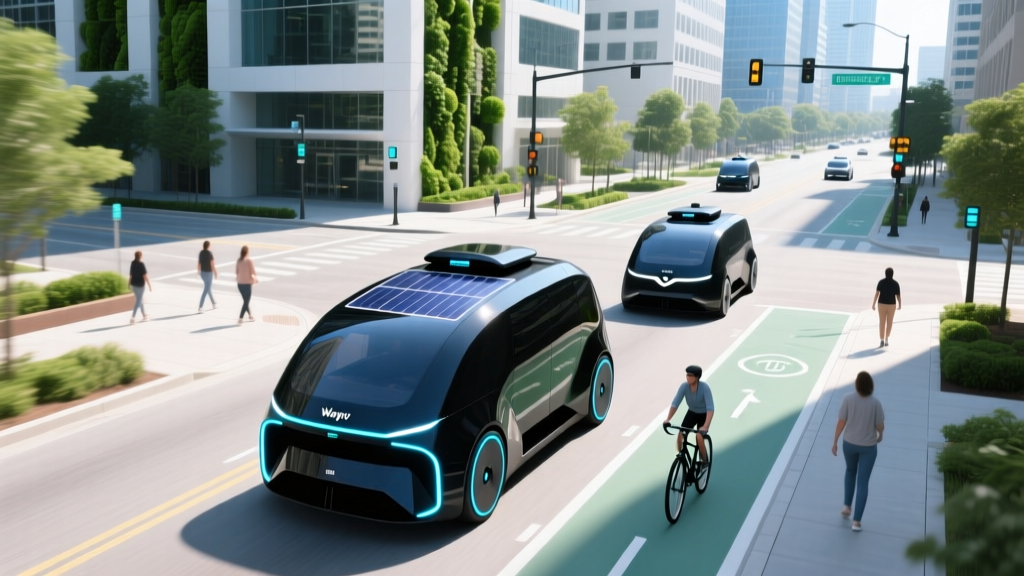
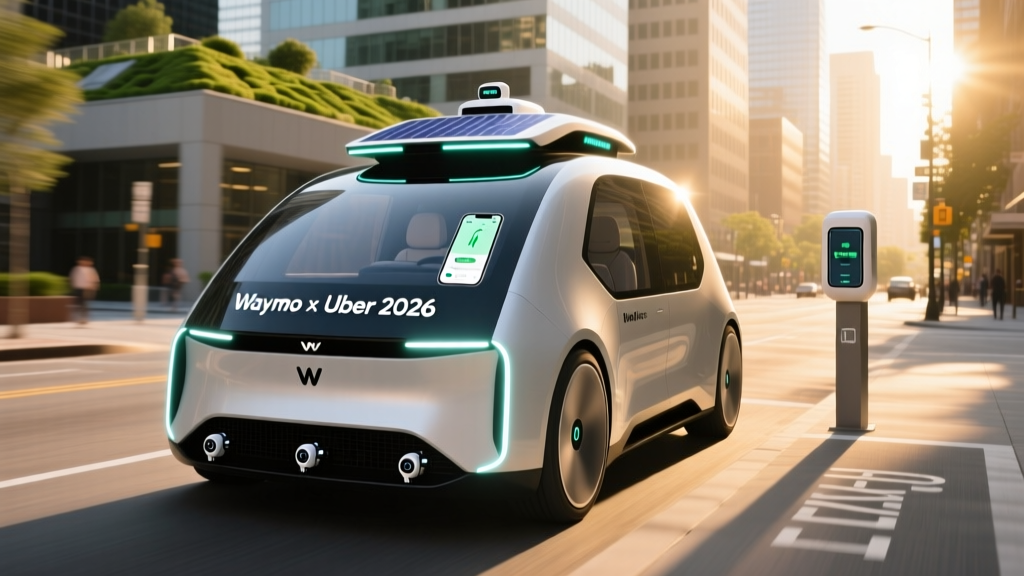
The Waymo Uber partnership is no longer a proof-of-concept — it is a live, revenue-generating integration that lets Uber users in select U.S. cities hail a driverless Waymo vehicle directly through the Uber app. Originally announced in late 2024 and expanded through 2025 and into 2026, the deal places Waymo's sixth-generation Jaguar I-PACE robotaxi fleet (and, increasingly, the purpose-built Zeekr M-Vision) onto the Uber platform as a bookable ride option alongside UberX, Comfort, and Black.
For riders, the practical result is simple: when a Waymo vehicle is in range and available, the Uber app surfaces a "Waymo" ride option with its own upfront price. The car arrives with no human behind the wheel, unlocks its doors via the app, and completes the trip on a geofenced roadway network that Waymo has mapped and validated. The partnership is significant because it solves Waymo's biggest historic weakness — rider acquisition — by plugging into Uber's existing demand base of tens of millions of monthly active users, rather than forcing every new rider to download a standalone Waymo One app.
SAE Automation Level: Level 4 (High Automation)
Waymo's robotaxi service operates at SAE Level 4 within its defined Operational Design Domain (ODD). The vehicle performs all driving tasks — steering, braking, route planning, obstacle response — without any human driver, and no rider intervention is expected or possible. This is categorically different from Tesla Autopilot or FSD (Supervised), which remain SAE Level 2 systems requiring continuous driver attention. Level 5 (full autonomy everywhere, in all conditions) does not yet exist in any commercial service.
Where Can You Use the Waymo Uber Partnership Right Now?
As of mid-2026, Waymo robotaxis bookable through Uber are available in a defined subset of Waymo's broader commercial footprint. Not every Waymo city is on Uber, and not every neighborhood within a Waymo city is inside the geofence.
| Metro Area | Service Zone | Uber Integration | Hours |
|---|---|---|---|
| Phoenix, AZ | ~250 sq mi (Tempe, Scottsdale, Chandler, downtown Phoenix, Sky Harbor airport) | Live | 24/7 |
| San Francisco, CA | Most of SF proper, including SFO airport runs | Live | 24/7 |
| Los Angeles, CA | Santa Monica, Beverly Hills, Hollywood, Downtown LA, LAX corridor | Live | 24/7 |
| Austin, TX | Central Austin, downtown, South Congress, airport corridor | Live (2025 rollout) | 24/7 |
| Atlanta, GA | Midtown, Downtown, Buckhead (phased) | Announced / early access | Limited hours initially |
Key nuance: Waymo's geofence is not the entire metro area. A trip from downtown Phoenix to North Scottsdale will work; a trip from Phoenix to Tucson will not. The Uber app will only surface the Waymo option when both pickup and drop-off fall inside the approved ODD. Riders outside the zone see standard UberX and other human-driven options.
How to Hail a Waymo Through Uber (and What It Costs)
Booking a Waymo via Uber is identical to any other ride request: enter your destination, and if a Waymo is available in your zone, it appears as a distinct ride tier — typically labeled "Waymo" or "Waymo autonomous" — with an upfront price. You confirm, the app shows the specific vehicle's license plate and ETA, and on arrival you unlock the doors from the rear-seat screen or the app. In-cabin screens display your route, let you adjust climate, and offer music controls.
| Ride Type | Typical Base Fare (5-mi trip) | Per-Mile | Surge Behavior |
|---|---|---|---|
| UberX (human driver) | $12–$18 | $1.25–$1.75 | High variability |
| Waymo via Uber | $14–$22 | $1.40–$1.90 | Limited; algorithmic pricing |
| Waymo One (standalone app) | $13–$21 | $1.40–$1.90 | Similar to Uber integration |
| Uber Comfort | $16–$24 | $1.60–$2.10 | High variability |
Waymo pricing is typically set at a small premium to UberX — often 10–20% higher on short trips — but tends to be more stable during peak demand because the fleet's supply is algorithmically managed rather than dependent on individual driver decisions. On longer airport runs (e.g., Downtown LA to LAX), Waymo pricing has frequently undercut UberX during surge periods. Tipping is not expected or prompted, which on a typical $20 ride saves $3–$5 versus a human-driven trip.
How Safe Are Waymo Robotaxis? The Data
Waymo publishes safety data periodically and has been the subject of independent analyses by insurers and researchers. The most relevant benchmark is the rate of reported incidents per million autonomous miles driven, compared to human-driver baselines from the National Highway Traffic Safety Administration (NHTSA).
Waymo Safety Snapshot (through early 2026)
- Cumulative autonomous miles: Over 30 million fully driverless miles across Phoenix, SF, LA, and Austin.
- Property-damage-only contact rate: Waymo's published data shows roughly 5–7 at-fault contacts per million autonomous miles — compared to the U.S. human-driver benchmark of approximately 15–18 per million miles for comparable urban driving.
- Injury-involved incidents: Extremely low single digits across the entire cumulative fleet mileage; the vast majority of contacts are low-speed, low-severity events (e.g., a pole scrape, a minor tap from a reversing vehicle).
- Insurance data: Swiss Re's multi-year analysis of Waymo's Phoenix and SF operations found a meaningful reduction in injury-causing claims versus the human-driver control group.
Context: Robotaxis drive conservatively and are most frequently involved in incidents caused by other road users — rear-endings at stoplights, delivery trucks drifting into their lane, or cyclists threading between stopped cars. Waymo's sensor stack is strong at detecting these scenarios, but physics still applies to braking distance.
Riders should understand that "safe" does not mean "incident-free." It means the per-mile risk profile is measurably lower than the human-driver baseline in the environments where the service operates. NHTSA Standing General Order data — which requires all ADS operators to report crashes — is publicly searchable and provides a transparent, if imperfect, record.
Inside the Tech Stack: Lidar, Cameras, and the 6th-Gen System
The Waymo vehicles bookable through Uber use the company's sixth-generation "Waymo Driver" hardware suite. Unlike Tesla's camera-only approach, Waymo relies on a redundant, multi-modal sensor stack:
Waymo 6th-Gen Sensor Suite
- Lidar: Multiple custom-built, high-resolution lidar units providing a 360° 3D point cloud with range beyond 500 meters — critical for detecting pedestrians and small objects at night or in glare.
- Cameras: Dozen+ high-dynamic-range cameras covering all directions, optimized for traffic-light state detection, sign reading, and lane-marking classification.
- Imaging radar: New external imaging radar units that see through rain, fog, and dust more effectively than lidar or cameras alone, reducing weather-related service disruptions.
- Audio detection: External microphones that can identify approaching emergency-vehicle sirens before they are visible, allowing preemptive pull-over behavior.
- Compute: Custom-designed onboard AI inference hardware, replacing earlier off-the-shelf units, with lower power draw and higher throughput for the neural-network perception stack.
The combination matters for a specific reason: no single sensor modality works well in every condition. Cameras struggle in direct sun glare and darkness; lidar degrades in heavy precipitation; radar has lower spatial resolution. Waymo's fusion layer cross-checks all three, which is why the service can operate at night and in moderate rain — scenarios where camera-only systems typically disengage or request driver takeover (which, in a driverless robotaxi, is not an option).
Mapping is also central. Waymo vehicles operate only on pre-mapped roadways, where a high-definition prior map provides a baseline understanding of lane geometry, curb locations, and permanent infrastructure. The perception stack then handles the dynamic world — other vehicles, pedestrians, construction zones, temporary signage — in real time.
Regulatory Landscape: Who Approves Robotaxi Operations?
Robotaxi deployment in the United States is not federally pre-empted; it is governed primarily at the state level, with a patchwork of regulators:
- California: The California Public Utilities Commission (CPUC) issues permits for commercial passenger service, while the DMV issues testing and deployment permits. Waymo holds full commercial deployment permits in both SF and LA.
- Arizona: Among the most permissive regulatory environments. Waymo has operated commercially in Phoenix since 2020 under a relatively light-touch state framework.
- Texas: Austin's rollout proceeded under state autonomous-vehicle legislation passed in 2017, with local coordination on geofencing and emergency-services integration.
- Federal role: NHTSA oversees vehicle safety standards and crash reporting (Standing General Order), but does not currently issue operational permits for robotaxi services. The FMVSS exemption process for vehicles without steering wheels (relevant to the Zeekr M-Vision) remains case-by-case.
The CPUC process in California is particularly instructive: operators must demonstrate safety case documentation, incident-response procedures, insurance coverage, and equity-of-access plans before commercial deployment is authorized. This is not a rubber stamp — permits can be (and have been) suspended or restricted following safety incidents.
Current Limitations: Where the Service Falls Short
Even at SAE Level 4, Waymo robotaxis are far from universal. Understanding the limitations is essential for any rider setting expectations:
- Geofencing: Service is confined to pre-mapped zones. Trips that cross outside the ODD — even by one block — cannot be booked.
- Weather: Moderate rain is handled; heavy downpours, dense fog, and any snow or ice typically trigger service suspension or refusal to dispatch. Phoenix in monsoon season and SF in heavy fog can see reduced availability.
- Construction and road closures: Major, unmapped construction can cause the vehicle to stop and request remote guidance. Expect longer trip times or reroutes in rapidly changing urban work zones.
- No highway driving (most markets): As of 2026, Waymo's robotaxi service is primarily surface-street. Limited highway segments (e.g., specific Phoenix and LA freeway corridors to airports) are approved, but cross-city freeway trips are not generally available.
- Pickup/drop-off precision: The vehicle will pull to a safe, legal curb — not necessarily the exact front door you envisioned. Large apartment complexes, gated communities, and private driveways may be inaccessible.
- Capacity: The Jaguar I-PACE robotaxi seats up to 3 rear passengers. No car seats, no wheelchair-accessible vehicles in the current fleet, and cargo space is limited to what fits in the trunk (no frunk access in the robotaxi configuration).
- Wait times: In peak hours outside dense service cores, wait times can stretch to 15–25 minutes, longer than a typical UberX ETA, because the Waymo fleet is smaller than the human-driver supply.
Waymo Uber Partnership vs. Standalone Waymo One: Which App?
Riders in Waymo markets effectively have two front doors to the same service: the Uber app and the standalone Waymo One app. Pricing is broadly similar, but there are practical differences. Uber's integration gives you a single app for both robotaxi and human-driven rides, which is valuable when a Waymo is unavailable or your trip falls outside the geofence. Waymo One occasionally offers loyalty promotions and more granular preferences (favorite stops, saved home/work addresses) and may surface Waymo availability a few seconds faster because it does not have to reconcile with Uber's broader dispatch logic.
For travelers who already use Uber in their home city, the Uber integration is the path of least resistance — no new account, no new payment method, no new app to learn. For Phoenix or SF residents who ride Waymo multiple times per week, Waymo One's dedicated experience is marginally smoother.
FAQ: Waymo Uber Partnership Questions Answered
Is Waymo on Uber truly self-driving, or is there a safety driver?
Truly driverless. There is no human in the front seat, no remote teleoperator "driving" the car in real time. Remote support staff can provide high-level route guidance if the vehicle encounters an unusual scenario, but the vehicle performs all dynamic driving tasks itself. This is SAE Level 4 within its ODD — categorically different from Level 2 driver-assist systems like Tesla Autopilot or GM Super Cruise, which require a human driver.
How much does a Waymo via Uber cost compared to a regular UberX?
Typically 10–20% higher on short urban trips, but often comparable or cheaper on airport runs during surge pricing, because Waymo's algorithmic pricing is less prone to the sharp spikes human-driver UberX experiences. No tipping is expected, which effectively narrows the gap further.
What happens if the Waymo gets into an accident during my ride?
Waymo carries commercial insurance for its robotaxi operations. The vehicle is programmed to stop safely, contact emergency services if needed, and alert Waymo support. Riders are treated as passengers in a commercially insured vehicle — similar to a taxi or rideshare incident, with Waymo and its insurers handling liability.
Can I use the Waymo Uber partnership in any city?
No. As of 2026, the service is live in Phoenix, San Francisco, Los Angeles, and Austin, with Atlanta in early rollout. Expansion to additional cities is ongoing but gated by regulatory approval, mapping, and fleet deployment timelines.
Does the Waymo work at night and in bad weather?
Night operation is fully supported — the lidar and imaging radar stack performs well in darkness. Light to moderate rain is handled. Heavy rain, snow, ice, and dense fog typically result in service suspension or reduced availability, because sensor performance degrades and road conditions exceed the system's validated ODD.
Is this partnership exclusive to Uber?
No. Waymo has also partnered with other mobility platforms and maintains its own Waymo One app. The Uber partnership is the largest third-party distribution channel but is not exclusive, and Waymo has signaled intent to integrate with additional apps over time.
Sources: NHTSA Standing General Order crash data; California Public Utilities Commission (CPUC) AV program permits; Waymo safety reports and technical publications.