Waymo Tampa: What's Actually Happening in 2026
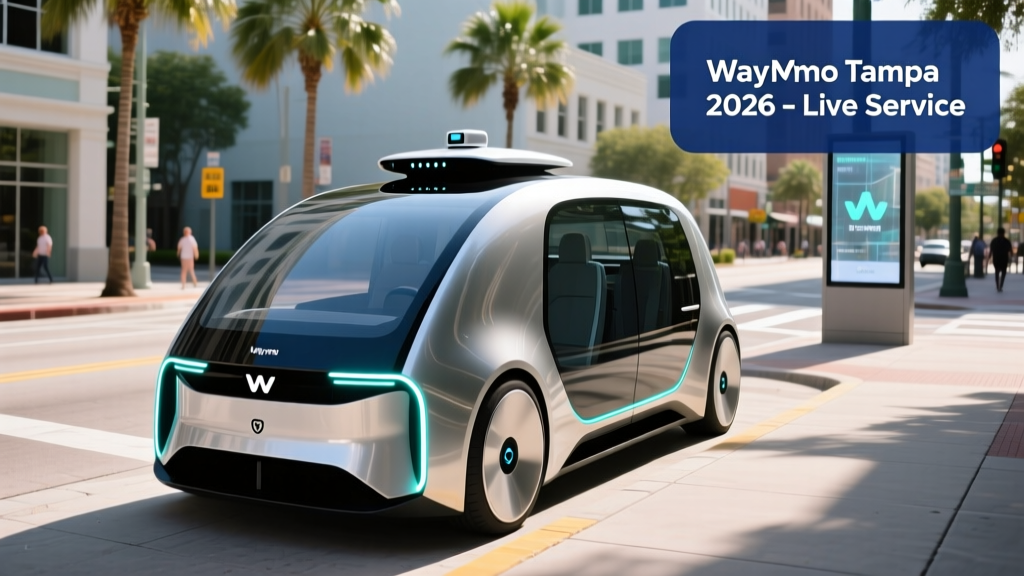
If you've been searching for "Waymo Tampa" hoping to hail a driverless ride across the Bay, the short answer is: Waymo's commercial robotaxi service is not yet live in Tampa as of early 2026. However, Tampa has appeared in Waymo's broader Florida expansion roadmap, and the company has been laying groundwork across the Sunshine State. Here's what we know with certainty, what's still pending, and what the data says about robotaxi readiness in Florida's Gulf Coast metro.
This guide separates confirmed facts from speculation, pulls real safety and pricing data from Waymo's active markets, and gives you a framework for understanding when — and if — a driverless Waymo will pull up to your curb in Ybor City or Channelside.
Where Can I Use Waymo Right Now?
Before projecting Tampa's timeline, it's critical to understand where Waymo's commercial service actually operates today. Waymo One, the company's paid rider-hailing product, is geofenced to specific operational design domains (ODDs) — carefully mapped zones where the system has been validated for driverless operation.
| City | Service Status | Approx. Geofence Coverage | Vehicle Platform |
|---|---|---|---|
| Phoenix, AZ (Metro) | Fully commercial, open to public | ~300+ sq mi across Chandler, Tempe, Mesa, Scottsdale, Gilbert | Jaguar I-PACE (Gen 5), Zeekr RT (Gen 6) |
| San Francisco, CA | Fully commercial, open to public | ~50+ sq mi, expanding across SF peninsula | Jaguar I-PACE (Gen 5), Zeekr RT (Gen 6) |
| Los Angeles, CA | Fully commercial, open to public | ~80+ sq mi covering Hollywood, Santa Monica, Downtown, Beverly Hills | Jaguar I-PACE (Gen 5), Zeekr RT (Gen 6) |
| Austin, TX | Commercial launch in progress (2025–2026 rollout) | Initial downtown/south Austin zones | Zeekr RT (Gen 6) |
| Tampa, FL | Not yet announced for commercial service | N/A | N/A |
Phoenix remains Waymo's most mature market, with over six years of continuous commercial driverless operations. San Francisco and Los Angeles followed with high-density urban environments that stress-test the system in ways suburban Tampa would not. Austin represents Waymo's newest expansion frontier.
Florida as a state is important to Waymo — the company has conducted testing in various Florida locations — but a commercial Tampa deployment has not received a public launch date. Any service in Tampa would require completing the same phased approach: mapping, testing with safety drivers, limited early-rider programs, and finally open commercial access.
Understanding the Autonomy Level: Level 4, Not Level 2
This distinction is the single most important concept in the robotaxi conversation, and it's routinely muddled in mainstream coverage.
| SAE Level | Definition | Examples | Driver Required? |
|---|---|---|---|
| Level 2 | Driver-assist: steering + acceleration support under human supervision | Tesla Autopilot, FSD (Supervised), GM Super Cruise, Ford BlueCruise | Yes — always |
| Level 3 | Conditional automation: system drives in limited conditions, human must take over when requested | Mercedes DRIVE PILOT (highway, <40 mph, approved roads only) | Yes — on standby |
| Level 4 | High automation: system drives without human intervention within its geofenced ODD | Waymo One, Zoox | No — no driver in vehicle |
| Level 5 | Full automation: system drives everywhere, all conditions | Does not exist commercially | No |
Waymo One is SAE Level 4. There is no human driver in the vehicle, no steering wheel intervention, and no expectation that a passenger will take control. The vehicle operates entirely within its geofenced operational domain. If the system encounters a scenario it cannot handle, it executes a minimal-risk maneuver — typically pulling over safely — rather than handing control to a passenger.
This is categorically different from Tesla's FSD (Supervised), GM's Super Cruise, or Ford's BlueCruise, all of which are Level 2 systems requiring continuous driver attention. Conflating the two is a disservice to buyers evaluating either technology.
How Waymo's Robotaxi Technology Works
Waymo's vehicles — currently transitioning from the Jaguar I-PACE-based 5th-generation platform to the purpose-built Zeekr RT 6th-generation vehicle — rely on a redundant, multi-sensor perception stack. This is not a camera-only system.
- LiDAR: Multiple roof- and body-mounted LiDAR units providing a real-time 360° 3D point cloud. Primary sensor for depth perception and object detection regardless of lighting.
- Cameras: High-resolution camera array covering 360° with overlapping fields of view. Used for lane detection, traffic signal recognition, sign reading, and object classification.
- Radar: Millimeter-wave radar units for velocity detection of moving objects and performance in adverse weather (rain, fog) where LiDAR and cameras degrade.
- IMU/GPS/HD Maps: Inertial measurement units, high-precision GPS, and pre-built centimeter-accuracy maps form the localization backbone. The vehicle always knows its position within ~2 cm.
- Audio detection: External microphones detect sirens from emergency vehicles, enabling the system to pull over proactively.
The fusion of these sensors — not any single one — is what enables Level 4 operation. LiDAR provides the depth certainty that cameras alone struggle with, while cameras supply the semantic understanding (reading a temporary construction sign, for instance) that LiDAR cannot. Radar fills in during weather events. This redundancy is a deliberate architectural choice, and it stands in contrast to Tesla's camera-only approach for its Level 2 FSD system.
Geofencing is the other pillar. Waymo vehicles only operate within pre-mapped zones that have been exhaustively driven, validated, and approved. The system does not attempt to drive outside these boundaries. Within the geofence, the HD map provides a digital twin of every lane, curb, intersection, and signal — the vehicle is never navigating unknown territory.
Waymo's Safety Record: What the Data Shows
Safety is the most scrutinized dimension of any robotaxi operation, and Waymo has published more transparent data than any competitor. Here are the key figures as of late 2025 / early 2026:
- Cumulative fully driverless miles: Over 15 million driverless miles completed across all markets (as reported by Waymo, late 2025).
- Injury-causing crash rate: Waymo's published analysis (peer-reviewed methodology, compared against NHTSA national benchmarks) showed an 85% reduction in injury-causing crash rate versus human drivers in comparable urban environments.
- Police-reported crash rate: Approximately 57% lower than human benchmarks per million miles driven.
- Contact rate: The vast majority of Waymo-involved incidents are low-speed contact events (e.g., a human driver rear-ending a stopped Waymo at a light), not at-fault collisions caused by the autonomous system.
Sources: Waymo Safety Report, NHTSA
These numbers are significant but come with context. Waymo operates primarily in fair-weather, well-mapped urban environments — conditions that are statistically safer than rural two-lane roads or snow-covered highways. The comparison to human drivers is also weighted: urban driving at 25–45 mph has different risk profiles than highway driving at 75 mph.
That said, Waymo's data is the most rigorous in the industry. The company participated in studies reviewed by IIHS and has submitted incident data to NHTSA's standing general order for automated driving systems. No robotaxi system is incident-free, but Waymo's track record is the benchmark against which all others are measured.
Pricing: What Would a Waymo Ride in Tampa Cost?
While Tampa pricing doesn't exist yet, Waymo's pricing in active markets gives us a reliable template. Waymo One pricing is dynamic — it factors in distance, time, and demand — but it's structured to be competitive with Uber and Lyft, not dramatically cheaper or more expensive.
| Route Example | Waymo One (est.) | UberX (est.) | Lyft (est.) |
|---|---|---|---|
| Short trip (~3 mi, urban core) | $9–$13 | $10–$15 | $9–$14 |
| Medium trip (~8 mi, cross-town) | $18–$26 | $17–$28 | $16–$27 |
| Airport run (~15 mi) | $32–$45 | $30–$48 | $28–$46 |
Key differences from rideshare:
- No tipping: There's no driver to tip, which effectively reduces total cost by 15–20% versus an equivalent Uber/Lyft ride where tipping is customary.
- No surge unpredictability: Waymo's pricing tends to be more stable than rideshare surge pricing, though wait times increase during peak demand rather than prices spiking aggressively.
- Promotional pricing: In new markets, Waymo has historically offered significant introductory discounts to build ridership.
If Waymo launches in Tampa, expect similar pricing structures. A ride from Downtown Tampa to Tampa International Airport (~8 miles) would likely fall in the $18–$26 range, competitive with current Uber/Lyft fares on that corridor.
Regulatory Landscape: Who Approves Robotaxi Service?
Robotaxi deployment in the United States is governed by a patchwork of state and local regulations. There is no single federal license to operate a driverless taxi service.
In California, the California Public Utilities Commission (CPUC) and the California DMV jointly regulate commercial robotaxi operations. The DMV issues testing and deployment permits; the CPUC authorizes commercial passenger service and sets insurance and reporting requirements. Waymo holds both.
In Arizona, the regulatory environment is notably permissive. Governor Doug Ducey's 2015 executive order opened the state to autonomous vehicle testing and deployment with minimal bureaucratic friction. The Arizona Department of Transportation oversees a voluntary reporting framework. This is why Phoenix became Waymo's first commercial market.
In Florida, state law (F.S. § 316.85 et seq.) permits the operation of fully autonomous vehicles on public roads. Florida does not require a human safety driver to be present in the vehicle, making it a legally viable state for Level 4 robotaxi operations. However, local municipalities and transportation planning organizations have input on geofencing and operational zones. A Tampa launch would require coordination with the City of Tampa, Hillsborough County, and potentially the Hillsborough Area Regional Transit Authority (HART).
At the federal level, NHTSA maintains safety oversight authority and requires crash reporting from all ADS-equipped vehicles through its Standing General Order. NHTSA does not "approve" robotaxi services but can investigate and order recalls if safety defects are identified.
Current Limitations: Where Robotaxis Fall Short
Honest assessment of robotaxi limitations is essential. Waymo's Level 4 system is impressive within its domain, but that domain has real boundaries.
- Heavy rain and flooding: While Waymo's sensor suite handles light rain, torrential downpours — common in Tampa from June through September — degrade LiDAR and camera performance. Waymo may restrict or suspend service during severe weather events.
- Outside the geofence: The vehicle will not drive beyond its mapped operational domain. A ride from Tampa to Orlando is not possible unless both cities are mapped and connected.
- Unmapped construction zones: While the system handles many construction scenarios, long-term or complex road reconfigurations that aren't reflected in HD maps can cause the vehicle to pull over and request remote assistance.
- Highway driving at high speeds: Waymo's current commercial operations are predominantly on surface streets at speeds up to ~45–50 mph. Limited highway operation exists in some markets but is not the primary use case.
- Picking up in unmapped locations: You can only request rides to and from locations within the geofenced zone. Rural or suburban areas outside the zone are inaccessible.
- Wheelchair accessibility: Waymo has been working on accessible vehicle options, but the current Jaguar I-PACE fleet does not accommodate wheelchair users. The Zeekr RT platform is designed with a flat floor and wider doors to address this.
For Tampa specifically, the summer thunderstorm pattern is a genuine operational challenge. Afternoon convective storms with intense rainfall rates (2–4 inches per hour) are routine from May through October. Waymo's system would need to demonstrate reliable performance in these conditions before a wide Tampa deployment could be approved.
What a Tampa Launch Would Look Like
Based on Waymo's expansion playbook in Austin and Los Angeles, a hypothetical Tampa launch would follow this sequence:
- Mapping phase: Waymo vehicles (with safety drivers) drive thousands of miles across target zones to build HD maps. This typically takes 3–6 months.
- Testing with safety drivers: Vehicles operate autonomously but with a trained safety operator in the driver's seat, ready to intervene. Duration: 6–12 months.
- Early Rider Program: Invite-only, limited to select users within a small geofence (e.g., Downtown Tampa, Channelside, Hyde Park). Free or heavily discounted rides.
- Commercial launch: Waymo One opens to the public within the validated geofence, with paid rides via the Waymo app.
From first mapping vehicle to commercial launch, the typical timeline is 18–30 months. If Waymo were to announce Tampa today, the earliest realistic commercial rides would be late 2027 or 2028. No such announcement has been made as of this writing.
Frequently Asked Questions
Is Waymo available in Tampa right now?
No. As of early 2026, Waymo One does not operate commercially in Tampa, Florida. Waymo's active commercial markets are Phoenix, San Francisco, Los Angeles, and Austin (in rollout). Tampa has not received a confirmed launch date.
Is Waymo truly self-driving, or is there a driver?
Waymo One is SAE Level 4 — fully driverless within its geofenced service area. There is no human driver in the vehicle, no steering wheel, and no expectation that passengers will take control. This is fundamentally different from Level 2 driver-assist systems like Tesla Autopilot or GM Super Cruise, which require an attentive human driver at all times.
How safe are Waymo robotaxis compared to human drivers?
Waymo's published safety data, based on over 15 million fully driverless miles, indicates an 85% reduction in injury-causing crashes and a 57% reduction in police-reported crashes compared to human driver benchmarks in similar urban environments. However, Waymo operates in geofenced, predominantly fair-weather urban zones, which are statistically lower-risk than the full spectrum of driving environments.
How much would a Waymo ride cost in Tampa?
Based on pricing in active markets, expect Waymo rides in Tampa to be competitive with Uber and Lyft — approximately $9–$13 for a short 3-mile trip, $18–$26 for an 8-mile cross-town ride, and $32–$45 for an airport run. The absence of tipping effectively makes Waymo 15–20% cheaper than an equivalent rideshare trip with a tip.
Why hasn't Waymo launched in Tampa yet?
Waymo expands methodically, prioritizing markets where it can validate safety in the local driving environment before opening to the public. Tampa's unique challenges — frequent intense thunderstorms, tourist-heavy traffic patterns, and sprawling suburban geography — require dedicated mapping and testing. Waymo has not publicly announced a Tampa timeline.
What vehicle does Waymo use?
Waymo's current fleet includes the 5th-generation system integrated into the Jaguar I-PACE (an all-electric SUV with a 90 kWh battery pack) and the newer 6th-generation system in the purpose-built Zeekr RT, a boxy, low-floor electric van designed specifically for robotaxi service with redundant braking, steering, and computing systems.
Can I invest in Waymo?
Waymo is a subsidiary of Alphabet Inc. (NASDAQ: GOOGL / GOOG). There is no separate Waymo IPO as of 2026. Investing in Alphabet provides indirect exposure to Waymo's operations.