The Short Answer: Waymo at San Francisco International Airport
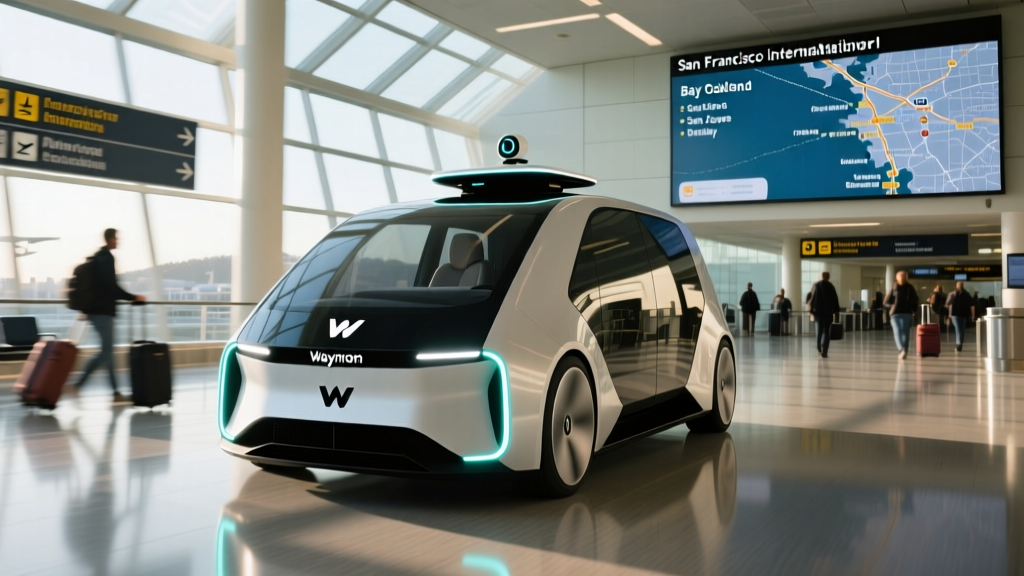
Yes — Waymo One serves San Francisco International Airport (SFO) as of early 2026, but with important caveats that trip up first-time riders. The service operates within a defined geofence that covers the SFO departure and arrivals terminals, meaning you can hail a driverless Waymo vehicle to or from the airport. However, pickup and drop-off occur at designated zones rather than the standard rideshare curbs, and availability can be constrained during peak travel windows.
If you're planning a trip and wondering whether to rely on Waymo for your airport run, this guide covers the exact coverage boundaries, real pricing comparisons, safety data, and the practical limitations you need to know before you book.
Waymo's robotaxi service operates at SAE Level 4 within its geofenced service area. This means the vehicle handles all driving tasks without any human intervention — there is no driver behind the wheel, no steering wheel for a passenger to grab, and no expectation that you monitor the road. This is fundamentally different from Level 2 systems like Tesla Autopilot or GM Super Cruise, which require continuous driver supervision. Level 4 autonomy is constrained to pre-mapped, approved zones under defined conditions, which is why geofencing matters for where you can and can't ride.
Where Can You Use Waymo Right Now?
Waymo One's commercial service footprint has expanded steadily, but it remains a city-by-city rollout governed by state and local regulatory approvals. Here's the current operational landscape as of 2026:
| City / Region | Status | Airport Service | Key Coverage Notes |
|---|---|---|---|
| San Francisco (incl. SFO) | Fully operational | Yes — designated zone | Most of SF proper; SFO terminals; limited late-night availability |
| Phoenix Metro (East Valley) | Fully operational | Yes — PHX Sky Harbor | Largest service area; Chandler, Tempe, Mesa, Scottsdale, downtown Phoenix |
| Los Angeles | Fully operational | LAX — limited | Downtown LA, Hollywood, Santa Monica, Westside; expanding eastward |
| Austin, TX | Operational (expanding) | AUS — announced | Central Austin, South Austin; geofence growing quarterly |
The Bay Area geofence extends well beyond SFO. Within San Francisco, Waymo covers the vast majority of neighborhoods from the Presidio to the Mission to the Sunset District. Cross-bay trips to Oakland are available on select routes, though coverage on the East Side of the Bay Bridge remains more limited than within SF proper.
For SFO specifically, Waymo uses a designated pickup and drop-off area on the departures/ticketing level. The Waymo One app guides you to the exact spot with walking directions once you confirm your ride. Expect a slightly longer walk compared to the standard Uber/Lyft curbside — plan an extra 3-5 minutes.
How to Ride Waymo and What It Costs vs. Uber and Lyft
Booking a Waymo works like any rideshare app: download Waymo One, enter your pickup and destination, and confirm. The vehicle arrives without a driver, you unlock it via the app, and it handles the entire trip. You can add stops, share your trip ETA with contacts, and adjust climate and music from the rear-seat screen.
Here's how Waymo pricing stacks up against conventional rideshare for common Bay Area routes based on typical fare ranges in early 2026:
| Route | Waymo One | UberX | Lyft Standard |
|---|---|---|---|
| SFO → Downtown SF (Union Square) | $38–$48 | $35–$55 | $33–$52 |
| SFO → Mission District | $42–$55 | $40–$60 | $38–$58 |
| Downtown SF → SFO | $38–$48 | $35–$55 | $33–$52 |
| SoMa → Marina District | $16–$22 | $14–$25 | $13–$24 |
Key pricing takeaway: Waymo's fares are generally competitive with UberX and Lyft Standard — not cheaper, but not significantly more expensive. The real advantage is consistency: Waymo does not implement surge pricing in the same aggressive way that Uber and Lyft do during peak demand. During major events, holidays, or rush hour, Uber and Lyft fares can spike 2-3x, while Waymo fares remain relatively stable (though wait times increase). Tipping is optional in the app, and there's no human driver to feel awkward about skipping.
Waymo also offers a subscription-style membership with perks like priority matching and discounted rates for frequent riders. For airport regulars, this can shave $3–$5 off per trip.
How Safe Are Waymo Robotaxis? The Real Data
This is the question every first-time rider asks, and it deserves a data-driven answer rather than marketing claims. Waymo has accumulated tens of millions of fully driverless miles across its operational cities, and the safety record has been scrutinized by regulators, researchers, and insurers.
- Total driverless miles driven: Over 40 million fully autonomous miles across Phoenix, SF, LA, and Austin (Waymo Safety Report)
- Injury-causing crash rate: Waymo's fully driverless vehicles showed an 85% reduction in injury-causing crashes compared to human-driven benchmarks in comparable urban environments, according to a study by the Insurance Institute for Highway Safety (IIHS)
- Contact rate: Police-contactable incidents occur at a rate significantly below the human driver baseline in the same geographies, per Waymo's published safety data
- Most common incident type: Low-speed contact with stationary objects (parked cars, bollards) during complex urban maneuvers — not high-speed collisions
Waymo publishes periodic safety performance data and has submitted incident reports to the National Highway Traffic Safety Administration (NHTSA) as required for autonomous vehicle operators. The data consistently shows that Waymo vehicles are involved in fewer injury-causing crashes per million miles than human drivers in the same dense urban environments.
That said, robotaxis are not incident-free. There have been documented cases of Waymo vehicles making contact with construction-zone cones, temporarily stopping in travel lanes during complex scenarios, and — in rare cases — low-speed collisions with other vehicles. The difference is severity: because Waymo vehicles operate conservatively (obeying speed limits, maintaining following distances, never driving impaired), the crashes that do occur tend to be low-energy events rather than the high-speed, high-severity collisions that dominate human crash statistics.
For context, human drivers in the US experience roughly 1.3 fatalities per 100 million vehicle miles driven (NHTSA data). Waymo's tens of millions of driverless miles have recorded zero fatalities, though the sample size is still far smaller than the national driving population. Statistical significance will grow as the fleet scales.
Under the Hood: Waymo's Technology Stack
Waymo's approach to autonomy differs fundamentally from camera-centric systems. The current fleet — based on the Jaguar I-PACE and the purpose-built Zeekr M-Vision (entering limited service) — uses a multi-sensor architecture:
Sensor Suite Breakdown
| Sensor Type | Count (Jaguar I-PACE 6th-gen) | Function |
|---|---|---|
| LiDAR (custom, roof + corners) | 5 units | 360° 3D point cloud; object detection at 500m+; works in darkness |
| Cameras (high-res, multi-focal) | 29 cameras | Traffic light/signal recognition, lane markings, text/sign reading |
| Radar (imaging radar) | 6 units | Velocity detection of moving objects; performs in rain/fog where LiDAR degrades |
| Audio sensors (external mics) | Multiple | Detects emergency vehicle sirens for yielding behavior |
Why this matters: Waymo's LiDAR-first approach provides direct depth measurement — the vehicle knows exactly how far away objects are without inferring distance from 2D images. This is a key differentiator from Tesla's camera-only FSD system (Level 2), which must estimate depth computationally. The redundancy across sensor types means the system can cross-validate detections: if LiDAR sees an object but the camera doesn't classify it, the vehicle still reacts conservatively.
Waymo also relies heavily on HD pre-mapping. Before any vehicle operates driverless in a zone, Waymo maps every lane, curb, traffic signal, crosswalk, and speed limit to centimeter-level precision. The vehicle then uses real-time sensor data to localize within that map and detect changes (construction, temporary closures). This is why expansion takes time — new areas must be mapped, validated, and approved before driverless service begins.
Regulatory Landscape: Who Approves Robotaxi Operations?
Robotaxi operations in the US are governed by a patchwork of state and local regulations, not a single federal framework. Here's how the approval chain works:
- Federal (NHTSA): Sets vehicle safety standards (FMVSS). NHTSA can investigate incidents and issue recalls but does not currently "approve" autonomous driving operations directly. Waymo vehicles must comply with existing FMVSS or obtain exemptions for vehicles without steering wheels (relevant to the upcoming Zeekr fleet).
- State DMV / PUC: In California, the Department of Motor Vehicles (DMV) issues testing permits and the California Public Utilities Commission (CPUC) issues permits for commercial passenger service. Waymo holds both a DMV driverless testing permit and a CPUC commercial deployment permit for San Francisco and other CA cities.
- Local government: Cities like San Francisco and Los Angeles have input on operational zones, hours, and fleet size caps. Local fire, police, and transportation agencies negotiate pickup/drop-off logistics — including the SFO designated zone.
- Airport authorities: SFO is operated by the San Francisco Airport Commission, which must separately approve commercial ground transportation services. Waymo's SFO access required a specific agreement covering designated zones, per-trip fees, and operational hours.
This regulatory complexity is a primary reason robotaxi expansion is slow and city-specific. Each new metro area requires state permits, local negotiations, and often airport-specific agreements. There is no "flip a switch and go national" pathway under the current framework.
Current Limitations: Where Waymo Can't Go (and Why)
For all its capability, Waymo's Level 4 service has defined boundaries. Understanding these limitations is essential for trip planning — especially for airport runs where timing matters.
Known Operational Limitations
- Geofence boundaries: If your destination falls outside the mapped service area, the app won't let you book the trip. The geofence is expanding but doesn't yet cover all suburbs, exurbs, or rural routes.
- Heavy fog and atmospheric rivers: While Waymo's radar and LiDAR handle rain better than camera-only systems, extreme fog (common in SF during summer marine-layer mornings) can cause service slowdowns or temporary suspensions in affected zones.
- Construction zones: Major lane reconfigurations or unmapped construction can cause the vehicle to pull over safely and request remote assistance, adding minutes to your trip.
- Peak demand wait times: During SFO arrival peaks (late evening international waves), Waymo vehicle availability can thin out. Expect 8–15 minute waits vs. 2–5 minutes off-peak.
- No highway driving to distant cities: Waymo operates on highways within its geofence (e.g., US-101 to SFO), but won't take you to Sacramento, Monterey, or Wine Country. These are outside the operational zone.
- Wheelchair accessibility: Waymo has been working on WAV (wheelchair-accessible vehicle) options, but availability remains limited compared to standard vehicles. Check the app for WAV availability in your area.
- Child seats: Waymo vehicles do not currently provide child safety seats. Children under a certain age/height may not ride without an appropriate restraint — check local laws and Waymo's rider policy.
For SFO travelers specifically, the most impactful limitation is wait time during peak hours. If you have a tight flight connection or an early-morning departure, build in a buffer. The vehicle will get you there safely and at the speed limit, but you can't ask it to hurry.
Waymo vs. the Competition: Zoox, Cruise, and Tesla's Robotaxi Ambitions
Waymo is the current market leader in commercial robotaxi service, but it's not the only player:
- Zoox (Amazon): Operating its purpose-built, bidirectional vehicle in limited service in Las Vegas and Foster City, CA. The Zoox vehicle has no steering wheel and seats four facing each other. Service area is smaller than Waymo's.
- Cruise (GM): After a high-profile safety incident in San Francisco in late 2023 led to a suspension and restructuring, Cruise has been rebuilding its operations with a phased return to select cities. Service scope remains significantly reduced compared to its pre-suspension footprint.
- Tesla Robotaxi (announced): Tesla has announced a robotaxi service based on its Cybercab concept, targeting a camera-only Level 4/5 approach. As of early 2026, this remains in pre-commercial testing. Tesla's FSD (Supervised) on consumer vehicles remains a Level 2 driver-assist system — the driver must remain fully engaged. Do not confuse FSD with a Waymo-style driverless experience.
Frequently Asked Questions
Does Waymo go to SFO from downtown San Francisco?
Yes. You can hail a Waymo from anywhere within the San Francisco geofence and ride to SFO's designated Waymo pickup/drop-off zone. The trip typically takes 25–45 minutes depending on traffic and costs approximately $38–$48.
Can I take a Waymo from SFO to Oakland or the East Bay?
Cross-bay trips to certain parts of Oakland are available, but coverage on the East Bay side is more limited than within SF. Check the Waymo One app for your specific destination — if it's within the geofence, you can book it. If not, you'll need an alternative.
Is Waymo truly self-driving or is there a remote driver?
Waymo vehicles are fully driverless — there is no human in the vehicle, and no remote "joystick" operator driving in real time. Waymo does have a remote assistance team that can provide guidance in edge cases (e.g., the vehicle encounters an unusual construction zone and needs confirmation on a path), but the remote team does not steer or control the vehicle directly. The vehicle's AI handles all real-time driving decisions.
How does Waymo handle emergencies or accidents?
Waymo vehicles are equipped with an in-cabin "Help" button and 24/7 rider support. In the event of a collision or medical emergency, the vehicle contacts Waymo's response team, which can dispatch emergency services. The vehicle's exterior also has indicators for first responders. All incidents are reported to NHTSA as required.
Is Waymo cheaper than Uber for airport trips?
Waymo fares are generally comparable to UberX and Lyft Standard — not significantly cheaper or more expensive. The advantage is price stability: Waymo doesn't surge-price as aggressively during peak demand. During high-demand periods, Waymo can be cheaper than a surging Uber, though wait times may be longer.
Can I use Waymo at SFO at 2 AM?
Waymo operates at SFO during most hours, but fleet availability is thinner in the late-night and early-morning windows. You may experience longer wait times or, in rare cases, no available vehicles. For critical early-morning flights, consider booking with a buffer or having a backup rideshare app ready.
What vehicle will pick me up?
Most Waymo One rides in San Francisco use the Jaguar I-PACE — a fully electric luxury crossover with 234 miles of EPA range, modified with Waymo's 6th-generation sensor suite. The fleet is transitioning over time to include the purpose-built Zeekr M-Vision, which offers a more spacious, lounge-style interior with no driver's seat.
Bottom line: Waymo does go to SFO, and the experience is genuinely driverless, safe by the data, and priced competitively with Uber and Lyft. The main constraints are the geofence (you can't ride beyond the service area), peak-hour wait times, and the designated pickup zone that adds a few minutes of walking. For most SF-to-SFO trips, it's a viable and increasingly routine option — one that demonstrates what Level 4 autonomy looks like when it actually works at commercial scale.