Quick Verdict: Waymo Is Live in LA — But the Map Has Edges
Waymo's driverless ride-hail service is operating across a substantial and growing portion of Los Angeles as of early 2026. If you're searching for the Waymo service area Los Angeles to figure out whether you can catch a robotaxi from your neighborhood, the short answer is: most of central, westside, and downtown LA is covered, but coverage thins out significantly in the San Fernando Valley, far-east side, and south-bay beach cities. Unlike Uber or Lyft, you can't summon a Waymo from just anywhere — the service is geofenced to approved operational zones, and those boundaries matter enormously for trip planning.
This guide maps out exactly where Waymo operates in LA, what a ride costs, the hard safety data behind the service, the sensor stack that makes it work, and the real-world limitations you'll hit as a rider. No hype — just the numbers and the boundaries.
SAE Automation Level: What "Driverless" Actually Means Here
Waymo operates at SAE Level 4, meaning the vehicle handles all driving tasks within its defined operational design domain (ODD) — a specific geofenced area under specific conditions — with no human driver present. There is no one in the driver's seat. This is fundamentally different from Tesla's FSD (Supervised), GM's Super Cruise, or Ford's BlueCruise, which are all SAE Level 2 systems requiring continuous human supervision. If a Waymo encounters a situation it cannot handle, it executes a minimal-risk maneuver (pulling over safely) rather than handing control to a passenger.
| Level | Name | Who Drives | Example |
|---|---|---|---|
| 0 | No Automation | Human | Standard car |
| 1 | Driver Assistance | Human (one feature aided) | Adaptive cruise control |
| 2 | Partial Automation | Human (must supervise) | Tesla Autopilot, FSD Supervised, BlueCruise |
| 3 | Conditional Automation | System (human on standby) | Mercedes Drive Pilot (limited markets) |
| 4 | High Automation | System (no human needed in ODD) | Waymo One, Zoox |
| 5 | Full Automation | System (everywhere, all conditions) | Does not exist commercially |
Where Can I Use Waymo in Los Angeles Right Now?
As of Q1 2026, the Waymo service area in Los Angeles spans roughly 80+ square miles of approved operational territory. Waymo has been incrementally expanding its LA geofence since launching limited rider access in 2023 and opening the service more broadly through 2024–2025. Here's a zone-by-zone breakdown based on current service availability:
| Zone | Coverage Status | Key Areas Included |
|---|---|---|
| Downtown LA & Arts District | ✅ Fully covered | Financial District, Little Tokyo, DTLA core |
| Hollywood & Mid-City | ✅ Fully covered | Hollywood Blvd corridor, Koreatown, Miracle Mile |
| Westside | ✅ Fully covered | Santa Monica (partial), Westwood, Century City, Beverly Hills |
| West Hollywood & Mid-Wilshire | ✅ Fully covered | WeHo, La Brea corridor, LACMA area |
| Los Feliz & Silver Lake | ✅ Fully covered | Los Feliz Blvd, Sunset Junction |
| Glendale & Pasadena | ⚠️ Partial / expanding | Select corridors; not full city coverage |
| San Fernando Valley | ❌ Not covered | Burbank, Studio City, Sherman Oaks — not in geofence |
| South Bay Beach Cities | ❌ Not covered | Manhattan Beach, Hermosa Beach, Redondo Beach |
| East LA & Boyle Heights | ⚠️ Limited | Some border areas; not core coverage |
| LAX Airport | ✅ Covered (designated zones) | Specific pickup/dropoff areas at LAX terminals |
How to check your exact address: Download the Waymo One app (available on iOS and Android), enter your pickup location, and the app will confirm whether it falls within the current service area. If your address is outside the geofence, the app will suggest the nearest valid pickup point — though walking to a boundary edge isn't always practical.
Airport note: LAX service launched in late 2024 and operates from designated pickup zones rather than the standard rideshare lots. Check the Waymo app for current terminal-specific instructions, as these have been updated periodically.
How to Ride and What It Costs vs. Uber/Lyft
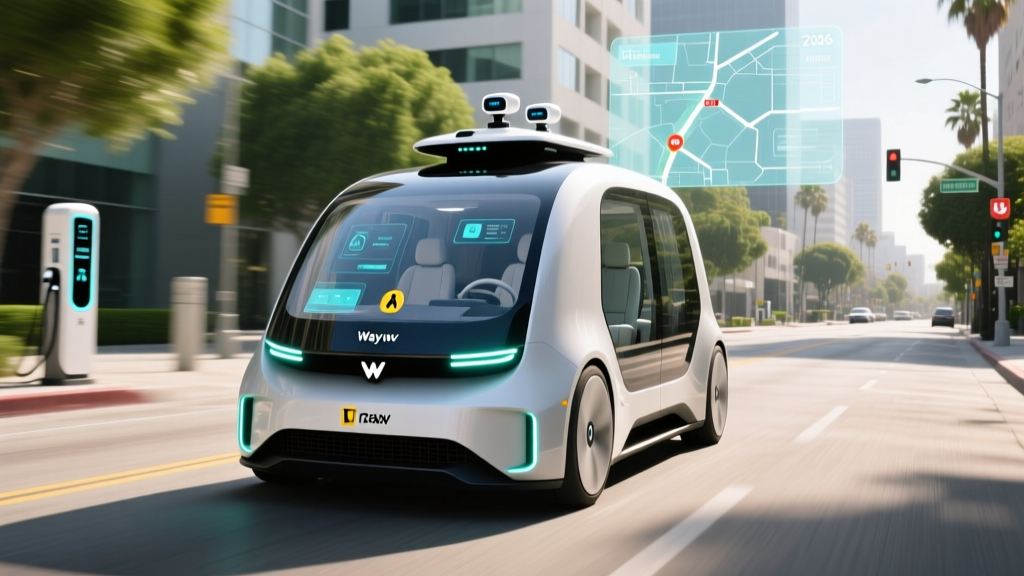
Using Waymo One is structurally similar to Uber or Lyft: you open the app, enter a destination, confirm pickup, and a vehicle arrives — except no one is behind the wheel. The fleet in LA consists primarily of Jaguar I-PACE electric SUVs retrofitted with Waymo's 5th-generation sensor suite, with newer Geely/Zeekr-based custom vehicles beginning to appear in the fleet.
Pricing Breakdown
Waymo prices rides using a dynamic model that factors in distance, time, and demand — similar to rideshare surge pricing, though Waymo has generally kept pricing competitive with UberX and Lyft standard tiers to build ridership. Based on rider reports and fare data from early 2026:
| Route | Distance | Waymo One | UberX | Lyft Standard |
|---|---|---|---|---|
| DTLA → Hollywood | ~6 mi | $14–$18 | $13–$19 | $12–$17 |
| Santa Monica → Westwood | ~7 mi | $16–$21 | $14–$20 | $13–$19 |
| DTLA → LAX | ~18 mi | $32–$42 | $30–$45 | $28–$40 |
| Koreatown → Beverly Hills | ~5 mi | $12–$16 | $11–$17 | $10–$15 |
| Hollywood → Silver Lake | ~3 mi | $9–$12 | $8–$13 | $8–$12 |
Key pricing notes:
- Waymo fares include a base fee plus per-mile and per-minute charges. Surge multipliers apply during peak demand.
- Tipping is optional and handled in-app; since there's no driver, tipping behavior varies widely among riders.
- Waymo occasionally offers promotional credits for new riders and frequent-use discounts, though these have become less generous as the service has scaled.
- Uber Comfort and Lyft Lux will typically run 30–50% higher than the figures above; Waymo's cabin experience is closer to those premium tiers (quiet EV, climate control, no driver conversation).
Safety Record: What the Data Actually Shows
- 30+ million fully driverless miles completed across all US markets as of late 2025 (Waymo Safety Report).
- Waymo's internal analysis, validated by third-party researchers, shows a ~85% reduction in injury-causing crash involvement compared to human-driven benchmarks in comparable urban environments.
- NHTSA Standing General Order requires Waymo (and all ADS operators) to report crashes involving their vehicles. Waymo's reported incidents have overwhelmingly been low-severity — typically rear-end contacts at low speed where the Waymo vehicle was stationary or nearly so.
- As of early 2026, Waymo has had no confirmed rider fatalities across its operational history in Phoenix, San Francisco, Los Angeles, and Austin.
It's important to contextualize these numbers. Waymo vehicles drive primarily in dense urban environments at moderate speeds — exactly where most low-severity collisions occur. The relevant comparison isn't highway fatality rates but urban fender-bender and pedestrian-incident rates. On that metric, Waymo's data is strong.
However, the fleet has drawn scrutiny for incidents involving first-responder vehicles (parked fire trucks, police cars) and school buses in various markets. In several documented cases, Waymo vehicles made contact with stationary emergency vehicles — a scenario that a human driver would typically avoid. Waymo has issued software updates to improve detection of these edge cases, and the NHTSA continues to monitor ADS crash reports under its standing order.
The honest takeaway: Waymo's safety record is compelling at a statistical level, but the fleet is not infallible. The types of failures it experiences — edge-case object recognition, complex construction zones — are categorically different from the failures that cause human crashes (distraction, impairment, speeding). Neither is zero-risk.
Under the Hood: Waymo's Sensor Stack and Tech
Waymo's approach to autonomy is sensor-heavy and redundant — the opposite of Tesla's camera-centric philosophy. The current 5th-generation Waymo Driver, deployed on the Jaguar I-PACE fleet in LA, integrates:
- LiDAR (Light Detection and Ranging): Multiple roof-mounted and side-mounted LiDAR units provide a real-time 360° 3D point cloud of the vehicle's surroundings, accurate to centimeter-level resolution at ranges exceeding 200 meters. LiDAR works independently of ambient light — critical for night driving and sun-glare scenarios.
- Cameras: A suite of high-resolution cameras covers 360° visual perception, reading traffic signals, detecting lane markings, identifying pedestrian gestures, and classifying objects. Waymo uses cameras for semantic understanding (what is this object?) while LiDAR handles spatial understanding (where exactly is it?).
- Radar: Millimeter-wave radar units complement LiDAR for velocity detection of moving objects (other vehicles, cyclists) and perform reliably in rain and fog where LiDAR and camera performance can degrade.
- HD Mapping: Waymo pre-maps every inch of its operational geofence at high definition. The vehicle localizes itself within this map in real time, cross-referencing sensor data against known road geometry, signage, and lane configurations. This is why the service cannot operate outside its geofence — there is no map to localize against.
- Compute: Custom-designed Waymo compute hardware processes sensor fusion, prediction, planning, and control decisions in real time, running Waymo's proprietary "Waymo Driver" software stack.
Why this matters for riders: The sensor redundancy means the vehicle can handle scenarios that would challenge a camera-only system — direct sun glare into a camera lens, nighttime unlit pedestrians, heavy rain partially obscuring camera views. The trade-off is cost: each Waymo-equipped I-PACE carries an estimated $100,000+ in sensor and compute hardware, which is why Waymo operates as a fleet service rather than selling the technology to consumers.
Regulatory Landscape: Who Approved Waymo to Operate in LA?
Robotaxi operations in California require approval from two state agencies, plus compliance with federal vehicle safety standards:
- California Department of Motor Vehicles (DMV): Issues the Autonomous Vehicle Testing and Deployment permits. Waymo holds a deployment permit allowing driverless commercial operations.
- California Public Utilities Commission (CPUC): Regulates passenger-carrying services (the "ride-hail" side). Waymo received CPUC authorization to charge fares for driverless rides, effectively making it a licensed transportation carrier.
- NHTSA (Federal): Oversees vehicle safety standards. Waymo's Jaguar I-PACE vehicles are production cars modified post-manufacture; the ADS equipment must comply with Federal Motor Vehicle Safety Standards (FMVSS). NHTSA's Standing General Order mandates crash reporting for all Level 4 operators.
- City of Los Angeles / LADOT: While the state issues primary permits, local jurisdictions influence curb access, pickup/dropoff zones (especially at LAX), and traffic management integration.
California's regulatory framework is among the most structured in the US for autonomous vehicle deployment. Operators must report disengagement data (how often a remote assistance operator intervenes) and crash data. This transparency is a key reason why Waymo's safety claims can be cross-referenced — unlike markets with less rigorous reporting requirements.
Current Limitations: Where Waymo Still Falls Short
Despite the impressive technology and safety data, riding a Waymo in LA in 2026 comes with real constraints that you won't encounter with a human Uber driver:
Geofence Boundaries
The service simply does not exist outside the mapped operational area. If your trip origin or destination falls outside the geofence, you'll need to use a traditional rideshare. There's no "manual override" — the car will not drive into unmapped territory.
Weather Sensitivity
While LA rarely sees extreme weather, heavy rain can degrade LiDAR and camera performance. Waymo has been known to reduce fleet operations or pause service during significant rain events — a rarity in LA, but it happens a few times per year. The system is not designed for snow, ice, or dense fog.
Construction Zones and Road Closures
Waymo vehicles rely on HD maps that reflect road geometry at the time of mapping. When a major construction project alters lane configurations, adds temporary barriers, or closes streets, the vehicle may struggle to navigate and will default to pulling over and requesting remote assistance. This can add 5–15 minutes to a trip.
No Highway Driving (Mostly)
Waymo's LA operations primarily cover surface streets and boulevards. Limited freeway segments may be included in the geofence for connecting zones, but the service is fundamentally an urban point-to-point system, not a highway cruiser. Long-distance or cross-valley trips that would be faster via freeway may route inefficiently.
Wait Times
Fleet density in LA is still scaling. During peak hours (weekday mornings, Friday/Saturday evenings), wait times of 8–15 minutes are common — longer than the 3–5 minute Uber/Lyft average in well-served areas. Off-peak waits are typically 4–8 minutes.
Special Stops and Requests
You can't ask a Waymo to "stop at the drive-thru" or "wait here for 5 minutes while I grab something." The service is point-A to point-B only. Multiple stops, intermediate errands, and waiting are not supported.
Accessibility
The Jaguar I-PACE fleet requires riders to enter a standard SUV cabin. Wheelchair-accessible vehicles are not yet widely available in the LA fleet, though Waymo has announced plans to integrate accessible vehicle options in future fleet expansions.
Is This Truly Self-Driving or Just Driver-Assist?
This is the most common point of confusion in the autonomous vehicle space, and the answer for Waymo is unambiguous: it is truly self-driving within its operational domain. There is no human in the driver's seat. There is no steering wheel being held by a person. The vehicle navigates, changes lanes, responds to traffic signals, yields to pedestrians, and parks itself — all without any human input.
This stands in stark contrast to consumer systems like:
- Tesla FSD (Supervised): SAE Level 2. The driver must remain attentive and is legally responsible for the vehicle at all times. Despite the "Full Self-Driving" name, this is a driver-assist system.
- GM Super Cruise / Ford BlueCruise: SAE Level 2. Hands-off on pre-mapped highways, but eyes-on and driver-responsible.
- Mercedes Drive Pilot: SAE Level 3 (in limited markets). The system drives in specific conditions (traffic jams under 40 mph on approved highways), and the driver can look away but must be ready to resume control within seconds.
Waymo skips Levels 2 and 3 entirely for its riders. You are a passenger, not a driver. If the system encounters a scenario it cannot resolve, it does not tap you on the shoulder — it pulls over safely and contacts remote assistance. This is the fundamental distinction that makes Waymo a robotaxi rather than an advanced driver-assist feature.
Frequently Asked Questions
Can I use Waymo to get to LAX from anywhere in LA?
Only if your pickup location is within the current Waymo geofence. Most of central LA, Westside, and Hollywood can reach LAX via Waymo. The Valley, South Bay, and far Eastside cannot. LAX dropoffs and pickups use designated zones — check the app for terminal-specific instructions.
How much does a Waymo ride cost compared to Uber?
Waymo fares are generally within $1–$3 of UberX for equivalent trips in the same demand conditions. During surge periods, Waymo's dynamic pricing can sometimes be lower than Uber's surge multiplier, and sometimes higher. For a typical 5-mile LA trip, expect $12–$18 on either platform.
Is Waymo available 24/7 in Los Angeles?
Waymo operates across extended hours in LA, including late-night service, but availability can vary by zone and fleet density. Early morning hours (2–5 AM) may have longer wait times or limited availability in peripheral zones.
What happens if the Waymo vehicle gets confused or stuck?
The vehicle will execute a minimal-risk maneuver — typically pulling to the curb and stopping. A remote assistance operator (a human monitoring from a operations center) can then provide guidance to the vehicle's planning system. The passenger does not take control. You can also contact Waymo support through the in-app help button or the in-vehicle screen at any time.
Can I bring my child in a Waymo?
Waymo's policy requires all riders to be 18 or older to request a ride. Minors may ride accompanied by an adult, but the I-PACE fleet does not provide child car seats. You would need to bring your own, which is impractical for most riders.
How does Waymo compare to Zoox or Cruise in LA?
As of early 2026, Waymo is the only scaled robotaxi service operating commercially in Los Angeles. Cruise (GM) suspended operations in late 2023 following a serious incident in San Francisco and has been slowly seeking to resume in limited markets. Amazon's Zoox has tested in LA but has not launched a public commercial service at Waymo's scale. Waymo is effectively the only option for LA riders wanting a Level 4 driverless ride today.
Does Waymo work in the rain?
Light rain generally does not disrupt service. However, during heavier rain events — uncommon but not unheard of in LA — Waymo may reduce fleet size or temporarily pause operations in affected zones. The vehicle's LiDAR, cameras, and radar can handle drizzle, but heavy precipitation scatters LiDAR returns and obscures cameras, reducing the system's confidence below its safety threshold.