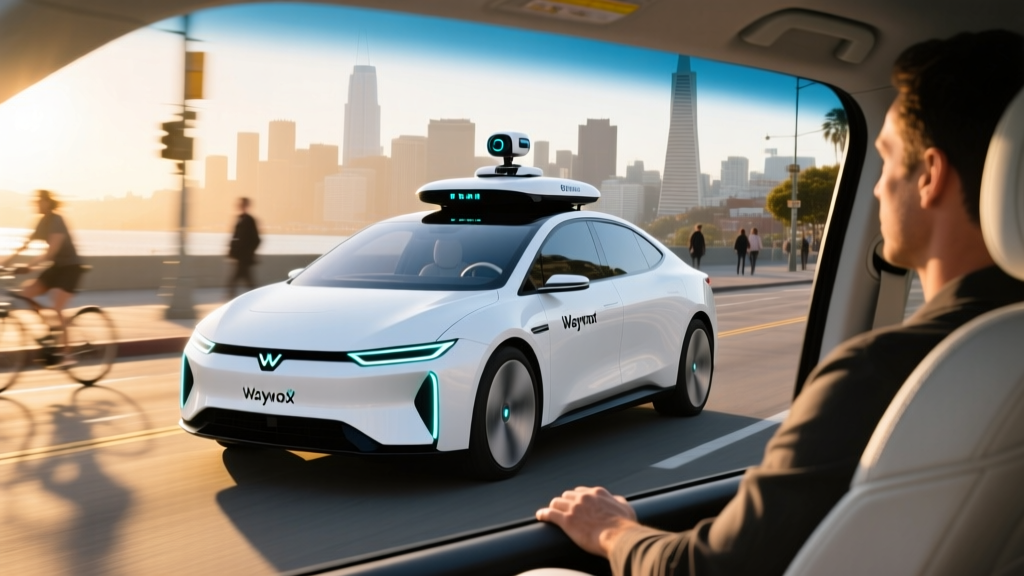
If you have spent any time on the streets of San Francisco over the past two years, you have almost certainly seen one: a white Jaguar I-PACE with a roof-mounted sensor array gliding through traffic with no one behind the wheel. Waymo's driverless ride-hail service — branded as Waymo One — has become a fixture of the city's transport landscape, completing tens of thousands of paid trips per week across the Bay Area. But for prospective riders and EV-curious observers alike, the practical questions remain: where exactly can you go, what does it cost, and how safe is the technology?
This guide breaks down the real-world state of Waymo's San Francisco operations in 2026, with concrete data on pricing, safety performance, technology, and the regulatory framework that keeps these vehicles on the road.
Where Can You Use Waymo in San Francisco Right Now?
Waymo One operates a fully driverless commercial ride-hail service across a large portion of San Francisco. The service area has expanded incrementally since its initial limited launch in 2022 and now covers most of the city, including neighborhoods like SoMa, the Mission, Castro, Sunset, Richmond, Marina, Pacific Heights, Nob Hill, and the Financial District. Waymo also serves trips to and from San Francisco International Airport (SFO) as part of its Bay Area expansion.
| Region | Status | Hours | Notes |
|---|---|---|---|
| San Francisco (core) | Live — open to all riders | 24/7 | Covers most neighborhoods within city limits |
| SFO Airport | Live | 24/7 | Pickups/drop-offs at designated zones |
| San Francisco Peninsula (Daly City, South SF, San Bruno) | Live | 24/7 | Added in phased expansion |
| Mountain View / Sunnyvale | Live — open to all | 24/7 | Original testing market |
| Greater Phoenix, AZ | Live — open to all | 24/7 | Largest service area by square miles |
| Los Angeles (metro) | Live | Limited hours | Phased expansion ongoing |
| Austin, TX | Announced / early access | TBD | Not yet open to general public |
To use the service, you download the Waymo One app (available on iOS and Android), enter your pickup and drop-off locations, and request a ride. The app confirms whether your trip falls within the geofenced service area. Wait times in San Francisco typically range from 3 to 10 minutes depending on time of day and neighborhood density.
Is Waymo Truly Self-Driving? Understanding SAE Levels
This is the single most important distinction in the autonomous vehicle conversation. Waymo's robotaxi service is classified as SAE Level 4 — high automation within a defined operational design domain (ODD). That means the vehicle handles all driving tasks — steering, braking, navigating, responding to traffic signals, yielding to pedestrians — with no human driver present and no expectation of human intervention within its service area.
SAE Automation Levels: What They Actually Mean
| Level | Name | Who Drives? | Example |
|---|---|---|---|
| Level 0 | No Automation | Human does everything | Basic car with no driver aids |
| Level 1 | Driver Assistance | Human drives; system assists one function | Adaptive cruise control OR lane-keeping |
| Level 2 | Partial Automation | Human must supervise at all times | Tesla Autopilot / FSD Supervised, GM Super Cruise, Ford BlueCruise |
| Level 3 | Conditional Automation | System drives in narrow conditions; human must take over on request | Mercedes Drive Pilot (limited markets, low speed) |
| Level 4 | High Automation | System drives fully within its ODD; no human needed | Waymo One robotaxis, Zoox |
| Level 5 | Full Automation | System drives everywhere, all conditions | Does not yet exist commercially |
This is fundamentally different from consumer systems like Tesla's FSD (Supervised), GM's Super Cruise, or Ford's BlueCruise, which are all SAE Level 2 — the driver must remain engaged, hands on or near the wheel, and legally responsible for the vehicle at all times. Waymo's vehicles have no steering wheel accessible to passengers and no driver seat occupant. If the system encounters a scenario it cannot handle, it performs a controlled stop (a "minimal risk condition") rather than handing control to a passenger.
How Much Does Waymo Cost vs. Uber and Lyft?
Waymo One uses dynamic pricing similar to rideshare platforms, with fares calculated based on distance, time, and demand. In San Francisco, Waymo fares are generally competitive with UberX and Lyft Standard — sometimes slightly higher, sometimes lower, depending on surge pricing on the competing platforms.
| Trip | Distance | Waymo One | UberX | Lyft Standard |
|---|---|---|---|---|
| Financial District → Mission | ~3 mi | $13–$18 | $12–$20 | $11–$19 |
| SoMa → Sunset District | ~6 mi | $20–$28 | $18–$30 | $17–$28 |
| Marina → SFO Airport | ~17 mi | $42–$58 | $38–$65 | $36–$60 |
| Castro → Nob Hill | ~2.5 mi | $11–$15 | $10–$17 | $10–$16 |
Key pricing notes:
- No tips required — there is no driver, though the app does offer an optional tip feature that contributes to Waymo's operations.
- No surge multipliers as extreme as rideshare — Waymo's pricing tends to be more stable, though it does adjust for demand.
- Upfront pricing — you see the exact fare before confirming, just like Uber and Lyft.
- Promotional pricing — Waymo periodically offers first-rider discounts or promo codes, particularly during expansion phases.
For cost-conscious riders, Waymo is not dramatically cheaper than rideshare, but the novelty, consistency, and zero-human-interaction factor make it a compelling alternative for many use cases.
Waymo's Safety Record: What the Data Shows
Safety is the most scrutinized dimension of robotaxi operations, and Waymo has published more transparency reports than any competitor. As of early 2026, Waymo's fleet has accumulated over 30 million fully autonomous miles across all markets (Phoenix, San Francisco, Los Angeles) with no front-seat human safety operator.
Waymo Safety Performance — Key Data Points
- Total driverless miles: 30+ million (cumulative, all markets)
- Fatalities: 0 involving a Waymo vehicle in autonomous mode
- Injury-causing collisions: Waymo's published analysis (based on 7.1 million autonomous miles) showed a 85% reduction in injury-causing crash rate compared to the human baseline in the same geographies, per Waymo's Safety Case data.
- Contact rate: Waymo vehicles make contact with objects at a significantly lower rate per million miles than human drivers in comparable urban environments.
- NHTSA Standing General Order: Waymo reports all Level 4 incidents as required. Most reported incidents involve minor low-speed contact, often with the Waymo vehicle being rear-ended by human-driven cars.
Context matters here. San Francisco's dense urban environment presents some of the most complex driving scenarios in the United States — unprotected left turns across bike lanes, double-parked delivery trucks, pedestrians stepping off curbs mid-block, and steep grades with limited visibility. Waymo's safety record in this environment has been strong relative to human benchmarks, but it is not incident-free.
Notable incidents have included low-speed collisions with cyclists (typically when a cyclist was filtering between lanes), contact with construction-zone barriers, and a widely reported December 2023 incident where a Waymo vehicle drove over a pedestrian who had been pushed into the road by a separate human-driven vehicle. The NHTSA investigated and closed that inquiry. Each incident informs Waymo's continuous software updates, and the company publishes periodic transparency reports detailing contact rates by severity.
For comparison, the human-driven fatality rate in San Francisco is approximately 3.7 per 100 million vehicle miles. Waymo's autonomous fatality count stands at zero across all markets. For more on autonomous vehicle safety reporting, see the NHTSA automated vehicles page.
The Technology Stack: How Waymo's Vehicles See the Road
Waymo's current fleet in San Francisco consists primarily of the Jaguar I-PACE — a fully electric SUV with a 90 kWh battery pack — retrofitted with Waymo's custom 6th-generation autonomous driving system. The vehicle is 100% battery electric, producing zero tailpipe emissions during operation.
Waymo 6th-Gen Sensor Suite
| Sensor Type | Function | Details |
|---|---|---|
| LiDAR (custom-built) | 3D spatial mapping, object detection and tracking | Multiple roof-mounted units; provides 360° point cloud out to 500+ meters; works in darkness and most weather |
| Cameras (high-res) | Color perception, traffic light/signal reading, lane markings, text recognition | Multi-camera array covering 360°; optimized for varying light conditions |
| Radar | Velocity detection, object tracking in poor visibility | Complements LiDAR in rain/fog; measures relative speed of objects |
| External audio sensors | Siren detection, horn detection | Identifies approaching emergency vehicles before visual line-of-sight |
This multi-sensor fusion approach stands in direct contrast to Tesla's camera-only "Tesla Vision" strategy. Waymo relies on LiDAR as a foundational sensor — it provides precise depth information independent of lighting conditions, which is critical for nighttime operations and for detecting objects that cameras alone might miss (a partially obscured pedestrian, a low-reflectivity obstacle). The trade-off is cost: each Waymo-equipped I-PACE carries an estimated $100,000+ in sensor and compute hardware, making the per-vehicle cost substantially higher than a consumer ADAS system.
Waymo also relies on HD mapping and geofencing. The vehicles operate only within pre-mapped areas where the system has centimeter-level knowledge of lane geometry, traffic signal positions, speed limits, and known construction zones. This is both a strength (the vehicle "knows" the road intimately) and a limitation (it cannot operate outside its mapped domain).
Regulatory Framework: Who Allows Robotaxis on Public Roads?
Robotaxi operations in California require approval from two state agencies, plus compliance with federal vehicle safety standards:
- California DMV: Issues autonomous vehicle testing and deployment permits. Waymo holds a DMV Deployment Permit, which allows commercial driverless operations.
- California Public Utilities Commission (CPUC): Regulates passenger-carrying commercial transport. Waymo received CPUC approval to charge fares for driverless rides in San Francisco in August 2023, with full 24/7 authorization following.
- NHTSA (federal): Sets vehicle safety standards (FMVSS). Waymo's Jaguar I-PACE fleet was manufactured to standard FMVSS requirements. NHTSA also mandates incident reporting through its Standing General Order for automated driving systems.
- San Francisco Municipal Transportation Agency (SFMTA): Manages local street operations, parking, and curb access. Waymo coordinates with SFMTA on pickup/drop-off zones and traffic-flow impacts.
The regulatory environment has not been frictionless. In mid-2023, the SFMTA and San Francisco's Board of Supervisors raised concerns about Waymo vehicles blocking bus lanes, failing to yield to emergency vehicles in some instances, and contributing to traffic congestion. The CPUC ultimately approved full expansion, but required Waymo to maintain regular reporting on incident data and service reliability. This tension between local transit agencies and state-level regulators remains a defining feature of the robotaxi policy landscape.
Current Limitations: What Waymo Cannot Do
For all its sophistication, Waymo's Level 4 system operates within clearly defined boundaries. Understanding these limitations is essential for setting expectations as a rider:
- Geofenced service area only: The vehicle will not drive outside its pre-mapped zone. If your destination falls outside the boundary, the app will not allow you to request the trip.
- Heavy fog and extreme rain: While Waymo's 6th-gen sensors handle light-to-moderate rain well, the system may reduce service availability or pull vehicles from the road during dense fog (common in San Francisco's Sunset and Richmond districts) or severe storms where sensor performance degrades below safety thresholds.
- No highway driving in SF: Waymo vehicles in San Francisco primarily operate on surface streets. They do not currently take passengers across the Golden Gate Bridge or on long freeway segments outside their mapped urban ODD.
- Construction zones: Major, unmapped construction detours can cause the vehicle to stop and wait or reroute. The system handles minor lane shifts but cannot improvise through entirely novel road configurations.
- Accessibility: Waymo's Jaguar I-PACE fleet is not wheelchair-accessible. The company has announced plans to integrate accessible vehicles (including the purpose-built Zeekr robotaxi), but these are not yet in San Francisco service.
- No multi-stop trips: You cannot add intermediate stops. It is a point-A-to-point-B service only.
- Pets and unaccompanied minors: Riders must be 18+. Pets are generally not permitted unless in a carrier, and policies are still evolving.
- Luggage limitations: The I-PACE has limited cargo space. Large suitcases may not fit, particularly with multiple passengers.
These constraints define what the industry calls the Operational Design Domain (ODD). Waymo's ODD in San Francisco covers a large portion of urban surface-street driving, but it is not a go-anywhere, do-anything solution. Level 5 autonomy — a vehicle that can drive any road, in any condition, anywhere — does not exist commercially and remains years away at minimum.
The Riding Experience: What to Expect
For first-time riders, the experience is simultaneously mundane and remarkable. You approach the vehicle (identified by license plate in the app), unlock it via the app, and sit in the rear seats. Two screens on the back of the front seats display a real-time visualization of what the car "sees" — pedestrians rendered as bounding boxes, other vehicles tracked with velocity vectors, traffic signals identified by state.
The driving style is deliberate and conservative. Waymo vehicles tend to accelerate gently, maintain generous following distances, and come to full stops at stop signs (a behavior that occasionally frustrates human drivers behind them). Speed is kept at or slightly below the posted limit. The ride is quiet — the I-PACE's electric powertrain produces minimal noise, and there is no driver making conversation.
Most riders report that the novelty fades quickly, replaced by a practical appreciation for the consistency. There is no surge-pricing shock from a frustrated driver, no awkward small talk, no uncertainty about the route. The car simply drives.
Frequently Asked Questions
Do I need to sign up in advance to ride Waymo in San Francisco?
No. Waymo One is open to the general public in San Francisco. Download the Waymo One app, create an account with a payment method, and you can request a ride immediately — no waitlist as of 2026.
What happens if the Waymo vehicle encounters an emergency?
The vehicle is equipped with a rider support button and an in-app help feature that connects you to a live Waymo support agent. If the vehicle detects a collision or system fault, it will initiate a controlled stop and automatically alert Waymo's remote assistance team and, if necessary, emergency services.
Can Waymo drive me across the Bay Bridge or Golden Gate Bridge?
As of 2026, Waymo's San Francisco service area does not include freeway segments that cross the Bay Bridge into the East Bay or the Golden Gate Bridge into Marin County. Service is focused on San Francisco surface streets and the Peninsula.
How does Waymo compare to Tesla's Full Self-Driving?
They are fundamentally different products. Waymo is a Level 4 driverless service — no human driver is present, and you are a passenger. Tesla FSD (Supervised) is a Level 2 driver-assist system — the owner sits in the driver's seat and must remain fully engaged, hands on the wheel, and legally responsible for the vehicle at all times. Tesla FSD cannot operate without a licensed driver present.
Is Waymo available in other cities besides San Francisco?
Yes. Waymo operates commercial driverless service in Phoenix (the largest coverage area), Los Angeles (expanding), and Mountain View/Sunnyvale. Austin has been announced but is not yet open to the general public. Each city requires separate regulatory approval.
What vehicle does Waymo use?
The current fleet is the Jaguar I-PACE, a fully electric luxury SUV with a 90 kWh battery, modified with Waymo's 6th-generation sensor suite and compute platform. Waymo has also announced partnerships with Geely/Zeekr for a purpose-built robotaxi vehicle, but these are not yet deployed in San Francisco.