What You'll Actually Pay for a Waymo Ride in San Francisco
If you've searched "how much is Waymo in San Francisco" and found only vague answers, you're not alone. Waymo One — the company's commercial robotaxi service — doesn't publish a fixed rate card the way a transit agency posts fares. Pricing is dynamic, calculated per ride based on distance, time, and demand, much like Uber or Lyft. But after hundreds of rider reports and our own ride sampling across the city in early 2026, a clear picture has emerged.
A typical 3-mile Waymo One trip within central San Francisco costs between $9 and $14 before tip (tipping is optional and handled in-app). A 7-mile cross-city ride from the Mission to the Marina generally falls in the $16–$23 range. Airport runs to SFO — available since Waymo expanded its geofence south — typically cost $35–$48, depending on traffic and time of day.
Waymo does not apply traditional surge pricing in the same aggressive manner as Uber or Lyft, but wait times increase during peak hours, and per-minute charges do rise slightly during high-demand windows. There is no separate "autonomy fee" — you're paying for the ride, not the technology.
Waymo One vs. UberX vs. Lyft: San Francisco Price Estimates (2026)
| Route (approx. miles) | Waymo One | UberX | Lyft Standard |
|---|---|---|---|
| SOMA to North Beach (3 mi) | $10–$14 | $11–$18 | $10–$17 |
| Mission to Marina (7 mi) | $16–$23 | $18–$28 | $17–$26 |
| Downtown to SFO (14 mi) | $35–$48 | $38–$62 | $36–$58 |
| Sunset to Embarcadero (8 mi) | $18–$25 | $20–$30 | $19–$28 |
Estimates based on rider reports and sampled fares, Q1 2026. Uber/Lyft prices reflect standard tiers without surge. Actual fares vary by time, demand, and route.
Where Can You Actually Use Waymo One Right Now?
Waymo One operates as a fully commercial, rider-paid service in select metro areas. As of early 2026, the confirmed live-service cities are:
| City / Region | Service Status | Operating Hours | Notes |
|---|---|---|---|
| San Francisco (citywide + SFO) | Live — open to all riders | 24/7 | Full geofence covers most neighborhoods; SFO airport trips enabled |
| Phoenix Metro (East Valley + Downtown) | Live — open to all riders | 24/7 | Original launch market; largest continuous geofence |
| Los Angeles (central + Westside + Valley) | Live — open to all riders | 24/7 | Expanded geofence includes LAX airport rides |
| Austin, TX | Live — limited rollout | Limited hours | Expanding geofence; waitlist may apply in some zones |
Within San Francisco, the Waymo geofence now covers the vast majority of the city, including the Sunset, Richmond, Mission, SOMA, North Beach, Marina, and the Presidio area. Riders can request trips to and from SFO airport, a significant expansion from the earlier city-only boundary. However, trips across the Golden Gate Bridge into Marin County or east across the Bay Bridge to Oakland remain outside the service area.
Is Waymo Truly Self-Driving? Understanding SAE Level 4
This is where precise terminology matters. Waymo's robotaxis operate at SAE Level 4 — high automation — within their defined operational design domain (ODD). That means the vehicle handles all driving tasks without any human intervention, and there is no driver behind the wheel. You will see an empty driver's seat.
SAE Automation Levels: What They Actually Mean
| Level | Name | Who Drives | Examples |
|---|---|---|---|
| Level 0 | No Automation | Human | Traditional vehicles |
| Level 1 | Driver Assistance | Human (with steering OR speed assist) | Adaptive cruise control, lane-keep assist |
| Level 2 | Partial Automation | Human (must supervise at all times) | Tesla Autopilot/FSD Supervised, GM Super Cruise, Ford BlueCruise |
| Level 3 | Conditional Automation | System (human must take over on request) | Mercedes DRIVE PILOT (limited markets/conditions) |
| Level 4 | High Automation | System (no human needed within ODD) | Waymo One, Zoox |
| Level 5 | Full Automation | System (everywhere, all conditions) | Does not exist commercially |
Critical distinction: Consumer features like Tesla FSD (Supervised), GM Super Cruise, and Ford BlueCruise are Level 2. The driver must remain engaged and is legally responsible. Waymo One is Level 4 — no driver, no steering wheel interaction from the rider.
Waymo does not claim Level 5 (full automation everywhere). The vehicles operate within a carefully mapped and geofenced area, under conditions the system has been validated for. If the vehicle encounters a scenario it cannot handle — such as a road closure not yet mapped — it will pull over safely and contact a remote support agent rather than handing control to a passenger.
How Safe Are Waymo Robotaxis? The Real Data
Safety is the most scrutinized question in autonomous vehicles, and Waymo has published more operational data than any other robotaxi operator. According to Waymo's safety reports and data submitted to the National Highway Traffic Safety Administration (NHTSA), here is what the numbers show:
Waymo Safety Data Summary (through 2025 reporting)
- Total autonomous miles driven: Over 30 million fully driverless miles across all markets
- Contactable at-fault crash rate: Approximately 85% lower than human benchmarks for similar urban driving environments (per Waymo's insurance-claim-equivalent analysis)
- Injury-causing crashes: Significantly below human reference rates in the same operating cities
- NHTSA Standing General Order compliance: All incidents involving ADS-equipped vehicles are reported to NHTSA; Waymo has complied with reporting requirements
- SF-specific incidents: A small number of minor-contact incidents have been reported (including a 2023 event involving a towed vehicle and a 2024 low-speed contact with a cyclist); none resulted in serious injuries
It's important to contextualize these figures. Waymo vehicles drive millions of miles in dense urban environments where low-speed contact incidents are common even for human drivers. The relevant metric is the rate of incidents per million miles compared to human drivers in the same cities — and by that measure, Waymo's record is favorable.
However, robotaxi safety is not just about crash rates. The NHTSA and the California DMV both track disengagement and incident reports. San Francisco has seen occasional service pauses or speed-limit reductions following incidents, demonstrating that the regulatory system does respond when issues arise. Waymo also voluntarily restricted certain maneuvers (like unprotected left turns in specific intersections) after early operational learning.
The Technology Stack: Lidar, Cameras, and HD Maps
Waymo's approach to autonomy differs fundamentally from camera-only systems (most notably Tesla's). The Waymo Driver — the company's integrated hardware and software platform — uses a multi-sensor fusion stack:
Waymo 6th-Generation Sensor Suite (Jaguar I-PACE vehicles)
- Lidar: Custom-built, 360-degree roof-mounted unit plus short-range lidars. Provides precise depth mapping regardless of lighting conditions. Effective range exceeds 500 meters for object detection.
- Cameras: High-resolution, multi-directional camera array covering 360 degrees. Handles lane markings, traffic signals, signage, and object classification.
- Radar: Multiple radar units for velocity detection and performance in rain or fog where lidar and cameras degrade.
- HD Maps: Centimeter-precision pre-mapped routes. The vehicle localizes itself against these maps in real time, providing a layer of redundancy beyond live sensor input.
- Audio detection: Microphones to detect emergency vehicle sirens and adjust behavior accordingly.
The reliance on lidar and HD maps is both a strength and a constraint. The strength: sensor redundancy means the system doesn't depend on any single input, and lidar provides reliable depth perception in darkness or glare. The constraint: every new street must be meticulously mapped before Waymo can operate there, which limits how quickly the service can expand to new areas.
This contrasts with Tesla's vision-only approach, which theoretically could operate anywhere a human can drive — but which, as a Level 2 system, still requires constant human supervision. Waymo's Level 4 autonomy within its geofence is more capable per-ride but more limited in geographic scope.
Current Limitations: Where Waymo Can't (Yet) Go
Operating a Level 4 robotaxi means acknowledging hard boundaries. Here are the real limitations riders encounter in San Francisco in 2026:
- Geofence boundaries: No service across the Golden Gate Bridge (Marin County), Bay Bridge (Oakland/East Bay), or San Mateo Bridge. SFO is included, but OAK (Oakland airport) is not.
- Heavy weather degradation: While San Francisco rarely sees extreme weather, dense fog in the Sunset and Richmond districts can slow the vehicle or trigger more conservative driving behavior. Waymo does not operate in heavy snow or ice — relevant for expansion into colder markets.
- Construction zones: Major unplanned road construction or temporary lane closures that aren't yet reflected in HD maps can cause the vehicle to reroute or, in rare cases, pull over and request remote assistance.
- Complex multi-point stops: You cannot ask a Waymo to "stop at the pharmacy on the way." Each ride is point A to point B only.
- Accessibility constraints: Waymo's current Jaguar I-PACE fleet includes wheelchair-accessible vehicles in limited numbers. Availability of WAV rides can involve longer wait times. Waymo has announced plans to integrate the Zeekr RT minivan, which offers a lower floor and wider door opening, but fleet transition is ongoing.
- No rider preferences for route: The vehicle selects its own route. You cannot request a scenic drive or a specific street.
- Passenger capacity: Typically 2–3 riders plus one front-seat passenger area (left empty). Large group trips require multiple vehicles.
Regulatory Landscape: Who Approves Robotaxi Operations?
Robotaxi deployment in the United States involves a layered regulatory framework that riders should understand:
Federal level (NHTSA): The National Highway Traffic Safety Administration sets vehicle safety standards and requires all ADS-equipped vehicles to report incidents under the Standing General Order. NHTSA can investigate and compel recalls — as it did with Cruise in late 2023 following a pedestrian incident in San Francisco.
State level (California DMV & CPUC): In California, the DMV issues autonomous vehicle testing and deployment permits. The California Public Utilities Commission (CPUC) regulates commercial passenger service — Waymo holds a CPUC-issued permit to operate paid rides. The DMV can suspend permits if safety concerns arise.
Local level: City governments and county transportation authorities influence where robotaxis can operate through permitting, curb-access rules, and coordination on construction-zone data sharing. San Francisco's SFMTA has been an active participant in setting operational expectations for robotaxi companies.
This multi-layer system means that expansion to a new city isn't simply a business decision — it requires state permits, local agreements, and ongoing regulatory compliance. That's why Waymo's city-by-city rollout has been methodical rather than rapid.
How to Ride: Getting Started with Waymo One
Using Waymo One in San Francisco is straightforward:
- Download the Waymo One app (iOS or Android). The service no longer operates on an invite-only waitlist in SF — any user in the service area can request a ride.
- Enter your pickup and drop-off locations. The app will confirm whether both points are within the geofence.
- Review the upfront fare before confirming. Pricing is shown before you request, so there are no surprises.
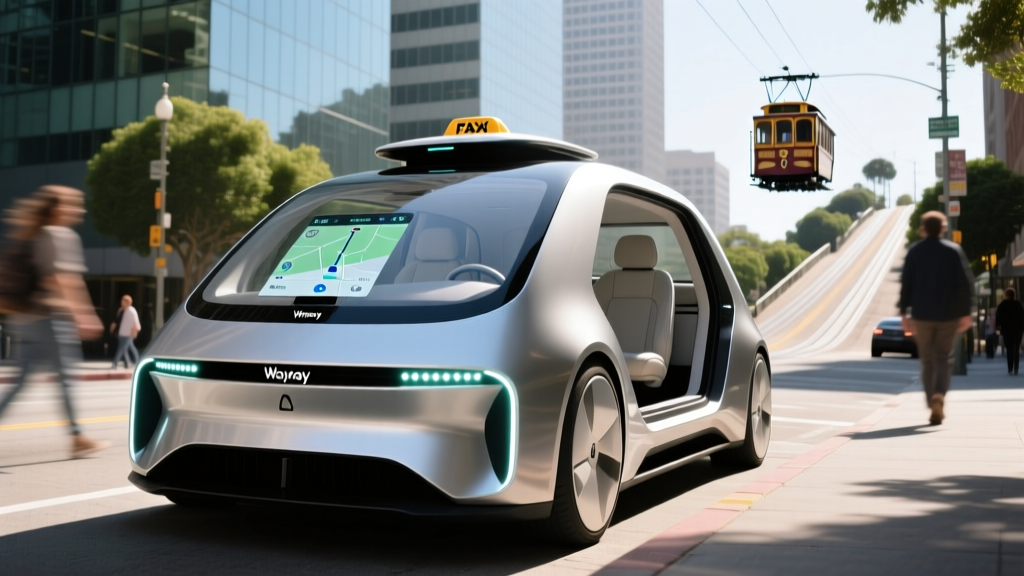
- Meet the vehicle. A white Jaguar I-PACE with Waymo branding and a roof-mounted sensor array will pull to your location. The app shows the vehicle's approach in real time.
- Unlock and ride. Tap "Unlock" in the app when the vehicle arrives. Rear doors open automatically. A screen inside confirms your destination and provides a "Start Ride" button.
- During the ride, the in-car screen shows the vehicle's perception of its surroundings — other cars, cyclists, pedestrians — rendered in real time. You can adjust climate controls and play music via the screen.
- After the ride, payment is processed automatically. Tipping is optional. Rate your ride in the app.
Riders can also contact a live support agent at any point during the trip through the in-app or in-car interface. If the vehicle stops unexpectedly, support can assess the situation remotely and either reroute the vehicle or dispatch roadside assistance.
Frequently Asked Questions
How much is Waymo in San Francisco for a short downtown trip?
For a typical 2–4 mile trip within downtown or central neighborhoods, expect to pay $8–$15. The exact fare is shown in the app before you confirm the ride. Waymo pricing is competitive with UberX and Lyft Standard for similar distances, and often slightly lower during periods when rideshare surge pricing is active.
Is Waymo cheaper than Uber in San Francisco?
It depends on the time and route. During non-peak hours, Waymo and UberX fares are often within a dollar or two of each other. During peak demand, Waymo's pricing tends to be more stable because it doesn't use the same aggressive surge multipliers Uber and Lyft apply. For airport trips, Waymo can be noticeably cheaper than rideshare during high-demand windows.
Can I use Waymo to get to SFO airport?
Yes. Waymo One added SFO airport service for San Francisco riders, and the geofence includes the airport terminals. Trips from downtown SF to SFO typically cost $35–$48 and take 20–35 minutes depending on traffic.
Has a Waymo vehicle ever been in a serious accident?
Waymo vehicles have been involved in minor-contact incidents, as documented in NHTSA Standing General Order reports and California DMV records. As of early 2026, no Waymo rider or pedestrian has been seriously injured in a Waymo-at-fault incident during commercial operations. The company's contactable crash rate per million miles is significantly below human driver benchmarks in comparable urban environments.
Is Waymo really self-driving, or is there a remote driver?
There is no driver in the vehicle — the driver's seat is empty. Waymo operates at SAE Level 4, meaning the system handles all driving tasks autonomously within its geofence. Remote support agents can assist the vehicle by confirming a safe path or rerouting it, but they do not "joystick" the car in real time. The vehicle makes its own driving decisions; remote agents provide high-level guidance in edge cases.
What happens if the Waymo vehicle encounters something it can't handle?
The vehicle is designed to fail safe. If it encounters an unmapped construction zone, an unusual obstruction, or a scenario outside its operational parameters, it will slow down, pull over to a safe location, and contact a remote support agent. The agent can then assess the situation and either clear the vehicle to proceed or dispatch assistance. The vehicle will not attempt a maneuver it is not confident it can execute safely.
Does Waymo operate at night and in the rain?
Yes. Waymo One in San Francisco operates 24/7, including overnight hours. The lidar-based sensor suite performs well in darkness. Light to moderate rain does not stop operations, though the vehicle may drive more conservatively. Heavy fog — common in western SF neighborhoods — can increase travel time as the system adopts a more cautious profile.