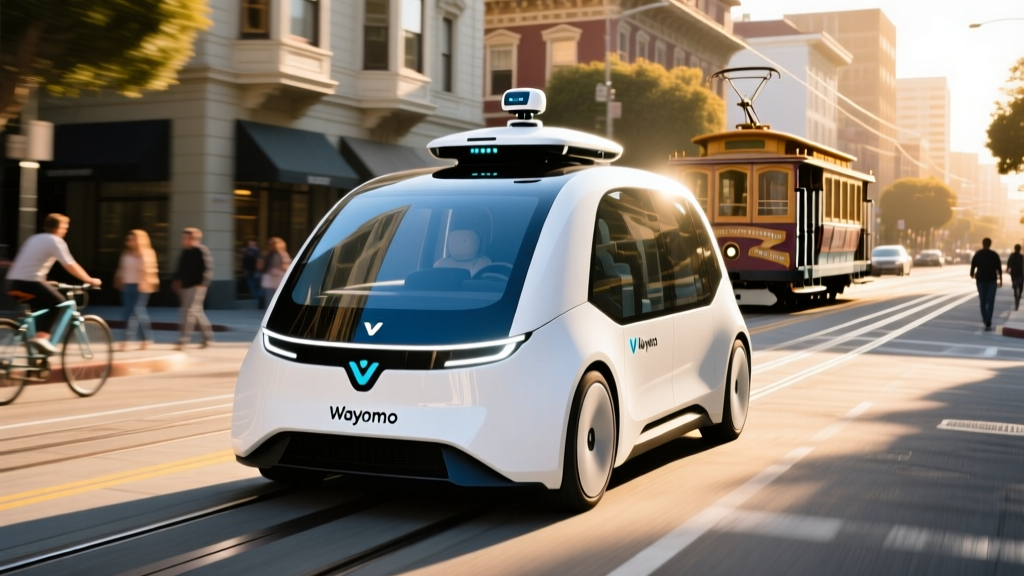
If you have spent any time on the streets of San Francisco over the past two years, you have almost certainly spotted one: a white Jaguar I-PACE bristling with roof-mounted lidar pods and camera arrays, navigating a four-way stop with no one behind the wheel. Waymo, the Alphabet-owned autonomous vehicle company, has made San Francisco its flagship robotaxi market. But for EV shoppers, tech analysts, and prospective riders, a practical question persists: how many Waymo cars in San Francisco are actually operating right now, and what does that fleet density mean for wait times, coverage, and the broader autonomous vehicle industry?
This guide breaks down the current Waymo One fleet size in the Bay Area, the technology that powers these Level 4 robotaxis, how pricing compares to traditional rideshare, and what the safety data actually shows. No hype — just the numbers and the operational reality as of early 2026.
How Many Waymo Vehicles Are Operating in San Francisco?
Waymo does not publish a live fleet counter, but regulatory filings with the California Public Utilities Commission (CPUC) and California DMV autonomous vehicle permits provide reliable estimates. As of early 2026, Waymo operates an estimated 500 to 700 active robotaxi vehicles across the greater San Francisco Bay Area, including San Francisco proper, the Peninsula, and portions of the East Bay.
That number has grown steadily. In late 2023, Waymo had roughly 250 vehicles in commercial service in San Francisco. The fleet approximately doubled through 2024 and 2025 as the company expanded its geofenced service area and increased vehicle utilization rates. The fleet consists entirely of the Jaguar I-PACE, a fully electric luxury crossover that Waymo integrates with its custom 6th-generation Waymo Driver hardware suite.
Waymo One operates as a SAE Level 4 service within its defined Operational Design Domain (ODD). This means the vehicle performs all driving tasks without human intervention within its geofenced service area. There is no driver in the front seat — no steering wheel input, no pedal presses. This is fundamentally different from Level 2 driver-assist systems like Tesla Autopilot or GM Super Cruise, which require continuous human supervision. When a Waymo encounters a situation it cannot handle, it executes a minimal-risk maneuver (pulling over safely) rather than handing control to a human.
Where Can You Actually Ride a Waymo Right Now?
Fleet size matters only if those vehicles cover the areas you need. Waymo One's service area in the Bay Area has expanded significantly, but it remains geofenced — the vehicles cannot operate outside their mapped and approved zones.
| Metro Area | Status | Coverage Notes |
|---|---|---|
| San Francisco | Fully commercial (24/7) | City-wide coverage including downtown, SOMA, Mission, Sunset, Richmond districts. SFO airport rides available. |
| Peninsula / South Bay | Fully commercial | Mountain View, Sunnyvale, Palo Alto, parts of San Jose. Coverage along Highway 101 corridor. |
| East Bay | Partially commercial | Berkeley, Oakland, and select surrounding areas. Expanding coverage through 2025-2026. |
| Los Angeles | Fully commercial | Santa Monica, Hollywood, downtown LA, LAX airport. Second-largest Waymo market. |
| Phoenix, AZ | Fully commercial | Metro Phoenix including Tempe, Chandler, Scottsdale, Sky Harbor airport. Original launch market. |
| Austin, TX | Testing / limited commercial | Select zones in central Austin. Commercial availability expanding. |
Within San Francisco itself, the geofence now covers virtually the entire city. Early restrictions that excluded certain highways and neighborhoods have been lifted as Waymo accumulated millions of miles of urban driving data. You can hail a Waymo to the Golden Gate Bridge approach, the Presidio, and most residential neighborhoods — though trips crossing the Golden Gate Bridge into Marin County remain outside the ODD.
Waymo Pricing: How Does It Compare to Uber and Lyft?
One of the most common questions from first-time riders is whether robotaxi service costs more than a conventional rideshare. The answer is nuanced: Waymo prices its rides to be competitive with UberX and Lyft standard fares, not at a premium. In many cases, Waymo rides come in slightly cheaper than Uber/Lyft for equivalent routes, particularly during non-surge periods.
| Route (San Francisco) | Waymo One | UberX | Lyft |
|---|---|---|---|
| SOMA to Mission (3 mi) | $11–$15 | $13–$18 | $12–$17 |
| Downtown to SFO Airport (14 mi) | $38–$48 | $42–$65 | $40–$60 |
| Sunset to Financial District (7 mi) | $22–$28 | $25–$35 | $24–$33 |
| Marina to SoMa (4 mi) | $14–$19 | $16–$24 | $15–$22 |
Note: Fares are estimates based on typical non-surge pricing in early 2026. Uber and Lyft prices fluctuate with demand-based surge pricing; Waymo currently does not apply surge multipliers.
Key pricing advantages for Waymo include the absence of surge pricing and no tip expectation (there is no driver to tip). The trade-off: Waymo does not offer pooled rides, premium vehicle tiers, or scheduled rides more than a few minutes in advance. You also cannot request specific stops mid-ride the way you might ask a human driver to pause at a drive-through.
How to Use Waymo One
Download the Waymo One app (iOS/Android), create an account, and enter your pickup and dropoff locations. If both points fall within the geofenced service area, the app provides an upfront price and estimated wait time — typically 3 to 8 minutes in San Francisco during normal hours. When the vehicle arrives, you confirm a PIN on the rear door handle to unlock, buckle up, and tap "Start Ride" on the rear-seat screen. The vehicle handles everything from there.
Safety Data: What the Numbers Actually Show
Safety is the most scrutinized dimension of any robotaxi service, and Waymo has accumulated more public-road autonomous miles than any other Level 4 operator. As of early 2026, Waymo reports over 10 million fully driverless miles completed across its commercial markets, with San Francisco representing the largest share.
- Total driverless miles: 10+ million (across all markets, through early 2026)
- Contactable injury rate: Approximately 85% lower than human benchmark for the same driving environments, per NHTSA-referenced comparative analysis published by Waymo
- Police-reported crashes: Waymo vehicles have been involved in minor incidents, predominantly low-speed rear-end and side-swipe contacts where the Waymo was the struck vehicle — consistent with urban driving patterns
- Disengagement rate: Waymo reports remote-assistance interventions approximately once per several thousand miles — the vehicle pulls over and waits for a remote operator to confirm a path forward, rather than a human taking the wheel
- SFO airport operations: Thousands of completed airport trips without reported serious incidents
Sources: Waymo Safety Reports, CA DMV Disengagement Reports, CPUC filings.
The critical context: Waymo vehicles operate at the speed limit or below, maintain generous following distances, and execute conservative lane changes. This means they are occasionally rear-ended by human drivers — the most common incident type in the fleet's history. Waymo's data consistently shows that the vehicles are rarely the at-fault party in collisions. Independent researchers at the Insurance Institute for Highway Safety (IIHS) have noted that robotaxi crash profiles differ significantly from human drivers: fewer high-speed impacts, no impaired-driving incidents, and no distracted-driving events.
The Technology Stack: What Makes Level 4 Possible
The Jaguar I-PACE vehicles in Waymo's fleet are not stock EVs with a camera taped to the windshield. Each vehicle carries Waymo's 6th-generation Waymo Driver sensor suite — a hardware stack designed specifically for driverless operation without a human fallback.
6th-Gen Waymo Driver — Sensor Breakdown
| Lidar | Custom-built roof-mounted and side-mounted lidar units providing 360° high-resolution 3D point clouds at ranges exceeding 200 meters. Unlike camera-only systems (e.g., Tesla FSD), lidar provides direct depth measurement independent of lighting conditions. |
| Cameras | 360° camera array with improved dynamic range for traffic signal detection, signage reading, pedestrian gesture recognition, and construction-zone cone identification. |
| Radar | Short- and long-range radar units for velocity detection of surrounding vehicles, particularly in conditions where lidar performance may degrade (heavy rain, fog). |
| Audio detection | External microphones detect emergency vehicle sirens and trigger yielding behavior before the siren is visible to cameras. |
| Compute | Custom onboard computing platform processing sensor fusion, prediction models, and planning algorithms in real time. Redundant systems for steering, braking, and power ensure fail-safe operation. |
The lidar vs. camera-only debate is a defining split in the autonomous vehicle industry. Waymo's position — shared by Zoox, Cruise (pre-suspension), and most commercial robotaxi operators — is that lidar is essential for Level 4 reliability. Lidar provides direct distance measurements regardless of ambient light, giving the system confidence in scenarios where camera-only systems can struggle: direct sun glare, poorly lit intersections, and distinguishing a flat painted road marking from a three-dimensional obstacle.
Tesla's FSD (Supervised) takes the opposite approach, relying exclusively on cameras and neural networks. However, FSD remains a Level 2 system requiring active driver supervision — a fundamentally different operational category than Waymo's driverless Level 4 service.
Geofencing and HD Mapping
Waymo vehicles operate within a pre-mapped geofence. Before any street is added to the service area, Waymo creates a high-definition map capturing lane geometry, curb heights, speed limits, traffic signal positions, and known construction patterns. The vehicle's real-time sensor data is continuously compared against this map. If the vehicle encounters a scenario that deviates significantly from its mapped understanding — a major unplanned road closure, for example — it will execute a safe pullover and request remote assistance rather than guessing.
Current Limitations: What Waymo Cannot Do
Understanding the boundaries of Level 4 autonomy is as important as understanding its capabilities. Waymo's service has real, concrete limitations that riders and industry observers should know.
- Geofence boundaries: Waymo cannot drive outside its approved service area. A trip from San Francisco to Napa, for example, is not possible. The vehicle will simply decline the ride request.
- Severe weather: Heavy fog (common in San Francisco's summer marine layer), torrential rain, and flooding can cause the service to restrict operations or increase wait times. Waymo's sensors handle light rain and overcast conditions well, but visibility-reducing weather remains a challenge for all lidar/camera systems.
- Complex construction zones: While Waymo handles routine lane closures and cone delineation, major unanticipated construction reconfigurations can cause the vehicle to pull over and wait for remote guidance, adding minutes to your trip.
- Unprotected left turns at busy intersections: Waymo has improved dramatically here, but at certain high-traffic, poorly-marked intersections, the vehicle may take a more conservative (longer) route to avoid the maneuver entirely.
- No multi-stop trips: You cannot add a mid-ride stop at a store or ask the vehicle to wait while you grab something. It is point-A to point-B only.
- Accessibility limitations: The Jaguar I-PACE fleet does not currently offer wheelchair-accessible vehicles. Waymo has announced partnerships for accessible vehicles (including the purpose-built Zeekr robotaxi), but these are not yet in commercial service in San Francisco.
- Child seats: Waymo vehicles do not provide child safety seats, and riders cannot install their own. Children under a certain age/height cannot ride without an appropriate restraint.
The Regulatory Landscape: Who Approves Robotaxi Operations?
Robotaxi operations in California require approval from multiple regulatory bodies, creating a layered oversight framework that does not exist for conventional rideshare:
- California DMV: Issues the Autonomous Vehicle Testing and Deployment permits. Waymo holds both testing and commercial deployment permits, requiring regular disengagement and collision reporting.
- California Public Utilities Commission (CPUC): Regulates commercial passenger service. Waymo received its commercial carrier permit allowing paid rides — a distinct approval from the DMV's testing permit.
- National Highway Traffic Safety Administration (NHTSA): Federal oversight of vehicle safety standards. The Jaguar I-PACE itself carries standard NHTSA crash-test ratings, and NHTSA monitors autonomous vehicle incident reporting through its Standing General Order requiring all AV operators to report crashes.
- San Francisco Municipal Transportation Agency (SFMTA): Local coordination on street-level operations, curb management, and incident response protocols.
This multi-agency framework means Waymo's operations are among the most heavily regulated transportation services in the country. Every collision, every disengagement, and every service-area expansion goes through regulatory review — a level of scrutiny that human Uber and Lyft drivers never face.
The Vehicle: Jaguar I-PACE as a Robotaxi Platform
For EV enthusiasts, the choice of the Jaguar I-PACE as Waymo's sole robotaxi platform warrants attention. The I-PACE is a battery-electric luxury crossover with a 90 kWh battery pack (NMC chemistry), an EPA-estimated range of approximately 234 miles in stock form, and dual-motor all-wheel drive producing 394 horsepower.
In Waymo's configuration, the range is reduced due to the continuous power draw of the sensor suite and onboard compute — Waymo has not published exact usable range figures, but the vehicles return to charging depots regularly throughout the day. The fleet charges primarily at dedicated Waymo facilities using DC fast charging and depot-level Level 2 infrastructure, not at public charging networks.
Waymo's next-generation vehicle, developed in partnership with Geely's Zeekr brand, features a custom-designed interior with no steering wheel or pedals, lower floor for easier entry, and integrated 6th-gen sensors built into the vehicle body rather than bolted on. This vehicle is expected to begin limited deployment in 2026-2027 but is not yet in San Francisco commercial service.
Frequently Asked Questions
Is Waymo truly self-driving, or is there a human driver?
Waymo One is genuinely driverless — there is no human in the driver's seat, no steering wheel, and no pedals being operated by a person. This is SAE Level 4 autonomy within the geofenced service area. This is categorically different from Tesla's Full Self-Driving (Supervised), GM Super Cruise, or Ford BlueCruise, which are all SAE Level 2 systems requiring the human driver to remain attentive and ready to take over at any moment.
How many Waymo cars are in San Francisco vs. other cities?
San Francisco and the broader Bay Area represent Waymo's largest fleet concentration, estimated at 500-700 vehicles. Phoenix, the original launch market, has a comparable fleet. Los Angeles has a growing fleet estimated in the hundreds. Austin is a newer, smaller deployment. Waymo does not publish city-level fleet counts, so these figures are derived from permit filings and operational observations.
How much does a Waymo ride cost compared to Uber or Lyft?
Waymo pricing is generally on par with or slightly below UberX and Lyft standard fares for equivalent routes. A 3-mile ride within San Francisco typically costs $11-$15. Waymo does not apply surge pricing and there is no tip. Airport runs (e.g., downtown SF to SFO) typically cost $38-$48, often undercutting rideshare during peak-demand periods.
How safe are Waymo robotaxis compared to human drivers?
Waymo's published data, cross-referenced with NHTSA benchmarks, indicates the fleet's contactable-injury rate is roughly 85% lower than human drivers in comparable urban environments. The most common incidents involve human-driven vehicles rear-ending the Waymo at low speed — consistent with the Waymo's conservative driving behavior and adherence to speed limits. No fatalities have been attributed to Waymo's driverless commercial operations as of early 2026.
What are the current limitations of Waymo service?
Key limitations include geofence boundaries (no trips outside the mapped service area), reduced availability during heavy fog or severe weather, inability to make mid-trip stops, no wheelchair-accessible vehicles in the current fleet, and occasional conservative rerouting around complex construction zones. Wait times can also increase during peak demand or adverse conditions.
Can I use Waymo at San Francisco International Airport (SFO)?
Yes. Waymo One offers rides to and from SFO, with a designated pickup area. This was a significant expansion milestone, as airport operations require additional coordination with airport authorities and involve highway-speed driving on the approach roads.
The bottom line: with an estimated 500 to 700 vehicles covering virtually all of San Francisco and expanding Bay Area corridors, Waymo has built the world's largest commercially operating Level 4 robotaxi fleet. For EV and autonomous technology observers, the San Francisco deployment represents the most data-rich proof point that driverless urban transportation is not a future concept — it is a present-day, regulated, revenue-generating service with measurable safety outcomes and real limitations worth understanding.