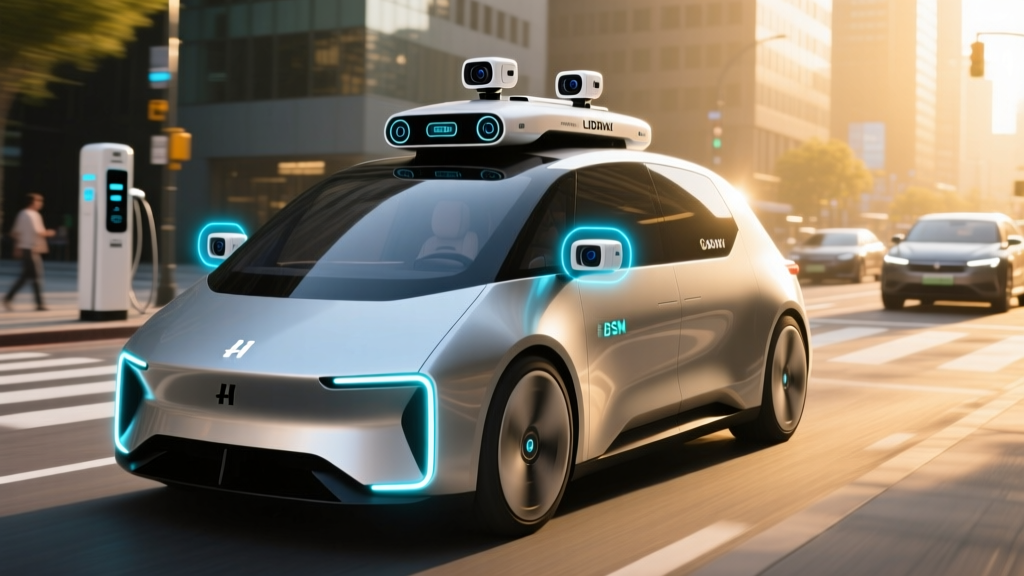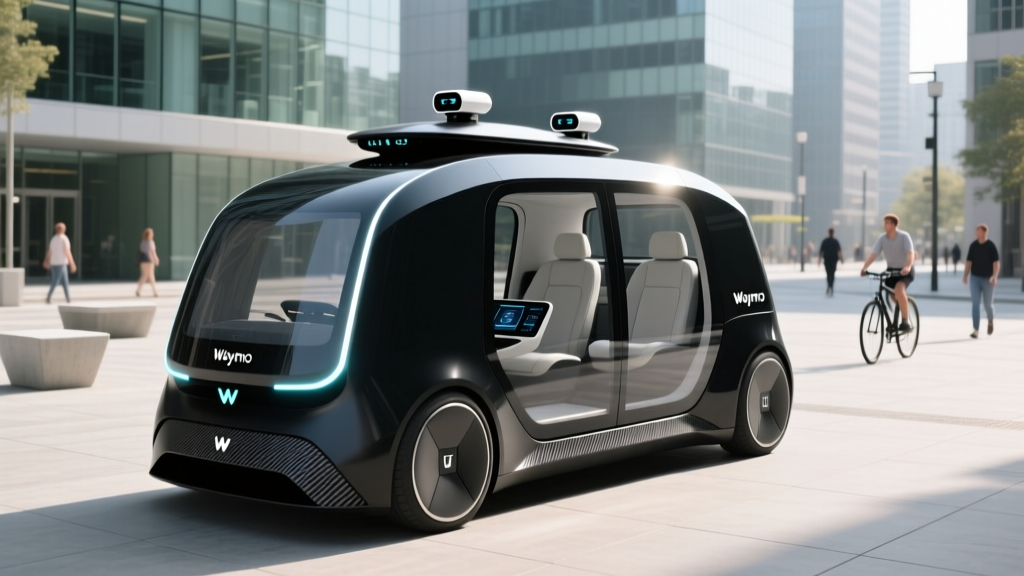
You can't buy a Waymo. That's the short answer to "how much is a Waymo car worth?" — because Waymo doesn't sell its vehicles to consumers. But the question opens a window into one of the most expensive, sensor-dense, and technologically complex machines ever to operate on public roads. Each Waymo robotaxi represents roughly $200,000 to $250,000 in combined vehicle and autonomous-driving hardware, and understanding that number reveals why robotaxi economics work the way they do — and what it costs you to ride in one.
This guide breaks down the real cost of a Waymo vehicle, the technology that drives that price, where the service operates in 2026, how ride pricing compares to Uber and Lyft, and the safety data behind the wheel-less operation.
The Real Cost Behind a Waymo Robotaxi
A Waymo vehicle isn't a car in the traditional sense — it's a rolling data center wrapped around a passenger cabin. The current fleet primarily uses the Zeekr RT1 (a purpose-built robotaxi co-developed with Geely's Zeekr brand) alongside remaining Jaguar I-PACE units from earlier deployments. Here's how the cost layers up:
| Component | Estimated Cost | Details |
|---|---|---|
| Base vehicle (Zeekr RT1 or Jaguar I-PACE) | $50,000–$75,000 | EV platform, battery pack, interior |
| LiDAR array (5th-gen custom) | $30,000–$50,000 | Multiple units for 360° coverage |
| Camera system (29+ sensors) | $5,000–$10,000 | High-res, redundant imaging |
| Radar units | $3,000–$5,000 | All-weather object detection |
| Compute platform (custom AI hardware) | $15,000–$25,000 | Onboard inference, sensor fusion |
| Integration, calibration, testing | $20,000–$40,000 | Assembly, QA, redundancy systems |
| Estimated total per vehicle | $200,000–$250,000+ | Before fleet ops, software, mapping |
That per-vehicle cost doesn't include the HD mapping infrastructure, remote fleet operations centers, software development (billions across the fleet), or the maintenance depots Waymo operates in each city. Alphabet's total investment in Waymo has been estimated at over $30 billion since the project's inception as Google's self-driving car program.
This is why Waymo doesn't sell cars to individuals: the vehicle is useless without the geofenced map data, the fleet operations network, and the continuous software updates that make autonomous driving possible. You're not buying a car — you'd be buying a paperweight without the ecosystem.
SAE Automation Level: What Level Is Waymo?
This means the vehicle handles all driving tasks within its defined operational design domain (ODD) — specific geofenced areas under specific conditions — with no human driver required. There is no steering wheel, no pedals, and no expectation that a passenger will intervene.
This is fundamentally different from SAE Level 2 systems like Tesla Autopilot, Ford BlueCruise, or GM Super Cruise, which require continuous driver supervision. Level 2 is driver-assist. Level 4 is driverless (within its zone). Never conflate the two.
| Level | Name | Who Drives | Example |
|---|---|---|---|
| 0 | No Automation | Human | Standard car |
| 1 | Driver Assistance | Human (with aid) | Adaptive cruise control |
| 2 | Partial Automation | Human (must supervise) | Tesla Autopilot, BlueCruise |
| 3 | Conditional Automation | System (human on standby) | Mercedes DRIVE PILOT (limited) |
| 4 | High Automation | System (no human needed in ODD) | Waymo, Zoox |
| 5 | Full Automation | System (everywhere, all conditions) | Does not yet exist |
Where Can You Use Waymo Right Now?
As of early 2026, Waymo One — the company's commercial ride-hailing service — operates in the following metro areas. Service is geofenced: the car will only drive within pre-mapped zones, and you cannot request a ride that exits the operational boundary.
| City | Status | Coverage Area (approx.) | Notes |
|---|---|---|---|
| Phoenix, AZ (metro) | Fully operational | ~315 sq mi | Largest and longest-running market; includes Chandler, Tempe, Mesa, Scottsdale, airport service |
| San Francisco, CA | Fully operational | ~47 sq mi (city core) | 24/7 service; includes SFO airport rides |
| Los Angeles, CA | Fully operational | ~80+ sq mi | Covers downtown LA, Hollywood, Santa Monica, Westside, LAX |
| Austin, TX | Operational (expanding) | ~45 sq mi (initial) | Launched 2025; expansion ongoing |
Waymo has announced intentions to expand to additional cities, but announced plans are not live service. If you're outside these geofenced zones, you cannot hail a Waymo today. Check the Waymo One app for the most current coverage maps.
How Much Does a Waymo Ride Cost vs. Uber and Lyft?
Waymo One uses dynamic pricing similar to rideshare platforms, with costs based on distance, time, and demand. In practice, Waymo rides tend to price competitively with UberX and Lyft Standard — sometimes slightly higher during off-peak hours, sometimes lower when Uber/Lyft surge pricing is active.
| Route Example | Waymo One | UberX | Lyft Standard |
|---|---|---|---|
| Short trip (~3 mi, Phoenix) | $8–$12 | $7–$11 | $7–$10 |
| Medium trip (~8 mi, SF) | $16–$24 | $14–$22 | $13–$20 |
| Airport run (~15 mi, LAX) | $28–$40 | $25–$38 | $24–$35 |
| Surge/peak pricing | Moderate increase | Can 2–3x | Can 2–3x |
Key advantage for Waymo: No surge multipliers as aggressive as rideshare. When demand spikes, Uber and Lyft can 2x or 3x fares because they're competing for a limited pool of human drivers. Waymo's fleet is fixed and dispatched algorithmically, so pricing increases are more moderate. The trade-off is that wait times can be longer during peak demand if no vehicle is nearby.
How to use it: Download the Waymo One app (iOS/Android), enter your pickup and destination within the service area, confirm the price, and a vehicle arrives — typically within 5–15 minutes. You unlock the car via the app, and the ride proceeds entirely autonomously.
Waymo's Safety Record: What the Data Shows
- 50+ million fully autonomous miles driven on public roads (cumulative fleet)
- ~10 million+ paid rides completed
- Zero passenger fatalities attributed to Waymo autonomous operation
- Waymo's own published study (2024, peer-reviewed) showed a ~85% reduction in injury-causing crash rates compared to human-driven benchmarks in the same operating areas
- Most reported incidents involve low-speed contact with other vehicles, not at-fault collisions
Sources: NHTSA Standing General Order data, Waymo safety reports, and independent analyses. Always check the latest NHTSA and California DMV disengagement/incident reports for current figures.
Safety context matters. Waymo vehicles operate primarily in urban environments at moderate speeds (typically under 45 mph). They don't drive on high-speed freeways in most markets. The comparison benchmark is human drivers in the same urban conditions — where distraction, impairment, and fatigue cause the majority of crashes. Waymo's sensor suite doesn't get tired, drunk, or distracted.
That said, the system isn't perfect. Documented edge cases include confusion around temporary construction zones, unusual road configurations, and interactions with emergency vehicles. Waymo vehicles have been recorded stopping unexpectedly in travel lanes — a different kind of safety concern that regulators have flagged.
The Technology Stack: Why a Waymo Car Costs So Much
Waymo's approach is sensor-rich and redundancy-heavy — the opposite of Tesla's camera-only philosophy. Here's what's on each vehicle:
- LiDAR (5th generation, custom-built): Multiple roof- and body-mounted units create a real-time 3D point cloud of the environment up to 500+ meters. LiDAR works in darkness and is independent of visible light. This is the single most expensive sensor category on the car.
- Cameras (29+ high-resolution units): Cover 360° vision at varying focal lengths — reading traffic lights, detecting hand signals, identifying pedestrians at distance.
- Radar (6+ units): Provides velocity data on moving objects and operates reliably in rain, fog, and dust — conditions where LiDAR and cameras degrade.
- External audio sensors: Detect sirens from emergency vehicles and adjust behavior accordingly.
- Custom compute platform: Processes terabytes of sensor data per hour in real time, running perception, prediction, and planning models simultaneously.
- HD maps + geofencing: Every inch of the operational area is pre-mapped at centimeter-level precision. The vehicle knows where every lane, crosswalk, and signal is before it arrives.
This multi-sensor fusion approach is why the per-vehicle cost stays above $200,000. Tesla's camera-only FSD system costs the consumer roughly $8,000 as an add-on — but it remains SAE Level 2, requiring driver supervision. Waymo's hardware cost is the price of removing the human from the equation entirely.
Current Limitations: What Waymo Cannot Do
For all its capability, Waymo's Level 4 system has defined boundaries. Understanding these limitations is essential for anyone evaluating robotaxi service:
- Geofence restriction: The vehicle will not drive outside its pre-mapped zone. If your destination is beyond the boundary, you'll need another ride for the last mile.
- Weather limitations: Heavy rain, fog, and snow degrade LiDAR and camera performance. Waymo has improved its rain-handling significantly in Phoenix and LA, but severe weather can trigger service pauses. Snow and ice remain largely unsupported — which is why Waymo doesn't operate in Chicago or Minneapolis.
- No high-speed freeway driving (in most markets): Most Waymo routes use surface streets. Limited freeway segments are approved in some markets, but the system primarily avoids 65+ mph roads.
- Construction zones: Temporary lane shifts, missing lane markings, and flaggers can confuse the system. Waymo may reroute or pull over and request remote assistance.
- Unusual scenarios: Hand-directed traffic, off-road detours, unmapped private driveways, and certain complex multi-point turns remain challenging edge cases.
- No intercity travel: You cannot take a Waymo from Phoenix to Tucson or SF to Sacramento. These are strictly intra-city services.
Regulatory Landscape: Who Approves Robotaxi Operations?
Robotaxi operations in the U.S. exist under a patchwork of state and local regulation — there is no single federal license for autonomous vehicle deployment.
California: The California DMV issues autonomous vehicle testing and deployment permits, while the California Public Utilities Commission (CPUC) regulates commercial passenger service. Waymo holds full deployment permits in San Francisco and Los Angeles.
Arizona: Arizona has taken one of the most permissive approaches in the country, with no specific state-level autonomous vehicle permit required beyond standard vehicle registration and insurance. The Phoenix metro has been Waymo's longest-running market under this framework.
Texas: Austin operations fall under a combination of state legislation (Texas Transportation Code Chapter 545 provisions for autonomous vehicles) and city-level coordination.
Federal level: NHTSA oversees vehicle safety standards and requires all autonomous vehicle operators to report crashes under the Standing General Order. However, NHTSA has not established a comprehensive federal regulatory framework for Level 4 deployment — that authority largely remains with states.
The Economics: Why You'll Ride Waymo Before You Own One
At $200,000+ per vehicle, plus fleet operations, mapping, and software costs, the robotaxi business model only works at scale. Waymo needs each vehicle running 15–20 hours per day, completing dozens of rides, to amortize that capital cost. This is fundamentally a fleet-operations business — closer to an airline than a car company.
For consumers, the implication is clear: you will experience Waymo's technology as a service, not a product. The $15 ride across town is subsidized by Alphabet's balance sheet and the long-term bet that sensor costs will drop, software will improve, and fleet utilization will climb. Whether that economics ever reaches profitability at the unit level remains one of the defining questions of the autonomous vehicle industry.
The vehicle itself? It's not for sale — at any price.
Frequently Asked Questions
Can I buy a Waymo car for personal use?
No. Waymo does not sell vehicles to consumers. The cars are purpose-built for fleet operations and require proprietary mapping, software, and remote-assistance infrastructure that only Waymo operates. Even if you acquired a decommissioned unit, the autonomous driving system would not function without Waymo's backend.
Is Waymo truly self-driving, or is someone monitoring remotely?
Waymo is truly self-driving (SAE Level 4) within its operational domain. There is no remote driver controlling the vehicle in real time. However, Waymo does employ remote fleet responders who can assist the vehicle if it encounters an unfamiliar scenario — they don't "drive" the car, but they can confirm a safe path or authorize a maneuver. Think of it as on-call support, not remote piloting.
How does Waymo's cost compare to owning a car in the city?
For urban residents who drive less than 8,000 miles per year, Waymo plus occasional car-sharing can be cheaper than ownership when you factor in insurance, parking, maintenance, and depreciation. For higher-mileage drivers or those outside the geofence, personal vehicle ownership (or a hybrid approach) remains more practical. The breakeven point depends heavily on your city, commute, and parking costs.
What happens if a Waymo gets in an accident?
Waymo carries commercial insurance for its fleet. In the event of a collision, the vehicle is designed to pull over safely, contact emergency services if needed, and notify Waymo's fleet operations center. Passengers are covered under Waymo's insurance. NHTSA's Standing General Order requires Waymo to report all crashes involving its autonomous vehicles.
Will Waymo ever sell cars to consumers?
Waymo has not announced any consumer vehicle sales program, and the company's business model is built entirely around fleet-operated ride-hailing. It's possible that Waymo's technology could eventually be licensed to automakers for consumer vehicles (similar to how Mobileye supplies ADAS systems), but a consumer-purchasable Waymo car is not on the near-term roadmap.