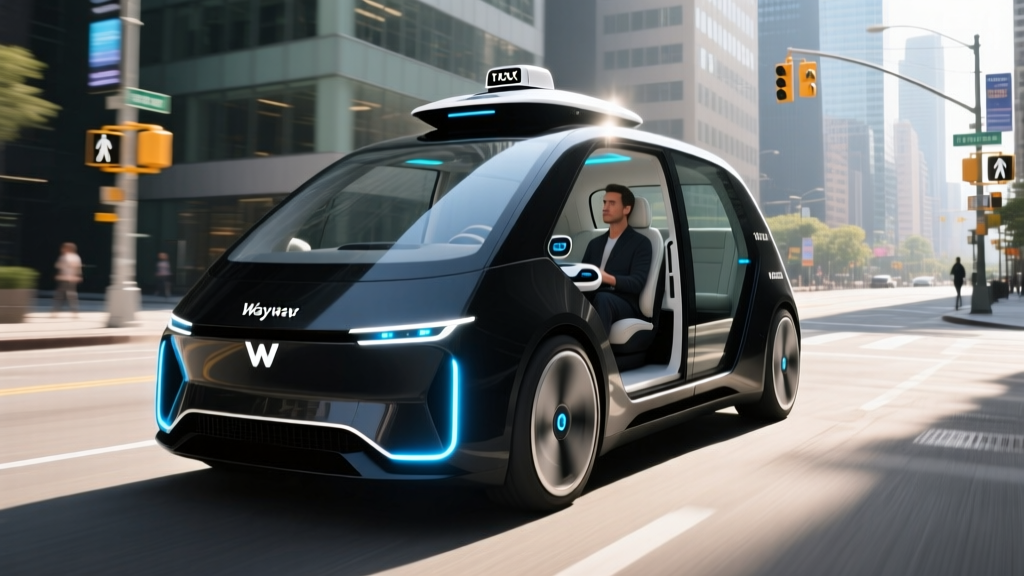
If you have scrolled through a podcast feed, watched a YouTube pre-roll, or driven past a billboard in Phoenix or San Francisco lately, you have likely encountered Waymo advertising. Alphabet's autonomous vehicle division has ramped up its marketing spend considerably as it expands its commercial driverless ride-hail service across the United States. The ads promise a future where you summon a car with no driver, sit back, and arrive safely. But how much of that messaging holds up against real-world data, regulatory filings, and the experience of actual riders?
This guide cuts through the marketing to give you the numbers: where Waymo One operates today, what a ride actually costs compared to Uber and Lyft, the published safety record, the sensor stack that makes Level 4 autonomy possible, and the hard limitations the commercials gloss over. Whether you are a prospective rider, an EV-curious buyer benchmarking autonomous tech, or an investor tracking the robotaxi sector, this is the spec-sheet view.
SAE Automation Level: What Waymo Actually Is (and Isn't)
Before evaluating any Waymo advertisement, you need to understand where the service sits on the SAE International automation scale. Waymo One is a SAE Level 4 driverless service. That means the vehicle handles all driving tasks within a defined Operational Design Domain (ODD) — a geofenced area under specific conditions — with no human driver behind the wheel and no expectation that a passenger will intervene.
| Level | Name | Who Drives? | Example |
|---|---|---|---|
| 0–1 | No Automation / Driver Assist | Human | Cruise control, lane-keep |
| 2 | Partial Automation | Human (must supervise) | Tesla Autopilot, GM Super Cruise, Ford BlueCruise |
| 3 | Conditional Automation | System (human on standby) | Mercedes DRIVE PILOT (limited markets) |
| 4 | High Automation | System (within ODD) | Waymo One, Zoox |
| 5 | Full Automation | System (all conditions) | Does not yet exist commercially |
This is the critical distinction that Waymo advertising generally gets right and that consumer marketing from some automakers gets wrong: Tesla's FSD (Supervised), GM's Super Cruise, and Ford's BlueCruise are all Level 2 systems. The human driver remains legally and operationally responsible. Waymo's robotaxis are Level 4 — no steering wheel, no driver, no supervision required from the rider. They are fundamentally different categories of technology, and conflating them is the single most common error in mainstream autonomous-vehicle coverage.
Where Can I Use Waymo One Right Now?
Waymo's commercial service availability is defined by geofenced zones within specific metro areas. As of early 2026, Waymo One is operational or in active paid-service rollout in the following cities:
| Metro Area | Status | Service Area Notes |
|---|---|---|
| Phoenix, AZ | Fully operational | Largest coverage area (~225+ sq mi); includes Chandler, Tempe, Mesa, Scottsdale, Sky Harbor airport |
| San Francisco, CA | Fully operational | City-wide coverage; expanded to include SFO airport rides |
| Los Angeles, CA | Operational (expanding) | Downtown LA, Hollywood, Santa Monica, Westside; LAX service in rollout |
| Austin, TX | Operational | Central Austin and surrounding corridors; Uber integration available |
| Atlanta, GA | Announced / early rollout | Partnership with Uber; limited initial geofence, expanding |
Waymo advertising frequently highlights Phoenix and San Francisco as its flagship markets, and the data bears this out: Phoenix alone has logged the highest cumulative rider count, while San Francisco represents the most technically challenging urban environment the fleet operates in. If you are outside these metros, you cannot yet hail a Waymo — no amount of app-downloading will change that until the geofence reaches your area.
To use the service in an active market, you download the Waymo One app (iOS/Android), enter your pickup and drop-off within the geofenced zone, and confirm the ride. In select markets, you can also request a Waymo through the Uber app, where Waymo vehicles appear as a ride option alongside UberX and other tiers.
Pricing: Waymo vs. Uber and Lyft
One of the most common questions from riders encountering Waymo advertising for the first time: how much does it actually cost? Waymo uses dynamic pricing that factors in distance, time, and demand, similar to rideshare. Here is how typical fares compare based on rider reports and published pricing data from 2025–2026:
| Route (Example) | Waymo One | UberX | Lyft Standard |
|---|---|---|---|
| Short urban trip (~3 mi) | $9–$14 | $8–$13 | $8–$12 |
| Medium trip (~8 mi) | $18–$28 | $15–$24 | $14–$22 |
| Airport run (~15 mi) | $35–$55 | $30–$50 | $28–$48 |
| Surge pricing event | Moderate increase | High surge (2–4x) | High surge (2–3x) |
The takeaway: Waymo fares are broadly comparable to UberX and Lyft on standard trips, with a modest premium on some routes. The advantage is consistency — Waymo's dynamic pricing tends to surge less aggressively than human-driven rideshare during peak demand, because fleet supply is managed centrally and there is no driver incentive to log off during low-margin hours. Waymo also runs promotional pricing in new markets to build ridership, so first-time users in expansion cities often see discounted fares.
Safety Record: What the Data Actually Shows
Waymo advertising leans heavily on safety messaging — "the world's most experienced driver" is a recurring tagline. But marketing claims need verification. Here is what the published data tells us.
- Cumulative autonomous miles driven: 50+ million fully driverless miles (as of late 2025 reporting)
- Insurance-claimed injury rate: Waymo's driverless vehicles showed a 85% lower injury claim rate compared to human-driven benchmarks, per a study by the Insurance Institute for Highway Safety (IIHS) and Swiss Re analyzing over 25 million miles
- Police-reported crash rate: Approximately 6x lower than human drivers in comparable urban environments, per Waymo's published safety data submitted to NHTSA
- Contact events: The vast majority of minor incidents involve other human-driven vehicles contacting the Waymo (rear-end at stop, side-swipe in lane changes), not the Waymo initiating contact
Waymo is required to report disengagements and incidents to state regulators in California (via the DMV) and to NHTSA at the federal level under Standing General Order 2021-01, which mandates crash reporting for all ADS-equipped vehicles. The data is imperfect — comparison baselines vary, and urban low-speed environments produce different crash profiles than highway driving — but the directional finding is consistent: Waymo's Level 4 fleet is involved in fewer injury-producing and property-damage crashes per million miles than the human-driven average in the same cities.
That said, Waymo vehicles are not incident-free. There have been documented cases of Waymo vehicles making contact with pedestrians in crosswalks at very low speed, encountering improperly parked vehicles, and being vandalized. Each incident is reported and investigated. The honest framing is that Level 4 autonomy in a geofenced urban zone appears to produce a meaningfully better safety outcome than the human average, but it is not zero-risk — no driving system is.
Technology Stack: Lidar, Cameras, and the 6th-Gen System
Waymo's current production fleet uses the 6th-generation Waymo Driver hardware suite, integrated primarily into the Zeekr RT (a purpose-built electric robotaxi) and the Jaguar I-PACE (the legacy fleet vehicle). The tech stack is sensor-diverse, which is a deliberate contrast to Tesla's camera-only approach:
- Lidar: Multiple solid-state and spinning lidar units providing 360° high-resolution 3D point-cloud mapping at ranges exceeding 200 meters. Lidar gives precise distance measurement independent of lighting conditions.
- Cameras: High-resolution surround cameras for object classification, traffic-light state detection, signage reading, and lane marking identification. Improved low-light and high-dynamic-range performance over 5th-gen.
- Radar: Imaging radar arrays for velocity detection of moving objects (vehicles, cyclists, pedestrians) and operation in rain and fog where lidar and cameras degrade.
- Audio sensors: External microphones to detect emergency-vehicle sirens and trigger appropriate yield behavior.
- Compute: Custom-designed AI inference hardware onboard, with redundant systems for steering, braking, and perception.
The lidar-first approach is the defining technical bet that separates Waymo from Tesla's vision-only FSD. Lidar provides ground-truth distance data that cameras must estimate, which matters enormously for edge cases like a pedestrian partially occluded behind a parked truck at dusk. The trade-off is cost and complexity — a 6th-gen Waymo sensor suite is estimated to cost tens of thousands of dollars per vehicle, which is why Waymo operates as a fleet service rather than selling hardware to consumers.
The fleet is also geofenced: each vehicle operates only within a pre-mapped Operational Design Domain where Waymo has built high-definition maps including lane geometry, traffic signal positions, speed limits, and construction-zone protocols. The vehicle does not drive into unmapped territory. If you request a ride with a drop-off outside the geofence, the app will not allow it.
Regulatory Landscape: Who Approves Waymo?
Robotaxi operations in the United States are governed by a patchwork of state and federal authority. There is no single federal "robotaxi license." Instead:
- Federal (NHTSA): Sets vehicle safety standards (FMVSS). NHTSA has granted Waymo specific exemptions for vehicles without traditional controls (steering wheel, pedals, mirrors). NHTSA also collects crash data under Standing General Orders.
- California (CPUC + DMV): The California Public Utilities Commission issues permits for commercial passenger service. The DMV issues testing and deployment permits and collects disengagement reports. Waymo holds a CPUC "Phase 3" permit allowing commercial driverless service with fares.
- Arizona: Has a permissive regulatory environment via executive order; no specific state agency permit is required beyond standard business and vehicle registration. This is why Phoenix was Waymo's first commercial market.
- Texas (Austin): The Texas Department of Licensing and Regulation (TDLR) oversees autonomous vehicle operations. Waymo received authorization to operate commercially in Austin.
- Local municipalities: City councils and transportation departments often negotiate operational agreements covering curb access, parking, emergency response protocols, and equity commitments.
Waymo advertising rarely dwells on this regulatory complexity, but it is a major competitive moat. Each new city requires months or years of permitting, public comment, emergency-responder training, and operational testing before paid rides can begin. Competitors entering a new market face the same gauntlet.
Current Limitations: What Waymo Advertising Doesn't Show
Every technology has an operational envelope, and Waymo's Level 4 service is no exception. Here are the constraints riders should understand before their first trip:
- Geofencing: You cannot go everywhere. The service area is a fixed boundary, and rides outside it are blocked in the app. Expansion is incremental, not continuous.
- Weather degradation: Heavy rain, dense fog, and snow reduce lidar and camera effectiveness. In Phoenix, this is rarely an issue. In San Francisco, fog events can trigger service slowdowns or temporary suspension in affected zones. Waymo does not currently operate in cities with significant snowfall.
- Construction zones: While Waymo has improved its handling of lane closures and temporary traffic controls, major unmapped construction can cause the vehicle to take conservative routes, stop and wait, or pull over and request remote guidance.
- No highway-only corridors (yet): Waymo's current ODD is primarily surface streets and controlled-access urban highways at moderate speeds. Long-distance interstate travel between cities is not part of the service.
- Limited vehicle types: You get a Zeekr RT or Jaguar I-PACE. There is no option for an SUV, a wheelchair-accessible vehicle (though Waymo has announced plans for accessible vehicles), or a vehicle with a car seat.
- Passenger limits: Typically up to 3 adult riders per vehicle. No pets (service animals excepted). No unaccompanied minors.
- Wait times: In high-demand periods or at the edges of the geofence, wait times can exceed 15 minutes — longer than Uber/Lyft in the same area, because Waymo's fleet size is smaller than the aggregate rideshare driver pool.
These limitations are not failures — they are the defined boundaries of a Level 4 ODD. The vehicle is engineered to operate safely within them and to decline trips or pull over when conditions fall outside them. Waymo advertising tends to show idealized scenarios (sunny Phoenix boulevards, clear San Francisco nights) without always disclosing the operational envelope, which is standard for marketing but important for riders to understand.
The Vehicle: Zeekr RT and Jaguar I-PACE Specs
For EV buyers interested in the hardware underneath the autonomy software, here is what Waymo's fleet vehicles bring to the table:
| Spec | Zeekr RT (6th-Gen Fleet) | Jaguar I-PACE (Legacy Fleet) |
|---|---|---|
| Battery (usable) | ~100 kWh (NMC) | 84.7 kWh (NMC) |
| EPA Range (est.) | ~250–280 mi (sensor-drag adjusted) | 234 mi (stock EPA) |
| DC Fast Charge Peak | ~200 kW (800V architecture) | 100 kW |
| 10–80% Charge Time | ~25 min | ~45 min |
| Powertrain | Dual-motor AWD | Dual-motor AWD, 394 hp |
| Design | Purpose-built robotaxi (no steering wheel, sliding doors, low floor) | Modified production SUV |
The Zeekr RT, built by Geely's Zeekr brand to Waymo's specifications, represents a significant leap in purpose-built robotaxi design. The 800-volt architecture enables faster depot charging between shifts, and the low-floor, wide-door layout speeds passenger entry and exit. Real-world range is lower than a stock consumer EV would achieve on the same battery because the sensor suite, compute hardware, and climate conditioning for passenger comfort all draw continuous power even when the vehicle is stationary.
Frequently Asked Questions
Is Waymo truly self-driving, or is there a remote human operator?
Waymo vehicles are SAE Level 4 — fully driverless within their geofenced ODD, with no human behind the wheel. However, Waymo employs remote fleet-assistance agents who can be consulted when the vehicle encounters an ambiguous situation (e.g., an unusual construction zone or an emergency responder directing traffic in a non-standard way). The remote agent does not "drive" the vehicle in real time — they provide high-level guidance (e.g., "proceed past the cone"), and the vehicle's onboard system executes the maneuver. This is a key distinction from teleoperation, where a remote human directly controls steering and braking.
How much does a Waymo ride cost compared to Uber or Lyft?
On standard urban trips, Waymo fares are typically within $1–$5 of an equivalent UberX or Lyft ride. The gap narrows during surge events, where Waymo's pricing tends to increase more moderately than rideshare. Airport runs and longer trips may carry a slight premium. Promotional pricing in new markets can make Waymo temporarily cheaper than rideshare.
Can I use Waymo if I am visiting from out of town?
Yes. If you are in a city where Waymo One operates (Phoenix, San Francisco, Los Angeles, Austin), you can download the app and request rides like any local rider. There is no residency requirement. The main constraint is that your pickup and drop-off must both fall within the active geofence.
What happens if the Waymo vehicle gets into an accident?
Waymo vehicles carry commercial insurance, and the company accepts liability for incidents caused by its autonomous driving system. After any collision, the vehicle's data (sensor logs, decision traces) is preserved and reported to regulators. Riders are not held financially responsible for crashes caused by the autonomous system. This is a fundamentally different liability model than Level 2 driver-assist, where the human driver bears responsibility.
Does Waymo operate in bad weather?
Light rain and moderate fog generally do not disrupt service. Heavy downpours, dense fog, and snow can cause the system to slow down, reroute, or temporarily suspend service in affected zones. Phoenix's dry climate is one reason it was the first market. Waymo does not currently operate in cities with regular snowfall, though testing in varied conditions is ongoing.
How does Waymo advertising compare to the actual rider experience?
Waymo's advertising accurately represents the core experience: summon a car, ride without a driver, arrive at your destination. Where the ads simplify is in the operational constraints — geofence boundaries, weather limitations, wait times during peak demand, and the types of trips the service cannot yet handle (intercity travel, rural roads, heavy snow). The safety claims in Waymo advertising are broadly supported by published data, but riders should understand that "safer than the human average" is not the same as "zero incidents."
Waymo's advertising investment signals confidence in the commercial viability of Level 4 robotaxi service, and the underlying data — on safety, ridership growth, and technical capability — largely supports that confidence. But for riders and EV watchers alike, the value is in the specifics: the geofence boundaries, the pricing relative to rideshare, the sensor-stack choices, and the regulatory framework that makes it all legal. The commercials show the destination. The data shows the road.