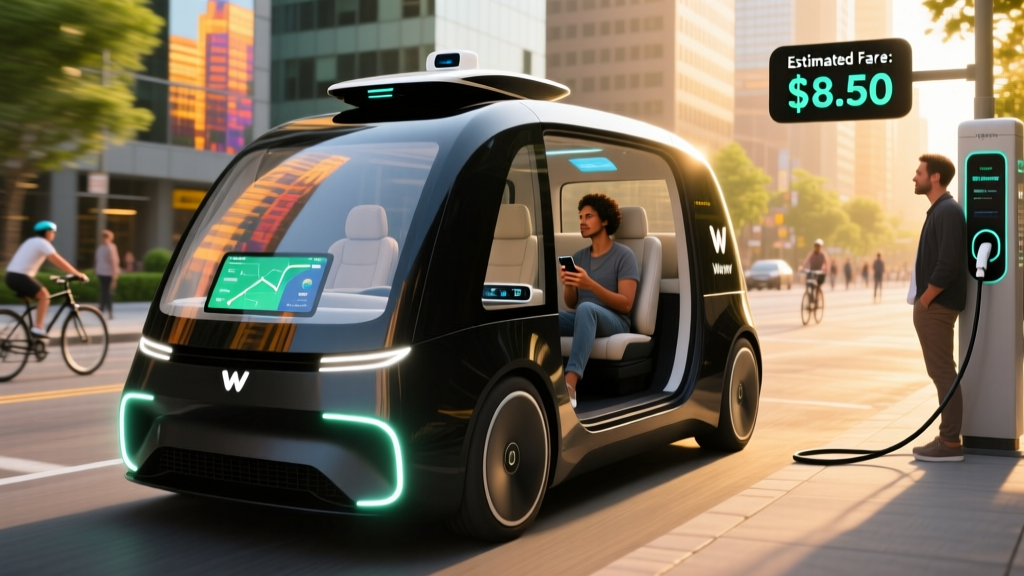
If you've seen a white Jaguar I-PACE with a spinning rooftop lidar array gliding through Phoenix or San Francisco traffic with no one behind the wheel, you've seen a Waymo One robotaxi. The question most riders ask before hailing one is practical: how much does Waymo cost, and is it cheaper than calling an Uber or Lyft?
This guide breaks down Waymo's real pricing structure in 2026, compares it against traditional rideshare, explains the Level 4 technology that makes driverless operation possible, and examines the safety data and regulatory framework behind the service.
Where Can You Use Waymo Right Now?
Waymo One — the company's commercial rider-hailing service — operates in a growing but still limited set of U.S. metro areas. Unlike Uber or Lyft, which are available virtually everywhere, Waymo is restricted to geofenced operational zones within specific cities where the company has mapped roads in high definition and received regulatory approval.
| City | Status | Coverage Area | Service Hours |
|---|---|---|---|
| Phoenix, AZ | Fully open to public | ~315 sq mi (East Valley, Chandler, Tempe, Mesa, Scottsdale, downtown Phoenix) | 24/7 |
| San Francisco, CA | Fully open to public | ~50 sq mi (most of SF proper, including SFO airport trips) | 24/7 |
| Los Angeles, CA | Fully open to public | ~80 sq mi (Santa Monica, Hollywood, downtown LA, Beverly Hills expansion) | 24/7 |
| Austin, TX | Early rider / limited public | ~30 sq mi (initial downtown and south Austin zone) | Limited hours |
Waymo has announced plans to expand into additional cities, but as of this writing, the four metros above represent the live, rideable footprint. If you're outside a geofenced zone, the Waymo app simply won't let you request a ride — there's no override.
How Much Does Waymo Cost? Pricing vs. Uber and Lyft
Waymo uses a dynamic pricing model similar to rideshare platforms: fares are calculated based on distance, time, and demand. There is no separate subscription fee to use Waymo One, and you pay per ride through the app with a linked card.
| Service | Base Fare Range | Per-Mile Rate | Per-Minute Rate | Surge Behavior |
|---|---|---|---|---|
| Waymo One | $3.50–$5.00 | $1.25–$1.75 | $0.20–$0.35 | Moderate; capped multipliers |
| UberX | $2.50–$4.00 | $1.10–$1.60 | $0.18–$0.30 | Variable; can exceed 2x |
| Lyft | $2.50–$4.00 | $1.05–$1.55 | $0.17–$0.28 | Variable; Prime Time pricing |
Key pricing takeaways:
- No tipping. Waymo does not prompt for a tip. This saves riders $2–$5 per trip compared to the social norm of tipping rideshare drivers 15–20%.
- No human driver overhead. Waymo's pricing doesn't need to compensate a driver's time, which gives the company structural flexibility to keep fares competitive even as it scales.
- Promotional pricing. Waymo frequently offers first-ride credits and discounted fares for new users, sometimes as low as $5 off. Check the app for active promos in your city.
- Airport trips. Waymo One supports rides to and from SFO and Phoenix Sky Harbor. Airport surcharges apply (typically $4–$6), similar to rideshare airport fees.
On a pure cost-per-mile basis, Waymo is roughly on par with or slightly above UberX and Lyft in most markets — but the no-tip factor often makes the total out-of-pocket cost comparable or even lower, especially on shorter trips.
Is Waymo Truly Self-Driving? Understanding SAE Level 4
This is where critical terminology matters. Consumer vehicles with features like Tesla's FSD (Supervised), GM's Super Cruise, or Ford's BlueCruise are classified as SAE Level 2 driver-assistance systems. They require a fully attentive human driver at all times, ready to take over instantly. They are not self-driving.
Waymo One is fundamentally different. It operates at SAE Level 4 — high automation within a defined operational design domain (ODD). Here's what that means in practice:
| SAE Level | Name | Who Drives? | Examples |
|---|---|---|---|
| Level 0 | No Automation | Human 100% | Basic cruise control |
| Level 1 | Driver Assistance | Human (system assists one axis) | Adaptive cruise OR lane-keeping |
| Level 2 | Partial Automation | Human (must supervise constantly) | Tesla Autopilot/FSD, BlueCruise, Super Cruise |
| Level 3 | Conditional Automation | System (human must take over on request) | Mercedes Drive Pilot (limited markets, ≤40 mph) |
| Level 4 | High Automation | System fully (within geofenced ODD) | Waymo One, Zoox |
| Level 5 | Full Automation | System (all roads, all conditions) | None currently deployed |
This is a fundamental distinction from any vehicle you can buy today. When you ride in a Waymo, you are a passenger, not a driver. The car handles lane changes, unprotected left turns, school zones, construction zones, and emergency vehicle detection autonomously.
The Technology Stack: How Waymo Sees the World
Waymo's approach to autonomous driving is sensor-diverse — the opposite of Tesla's camera-only (Tesla Vision) strategy. Each Waymo vehicle carries a redundant suite of perception hardware:
- Lidar (custom-built, 6th-gen): Multiple roof-mounted and body-integrated lidar units create a real-time 360° 3D point cloud of the environment, detecting objects, pedestrians, and road geometry up to 500+ meters away. Lidar works identically in daylight and darkness.
- Cameras (29+ per vehicle): High-resolution cameras handle traffic light state detection, sign reading, lane marking identification, and fine-grained object classification (distinguishing a plastic bag from a child, for example).
- Radar: Imaging radar provides velocity data for moving objects and functions reliably in fog, rain, and other conditions where cameras and lidar can degrade.
- Audio detection: External microphones detect sirens from approaching emergency vehicles, triggering appropriate pull-over behavior.
- HD maps: Waymo pre-maps every inch of its operational domain at centimeter-level precision. The vehicle knows where every lane, crosswalk, curb, and speed limit sign is before it arrives.
This sensor fusion approach is more expensive per vehicle than a camera-only system — Waymo's sensor suite is estimated to add $50,000–$100,000+ in hardware per vehicle — but it provides the redundancy required for true driverless operation. No single sensor failure can blind the system.
The onboard computing platform runs Waymo's proprietary "Waymo Driver" software, which handles perception, prediction (what other road users will do next), and planning (what the vehicle should do) in real time. Waymo has logged over 50 million fully autonomous miles on public roads as of late 2025, and billions more in simulation.
Safety Record: What the Data Actually Shows
Safety is the most scrutinized aspect of robotaxi operations. Waymo publishes safety data and is subject to NHTSA reporting requirements. Here's what the available evidence shows:
- 50+ million fully autonomous miles driven on public roads without a safety driver.
- Injury-reducing crash rate: Waymo's published analysis (peer-reviewed and submitted to NHTSA) shows an 85% reduction in injury-causing crashes per million miles compared to human driver benchmarks.
- Police-reported crash rate: Approximately 57% lower than human drivers in comparable urban environments.
- Contact incidents: The majority of Waymo-involved collisions have been low-speed rear-end or sideswipe contacts where the other party (human driver) was at fault. Waymo vehicles tend to be more cautious than human drivers at intersections, which occasionally leads to being rear-ended by following traffic.
Waymo is required to report every collision to state regulators (the California DMV and Arizona Department of Transportation). The company's Waymo Safety Report provides detailed methodology comparing its crash rates against human benchmarks from NHTSA's National Motor Vehicle Crash Causation Survey.
Important context: Robotaxi safety data is still being accumulated. 50 million miles is substantial but is a fraction of the ~3 trillion miles Americans drive annually. Statistically significant conclusions are possible for common crash types, but rare edge-case scenarios remain an area of ongoing monitoring.
Current Limitations: Where Waymo Cannot (Yet) Operate
Level 4 autonomy is powerful but bounded. Waymo's operational design domain has real constraints that riders should understand:
- Geofencing: Waymo only operates within pre-mapped zones. You cannot hail a ride from Scottsdale to Flagstaff. If your destination falls outside the geofence, the app won't allow the booking.
- Heavy weather: While Waymo vehicles handle light rain and nighttime driving well, heavy fog, monsoon conditions, dust storms, or snow can trigger service suspensions. Phoenix monsoon season and San Francisco fog events have caused temporary pullbacks.
- Construction zones: Major, unmapped road construction can cause Waymo vehicles to stop and wait or reroute. The system handles minor cone shifts but may struggle with large-scale lane reconfigurations not yet reflected in HD maps.
- No intercity or highway-only trips: Most Waymo operations are urban and suburban. Long-distance highway routes between cities are not part of the current service model.
- Passenger limitations: Waymo One currently does not accommodate unaccompanied minors, pets (service animals excepted), or open alcohol containers. Riders must be 18+ (some markets allow 16+ with parental consent in the app).
- Wait times: In high-demand areas, wait times can exceed 10–15 minutes because the fleet is finite. Unlike Uber, Waymo cannot dynamically recruit more drivers during peak hours.
- Accessibility: Waymo has been deploying wheelchair-accessible vehicles (WAVs) in Phoenix, but availability is limited compared to standard vehicles. The company's 6th-gen custom vehicle (built with Geely/Zeekr) features a low floor and wide opening designed for improved accessibility.
Regulatory Framework: Who Approves Robotaxi Operations?
Robotaxi operations in the U.S. exist under a patchwork of state and local regulations — there is no single federal license for autonomous ride-hailing.
- California (CPUC + DMV): The California Public Utilities Commission issues permits for autonomous vehicle passenger service. The DMV separately issues testing and deployment permits. Waymo holds both. San Francisco operations required contentious public hearings and approval from the CPUC in 2023, with expansion approved in phases.
- Arizona: Arizona has taken a permissive approach since 2015, with executive orders enabling AV testing and commercial operations with minimal state-level barriers. Waymo's Phoenix operations benefit from this regulatory environment.
- Texas: Austin's regulatory framework for AV passenger service was formalized in 2024, allowing Waymo to begin limited operations.
- Federal (NHTSA): The National Highway Traffic Safety Administration sets vehicle safety standards and investigates incidents. NHTSA issued a standing General Order requiring all AV operators to report crashes promptly. However, NHTSA does not currently issue "approval" for robotaxi services — that authority rests with states.
This state-by-state framework means Waymo's expansion timeline depends as much on regulatory approval processes as on technical readiness. Each new city requires mapping, testing, regulatory engagement, and public comment periods.
How to Use Waymo One: Step by Step
- Download the Waymo One app (iOS or Android) and create an account with your phone number and payment method.
- Verify you're in a service area. The app will show the geofenced zone on a map. If you're outside it, you'll see a message that service is unavailable.
- Enter your pickup and destination. The app provides an upfront fare estimate before you confirm — no metered surprises.
- Confirm your ride. You'll see the vehicle type, license plate, and estimated arrival time. Walk to the designated pickup spot (Waymo uses specific pull-over points, not always the exact GPS pin).
- Unlock the vehicle. When the car arrives, tap "Start Ride" in the app. The doors unlock automatically. There's no driver to greet you.
- Ride. Screens inside the vehicle show the route, current speed, and what the car's sensors are detecting. You can adjust climate and music via the seatback screen.
- Arrive and exit. The vehicle pulls over, the doors unlock, and you exit. Payment is processed automatically. No tipping prompt.
Frequently Asked Questions
Can I hail a Waymo to a destination outside the geofenced zone?
No. If either your pickup or drop-off is outside Waymo's mapped operational area, the app will not allow you to book the ride. You'd need to use Uber, Lyft, or another service for trips beyond the geofence.
Does Waymo cost more at night or during bad weather?
Waymo uses dynamic pricing that responds to demand, not specifically to time of day. However, if severe weather reduces the active fleet (some vehicles may be pulled for safety), reduced supply can increase fares. Waymo has historically kept surge multipliers more moderate than rideshare competitors.
Is there a Waymo subscription or membership fee?
No. Waymo One is pay-per-ride with no subscription required. You simply link a payment method and book rides as needed.
What happens if the Waymo vehicle encounters a problem mid-ride?
Waymo vehicles are monitored by a remote support team. If the vehicle encounters a scenario it cannot resolve autonomously, it will pull over safely. A remote assistance operator can then provide guidance to the vehicle's planning system (they don't "drive" the car remotely — they confirm safe path options). In-app support is also available for riders.
How does Waymo's no-tip model affect total cost?
For a typical $15 rideshare trip, a 20% tip adds $3.00, bringing the total to $18.00. A comparable Waymo ride at $16.00 with no tip required comes out cheaper. Over frequent use, the tip savings are meaningful — potentially $150–$300/month for daily commuters.
Is Waymo safer than a human Uber driver?
Waymo's published data shows significantly lower injury-causing crash rates per million miles compared to human benchmarks. The system never drives distracted, drowsy, or impaired. However, robotaxis can behave more cautiously than human drivers, which occasionally causes friction (being rear-ended by impatient human drivers, for instance). The data favors Waymo on safety outcomes, but the sample size — while large — is still growing relative to total U.S. driving miles.