If you've ever opened the Waymo One app in Phoenix, San Francisco, or Los Angeles, you've probably asked the same question millions of riders have: how much does Waymo cost compared to a standard Uber or Lyft? The answer isn't a flat rate — it's a dynamic pricing model that mirrors rideshare in structure but diverges in ways that matter for your wallet and your expectations.
This guide breaks down real Waymo ride costs, city-by-city availability, the Level 4 technology powering the fleet, verified safety data, and the limitations no marketing page will highlight. Whether you're planning your first driverless ride or evaluating robotaxi economics for regular commuting, here's what the numbers actually show.
Waymo Pricing Explained: What You'll Actually Pay
Waymo One uses dynamic pricing similar to Uber and Lyft — fares fluctuate based on demand, time of day, distance, and estimated trip duration. There's no subscription fee to use the service; you simply download the app, enter your destination, and receive an upfront price before confirming the ride.
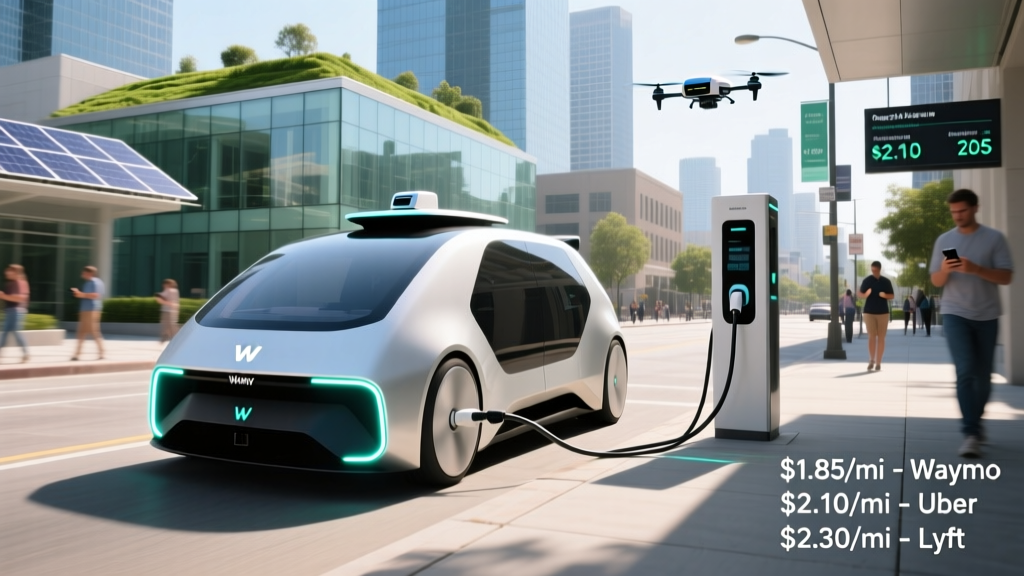
Based on aggregated rider reports and fare analyses from major metro areas, here's how Waymo One pricing stacks up against traditional rideshare for common trip types:
| Trip Type | Waymo One | UberX | Lyft Standard |
|---|---|---|---|
| Short (3–5 miles, off-peak) | $9–$14 | $8–$13 | $8–$12 |
| Medium (8–12 miles, off-peak) | $18–$28 | $16–$25 | $15–$24 |
| Airport run (15–20 miles) | $30–$48 | $28–$45 | $26–$42 |
| Surge pricing (rush hour) | 1.3x–1.8x base | 1.5x–3.0x base | 1.4x–2.5x base |
| Tipping | In-app, optional | In-app, expected | In-app, expected |
Key takeaway: Waymo fares are generally within $1–$5 of comparable UberX or Lyft rides for standard trips. Where Waymo can cost less is during peak demand — its surge multipliers tend to be more moderate because the fleet doesn't rely on incentivizing independent drivers to get on the road. There's also no tipping expectation (though the app allows it), which can shave $3–$8 off the effective cost per ride versus rideshare.
Waymo also offers promotional credits for new riders in newly launched cities, typically $5–$15 off the first few trips. Waymo One membership tiers and ride-pass options have been tested in select markets, providing bundled ride credits at a discount for frequent users.
Where Can You Use Waymo Right Now?
Waymo One operates fully driverless commercial service in a growing but still limited set of U.S. metro areas. As of early 2026, confirmed live service cities include:
| City | Status | Service Area Notes |
|---|---|---|
| Phoenix, AZ (Metro) | Fully operational since 2020 | Largest geofence: Chandler, Tempe, Mesa, Scottsdale, Sky Harbor Airport |
| San Francisco, CA | Fully operational since 2022 | City-wide coverage including downtown, Sunset, Richmond; SFO airport service added |
| Los Angeles, CA | Fully operational since 2024 | Santa Monica, Hollywood, Downtown LA, LAX; expanding to Valley |
| Austin, TX | Operational (launched 2025) | Central Austin, South Congress, Domain; geofence expanding |
| Atlanta, GA | Announced / early access | Limited rider pool; full commercial launch expected 2026 |
Critical context: Waymo's service is geofenced. The vehicle will only pick up and drop off within its mapped operational zone. If your destination falls outside the boundary, the app won't let you book the ride. Coverage maps are available in-app and expand incrementally — Phoenix has the most mature and largest coverage area, while newer cities like Austin are still filling in their maps.
For the latest official coverage maps and city announcements, Waymo publishes updates on its Waymo One service page.
Is Waymo Truly Self-Driving? The SAE Level 4 Distinction
This is where confusion runs rampant. Waymo's robotaxis are SAE Level 4 — high automation within a defined operational design domain (ODD). That means the vehicle handles all driving tasks within its geofenced service area with no human behind the wheel. There is no steering wheel accessible to passengers, no driver to take over.
SAE Automation Levels: Where Waymo Fits
| SAE Level | Name | Who Drives | Examples |
|---|---|---|---|
| Level 0 | No Automation | Human | Basic cruise control |
| Level 1 | Driver Assistance | Human (one feature assisted) | Adaptive cruise OR lane-keep |
| Level 2 | Partial Automation | Human (must supervise) | Tesla Autopilot/FSD, GM Super Cruise, Ford BlueCruise |
| Level 3 | Conditional Automation | System (human on standby) | Mercedes Drive Pilot (limited conditions) |
| Level 4 | High Automation | System (no human needed in ODD) | Waymo One, Zoox |
| Level 5 | Full Automation | System (everywhere, all conditions) | Does not exist commercially |
Bottom line: Consumer driver-assist systems like Tesla FSD (Supervised) are Level 2 — the driver must remain attentive at all times. Waymo is Level 4 — no driver, no steering wheel, but only within its approved geofence and conditions.
Waymo's Technology Stack: Sensors, Lidar, and Geofencing
Waymo's sixth-generation autonomous driving system (called the "Waymo Driver") uses a redundant, multi-sensor approach — a deliberate contrast to Tesla's camera-only philosophy. Here's what's on every Waymo vehicle (currently the Zeekr RT and previously the Jaguar I-PACE):
- Lidar: Multiple roof-mounted lidar units provide a real-time 360° 3D point cloud, detecting objects at 200+ meters regardless of lighting. This is Waymo's primary depth-sensing modality.
- Cameras: A suite of high-resolution cameras (visible spectrum) handles lane detection, traffic signal recognition, and semantic understanding of the scene.
- Radar: Imaging radar supplements lidar for velocity detection of moving objects and performs in heavy rain where lidar and cameras degrade.
- External audio sensors: Microphones detect emergency vehicle sirens and adjust behavior accordingly (pulling over, yielding).
- HD maps + geofencing: Waymo pre-maps every inch of its service area at centimeter-level precision. The vehicle localizes against this map in real time. If the vehicle exits its geofence or encounters unmapped construction, it safely pulls over and contacts remote assistance.
This sensor redundancy is why Waymo operates at Level 4 while camera-only systems remain at Level 2. Lidar provides ground-truth depth data that doesn't rely on neural network inference — critical for safety certification with no human fallback driver.
The fleet currently uses the Zeekr RT, a purpose-built electric minivan manufactured by Geely's Zeekr brand, featuring a low floor, wide doors, and a passenger-facing interior with no driver controls. Earlier fleets used the Jaguar I-PACE, which has been phased out of new production.
How Safe Are Waymo Robotaxis? The Real Data
Safety is the most scrutinized aspect of robotaxi operations — and Waymo publishes more verified data than any competitor. Here's what the numbers show:
Waymo Safety Record: Verified Data Points
- Cumulative fully autonomous miles: Over 50 million driverless miles completed across all service cities (as of late 2025).
- Injury-causing crash rate: Waymo's insurance claims data shows a 85% reduction in injury-causing crashes compared to human baseline drivers in the same cities, per a study published by the Swiss Re reinsurance firm and validated by NHTSA-reported data.
- Police-reported crash rate: 6.1 per million miles for Waymo vs. approximately 19.8 per million for human drivers in comparable urban environments (Swiss Re analysis, 2024).
- Property-damage-only incidents: Most Waymo-involved collisions are low-speed, rear-end, or sideswipe incidents caused by other human drivers — not the robotaxi.
- Recall events: Waymo has issued voluntary recalls (as required by NHTSA for all automated systems) for software updates following specific incidents, such as a 2023 event in Phoenix involving a pickup truck in a construction zone. Each recall resulted in an OTA software patch.
For context, the U.S. average is roughly 5.2 fatal crashes per billion vehicle miles and about 190 police-reported crashes per million miles across all road types. Waymo's urban-only operation naturally encounters higher conflict density, making its sub-7 per million rate notable.
That said, incidents do occur. In San Francisco, Waymo vehicles have been documented briefly stopping in live traffic lanes during complex construction scenarios, and a small number of minor collisions with cyclists and pedestrians have been reported to the NHTSA incident database. The company's response protocol involves safe pullover, remote fleet assistance, and software updates.
Current Limitations: Where Waymo Cannot Drive
Level 4 autonomy is powerful but bounded. Understanding these constraints is essential before booking a ride:
What Waymo Cannot Do (as of 2026)
- Geofence boundaries: If your destination is outside the mapped zone, you cannot book the ride. No exceptions, no manual override.
- Heavy fog and extreme weather: In Phoenix dust storms (haboobs) or San Francisco dense fog, Waymo may pause operations in affected zones. The system degrades gracefully — it pulls over safely rather than continuing blind.
- Unmapped construction zones: If road geometry has changed significantly since the last HD map update and the vehicle cannot reconcile the scene, it will stop and request remote guidance. Expect a 2–5 minute delay.
- Highway driving: Waymo's current service areas are primarily surface streets and urban arterials. Limited highway segments are included (e.g., certain Phoenix freeway on/off ramps), but long-distance highway routing is not available.
- Complex unpaved roads: Dirt roads, private driveways, and parking garages are not part of the operational domain.
- Pet and unaccompanied minor policies: Service animals are permitted; pets in carriers are generally allowed but policies vary by city. Unaccompanied minors under 18 cannot ride alone.
Regulatory Landscape: Who Approves Robotaxi Operations?
Robotaxi deployment in the U.S. is governed by a patchwork of state and local authorities — there is no single federal license to operate a driverless fleet nationwide.
Key regulatory bodies include:
- California Public Utilities Commission (CPUC): Issues permits for commercial driverless passenger service in California. Waymo holds a full deployment permit for SF and LA.
- California DMV: Issues testing and deployment permits for autonomous vehicles on public roads.
- Arizona: Among the most permissive states — no special state permit required beyond standard business licensing. Phoenix has been Waymo's longest-running market partly because of this regulatory environment.
- Texas (Austin): Autonomous vehicle operations are governed under state law (Texas Transportation Code Ch. 545) with local coordination for curb access and pickup zones.
- NHTSA (Federal): Does not currently "approve" robotaxis but mandates incident reporting for all Level 2+ and Level 4 systems and can issue recalls for safety defects in automated driving software.
Each new city launch requires navigating local permitting, first-responder coordination (fire, police, EMS protocols for interacting with driverless vehicles), and curb-management agreements. This is why expansion is measured — it's a regulatory process, not just a software deployment.
How to Use Waymo One: A Rider's Quick Guide
- Download the Waymo One app (iOS or Android) and create an account with a payment method.
- Check availability: The app will confirm whether you're within a live service area. If Waymo hasn't launched in your city, you'll see a waitlist option.
- Enter your destination: The app shows an upfront fare, estimated pickup time, and the vehicle type (Zeekr RT).
- Confirm and wait: Average pickup times in mature markets (Phoenix, SF) run 3–7 minutes. Newer markets may see 8–15 minute waits during peak hours.
- Ride: The vehicle arrives, you unlock via the app, and the ride proceeds fully autonomously. In-app screens show the vehicle's perception of the environment (detected cars, pedestrians, signals).
- Payment: Charged automatically upon arrival. Tip optional.
Frequently Asked Questions
Is Waymo more expensive than Uber?
For standard off-peak rides, Waymo One fares are typically within $1–$5 of UberX — sometimes slightly higher, sometimes slightly lower. Where Waymo often wins on cost is during surge pricing: its multipliers tend to cap lower than Uber's, and there's no social expectation to tip a driverless vehicle, saving $3–$8 per ride.
Can I use Waymo at the airport?
Yes, in cities where airport service has been enabled. Phoenix Sky Harbor (PHX), San Francisco International (SFO), and Los Angeles International (LAX) all have Waymo pickup/dropoff zones. Austin-Bergstrom (AUS) service availability depends on current geofence coverage.
What happens if the Waymo vehicle encounters a problem mid-ride?
The vehicle is designed to execute a "minimal risk condition" — it signals, pulls to the nearest safe stopping point, and contacts Waymo's remote fleet assistance team. Passengers can communicate with the support team via the in-app intercom. If the vehicle cannot continue, Waymo dispatches a replacement or provides a ride credit.
Does Waymo operate in rain?
Yes, Waymo operates in moderate rain across all its service cities. However, in extreme weather events — Phoenix haboobs, heavy flooding, or zero-visibility fog — the system may restrict or pause operations in affected zones as a safety precaution.
How is Waymo different from Tesla's Full Self-Driving?
Tesla FSD (Supervised) is an SAE Level 2 driver-assistance system — a human driver must remain attentive and ready to take over at all times. Waymo One is SAE Level 4 — no human driver is present, and the system handles all driving within its geofenced service area. They are fundamentally different categories of automation with different safety certifications and liability models.
Can Waymo take me between cities?
No. Waymo's Level 4 operation is geofenced to specific metro areas. You cannot book a ride from San Francisco to Los Angeles, for example. Inter-city travel remains outside the operational domain.