The Short Answer: Waymo vs. Uber Pricing in 2026
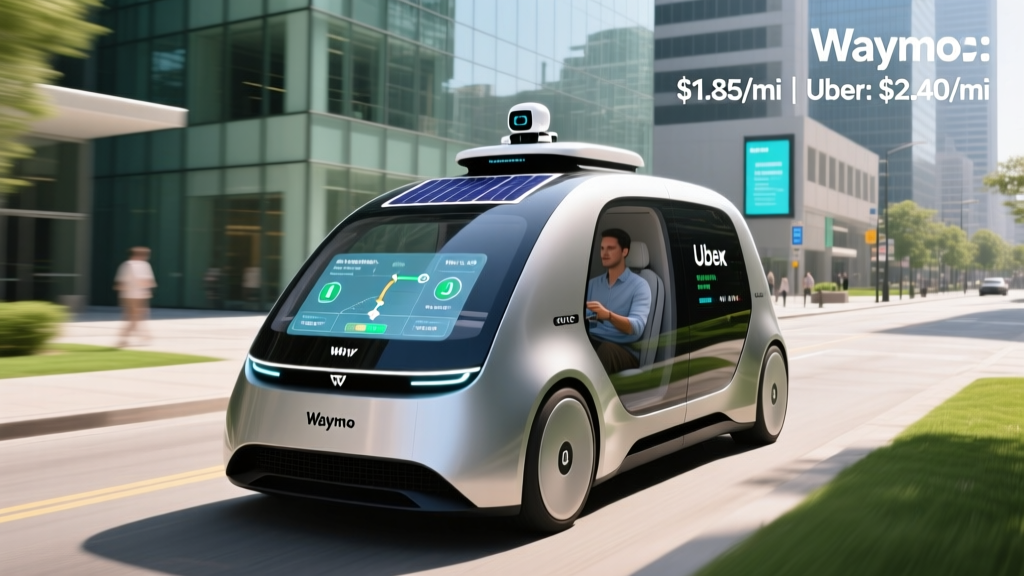
If you've opened the Waymo One app and compared a fare quote to Uber on the same route, you've probably noticed something surprising: Waymo's base fares are often comparable to or slightly higher than UberX on standard trips — but the calculus flips during surge pricing. Because Waymo doesn't apply the same dynamic surge multipliers that Uber and Lyft use during peak demand, a robotaxi can end up being the cheaper option precisely when you need a ride most.
But pricing is only one part of the robotaxi equation. Before you book, you need to understand where Waymo actually operates, what its safety record shows, and what limitations still apply. Here's the full breakdown.
Where Can You Actually Ride a Waymo Robotaxi Right Now?
Waymo One — the company's commercial rider-hailing service — is not available everywhere. As of early 2026, fully driverless (no safety operator in the vehicle) commercial service operates in these metro areas:
| Metro Area | Service Zone Size | Operating Hours | Status |
|---|---|---|---|
| Phoenix, AZ (East Valley + Downtown) | ~315 sq mi | 24/7 | Fully driverless, open to public |
| San Francisco, CA | ~50 sq mi (city core + expanding) | 24/7 | Fully driverless, open to public |
| Los Angeles, CA | ~80 sq mi (Santa Monica, Hollywood, Downtown, Beverly Hills) | 24/7 | Fully driverless, open to public |
| Austin, TX | Limited geofenced zone | Limited hours | Early access / expanding |
Waymo has also announced expansion plans for additional cities, but those remain in testing or early-access phases — not yet open for general public booking. If you're outside these metros, you cannot currently hail a Waymo.
How Much Does Waymo Cost vs. Uber? A Fare-by-Fare Comparison
Waymo uses a pricing model based on distance, time, and demand — similar to Uber's algorithm — but with critical differences in how surge pricing works. Here's what we've observed across matched routes in Phoenix and San Francisco:
| Scenario | Waymo One Fare | UberX Fare | Uber Surge Fare | Cheaper Option |
|---|---|---|---|---|
| 3-mile trip, off-peak (Phoenix) | $8.50 – $11.00 | $7.00 – $9.50 | $7.00 – $9.50 | UberX (marginal) |
| 7-mile trip, off-peak (SF) | $16.00 – $21.00 | $14.00 – $19.00 | $14.00 – $19.00 | Comparable |
| 5-mile trip, Friday night surge (SF) | $18.00 – $23.00 | $14.00 – $19.00 | $28.00 – $42.00 (1.8x–2.5x) | Waymo (significant) |
| Airport run, 15 miles (PHX) | $32.00 – $40.00 | $28.00 – $35.00 | $28.00 – $35.00 | UberX (marginal) |
Key takeaway: On calm, off-peak rides, UberX usually wins by $1–$4. During high-demand periods — bar closings, concerts, rainstorms, airport rushes — Waymo's pricing stays relatively flat while Uber's surge multiplier can push fares 1.5x to 3x higher. That's where Waymo becomes the cheaper ride.
Waymo also runs frequent promotional discounts for new riders (often $5–$10 off first rides) and loyalty credits, which can tip the economics further in its favor if you're a new user.
Is Waymo Truly Self-Driving? Understanding SAE Automation Levels
This is where confusion runs rampant in the EV and autonomous vehicle space. Waymo's robotaxis operate at SAE Level 4 — meaning the vehicle handles all driving tasks within its defined operational design domain (geofenced area, specific conditions) with no human driver required. There is no one behind the wheel. There is no steering wheel for a passenger to grab.
| SAE Level | Name | Who Drives? | Example |
|---|---|---|---|
| Level 2 | Driver Assistance | Human (must supervise at all times) | Tesla Autopilot / FSD (Supervised), GM Super Cruise, Ford BlueCruise |
| Level 3 | Conditional Automation | System drives in narrow conditions; human takes over on request | Mercedes DRIVE PILOT (limited markets, under 40 mph) |
| Level 4 | High Automation | System drives fully within geofenced zone; no human needed | Waymo One, Zoox |
| Level 5 | Full Automation | System drives everywhere, all conditions | Does not exist commercially |
This distinction matters enormously. When you see Tesla's "Full Self-Driving (Supervised)" in headlines, that is Level 2 — the driver must remain engaged and is legally responsible. Waymo One is a fundamentally different category: a vehicle with no driver, operating commercially under regulatory permits. Never conflate the two.
How Safe Are Waymo Robotaxis? The Actual Data
Waymo has accumulated over 40 million fully driverless miles on public roads as of early 2026, with the bulk concentrated in Phoenix, San Francisco, and Los Angeles. The company publishes safety data and has submitted findings to the National Highway Traffic Safety Administration (NHTSA).
Waymo Safety Snapshot (through early 2026):
- Total driverless miles: 40+ million
- Injury-causing crashes: Significantly lower rate per million miles than human drivers in the same metro areas, based on Waymo's published comparison to NHTSA benchmark data
- Most common incidents: Low-speed contact with stationary objects (parked cars, curbs, construction barriers) — typically property damage only, no injuries
- Disengagement rate: Not directly comparable to Level 2 systems; Waymo's remote-assistance interventions are logged but infrequent per-thousand-miles
- Pedestrian/cyclist interactions: Waymo vehicles are programmed for conservative behavior around vulnerable road users, often stopping or yielding earlier than a human driver would
Independent analyses, including studies referenced by the Insurance Institute for Highway Safety (IIHS), have noted that robotaxi fleets show promise in reducing serious injury crashes compared to human baselines, but the sample size — while growing — still represents a fraction of total urban vehicle miles. San Francisco, in particular, has seen public debate around robotaxis blocking emergency vehicles or stalling in complex construction zones. Waymo has addressed several of these issues through software updates and expanded remote-assistance staffing.
The honest assessment: Waymo's data shows a strong safety record, especially for injury prevention, but the fleet has not been tested at the scale or diversity of conditions that human drivers encounter nationally.
Under the Hood: Waymo's Technology Stack Explained
Waymo's sixth-generation driver system, deployed on the Geely Zeekr-based Ojai vehicle and retrofitted Jaguar I-PACE fleet, uses a sensor-rich approach that differs sharply from Tesla's camera-only philosophy:
Sensor Suite:
- LiDAR: Multiple roof-mounted and side-mounted LiDAR units providing a 360° 3D point cloud of the environment, effective to 500+ meters. LiDAR gives precise depth perception independent of lighting conditions.
- Cameras: High-resolution visual cameras for lane marking detection, traffic signal state recognition, and object classification (pedestrian vs. cyclist vs. vehicle).
- Radar: Imaging radar for velocity detection of moving objects and operation in rain or fog where LiDAR performance can degrade.
- External audio sensors: Microphones to detect sirens from emergency vehicles, triggering pull-over behavior.
Software & Mapping:
- HD Maps: Waymo pre-maps every inch of its service area at centimeter-level precision. The vehicle localizes itself within this map in real time.
- Geofencing: The vehicle will only operate within its approved zone. If a route would exit the geofence, the app won't allow the booking.
- Remote Assistance: If the vehicle encounters an ambiguous scenario (unusual construction, an accident blocking all lanes), it can pull over safely and request guidance from a remote human operator who provides a path forward — not remote driving, but decision support.
This sensor-fusion approach is expensive — each vehicle carries tens of thousands of dollars in hardware — but it provides redundancy that camera-only systems lack, particularly in challenging lighting (direct sun glare, nighttime, tunnels).
Current Limitations: What Waymo Cannot Do
For all its capability, Waymo's Level 4 service has real constraints you should understand before relying on it as your primary transportation:
- Geofenced zones only: You cannot book a Waymo from Scottsdale to Sedona. If your destination falls outside the mapped service area, the app blocks the ride.
- Weather restrictions: Heavy rain, dense fog, or dust storms can trigger service suspension. Phoenix monsoon season and San Francisco fog have both caused temporary shutdowns. Waymo's sensors degrade in heavy precipitation, and the company errs on the side of caution.
- No highway driving (most markets): Waymo's Phoenix service includes some freeway segments, but San Francisco and Los Angeles operations are predominantly surface streets. Don't expect a Waymo to take you on a 60-mile interstate trip.
- Construction zone handling: While improved, complex temporary lane shifts and flagger-controlled zones can still cause the vehicle to stop and wait for remote assistance, adding minutes to your trip.
- Wait times: In high-demand areas, Waymo's fleet size (thousands of vehicles, not tens of thousands) means wait times of 8–15 minutes are common, versus 3–6 minutes for Uber/Lyft in dense urban areas.
- No multi-stop or special requests: You can't add a stop, request a specific route, or bring oversized items easily. It's point A to point B.
- Accessibility: Waymo has deployed wheelchair-accessible vehicles in some markets, but availability is limited compared to Uber WAV options.
Regulatory Landscape: Who Approves Robotaxi Operations?
Robotaxi deployment in the United States is governed by a patchwork of state and local regulations — there is no single federal permit for driverless commercial service.
- California: The California Public Utilities Commission (CPUC) issues permits for commercial robotaxi service. The California DMV issues testing and deployment permits. Both agencies can impose restrictions or revoke permits, as seen when the CPUC initially limited Waymo and Cruise's San Francisco operations before granting full expansion.
- Arizona: The state has taken a permissive approach since 2015, with minimal regulatory barriers to testing and commercial deployment. Waymo's Phoenix operation benefited from this early.
- Texas: Austin's entry required coordination with the city's transportation department and state regulators. Texas passed legislation in 2023 clarifying the legal framework for autonomous vehicle operation.
- Federal (NHTSA): The National Highway Traffic Safety Administration sets vehicle safety standards and investigates crashes involving automated systems, but does not currently issue operational permits for robotaxi services. NHTSA's Standing General Order requires manufacturers and operators to report crashes involving Level 2+ and Level 3-5 systems.
This regulatory fragmentation means expansion is slow and market-by-market. Waymo cannot simply "turn on" a new city — it must map the area, test extensively, and secure state and local approvals.
How to Use Waymo One: Booking Your First Ride
The user experience is straightforward and deliberately mirrors rideshare apps:
- Download the Waymo One app (iOS/Android) and create an account.
- Enter your pickup and dropoff locations. The app confirms whether both points fall within the active service zone.
- Review the upfront fare. Unlike Uber, which sometimes shows estimates, Waymo displays a guaranteed price before you confirm.
- Confirm the ride. The app shows your vehicle's location, license plate, and a photo of the specific Jaguar I-PACE or Ojai vehicle assigned to you.
- Approach the vehicle. Tap "Start Ride" on the app when you're near the car. The doors unlock automatically. There is no driver to greet you.
- Inside the vehicle: Screens in the back seat show your route, a visualization of what the car's sensors see (pedestrians, other vehicles, cyclists highlighted), and controls for music and climate. A "Pull Over" button lets you request an early stop if needed.
Tipping is not expected — there's no driver to tip. You can rate the ride and report issues through the app afterward.
Frequently Asked Questions
Are Waymo rides cheaper than Uber during surge pricing?
Yes, in most cases. Waymo does not apply the aggressive surge multipliers (1.5x–3x) that Uber and Lyft use during high-demand periods. During Friday night bar closings, post-event rushes, or rainy evenings, Waymo's fare often stays within $2–$5 of its off-peak price, while UberX can jump 2x or more. This is where Waymo consistently wins on cost.
Are Waymo rides cheaper than Uber for airport trips?
Generally, no. For longer, fixed-route trips like a 15-mile airport run during off-peak hours, UberX tends to be $3–$7 cheaper. Uber's larger driver pool also means shorter wait times for scheduled airport rides. However, if you're traveling during peak airport rush (early morning or late evening holiday periods), Waymo's flat pricing can be competitive or cheaper.
Can I use Waymo if I'm visiting Phoenix or San Francisco?
Yes. Waymo One is open to the public — you don't need an invitation or early-access code in Phoenix, San Francisco, or Los Angeles. Download the app, create an account, and book. Visitors are a significant share of Waymo's ridership, especially in Phoenix (tourists heading to Old Town, Scottsdale border areas, or the airport).
What happens if the Waymo vehicle encounters an emergency or gets confused?
The vehicle is programmed to pull over safely and stop. It can then connect to a remote assistance operator who reviews the situation through the vehicle's cameras and sensors and provides guidance (e.g., "proceed around the obstacle using the left lane"). The remote operator does not steer the vehicle — they approve a path. In a medical emergency, you can use the in-vehicle support button to reach Waymo's rider support team, who can contact emergency services.
Is Waymo safer than a human Uber driver?
Waymo's published data shows a lower rate of injury-causing crashes per million miles compared to human driver benchmarks in the same cities. The vehicles don't get distracted, don't drive impaired, and don't speed. However, robotaxis can behave unpredictably in edge cases (unusual construction, temporary road closures) and have occasionally blocked emergency vehicles — an issue Waymo has addressed through software updates. The data is encouraging but still represents a limited operational scope compared to the full spectrum of human driving scenarios. Check the NHTSA database for the latest crash reporting data.
Does Waymo operate in bad weather?
Limited. Light rain and overcast conditions don't affect service. Heavy rain, dense fog, or dust storms can trigger temporary service suspension because LiDAR and camera performance degrades. Phoenix monsoon storms (July–September) and San Francisco's heavy fog nights have both caused pauses. The app will notify you if service is unavailable.
Can Waymo take me on the freeway?
In Phoenix, yes — Waymo's service area includes segments of Loop 101 and Loop 202 freeways. In San Francisco and Los Angeles, operations are almost entirely on surface streets. Interstate or long-distance highway trips are not part of the service.
The Verdict: When Waymo Saves You Money (And When It Doesn't)
Are Waymo rides cheaper than Uber? The honest answer depends on when and where you're riding:
- Off-peak, short trips: UberX is usually $1–$4 cheaper.
- Surge periods (nights, weekends, events, bad weather): Waymo is often $5–$20+ cheaper because it doesn't surge the way Uber does.
- Airport runs, off-peak: UberX typically wins by a small margin.
- Novelty and experience value: Riding in a genuinely driverless Level 4 vehicle is an experience Uber can't match — and for many riders, that's worth a small premium.
Waymo's pricing strategy in 2026 appears designed to be competitive with rideshare rather than undercutting it dramatically. The company is prioritizing sustainable unit economics over predatory pricing as it scales. For riders in Phoenix, San Francisco, and Los Angeles, having Waymo as an option alongside Uber creates genuine competition — and the biggest savings come from checking both apps before you book, especially during high-demand hours.