How Many Passengers Can Fit in a Waymo?
If you've been searching for answers to how many can fit in a Waymo, the short answer depends on which vehicle generation you encounter. As of early 2026, Waymo's commercial fleet in the United States primarily consists of the Jaguar I-PACE (fully electric, Level 4 autonomous) and the newly introduced Zeekr RT purpose-built robotaxi. Here's the capacity breakdown:
- Waymo Jaguar I-PACE (5th-generation driver): Up to 3 passengers in the rear seat. The front passenger seat is blocked off and reserved for onboard computing and sensor equipment.
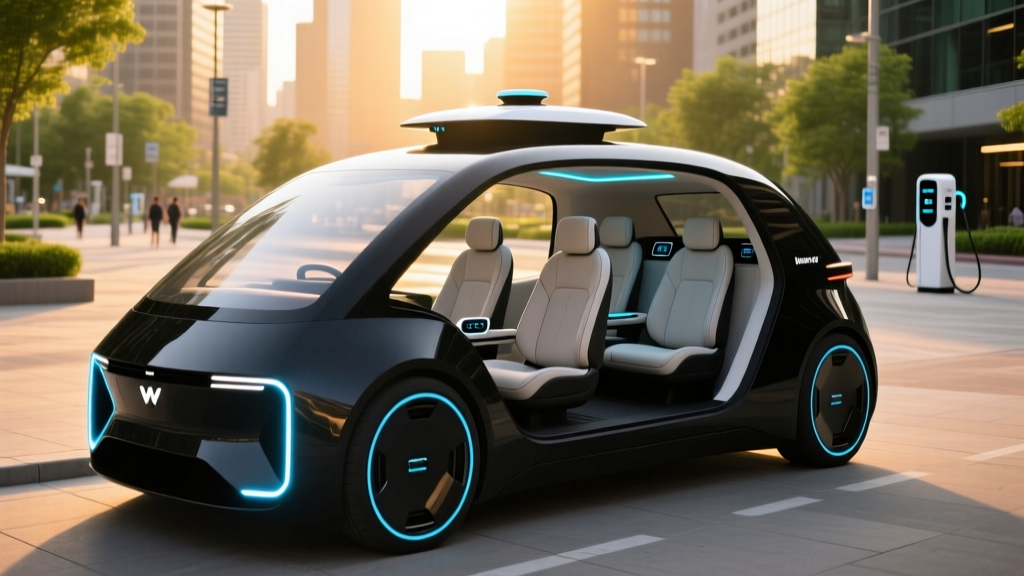
- Waymo Zeekr RT (6th-generation driver): Up to 3 passengers in the rear, with the front row fully eliminated in favor of a forward-facing lounge configuration and additional sensor housing.
- Wheelchair-accessible vehicles (WAV): Available in select markets (Phoenix, San Francisco, Los Angeles). These accommodate 1 wheelchair user plus 1 companion.
There is no front-seat passenger option in any current Waymo vehicle. The driver's seat area is occupied by the Waymo Driver hardware stack — the compute units, redundant steering and braking controllers, and thermal management systems that enable SAE Level 4 operation without a human behind the wheel.
Waymo operates at SAE Level 4 automation. This means the vehicle handles all driving tasks within its defined Operational Design Domain (ODD) — specific geofenced areas under specific conditions — with no human driver required. This is fundamentally different from Level 2 systems like Tesla Autopilot, Ford BlueCruise, or GM Super Cruise, which require continuous driver supervision. A Waymo has no steering wheel accessible to passengers and no expectation that you will intervene.
Where Can You Ride a Waymo Right Now?
Waymo's commercial service, branded Waymo One, is not available everywhere. The company operates within tightly defined geofences approved by state and local regulators. As of 2026, confirmed live service areas include:
| City / Region | Status | Service Area Notes |
|---|---|---|
| Phoenix, AZ (East Valley) | Fully open, 24/7 | Largest continuous geofence; includes Chandler, Tempe, Mesa, Scottsdale, and Phoenix Sky Harbor Airport |
| San Francisco, CA | Fully open, 24/7 | Full city coverage including highways (I-280, portions of US-101); expanded to SFO airport service |
| Los Angeles, CA | Fully open | Downtown LA, Hollywood, Santa Monica, LAX airport; geofence expanding incrementally |
| Austin, TX | Open (limited hours) | Downtown and South Austin corridor; launched late 2025 |
Waymo has also announced testing operations in additional cities, but testing is not the same as commercial availability. You cannot hail a paid Waymo One ride outside the geofenced zones listed above. If your destination falls outside the boundary, the app will not let you book the trip.
Waymo Pricing vs. Uber and Lyft: What Does a Ride Cost?
Waymo One pricing is dynamically calculated based on distance, time, and demand — similar to rideshare surge pricing. Based on rider reports and Waymo's published fare structure in early 2026, here's how costs compare on typical urban trips:
| Trip Type | Waymo One | UberX | Lyft Standard |
|---|---|---|---|
| Short trip (~3 miles, downtown) | $9 – $14 | $8 – $13 | $8 – $12 |
| Medium trip (~8 miles, cross-town) | $18 – $28 | $16 – $25 | $15 – $24 |
| Airport trip (~15 miles) | $32 – $48 | $28 – $45 | $26 – $42 |
| Surge / peak demand | Moderate multiplier | High multiplier | High multiplier |
Key pricing takeaway: Waymo fares are generally comparable to UberX and Lyft Standard — sometimes slightly higher, sometimes slightly lower depending on demand patterns. Waymo does not currently offer a shared/pool option, so you're always booking a private ride. The tradeoff is consistency: no surge pricing spikes as extreme as rideshare during major events, and no risk of a driver canceling mid-trip.
Tipping is available in the app but not expected, since there is no human driver. Waymo also offers Waymo One membership tiers in some markets that provide discounted per-mile rates for frequent riders.
How to Use Waymo One: Step by Step
- Download the Waymo One app (iOS or Android). You'll need to create an account and add a payment method.
- Check service availability. The app will confirm whether your pickup and drop-off locations fall within the active geofence.
- Enter your destination and confirm the upfront fare estimate.
- Wait for your vehicle. Typical wait times in Phoenix and San Francisco range from 2 to 7 minutes during normal hours. The app shows the vehicle's approach on a map.
- Verify the vehicle. The app displays the car's license plate, make/model, and a unique rooftop identifier. The doors unlock automatically when the vehicle arrives at your exact pickup pin.
- Start your ride. Once you buckle up and confirm on the rear-seat screen, the vehicle departs autonomously. You can adjust climate control and select a music station from the touchscreen.
- Arrive and exit. The vehicle pulls to a safe curbside stop, doors unlock, and the trip ends automatically.
There is no human to greet you, handle luggage, or answer questions. If you need assistance, the in-app support chat connects you to a Waymo remote agent. In the event the vehicle encounters a situation it cannot resolve (construction zone, unusual road closure), a remote human operator can guide the vehicle through the scenario — but this operator does not "drive" the car in real time.
How Safe Are Waymo Robotaxis? The Real Data
Safety is the most scrutinized aspect of robotaxi operations. Waymo has published collision and intervention data, and independent analyses from the National Highway Traffic Safety Administration (NHTSA) and insurance industry researchers provide additional context.
- Cumulative autonomous miles driven: Over 40 million fully driverless miles across all operational cities.
- Injury-causing crash rate: Waymo's published analysis (peer-reviewed methodology) shows a 85% reduction in injury-causing crash rate compared to human benchmarks in the same geographies, per IIHS-referenced studies.
- Police-reported crash rate: Approximately 6 times lower than the human baseline for crashes involving any injury, adjusted for exposure.
- Contact rate (minor incidents): Waymo vehicles do make contact with objects (parked cars, curbs, debris) at a low rate — the vast majority are minor, low-speed incidents with no injuries.
- Remote assistance interventions: Occur in a small fraction of trips (estimated <1% of rides require remote guidance), typically for construction zones or unusual road configurations.
It's critical to contextualize these numbers. Waymo operates primarily in urban environments at moderate speeds (25–45 mph typical), which differs from highway driving where human fatality risk is highest. The comparison benchmarks also matter: Waymo compares its record to human drivers in the same cities and conditions, which is the most relevant comparison but also the most favorable one for a geofenced, sensor-rich vehicle.
No robotaxi fleet has achieved zero incidents. Waymo vehicles have been involved in collisions — including a notable series of incidents in San Francisco in 2024 where vehicles made contact with towed cars and a cyclist. Each incident is investigated and reported to the California DMV and NHTSA as required. The overall trajectory, however, shows declining incident rates as software improves and operational geofences are refined.
Under the Hood: Waymo's Technology Stack
Waymo's approach to autonomy differs fundamentally from camera-only systems (most notably Tesla's). The Waymo Driver uses a multi-sensor fusion architecture:
Sensor Suite (6th-Generation Driver on Zeekr RT)
- LiDAR: Multiple solid-state and spinning LiDAR units providing a 360° point cloud with range exceeding 500 meters. LiDAR is the primary sensor for object detection and distance measurement in all lighting conditions.
- Cameras: High-resolution cameras (multiple overlapping fields of view) for lane detection, traffic signal recognition, sign reading, and object classification.
- Radar: Imaging radar units for velocity measurement of moving objects and redundancy in adverse weather (rain, fog) where LiDAR and camera performance degrade.
- External audio sensors: Microphones to detect emergency vehicle sirens, enabling the vehicle to pull over appropriately.
Compute and Redundancy
- Custom compute platform: Waymo-designed hardware running proprietary perception, prediction, and planning software.
- Redundant steering and braking: Dual-redundant actuators ensure the vehicle can stop safely even if one system fails.
- HD mapping: Waymo pre-maps every inch of its operational geofence at centimeter-level precision. The vehicle localizes itself against this map in real time — it does not drive in unmapped areas.
The reliance on LiDAR and HD maps is a deliberate architectural choice that trades scalability (you must map every road before operating on it) for reliability (the vehicle has a precise understanding of its environment that camera-only inference cannot yet match consistently). This is why Waymo expands city by city rather than deploying nationwide overnight.
The Regulatory Landscape: Who Approves Robotaxi Operations?
Robotaxi deployment in the United States is governed by a patchwork of state and local regulations — there is no single federal license that allows a company to operate driverless vehicles everywhere.
- California: The California DMV issues testing permits, while the California Public Utilities Commission (CPUC) issues commercial deployment permits. Waymo holds both.
- Arizona: The state has taken a permissive approach since 2016, with the Governor's office and the Arizona Department of Transportation overseeing operations. No special state-level commercial permit is required beyond standard business licensing.
- Texas: Austin's operations fall under a combination of state autonomous vehicle legislation (Texas Transportation Code Chapter 545) and city-level agreements with the Austin Transportation Department.
- Federal (NHTSA): NHTSA requires reporting of all crashes involving ADS-equipped vehicles and maintains recall authority over autonomous driving systems. NHTSA does not "approve" robotaxi services but can issue recalls or investigations that halt operations.
This fragmented regulatory environment means that even if Waymo has proven its technology in Phoenix, it must separately negotiate approval in each new city and state. Local concerns — firefighter access, pedestrian safety, traffic flow, disability access — all factor into whether a city grants operational permission.
Current Limitations: Where Waymo Cannot (Yet) Operate
Operational Constraints in 2026
- Geofencing: Waymo vehicles will not drive outside their approved operational area. If you request a trip that crosses the boundary, the app will reject it.
- Severe weather: Heavy rain, snow, ice, and dense fog can suspend service. Phoenix rarely faces this issue, but San Francisco fog and Los Angeles rain events have triggered temporary service pauses.
- Unmapped roads: New construction, recently opened roads, or roads outside the HD map will not be served until Waymo completes mapping and validation.
- Complex pickup environments: Large parking garages, private driveways, gated communities, and unpaved roads are generally not supported for pickup/drop-off.
- No highway driving (some markets): While San Francisco Waymos now use select highways, not all markets have highway-capable geofences. Phoenix highway integration is partial.
- No car seats: Waymo does not provide child safety seats. Children under a certain age/height may not ride without an appropriate restraint (check local laws and Waymo's rider policies).
- Pets: Only service animals are permitted. Pets in carriers are not currently allowed.
- Luggage limitations: The Jaguar I-PACE trunk space is available for luggage, but the Zeekr RT has a different cargo configuration. Oversized items (skis, large equipment) are not accommodated.
The Jaguar I-PACE: The Electric Platform Behind Most Waymo Rides
Since the question of how many can fit in a Waymo is partly a vehicle question, it's worth understanding the platform. The Jaguar I-PACE was Waymo's primary vehicle for 5th-generation operations and remains in the fleet:
| Specification | Value |
|---|---|
| Battery capacity | 90 kWh (NMC lithium-ion) |
| EPA range (stock) | 234 miles (reduced in robotaxi config due to sensor power draw) |
| Horsepower | 394 HP (dual-motor AWD) |
| 0–60 mph | 4.5 seconds (stock; Waymo drives conservatively) |
| DC fast charge peak | 100 kW (CCS1), 10–80% in ~40 minutes |
| Passenger capacity (Waymo config) | 3 rear-seat passengers |
| Charging strategy | Fleet depot charging between shifts; vehicles cycle through charging stations automatically |
The newer Zeekr RT (Geely/Zeekr, purpose-built for Waymo's 6th-generation driver) features a lower floor, sliding doors for curbside safety, and an interior designed specifically for passenger comfort without a driver. Exact battery specs for the US-spec Zeekr RT have not been fully published, but the platform is built on Geely's SEA (Sustainable Experience Architecture) with an estimated 100+ kWh NMC pack.
Frequently Asked Questions
Can I sit in the front seat of a Waymo?
No. In all current Waymo vehicles, the front seats are either blocked off or eliminated entirely. The front cabin houses computing hardware, redundant control systems, and sensor processing equipment. All passengers ride in the rear.
Is Waymo truly self-driving, or is there a remote human driving the car?
Waymo is genuinely self-driving within its geofenced operational area — SAE Level 4. There is no human driver in the vehicle, and no remote operator controlling the steering wheel in real time. Remote assistance exists for edge cases (the vehicle may pause and request guidance), but the remote agent provides high-level routing advice, not continuous driving input. The vehicle executes all acceleration, braking, and steering autonomously.
How many people can fit in a Waymo for a group trip?
The maximum is 3 passengers in the rear seat. If your group has 4 or more people, you'll need to book two separate Waymo rides. There is no larger vehicle option (no SUV or van variant) currently in the Waymo One fleet.
Does Waymo cost more than Uber?
On average, Waymo fares are comparable to UberX — typically within 10–15% higher or lower depending on the trip and time of day. Waymo's surge pricing tends to be less aggressive than Uber's during peak demand, which can make it cheaper during rush hours or major events.
What happens if the Waymo vehicle gets confused or stuck?
The vehicle will pull over safely and contact a remote support agent. The agent can assess the situation via the vehicle's cameras and sensors and provide routing guidance. If the issue cannot be resolved, Waymo dispatches a human roadside-assistance team. You are not expected to take control of the vehicle.
Can I use Waymo at the airport?
Yes, in supported markets. Waymo One serves Phoenix Sky Harbor (PHX), San Francisco International (SFO), and Los Angeles International (LAX) as of 2026. Airport pickups and drop-offs follow specific roadway procedures defined by each airport authority.
Is Waymo available in my city?
Check the Waymo One app — it will confirm availability based on your GPS location. As of 2026, commercial service is limited to Phoenix, San Francisco, Los Angeles, and Austin. Expansion to additional cities is ongoing but requires regulatory approval and HD mapping for each new market.