What Waymo One Costs in Phoenix (and How It Compares to Uber)
If you've searched "how much is Waymo in Phoenix" you're likely weighing whether a driverless robotaxi is a premium novelty or a genuine daily-transport alternative. The short answer: Waymo One pricing in Phoenix generally tracks within 5–15% of a comparable UberX or Lyft standard ride, with base fares typically starting around $5–$7 for short trips and scaling by distance and time. A 5-mile ride across central Phoenix usually lands between $10 and $16 before any promotional credits.
Unlike Uber's surge-pricing model, Waymo uses a more predictable pricing algorithm. You won't see 3x multipliers during a Friday-night bar rush, but you also won't find the deep discounting that Uber and Lyft use to acquire riders. The trade-off is consistency over bargains.
| Metric | Waymo One | UberX | Lyft Standard |
|---|---|---|---|
| Base fare | ~$5.50 | ~$3.00–$4.50 | ~$3.00–$4.00 |
| Per-mile rate | ~$1.20–$1.50 | ~$1.00–$1.40 | ~$0.95–$1.35 |
| Per-minute rate | ~$0.25–$0.35 | ~$0.20–$0.30 | ~$0.18–$0.28 |
| Surge / dynamic pricing | Limited | Frequent | Frequent |
| 5-mile ride estimate | $10–$16 | $9–$18 | $8–$17 |
| Airport trip (PHX, ~10 mi) | $18–$28 | $16–$35 | $15–$32 |
| Tipping | Not expected | Customary (15–20%) | Customary (15–20%) |
The tipping difference matters. When you factor in a standard 18% tip on a $15 UberX ride, the effective cost gap narrows or disappears entirely. For budget-conscious riders who skip tips on rideshare, Waymo will feel slightly more expensive. For those who tip consistently, the prices are nearly equivalent.
Where Can You Actually Use Waymo in Phoenix Right Now?
Waymo One's Phoenix service area is the largest fully driverless robotaxi zone in the United States, but it doesn't cover the entire metro. As of early 2026, the geofenced operational area spans roughly 225+ square miles across the Valley, encompassing:
- Central Phoenix — Downtown, Midtown, Uptown, and the Roosevelt Row area
- Scottsdale — Old Town, the Fashion Square corridor, and portions of South Scottsdale
- Tempe — Arizona State University campus area, Mill Avenue, and surrounding residential zones
- Mesa — Limited coverage in western Mesa near the Dobson Road corridor
- Chandler — Select zones where Waymo has historically tested
- Phoenix Sky Harbor International Airport (PHX) — Waymo added airport pickups and drop-offs, a significant expansion for business travelers
| City | Status | Notes |
|---|---|---|
| Phoenix, AZ | Fully operational | Largest service area; 24/7 in core zones |
| San Francisco, CA | Fully operational | Open to all riders; dense urban coverage |
| Los Angeles, CA | Operational (expanding) | LA proper; freeway-capable routes added |
| Austin, TX | Operational (limited) | Initial service area; expanding through 2026 |
| Mountain View / Bay Area | Testing / limited | Select rider programs |
The Phoenix coverage area continues to expand incrementally. Waymo adds new geofence boundaries in phases, typically extending outward from the dense urban core. If you live in far North Phoenix (beyond the Loop 101), Ahwatukee, Gilbert, or the far West Valley, you're likely outside the current service boundary. The app will tell you immediately whether your pickup and drop-off are within range.
Is This Truly Self-Driving or Just Driver-Assist?
Waymo operates at SAE Level 4, meaning the vehicle handles all driving tasks within its defined operational design domain (ODD) with no human driver behind the wheel. There is no steering wheel or pedal set accessible to passengers. This is fundamentally different from Tesla Autopilot, Ford BlueCruise, or GM Super Cruise, which are all SAE Level 2 systems requiring continuous driver supervision.
| Level | Name | Driver Required? | Examples |
|---|---|---|---|
| Level 0 | No Automation | Yes — full control | Basic cruise control |
| Level 1 | Driver Assistance | Yes — hands on wheel | Adaptive cruise OR lane-keep |
| Level 2 | Partial Automation | Yes — must supervise | Tesla Autopilot, BlueCruise, Super Cruise |
| Level 3 | Conditional Automation | Yes — on standby | Mercedes DRIVE PILOT (limited conditions) |
| Level 4 | High Automation | No — within geofence | Waymo One, Zoox |
| Level 5 | Full Automation | No — anywhere | Does not exist commercially |
This distinction is not semantic. When you step into a Waymo vehicle in Phoenix, there is nobody in the driver's seat. The car navigates, merges, handles unprotected left turns, and responds to emergency vehicles autonomously. If the system encounters a scenario it cannot resolve, it will pull over safely and contact a remote support team — but that team does not "joystick" the car in real time. They provide high-level guidance while the vehicle's own systems execute the maneuver.
How Safe Are Waymo Robotaxis? The Actual Data
- Cumulative fully driverless miles: 10+ million across all Waymo One markets
- Fatalities involving Waymo driverless vehicles: 0 as of early 2026
- Injury-causing crash rate: ~85% lower than human benchmarks in comparable urban environments (per Waymo's peer-reviewed insurance-claim analysis)
- Contactless incident rate: Property-damage-only contacts significantly below human driver baselines
Sources: Waymo Safety Reports, NHTSA
Waymo has published comparative safety analyses showing its vehicles are involved in injury-causing crashes at a substantially lower rate than human drivers in the same urban environments. The company's methodology compares insurance-reported claims from its fleet against human driver benchmarks from the same cities and road types.
That said, Waymo vehicles are not incident-free. Minor contacts — typically low-speed scrapes with stationary objects, bollards, or other vehicles in complex urban environments — have been documented. NHTSA's Standing General Order requires automated driving system operators to report crashes, and Waymo's filings are publicly accessible. Most reported incidents involve low-severity, low-speed events.
The context that matters: human drivers in Phoenix cause thousands of injury crashes annually. Waymo's fleet, operating millions of miles in the same streets, has not produced a comparable pattern. The data supports the conclusion that Level 4 robotaxis are meaningfully safer than the human average — but the sample size is still small relative to the billions of miles humans drive.
The Technology Stack: Lidar, Cameras, and Why It Matters
Waymo's 6th-generation "Waymo Driver" hardware suite, deployed on the Zeekr-branded custom vehicle and the Jaguar I-PACE fleet, uses a sensor-fusion approach that contrasts sharply with Tesla's camera-only strategy.
- Lidar: Multiple custom-built units providing 360° high-resolution 3D point clouds; effective range 500+ meters
- Cameras: High-dynamic-range imaging arrays covering 360° with enhanced low-light and glare performance
- Radar: Imaging radar units for velocity detection and adverse-weather redundancy
- External microphones: Detect emergency vehicle sirens from multiple directions
- Compute: Custom AI inference hardware with redundant systems
The lidar-first architecture gives Waymo a direct depth-measurement advantage. Cameras infer distance through software; lidar measures it physically with laser pulses. This matters in scenarios where camera-only systems struggle: direct sun glare (a real problem on Phoenix's east-west arterials at sunset), construction-zone cone detection at night, and distinguishing a pedestrian partially occluded by parked cars.
The trade-off is cost. Each Waymo vehicle carries tens of thousands of dollars in sensor hardware — a significant reason why the service requires high utilization rates to approach unit economics. Tesla's camera-only approach is far cheaper per vehicle but demands more from its neural-network inference, which is why FSD remains a Level 2 supervised system.
How to Hail a Waymo and What the Ride Feels Like
Using Waymo One in Phoenix is straightforward:
- Download the Waymo One app (iOS or Android) and create an account.
- Enter your pickup and drop-off. The app instantly confirms whether both points are within the geofence.
- Confirm your ride. Pricing is shown upfront — no surge surprises after you book.
- Wait for arrival. Typical wait times in central Phoenix range from 2–8 minutes depending on time of day and fleet density.
- Unlock the vehicle. The app identifies your specific car (license plate, color). Tap "unlock" when you're next to it; the doors open automatically.
- Buckle up and start the ride. A screen inside confirms your destination. Tap "Start Ride." The vehicle departs autonomously.
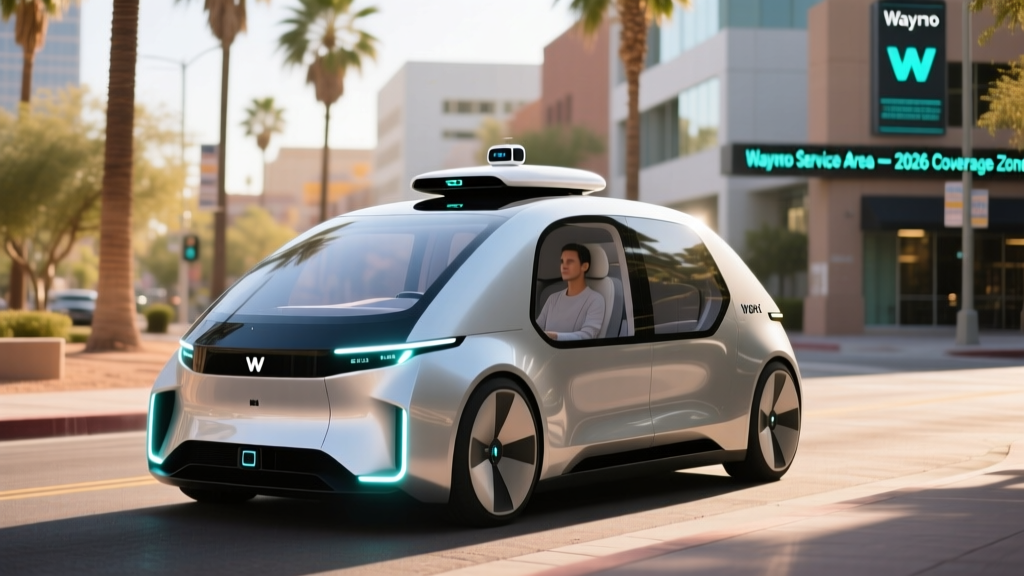
Inside, the experience is calm and unremarkable — which is the point. The Zeekr-based 6th-gen vehicle offers a spacious, lounge-like interior with screens showing the route and the vehicle's perception of surrounding traffic. The ride quality is smooth, with conservative acceleration and braking profiles. Waymo vehicles don't drive aggressively; they prioritize predictability over speed.
Current Limitations: Where Waymo Still Falls Short
- Geofence boundaries: Cannot travel outside the approved service area — no Phoenix-to-Tucson trips, no rural roads
- Heavy monsoon weather: During severe Phoenix monsoon storms (heavy rain, flash-flooding conditions), service may be temporarily suspended in affected zones
- Freeway driving: Phoenix freeway capability has been gradually introduced but is limited to specific highway corridors within the geofence
- Multi-stop trips: Currently single-destination only — no "stop at the pharmacy on the way home" flexibility
- Large groups / accessibility: Vehicle capacity is typically 2–3 passengers; wheelchair-accessible vehicles are available in limited numbers
- Pets: Service animals permitted; personal pets are generally not allowed
- Construction zones: While Waymo handles most construction rerouting, complex or poorly marked temporary lane configurations can cause extended stops or rerouting
The weather limitation deserves nuance. Phoenix's dry climate is actually one reason Waymo scaled here first — minimal rain, no snow, no ice. But when monsoon season brings sudden downpours and reduced visibility, Waymo's safety protocols may restrict operations. This is a feature, not a bug: the system errs on the side of caution rather than pushing through marginal conditions.
Regulatory Landscape: Who Approves Robotaxi Operations
Robotaxi operations sit at the intersection of state and federal authority:
- NHTSA (federal): Sets vehicle safety standards and requires crash reporting via Standing General Order for all ADS-equipped vehicles. NHTSA does not "approve" robotaxi services but investigates incidents and can issue recalls.
- Arizona state government: Arizona has been among the most permissive states for autonomous vehicle testing and deployment. Executive orders and state legislation have created a framework allowing driverless commercial operations without the heavy permitting requirements seen in California.
- Arizona Department of Transportation (ADOT): Coordinates on roadway infrastructure and data sharing.
- Local municipalities: City-level coordination on pickup/drop-off zones, airport access agreements (PHX), and first-responder protocols.
Arizona's regulatory posture is a key reason Phoenix became Waymo's launch market. Compare this to California, where the California DMV and the California Public Utilities Commission (CPUC) maintain separate permitting processes that have created more friction — including temporary suspensions following incidents in San Francisco.
Frequently Asked Questions
How much is Waymo in Phoenix compared to driving my own car?
For a single 5-mile trip, Waymo costs roughly $10–$16. If you drive a personal EV charged at home at $0.13/kWh and your car averages 3.5 mi/kWh, that same trip costs about $0.50 in electricity. Waymo makes economic sense when you factor in parking costs, vehicle depreciation, insurance, and the value of not driving yourself — not as a pure cost-per-mile replacement for personal EV ownership.
Can I use Waymo to get to Phoenix Sky Harbor Airport?
Yes. Waymo One added Sky Harbor Airport service, allowing pickups and drop-offs at designated zones. Airport trips from central Phoenix typically run $18–$28 depending on terminal and time of day. This is competitive with Uber/Lyft airport fares and eliminates the tip.
What happens if the Waymo vehicle encounters an emergency?
The vehicle is equipped with redundant systems and is designed to execute a minimal-risk condition (MRC) — typically pulling to the side of the road and stopping safely. A remote support team monitors the fleet and can provide guidance, but they do not remotely steer the vehicle. Passengers can contact support via the in-vehicle screen or app at any time. Emergency services (911) can be contacted directly from the vehicle.
Is Waymo available 24 hours a day in Phoenix?
Waymo One operates around the clock in core Phoenix zones, though fleet density is lower during late-night hours (roughly 1–5 AM), which can mean longer wait times. Service availability during overnight hours may vary by specific neighborhood within the geofence.
How does Waymo compare to Tesla's Full Self-Driving?
They are fundamentally different products. Waymo One is a Level 4 driverless service — no human driver, no steering wheel, operating within a geofence. Tesla FSD (Supervised) is a Level 2 driver-assist system that requires an attentive human driver behind the wheel at all times, but can operate on any road. Waymo removes the driver; Tesla assists the driver. Comparing them directly is like comparing a taxi to a driving instructor sitting beside you.
For the latest on Waymo's expansion plans and service updates, check Waymo's Phoenix page. For federal safety reporting data, see NHTSA's ADS resources.