Waymo's Valuation: What the Numbers Actually Mean
If you've searched for Waymo net worth, you've likely encountered a tangle of figures — $30 billion, $52 billion, $100 billion-plus in some speculative reports. The reality requires understanding what Waymo actually is and how its value gets measured.
Waymo is not a publicly traded company. It operates as a subsidiary of Alphabet Inc. (GOOGL), meaning it has no standalone market capitalization. Instead, its valuation comes from funding rounds, analyst estimates, and Alphabet's internal accounting. As of early 2026, the most credible valuation benchmark sits around $52–55 billion, based on Alphabet's disclosed internal valuations and external analyst consensus from firms like Morgan Stanley and Piper Sandler.
For context, that valuation makes Waymo one of the most valuable private-ish technology assets in the world — roughly comparable to a mid-cap automaker. But unlike Tesla or Toyota, Waymo doesn't sell vehicles. It sells rides. Understanding where that value comes from requires looking at its operational footprint, technology stack, and the hard data behind its safety claims.
Where Can I Use Waymo Right Now?
Waymo One — the company's commercial robotaxi service — operates in specific geofenced areas. Availability has expanded steadily but remains limited to select metro regions. Here's the current operational map as of 2026:
| City | Service Area | Status | Hours |
|---|---|---|---|
| Phoenix, AZ | ~225 sq mi (East Valley, Scottsdale, downtown, Sky Harbor airport) | Fully commercial, open to public | 24/7 |
| San Francisco, CA | ~50 sq mi (most of SF proper, expanding south) | Fully commercial, open to public | 24/7 |
| Los Angeles, CA | ~80 sq mi (Santa Monica, Hollywood, downtown LA, Beverly Hills) | Fully commercial, open to public | 24/7 |
| Austin, TX | Announced, limited testing | Early access / employee testing | Limited hours |
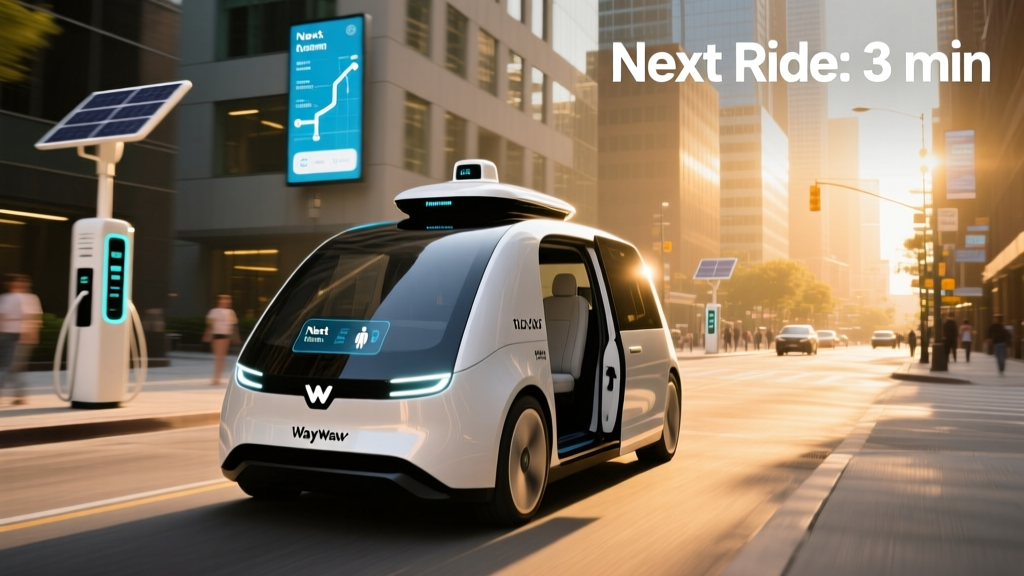
How to use it: Download the Waymo One app (iOS/Android), create an account, enter your pickup and dropoff within the service area, and a vehicle arrives — typically within 3–8 minutes in dense zones. No driver is present. The vehicle is a Jaguar I-PACE equipped with Waymo's 5th-generation Driver system (6th-gen vehicles began limited deployment in Phoenix in late 2025).
If you're outside a service area, you cannot summon a Waymo. The geofence is hard-enforced: the vehicle will not operate outside its mapped and approved zone, even if you're a mile beyond the boundary.
SAE Automation Level: This Is Level 4, Not Driver-Assist
Waymo One operates at SAE Level 4. This means the vehicle handles all driving tasks within its defined operational design domain (ODD) with no human driver required. There is no steering wheel interaction, no "take over" request, and no driver monitoring camera watching you. If the system encounters a situation it cannot handle, it performs a minimal risk maneuver — typically pulling over safely — rather than handing control to a passenger.
This is fundamentally different from Tesla Autopilot, FSD (Supervised), GM Super Cruise, or Ford BlueCruise, all of which are SAE Level 2 systems that require continuous driver attention and engagement. Level 2 is driver-assist. Level 4 is driverless (within its zone).
The distinction matters because consumers frequently conflate advanced driver-assist features with robotaxi capability. A Tesla on FSD (Supervised) still requires you to watch the road and take over at any moment. A Waymo vehicle has no expectation that you'll intervene — because you physically can't.
Waymo Pricing: Robotaxi vs. Uber vs. Lyft
One of the most common questions from prospective riders: does skipping the human driver make it cheaper? The answer is nuanced.
| Service | Base Fare | Per-Mile Rate | Typical 5-Mi Fare | Surge Pricing? |
|---|---|---|---|---|
| Waymo One | ~$3.50 | ~$1.20–$1.50/mi | $10–$13 | No (fixed pricing) |
| UberX | ~$2.50 | ~$1.00–$1.40/mi | $8–$12 | Yes (1.2x–3x+) |
| Lyft Standard | ~$2.50 | ~$1.00–$1.35/mi | $8–$11 | Yes (Prime Time) |
| Uber Black | ~$5.00 | ~$2.50/mi | $18–$22 | Yes |
Key takeaways on pricing:
- Waymo fares are generally competitive with UberX/Lyft Standard on standard trips, sometimes slightly higher.
- Waymo does not surge price. During peak demand, Uber/Lyft fares can spike 2–4x, while Waymo maintains fixed rates — making it potentially cheaper during rush hour or events.
- Waymo occasionally offers promotional credits for new riders ($5–$15 off first rides).
- Tipping is not expected (no driver), though the app allows optional tips that go to Waymo's safety and cleaning crews.
- Airport trips (e.g., Phoenix Sky Harbor) carry a flat surcharge of ~$4–$6.
The economics are still subsidized. Alphabet has invested over $30 billion cumulatively in Waymo since 2009 (originally as the Google Self-Driving Car Project). The company does not disclose per-ride profitability, and industry analysts widely agree that robotaxi unit economics have not yet reached sustained profitability at current fleet scales.
Safety Record: What the Data Actually Shows
- Cumulative autonomous miles driven: 40+ million fully driverless miles (Waymo's published figure via Waymo Safety Report)
- At-fault collision rate: ~85% lower than human benchmark for injury-causing crashes (per Waymo's peer-reviewed study published in JAMA Network Open, 2024)
- Contact rate (any physical contact): ~57% lower than human drivers in comparable urban environments
- NHTSA Standing General Order incidents: Waymo has reported incidents as required; the vast majority involve the Waymo vehicle being rear-ended or side-swiped by human drivers, not the AV initiating contact
- Pedestrian/cyclist fatalities: Zero reported pedestrian or cyclist fatalities attributed to Waymo driverless operations as of early 2026
Waymo publishes more safety data than any other robotaxi operator, including peer-reviewed research comparing its collision rates to human benchmarks. The NHTSA Standing General Order requires all AV operators to report crashes, providing a public record that can be cross-referenced.
Context that matters: Robotaxi safety data is strongest in fair-weather, well-mapped urban environments. Waymo's Phoenix operations benefit from wide roads, clear lane markings, and minimal snow. San Francisco introduces denser traffic, steeper grades, and fog — and incident reports reflect a higher rate of minor contacts in that environment, though still below human baselines.
The most common incident type is a human driver rear-ending a Waymo vehicle that has stopped (sometimes abruptly) for an obstacle. This mirrors the broader reality that most urban collisions involve human inattention, and a vehicle that never texts, never runs red lights, and always stops at crosswalks will still get hit by drivers who do.
Technology Stack: Lidar, Cameras, and Geofenced HD Maps
Waymo's approach is sensor-heavy and fundamentally different from Tesla's camera-centric ("Tesla Vision") philosophy. Here's what's on a current Waymo vehicle:
| Sensor Type | Count | Function |
|---|---|---|
| Lidar (custom-built) | 5 units (roof + corners) | 360° 3D point cloud, object detection to 500m+, works in darkness |
| Cameras | 29 units | Traffic light state, signage, lane markings, object classification |
| Radar | 6 units | Velocity detection, adverse weather penetration (rain, fog) |
| Audio sensors | External microphones | Siren detection (emergency vehicle approach direction) |
| HD Maps + GPS/IMU | Continuous | Centimeter-level localization within geofenced ODD |
The 6th-generation system (deploying in limited numbers in Phoenix as of late 2025) reduces sensor count through improved lidar resolution and AI processing, aiming to lower per-vehicle hardware cost — a critical factor in scaling the fleet.
Why this matters for the "Waymo net worth" question: The sensor suite is expensive. Each 5th-gen-equipped Jaguar I-PACE likely carries $100,000–$150,000+ in total hardware cost (vehicle + autonomy stack). Waymo's valuation depends heavily on whether it can drive that per-vehicle cost below $70,000 with the 6th-gen system while maintaining safety performance. That cost curve — not just ride volume — determines long-term unit economics and, by extension, the sustainability of the company's valuation.
Geofencing and HD mapping: Waymo does not operate in unmapped areas. Every inch of its service territory is pre-mapped at centimeter resolution, and the vehicle continuously cross-references its sensor data against that map. If road construction significantly alters the environment beyond the system's ability to reconcile, that area may be temporarily removed from the ODD. This is both Waymo's greatest strength (extremely high situational awareness in known areas) and its greatest scaling constraint (expanding to a new city requires months of mapping and validation).
Regulatory Landscape: Who Approves Robotaxi Operations?
Robotaxi operations in the United States are regulated at the state and local level, not by a single federal authority. Here's the regulatory stack:
- NHTSA (federal): Sets vehicle safety standards (FMVSS). Has granted limited exemptions for vehicles without steering wheels (relevant to Zoox, not yet Waymo's production fleet). Issues Standing General Orders requiring crash reporting. Does not approve or license robotaxi services.
- State DMV / PUC: Each state where Waymo operates has its own approval process. In California, both the California DMV (testing permits) and the California Public Utilities Commission (CPUC) (commercial passenger service permits) must grant approval. Arizona takes a lighter-touch approach with executive orders enabling AV operations.
- Local municipalities: Cities can impose operational restrictions — speed limits, hours of operation, geofence boundaries, and incident-response requirements. San Francisco's Board of Supervisors has at times pushed for restrictions on robotaxi operations following high-profile incidents.
The patchwork regulatory environment is a significant factor in Waymo's expansion timeline. Each new city or state requires separate approvals, public comment periods, and sometimes legislative action. This is why Waymo's service map, despite years of operation, covers only a handful of metros — regulatory friction is as binding a constraint as technology.
Current Limitations: What Waymo Cannot Do
Honest assessment of where Level 4 robotaxi service falls short in 2026:
- Weather: Waymo vehicles reduce speed or pull over in heavy rain, snow, or dense fog. Phoenix's dry climate is ideal; operations in cities with significant winter weather remain impractical with current sensor performance.
- Geofence rigidity: You cannot request a ride to an address 200 feet outside the service zone. The boundary is absolute.
- Complex construction zones: While Waymo handles many construction scenarios, large-scale road reconfigurations with temporary barriers, flaggers, and shifted lanes can cause the vehicle to stop and request remote assistance (a human operator guides the vehicle via teleoperations).
- Unprotected left turns in heavy traffic: Waymo is sometimes overly conservative at uncontrolled intersections, leading to long wait times or route recalculation.
- No highway driving (yet): Waymo One rides are surface-street only. Highway-speed autonomous operation is in testing but not part of the commercial service.
- Accessibility: Current Jaguar I-PACE vehicles are not wheelchair-accessible. Waymo has announced plans for accessible vehicles (partnering with Zeekr on a custom platform), but deployment timeline remains unconfirmed.
- Passenger capacity: Maximum 3 passengers in the rear seats. No front-seat passenger (the driver's area is sealed).
- No food/drink or pets: Policy restrictions to maintain vehicle cleanliness for the next rider.
Frequently Asked Questions
Is Waymo profitable?
Waymo does not disclose profitability. Industry analysts widely believe the company operates at a loss, subsidized by Alphabet's broader revenue. Cumulative investment exceeds $30 billion since 2009. Path to profitability depends on reducing per-vehicle hardware costs, increasing fleet utilization rates, and scaling to more cities — all of which are in progress but not yet achieved at a consolidated level.
How does Waymo's valuation compare to Tesla's FSD business?
These are fundamentally different business models. Waymo sells rides (mobility-as-a-service). Tesla sells software licenses ($8,000–$15,000 per vehicle) and subscription access ($99–$199/month) for a Level 2 driver-assist system. Tesla's FSD revenue is embedded in vehicle sales and is not broken out separately. Waymo's ~$52B valuation is based on future ride-hailing revenue potential; Tesla's FSD value is part of its ~$800B+ market cap. Comparing them directly is misleading because they serve different markets and operate at different SAE automation levels.
Can I use Waymo if I'm visiting Phoenix or San Francisco?
Yes. Waymo One is open to the public in Phoenix, San Francisco, and Los Angeles. Download the app, create an account, and request a ride within the geofenced service area. No waitlist is currently active in these cities (waitlists were eliminated in late 2024).
What happens if the Waymo vehicle encounters an emergency?
The vehicle is programmed to perform a minimal risk maneuver — typically pulling to the side of the road and stopping. Passengers can contact Waymo's remote assistance team via an in-vehicle button at any time. In the event of a collision, the vehicle automatically contacts emergency services and Waymo's incident response team. The NHTSA requires reporting of all incidents involving AVs.
Will Waymo expand to my city in 2026?
Waymo has announced testing in Austin, TX, with commercial service expected but not confirmed for 2026. Additional cities are under evaluation but have not been publicly named. Expansion is constrained by regulatory approvals, HD mapping requirements, and fleet logistics — expect gradual, city-by-city growth rather than rapid national rollout.