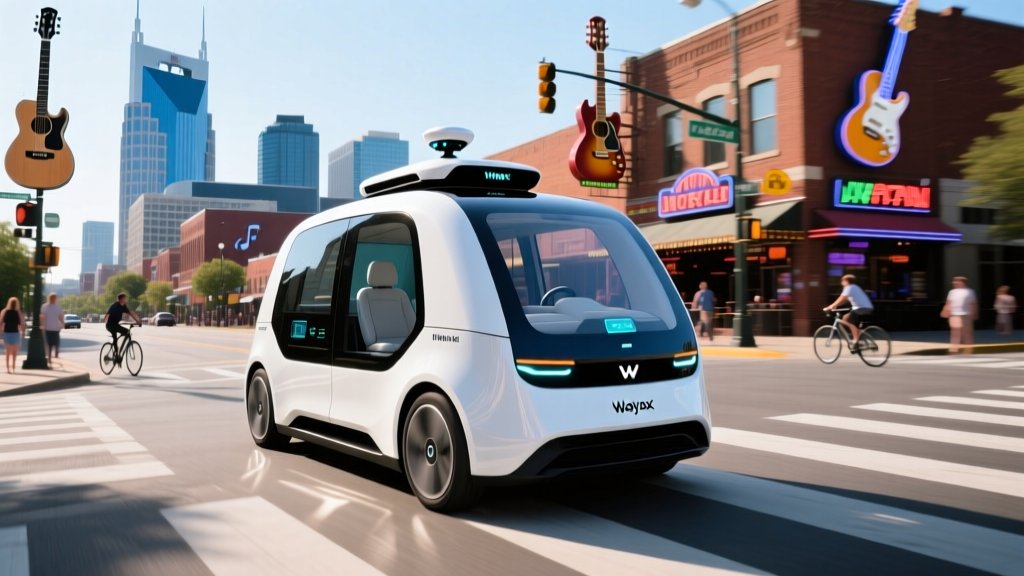
If you've been searching for Waymo Nashville TN hoping to hail a driverless ride through downtown or across the Cumberland River, here's the straightforward answer: Waymo's commercial robotaxi service is not currently available in Nashville, Tennessee. As of early 2026, Waymo One — the company's paid, fully driverless ride-hailing service — operates in a limited set of metro areas, and Nashville is not among them.
That doesn't mean Nashville will never see autonomous vehicles. But separating announced pilot programs from live, bookable service is critical for anyone planning around this technology. This guide breaks down exactly where Waymo operates right now, what it would take for Nashville to get service, how robotaxi pricing stacks up against Uber and Lyft, and the safety data you should actually care about.
Where Can I Use Waymo's Robotaxi Service Right Now?
Waymo One is a Level 4 autonomous ride-hailing service — meaning the vehicle handles all driving tasks within its defined operational design domain (ODD) with no human driver present and no expectation of human intervention. This is fundamentally different from consumer driver-assist systems like Tesla's FSD (Supervised) or GM's Super Cruise, which are Level 2 and require active driver engagement at all times.
Level 2 (Driver Assist): System controls steering and acceleration, but the human driver must monitor the road and intervene instantly. Examples: Tesla Autopilot, FSD Supervised, Ford BlueCruise, GM Super Cruise.
Level 4 (Driverless — Geofenced): Vehicle performs all driving without a human driver, but only within a mapped, approved geographic zone and defined conditions. Examples: Waymo One, Zoox (limited pilot). This is what "self-driving" actually means in production today.
Level 5 (Full Autonomy Everywhere): No production system achieves this. No vehicle can currently drive anywhere, in any condition, without a human.
Here is where Waymo One is actually live and bookable as of early 2026:
| Metro Area | Status | Service Area Notes |
|---|---|---|
| Phoenix, AZ | Fully commercial | Largest coverage area (~600+ sq mi), includes Tempe, Scottsdale, Chandler, Mesa. Airport service active. |
| San Francisco, CA | Fully commercial | Citywide coverage, including SFO airport rides. Dense urban environment. |
| Los Angeles, CA | Fully commercial | Expanded across West LA, Hollywood, downtown, Santa Monica. Freeway-capable routes. |
| Austin, TX | Commercial launch (2025–2026 ramp) | Initial geofenced zone, expanding. Partnership with Uber app integration. |
| Nashville, TN | Not available | No announced timeline for commercial service or public pilot. |
Waymo has also conducted testing in cities like Atlanta and Miami, but testing with safety drivers is not the same as open commercial service. For Nashville specifically, there is no public record of Waymo mapping operations, test fleets, or regulatory filings with the Tennessee Department of Transportation or Nashville Metro government as of this writing.
Why Nashville Isn't on Waymo's Map — Yet
Getting a Level 4 robotaxi service running in a new city is not simply a matter of flipping a software switch. Waymo's expansion follows a deliberate, multi-phase process:
- HD Mapping & Geofencing: Waymo creates centimeter-precision maps of every lane, curb, signal, and crosswalk in the target zone. This alone takes months of dedicated mapping vehicles driving every road.
- Regulatory Approval: Each state sets its own autonomous vehicle rules. Tennessee currently lacks the specific regulatory framework that states like Arizona, California, and Texas have enacted to permit commercial driverless operations. The National Highway Traffic Safety Administration (NHTSA) oversees vehicle safety standards, but operational permits are largely state-level.
- Fleet Deployment: Waymo must physically station its Jaguar I-PACE-based fleet (equipped with the 6th-generation Waymo Driver hardware) in the city, with local operations staff for cleaning, charging, maintenance, and remote assistance.
- Validation Miles: Before opening to paying riders, Waymo typically logs hundreds of thousands of miles in a new city with safety drivers, validating performance against local driving norms, weather patterns, and infrastructure quirks.
Nashville's growth, increasing traffic congestion, and expanding metro area make it a plausible future candidate. But Tennessee's legislative environment for autonomous vehicles has been less proactive than Arizona's or California's. Until state and local frameworks are established, commercial robotaxi operators have little incentive to invest in market entry.
How Much Does Waymo Cost vs. Uber and Lyft?
For riders in Waymo's active cities, pricing is designed to be competitive with conventional rideshare — not a premium novelty. Here's how it generally compares based on published rider reports and Waymo's own pricing disclosures:
| Factor | Waymo One | UberX / Lyft |
|---|---|---|
| Base fare (typical 5-mile trip) | $10–$15 | $10–$18 (varies by surge) |
| Surge pricing | No dynamic surge; wait times may increase | 1.5x–3x+ during peak demand |
| Tips | Optional in-app (goes to operations staff, not a driver) | Expected, typically 15–20% |
| Wait time (average) | 3–7 minutes in core zones | 2–10 minutes depending on area |
| Airport rides | Available at PHX, SFO; flat-rate in some cases | Available everywhere; often surcharged |
The key difference: Waymo doesn't surge price. During high-demand periods (concerts, events, rush hour), Uber and Lyft fares can spike dramatically, while Waymo's pricing stays stable — though you may wait longer for a vehicle to become available. In Austin, Waymo rides can be requested directly through the Uber app, making the experience seamless for existing rideshare users.
How Safe Are Robotaxis? The Real Data
- Total autonomous miles driven: Over 40 million fully driverless miles (as reported by Waymo)
- Injury-causing crash rate: Waymo reports an 85% reduction in injury-causing crash rates compared to human benchmarks in comparable urban environments, based on NHTSA-reported crash data comparisons
- Contactless at-fault incidents: Extremely rare; most minor incidents involve other human drivers rear-ending or sideswiping the Waymo vehicle at low speed
- NHTSA Standing General Order: Waymo reports all Level 4 incidents as required; data is publicly queryable through NHTSA's database
Sources: Waymo Safety Report, NHTSA AV incident data, IIHS research publications.
The safety question is where most coverage falls short — either breathlessly claiming robotaxis are "safer than humans" without context, or highlighting isolated incidents without statistical framing. The reality is nuanced:
What the data shows: Waymo's vehicles, operating in dense urban environments at moderate speeds (typically under 45 mph within geofenced zones), have demonstrated lower rates of injury-causing collisions per million miles than the human average in those same cities. This is largely because the Waymo Driver never gets distracted, drowsy, or intoxicated — the leading causes of urban crashes.
What the data doesn't yet prove: High-speed highway driving in mixed traffic, severe weather performance, and long-term scaling across hundreds of cities. Waymo's current safety record is impressive but reflects a carefully constrained operational domain. Generalizing it to "all driving, everywhere" would be premature.
Incident context: The handful of publicized incidents involving Waymo vehicles have largely involved low-speed contact where a human driver violated the Waymo vehicle's right-of-way, or situations where the Waymo vehicle stopped unexpectedly in traffic (a conservative safety behavior that can itself create rear-end risk). No fatalities have been attributed to Waymo's Level 4 operations as of early 2026.
Waymo's Technology Stack: Lidar, Cameras, and Geofencing
Understanding what's on the roof of a Waymo vehicle helps explain both its capabilities and its limitations. The 6th-generation Waymo Driver, deployed on the Jaguar I-PACE fleet, uses a sensor-fusion approach — not a single technology:
| Sensor Type | Function | Key Detail |
|---|---|---|
| Lidar (multiple units) | 3D point-cloud mapping of surroundings in real time | Works in darkness; less affected by glare. Custom-built by Waymo. Range ~500m. |
| Cameras (8+ units) | Traffic light state, signage, lane markings, object classification | High dynamic range; redundant coverage at all angles. |
| Radar | Object velocity detection, performance in rain/fog | Complements lidar in low-visibility conditions. |
| HD Maps + GPS/IMU | Precise localization within the geofence | Centimeter-level positioning; pre-mapped routes only. |
This is a fundamentally different architecture from Tesla's camera-only approach for FSD. Waymo's lidar-first strategy provides hardware redundancy but comes with higher per-vehicle cost and the constraint of operating only within pre-mapped zones. Tesla's vision-only system can theoretically drive anywhere but has not achieved Level 4 reliability without a human supervisor.
The geofencing constraint is critical: a Waymo vehicle will not drive outside its approved operational design domain. If you request a ride that crosses the geofence boundary — say, from downtown Phoenix out to a remote desert trailhead — the app will either adjust your pickup/dropoff to stay within bounds or decline the trip entirely.
Current Limitations of Waymo's Robotaxi Service
Level 4 autonomy is genuinely self-driving — but within a narrow box. Here are the real-world constraints riders encounter:
- Geofence boundaries: Service area is limited. Suburban and rural destinations outside the mapped zone are inaccessible.
- Weather restrictions: Heavy rain, flooding, ice, and dense fog can cause Waymo to suspend service in affected areas. Phoenix's dry climate is one reason it was the launch city. Nashville's humid subtropical climate with occasional ice storms would present additional challenges.
- Construction zones: While Waymo handles many construction scenarios, major road reconfigurations or unmarked detours can cause the vehicle to pull over and request remote assistance, adding delay.
- No highway driving in all markets: Waymo has begun limited freeway operations in Phoenix and LA, but not all geofenced zones include highway segments. Most rides are surface-street only.
- Accessibility: Waymo's Jaguar I-PACE fleet is not wheelchair-accessible. The company has stated intent to add accessible vehicles but has not deployed them at scale.
- Pets and extra cargo: Service animals are permitted, but pets are generally not. Large items that wouldn't fit in a standard rideshare trunk are similarly impractical.
- Multi-stop trips: Currently, Waymo supports single-destination rides only. No "stop at the pharmacy on the way" flexibility.
The Regulatory Landscape: Who Approves Robotaxi Operations?
Autonomous vehicle regulation in the United States is a patchwork. There is no single federal "robotaxi license." Instead:
- NHTSA (federal): Sets vehicle safety standards (FMVSS) and requires incident reporting through Standing General Orders. NHTSA does not "approve" robotaxi services but can investigate and issue recalls.
- State governments: The primary gatekeepers. Arizona issued permissive executive orders early, enabling Waymo's Phoenix launch. California's Public Utilities Commission (CPUC) and DMV both regulate different aspects of AV operations. Texas passed enabling legislation that allowed Austin's launch.
- Local/municipal governments: Cities can impose additional requirements around curb management, pickup/dropoff zones, and data sharing. San Francisco's Board of Supervisors has held multiple hearings on Waymo's operational impact.
For Tennessee and Nashville specifically, the state legislature has passed basic autonomous vehicle testing laws, but a comprehensive commercial deployment framework — the kind that gives companies like Waymo the legal certainty to invest in fleet operations — does not yet exist. This is the single largest barrier to Waymo Nashville TN service becoming reality.
What Would It Take for Waymo to Come to Nashville?
Based on Waymo's expansion pattern, a Nashville launch would likely require:
- Tennessee enacting clear commercial AV deployment legislation (beyond testing-only permits).
- Nashville Metro government establishing AV operating agreements (pickup zones, data sharing, incident response protocols).
- Waymo completing HD mapping of a sufficient initial geofence — likely downtown, The Gulch, Midtown, West End, and potentially BNA airport corridors.
- A local operations hub for fleet charging, maintenance, and remote assistance staffing.
- Validation driving with safety operators for a minimum of 6–12 months before commercial launch.
Realistically, this timeline suggests Nashville could be a candidate for the 2027–2028 expansion wave if regulatory conditions align — but that is speculation, not a commitment from Waymo or any government entity.
Alternatives for Autonomous Vehicle Experiences in Nashville
While you can't hail a driverless Waymo in Nashville today, there are adjacent options:
- Consumer Level 2 systems: If you own or rent a vehicle with GM Super Cruise or Ford BlueCruise, portions of I-40 and I-65 around Nashville are mapped for hands-free (but not driverless) operation. You must remain attentive and keep your eyes on the road.
- Tesla FSD (Supervised): Available on Tesla vehicles, FSD can navigate Nashville streets but requires continuous driver supervision. It is not autonomous — it is an advanced Level 2 assist system.
- Visit a Waymo city: If you're traveling to Phoenix, San Francisco, Los Angeles, or Austin, you can download the Waymo One app and request a ride. No waitlist is currently active in those markets for new riders.
Frequently Asked Questions
Is Waymo available in Nashville, TN right now?
No. As of early 2026, Waymo One does not operate in Nashville or anywhere in Tennessee. The service is available in Phoenix, San Francisco, Los Angeles, and Austin.
Is Waymo truly self-driving, or is there a driver?
Waymo One is SAE Level 4 — fully driverless within its geofenced service area. There is no human driver in the vehicle, no steering wheel intervention, and no expectation that a passenger will take control. This is categorically different from Level 2 driver-assist systems like Tesla Autopilot or GM Super Cruise, which require an engaged human driver.
How much would a Waymo ride cost compared to Uber?
In active markets, Waymo pricing is comparable to UberX — roughly $10–$15 for a typical 5-mile urban trip. The main advantage is the absence of surge pricing. During peak demand, Uber/Lyft fares can spike 2x–3x while Waymo's pricing stays flat (though wait times increase).
Has a Waymo vehicle ever been in a serious accident?
Waymo reports all incidents to NHTSA under Standing General Order requirements. The vast majority of reported incidents involve minor, low-speed contact where another human driver struck the Waymo vehicle. As of early 2026, no fatalities have been attributed to Waymo's Level 4 commercial operations. Waymo's published data indicates an 85% reduction in injury-causing crash rates compared to human benchmarks in comparable urban settings.
When will Waymo expand to more cities?
Waymo has been expanding methodically — from Phoenix to San Francisco, Los Angeles, and Austin over the course of 2023–2025. The company has not published a specific roadmap of future cities. Expansion depends on regulatory approval, mapping completion, and fleet logistics. Nashville has no announced timeline.
Can I use Waymo if I'm visiting one of the active cities?
Yes. Download the Waymo One app (available on iOS and Android), create an account, and request a ride within the geofenced service area. No waitlist is required in Phoenix, San Francisco, LA, or Austin as of 2026. In Austin, you can also request Waymo rides through the Uber app.