Is Waymo Available in Nashville Right Now?
If you've been searching for Waymo in Nashville, the short answer as of early 2026 is: no, Waymo's driverless robotaxi service is not yet operational in Nashville, Tennessee. Waymo One — the company's commercial ride-hailing service — currently operates in a limited set of metro areas, and Nashville has not been announced as a confirmed launch city.
That said, Waymo's expansion roadmap has been accelerating. The company has been systematically adding new cities to its testing and commercial footprint, and Nashville's growing population, grid-style downtown corridors, and tech-forward demographics make it a plausible future candidate. But plausible isn't the same as confirmed, and buyers and riders need clear facts — not hype timelines.
This guide breaks down exactly where Waymo operates today, what the Nashville timeline looks like, how the Level 4 robotaxi technology actually works, what the safety data shows, and how pricing compares to Uber and Lyft.
Waymo One is a SAE Level 4 service — meaning the vehicle operates without a human driver within a defined Operational Design Domain (ODD), which includes specific geofenced areas, speed limits, and weather conditions. This is fundamentally different from consumer driver-assist systems like Tesla Autopilot, GM Super Cruise, or Ford BlueCruise, which are SAE Level 2 and require continuous driver supervision. Level 4 means no one is behind the wheel. Level 2 means you are.
Where Waymo One Actually Operates in 2026
Before projecting when Waymo might reach Nashville, it's important to understand the current operational footprint. Waymo has been deliberate about expansion — each new city requires extensive mapping, regulatory approval, and local testing before commercial rides begin.
| City | Status | Service Type | Approx. Coverage Area |
|---|---|---|---|
| Phoenix, AZ (Metro) | Live — Fully Driverless | Waymo One (commercial) | ~315 sq mi (Chandler, Tempe, Mesa, Scottsdale, Phoenix core) |
| San Francisco, CA | Live — Fully Driverless | Waymo One (commercial) | ~50 sq mi (most of SF proper, expanding) |
| Los Angeles, CA | Live — Fully Driverless | Waymo One (commercial) | ~80+ sq mi (Santa Monica, Hollywood, Downtown, expanding) |
| Austin, TX | Testing / Early Access | Limited rider pool, Uber integration | Central Austin corridors |
| Nashville, TN | Not announced | N/A | N/A |
Phoenix remains Waymo's most mature market — the only city where you can hail a fully driverless ride across a large suburban footprint without a waitlist. San Francisco and Los Angeles have scaled to thousands of paid rides per week. Austin represents the company's push into the Sun Belt, which is relevant context for Nashville watchers: if Austin scales successfully, southeastern cities become more plausible next targets.
Why Nashville Isn't on the Map Yet — and What Would Need to Change
Nashville's absence from Waymo's current roster isn't a judgment on the city. It reflects the logistical and regulatory complexity of launching a Level 4 service in a new metro. Here's what stands between Nashville and robotaxi rides on Broadway:
Regulatory Approval
Tennessee does not currently have a comprehensive regulatory framework specifically governing commercial driverless ride-hailing. Arizona (Waymo's home base) passed permissive autonomous vehicle legislation early, and California's CPUC AV Deployer permit process provides a structured — if contentious — path. Tennessee would need to either pass enabling legislation or clarify existing law before Waymo could legally operate a driverless commercial service in Nashville.
HD Mapping and Geofencing
Waymo's Level 4 system relies on centimeter-precision HD maps of every street in its service area. Nashville's rapid construction, frequent lane reconfigurations, and ongoing infrastructure projects (including the I-40/I-24 interchange work) mean mapping would need to be thorough and continuously updated. This is solvable but time-intensive.
Weather Considerations
Nashville gets occasional ice storms, heavy rain events, and fog — conditions that challenge lidar and camera sensor suites. Phoenix and LA are notably dry markets. Waymo has been testing in adverse weather, but Nashville's winter precipitation would represent a new ODD challenge compared to current Sun Belt operations.
Fleet and Charging Infrastructure
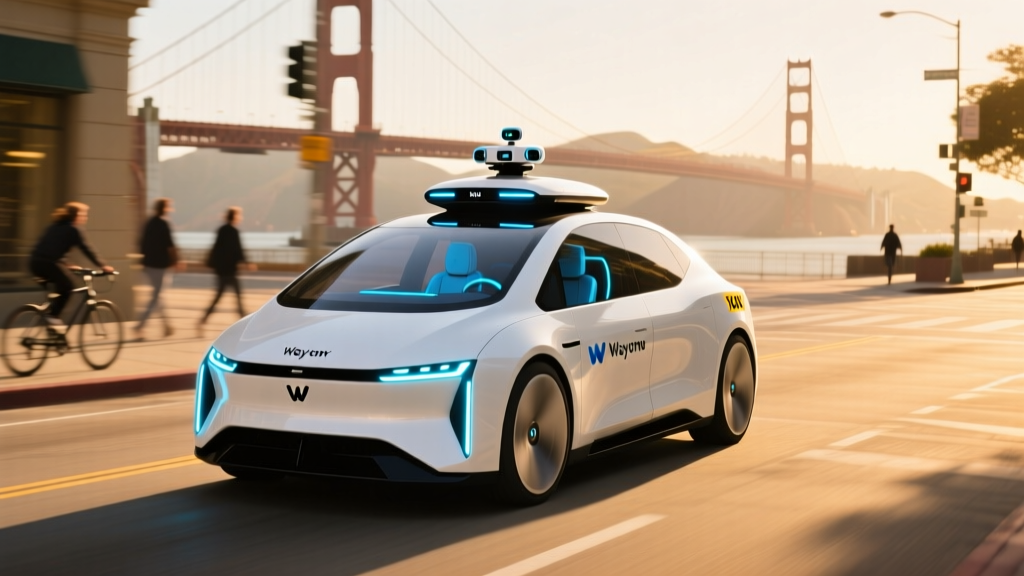
Waymo's current fleet consists primarily of Jaguar I-PACE battery-electric SUVs equipped with the company's 6th-generation Driver sensor suite. These vehicles require depot-based DC fast charging infrastructure. Nashville's public charging network has grown significantly, but a dedicated Waymo depot with 150+ kW chargers would need to be built or leased.
Waymo's Level 4 Tech Stack: How the Robotaxi Actually Sees the Road
Understanding why Waymo can operate without a driver — and why that's fundamentally different from consumer ADAS — requires looking at the sensor and compute stack.
- Lidar: Multiple high-resolution lidar units providing 360° 3D point-cloud mapping up to 500+ meters, functioning in darkness, rain, and glare — a key advantage over camera-only approaches.
- Cameras: High-dynamic-range camera arrays covering all directions, optimized for traffic light detection, signage reading, and object classification.
- Radar: Imaging radar for velocity detection of moving objects and operation in heavy precipitation where lidar scattering increases.
- External audio receivers: Microphones to detect sirens from emergency vehicles — a detail most consumers overlook but critical for urban operation.
- Compute: Custom-designed onboard AI inference hardware running Waymo's perception, prediction, and planning stack in real time.
The critical distinction: Tesla's FSD (Supervised) relies on a camera-only approach (no lidar) and remains a SAE Level 2 system requiring driver engagement. Waymo's multi-sensor redundancy — especially lidar — is what enables the system to operate at Level 4 without a human fallback within its geofence. This is why Waymo can remove the driver entirely in approved areas while Tesla cannot.
Waymo also relies on geofencing: the vehicle will only operate within its pre-mapped, approved service area. If you request a ride that exits the geofence, the app simply won't allow it. The vehicle won't attempt to navigate unmapped territory.
Safety Data: What the Numbers Actually Show
Robotaxi safety is the most debated topic in autonomous driving. Here's what we know from concrete, reported data — not marketing claims.
- Cumulative fully driverless miles: Over 10 million autonomous miles driven across Phoenix, San Francisco, and Los Angeles combined, per Waymo's published safety reports.
- Injury-causing crash rate: Waymo's published safety data shows an injury-causing crash rate approximately 85% lower than the human benchmark in comparable urban environments, based on police-reportable crashes per million miles.
- Contact rate: Any-contact incidents (including minor property damage at very low speeds) are roughly 57% lower than the human reference benchmark.
- NHTSA Standing General Order: Waymo reports all Level 4 incidents under NHTSA's crash reporting mandate, providing public transparency that most automakers with Level 2 systems do not match at the same granularity.
Important context: these numbers reflect operations in geofenced, well-mapped urban and suburban areas — not highway driving at 80 mph or rural roads. Waymo's ODD is deliberately constrained. The safety advantage comes partly from conservative driving behavior: the vehicles don't speed, don't run red lights, don't text, and don't drive impaired. They also tend to drive more cautiously than human drivers, which occasionally frustrates other motorists but reduces crash severity.
No Level 4 system is incident-free. Waymo vehicles have been involved in minor collisions, typically low-speed sideswipes or rear-end incidents where other human drivers were at fault. The company has also had software-related recalls filed with NHTSA — a sign that the regulatory system is working as intended, not that the technology is fundamentally unsafe.
Pricing: How Waymo Compares to Uber and Lyft
One of the most common questions about robotaxis: are they actually cheaper than a human-driven rideshare? The answer depends on the market, time of day, and trip distance.
| Factor | Waymo One | Uber / Lyft (human driver) |
|---|---|---|
| Base fare model | Per-mile + per-minute, similar to rideshare | Per-mile + per-minute + booking fee |
| Typical 5-mile urban trip | ~$12–$18 (varies by city/time) | ~$10–$20 (surge pricing can spike higher) |
| Surge pricing | Limited — no driver supply/demand dynamics | Can 2x–4x during peak demand |
| Tipping | Not expected (no driver) | 15–20% customary |
| Wait times | 3–8 min in active zones (fleet-size dependent) | 2–10 min (driver availability dependent) |
| Availability | Geofence restricted; no rides outside service area | Broad coverage, including suburbs and airports |
The bottom line: Waymo pricing is generally competitive with UberX/Lyft Standard — not dramatically cheaper, but also not more expensive. The real economic advantage of robotaxis emerges at scale, when fleet utilization is high and the per-ride cost of the vehicle and sensor hardware is amortized across thousands of trips per day. Waymo is not yet at that scale in most markets, so expect pricing to remain roughly at parity with traditional rideshare through 2026.
One practical advantage: no surge pricing. Because Waymo controls its fleet directly and doesn't rely on independent drivers deciding whether to log on, you won't see 3x price spikes after a concert lets out. The trade-off is that wait times may increase during peak demand rather than prices.
Current Limitations: What Waymo Cannot Do
Level 4 autonomy is impressive within its domain, but that domain has hard boundaries. Here's what the technology cannot handle as of 2026:
- Highway driving at high speeds: Waymo's current ODD is primarily surface streets and lower-speed arterials. Interstate merging and 70+ mph highway driving are limited or excluded in most markets.
- Severe weather: Heavy snow, ice accumulation, and dense fog can push conditions outside the ODD. The vehicle may pull over safely and end the ride rather than proceed in conditions it cannot handle.
- Unmapped areas: If a destination falls outside the geofenced service area, the ride cannot be requested. There is no "figure it out" mode.
- Construction zones: While Waymo handles many temporary lane shifts, major unplanned construction can cause rerouting delays or ride cancellations.
- Airport pickups: Some airport authorities have restricted robotaxi access. Phoenix Sky Harbor has been an exception, but this varies by jurisdiction.
- Complex human interactions: A police officer directing traffic with hand signals, a crossing guard, or an unusual road closure requiring negotiation with other drivers — these edge cases remain challenging and occasionally trigger remote assistance.
The Regulatory Picture: Who Decides If Waymo Comes to Nashville?
Autonomous vehicle regulation in the US is a patchwork. At the federal level, NHTSA sets vehicle safety standards but has not yet issued comprehensive FMVSS rules specific to driverless vehicles. That leaves significant authority to states and municipalities.
For Waymo to operate in Nashville, several things would need to align:
- Tennessee state law would need to explicitly permit commercial driverless ride-hailing, or existing law would need to be interpreted to allow it. Currently, states like Arizona, California, and Texas have clear frameworks; Tennessee does not.
- City of Nashville / Metro Government would need to cooperate on permitting, curb access, and potentially designated pickup/dropoff zones.
- Insurance and liability frameworks would need to be established — in a Level 4 operation, the company (not a "driver") carries liability, which requires specific insurance structures.
- Public engagement — cities that have welcomed Waymo (Phoenix, SF) typically went through public comment periods and council votes. Nashville would likely follow a similar process.
The realistic timeline for all of this, assuming Waymo prioritizes Nashville, is 18–36 months from announcement to first commercial ride. Given that no announcement has been made as of early 2026, a 2027 or 2028 launch — at the earliest — is a reasonable estimate, not a promise.
What Nashville Residents Can Do Today
If you're a Nashville resident interested in experiencing a Waymo ride, your best options in 2026 are:
- Visit Phoenix or Los Angeles: Download the Waymo One app, create an account, and hail a ride. Phoenix offers the largest service area and shortest wait times. LA provides a denser urban experience.
- Follow Waymo's expansion announcements: The company typically announces new cities 6–12 months before commercial launch, with a testing phase visible on local roads before rides go live.
- Monitor Tennessee legislation: Track autonomous vehicle bills in the Tennessee General Assembly. Regulatory enabling legislation is a prerequisite and a leading indicator of Waymo interest.
- Explore Level 2 alternatives: If your goal is advanced driver assistance on your daily Nashville commute, vehicles equipped with GM Super Cruise (hands-free on compatible highways) or Ford BlueCruise offer the most advanced consumer-available systems — but remember, these require your attention at all times and are not self-driving.
Frequently Asked Questions
Is Waymo coming to Nashville in 2026?
As of early 2026, Waymo has not announced Nashville as a launch city. The company is focused on scaling its existing markets (Phoenix, San Francisco, Los Angeles) and expanding to Austin. Nashville is a plausible future market, but no timeline has been confirmed.
Is Waymo truly self-driving, or is there a human behind the wheel?
Waymo One is SAE Level 4 — fully driverless within its geofenced service area. There is no human driver in the vehicle. This is fundamentally different from consumer systems like Tesla FSD (Supervised), which is Level 2 and requires you to remain alert and ready to take over at all times.
How much does a Waymo ride cost compared to Uber?
Waymo pricing is generally comparable to UberX or Lyft Standard — roughly $12–$18 for a typical 5-mile urban trip. The key difference is that Waymo does not use surge pricing, so costs remain more predictable during peak demand.
How safe are Waymo robotaxis?
Waymo's published safety data indicates an injury-causing crash rate approximately 85% lower than the human benchmark in comparable environments, across over 10 million fully driverless miles. No system is incident-free, but the data suggests a meaningful safety improvement within the operational design domain.
What happens if a Waymo vehicle encounters a situation it can't handle?
The vehicle will execute a safe stop — pulling to the curb or stopping in place with hazards on — and can connect to a remote assistance operator who can provide guidance. The vehicle does not attempt maneuvers outside its capability envelope.
What vehicle does Waymo use?
Waymo's current commercial fleet primarily uses the Jaguar I-PACE, a battery-electric SUV with a 90 kWh battery pack and approximately 234 miles of EPA range. The 6th-generation Waymo Driver sensor suite is integrated into the vehicle's roof, bumpers, and fenders. Waymo has also announced partnerships with Hyundai and Stellantis for future vehicle platforms.