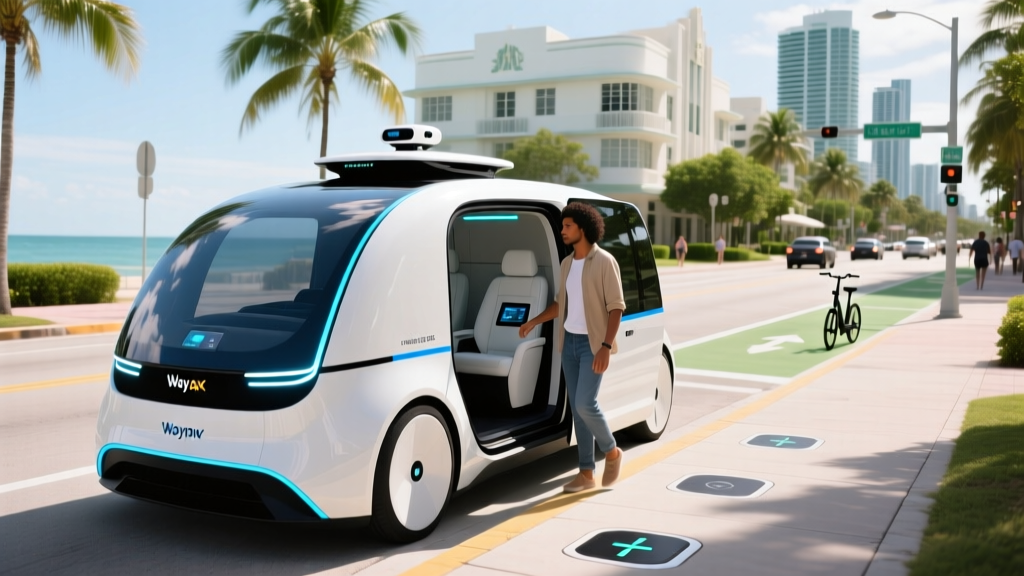
If you've watched Waymo's white Jaguar I-PACE SUVs navigate the streets of Phoenix or San Francisco, you might be wondering: is there Waymo in Miami? The short answer, as of early 2026, is no — Waymo does not yet operate a commercial robotaxi service in the Miami metropolitan area. But Miami is on the company's expansion radar, and understanding where the service does operate, what it costs, and how safe it is matters for anyone planning travel or tracking the autonomous vehicle industry.
This guide covers Waymo's current operational cities, the realistic timeline for Miami, pricing compared to Uber and Lyft, verified safety data, the technology under the hood, and the regulatory hurdles that determine where robotaxis can legally run.
Where Waymo Operates Right Now (And Where Miami Stands)
Waymo One — the company's commercial, app-based robotaxi service — is live in a limited set of U.S. metros. These are not pilot programs; they are fare-charging, fully driverless rides available to the public (or via waitlist). Here is the current operational map as of Q1 2026:
| City | Status | Service Area Notes | Year Launched |
|---|---|---|---|
| Phoenix, AZ (Metro) | ✅ Fully operational | Chandler, Tempe, Gilbert, Scottsdale, downtown Phoenix — 225+ sq mi geofence | 2020 |
| San Francisco, CA | ✅ Fully operational | Most of SF proper, including downtown, Sunset, Richmond; 24/7 service | 2022 |
| Los Angeles, CA | ✅ Operational (expanding) | Santa Monica, Hollywood, downtown LA, Beverly Hills; growing geofence | 2023 |
| Austin, TX | ✅ Operational (limited) | Central Austin, downtown, South Austin corridors | 2024 |
| Miami, FL | ❌ Not yet available | Testing/mapping phase; no commercial launch date announced | — |
Waymo has confirmed that Miami is part of its next-wave expansion cities, alongside Atlanta and other Sun Belt metros. The company began mapping Miami streets and conducting limited test drives in late 2024, but no commercial launch date has been announced. Based on Waymo's historical rollout pattern — roughly 12–18 months between initial mapping and public launch — a Miami debut in late 2026 or 2027 is plausible but unconfirmed.
Waymo's robotaxi is a SAE Level 4 system — meaning it handles all driving tasks without human intervention, but only within its defined operational design domain (geofenced area, certain weather conditions). There is no human driver in the vehicle, no steering wheel for a passenger to grab, and no expectation that you will take over. This is fundamentally different from Level 2 driver-assist systems like Tesla Autopilot or GM Super Cruise, which require an attentive human driver at all times. Waymo is not "self-driving everywhere" (that would be Level 5); it is driverless within strict geographic and environmental boundaries.
How to Use Waymo One and What It Costs vs. Uber
In cities where Waymo One is live, the experience mirrors a standard rideshare: download the Waymo One app, enter your pickup and destination, get matched to a nearby vehicle, and ride. The difference is that the driver's seat is empty.
Step-by-Step: Booking a Waymo Ride
- Download the Waymo One app (iOS/Android) and create an account.
- Verify availability — in some cities, new users join a waitlist before getting full access.
- Enter pickup/destination — both must fall within the geofenced service area.
- Confirm and wait — typical wait times are 3–8 minutes in Phoenix and SF.
- Board — the app unlocks the doors when the vehicle arrives; you can start the ride from the rear-seat screen.
- Ride — the vehicle handles all navigation, lane changes, and stops.
Pricing: Waymo vs. Uber vs. Lyft
Waymo prices its rides to be competitive with UberX and Lyft standard fares. Based on aggregated rider reports and Waymo's published pricing structure in Phoenix and San Francisco:
| Ride Type | Avg. Cost (5-mile trip) | Avg. Cost (10-mile trip) | Surge Pricing? | Tipping? |
|---|---|---|---|---|
| Waymo One | $11–$15 | $18–$26 | No surge pricing | Not applicable |
| UberX | $12–$18 | $20–$30 | Yes (can 1.5–3x) | Expected (15–20%) |
| Lyft Standard | $11–$17 | $19–$28 | Yes (Prime Time) | Expected (15–20%) |
The key economic advantage of Waymo is the absence of surge pricing. During high-demand periods (rain, events, rush hour), Uber and Lyft fares can double or triple. Waymo's pricing remains flat, though wait times may increase. For a routine 10-mile airport trip in Phoenix, Waymo typically undercuts UberX by 10–20%, especially when factoring in the tip you'd normally add.
Waymo's Safety Record: What the Data Actually Shows
Safety is the most scrutinized aspect of robotaxi operations. Waymo has accumulated over 40 million fully driverless miles across its operational cities as of late 2025, providing a statistically meaningful dataset.
- Total driverless miles: 40+ million (Waymo Safety Report)
- Injury-causing crash rate: ~85% lower than human benchmark (per Waymo's peer-reviewed study comparing police-reported injury crashes)
- Contactless incidents: Majority of reported incidents involve the Waymo vehicle being rear-ended at low speed — consistent with urban crash patterns
- NHTSA Standing General Order: Waymo reports all incidents involving its ADS to NHTSA under mandatory crash-reporting rules
- Disengagement rate: Not directly comparable to Level 2 systems; Waymo's remote-assistance interventions occur roughly once per 10,000–15,000 miles, typically for construction-zone routing ambiguity
It's important to contextualize these numbers. Waymo operates in dense urban environments at relatively low speeds (typically under 45 mph within its geofence). The comparison benchmark matters: Waymo's data is measured against the human driving average in similar urban conditions, not against highway driving in rural areas.
The National Highway Traffic Safety Administration (NHTSA) requires all ADS operators to report crashes under a Standing General Order. Waymo's public incident reports show that the most common collision type is another driver rear-ending a stopped Waymo vehicle — a scenario where the robotaxi is typically not at fault.
Under the Hood: Waymo's Sensor and Technology Stack
Waymo's fifth-generation "Waymo Driver" hardware suite, deployed on the Jaguar I-PACE robotaxi fleet, is one of the most sensor-dense platforms in the autonomous vehicle industry. Unlike camera-only approaches (most notably Tesla's), Waymo relies on a redundant, multi-modal perception system:
| Sensor Type | Count per Vehicle | Function |
|---|---|---|
| LiDAR (custom-built) | 5 units | 360° 3D point cloud; object detection to 500+ meters; works in darkness |
| Cameras (high-res) | 29 units | Traffic light state, signage, lane markings, pedestrian gesture recognition |
| Radar (imaging) | 6 units | Velocity measurement of moving objects; performs in rain/fog where LiDAR degrades |
| External audio sensors | Multiple | Detects sirens from emergency vehicles to yield proactively |
| GPS + IMU + HD maps | — | Centimeter-level localization within pre-mapped geofence |
The system processes sensor data through Waymo's custom "Waymo Driver" compute platform, running proprietary neural networks for perception, prediction, and planning. The vehicle's behavior is constrained by a high-definition map of its operating area, which includes lane geometry, speed limits, crosswalk locations, and known construction zones. This is geofenced autonomy: the car will not operate outside its mapped area, and if it detects that its localization confidence is dropping (e.g., due to major un-mapped road changes), it will pull over safely and request remote assistance.
The Regulatory Landscape: Who Decides Where Robotaxis Can Run?
Robotaxi operations in the U.S. are governed by a patchwork of state and local regulations — there is no single federal license that allows a company to deploy driverless vehicles nationwide.
Key Regulatory Bodies
- State level: Each state sets its own rules for testing and commercial deployment. California requires a permit from the California DMV and approval from the California Public Utilities Commission (CPUC) for commercial passenger service. Arizona has a more permissive framework, which is why Phoenix was Waymo's first market.
- Federal level: NHTSA oversees vehicle safety standards and crash reporting. The agency can issue recalls for ADS software defects (as it did for Cruise in late 2023). The Federal Motor Vehicle Safety Standards (FMVSS) currently require certain human-oriented vehicle features (mirrors, steering wheels), though Waymo's I-PACE fleet meets these because the base vehicle is a standard production model.
- Local level: Cities and counties control road access, speed limits, and can impose operational restrictions (e.g., school-zone speed caps, event-day route closures).
For Miami specifically, Florida has one of the more permissive state-level frameworks for autonomous vehicles. Florida Statute § 316.86 allows the operation of fully autonomous vehicles on public roads without a human driver, provided the vehicle is properly registered and insured. This means the state-level regulatory barrier is relatively low for a Waymo Miami launch — the bigger hurdles are local mapping, fleet logistics, and Waymo's own internal safety-validation timeline.
Current Limitations: What Waymo Cannot Do Yet
Level 4 autonomy is powerful within its domain, but that domain has hard edges. Here are the operational constraints that define — and limit — the Waymo experience today:
- No highway driving (most markets): Waymo's geofence generally covers surface streets. Limited highway segments are included in Phoenix, but you cannot book a Waymo for a long interstate trip.
- No heavy rain or flooding operation: In significant rain, Waymo vehicles may reduce speed or pull over. LiDAR performance degrades in heavy precipitation. This is a particular concern for Miami's tropical climate.
- No geofence flexibility: You cannot set a destination outside the mapped zone. The app will reject the request.
- No valet or door-to-door in private areas: Pickups and drop-offs occur on public roads. The vehicle will not navigate into parking garages, gated communities, or private driveways.
- No car seats or accessibility accommodations (yet): The fleet currently uses standard Jaguar I-PACE vehicles without wheelchair ramps or integrated child seats.
- Limited cargo: Trunk space is available but constrained by onboard compute equipment.
- No intercity travel: Phoenix to Tucson, or SF to LA, is not possible. These are strictly intra-metro services.
For Miami specifically, the weather limitation is significant. South Florida's afternoon thunderstorms, tropical downpours, and occasional flooding events could constrain Waymo's operational availability more than in its current dry-climate markets. Waymo has been testing in heavier rain conditions in other cities, but Miami would be its most weather-challenged market to date.
Miami Robotaxi Timeline: What to Realistically Expect
Based on Waymo's historical expansion pattern, here is a reasonable projection for Miami:
- Mapping and testing phase (2024–2025): Waymo vehicles have been spotted on Miami roads collecting HD map data and conducting supervised test runs with safety operators.
- Regulatory engagement (2025–2026): Coordination with Miami-Dade County, the City of Miami, and the Florida DOT on operational boundaries and permitting.
- Waitlist/limited launch (late 2026–2027): Initial service in a small geofence — likely downtown Miami, Brickell, Wynwood, and possibly Miami Beach — with a limited rider pool.
- Full commercial operation (2027–2028): Expanded geofence covering the core urban corridor, open to all riders via the app.
This timeline is a projection based on observed patterns, not a confirmed schedule. Waymo has historically been cautious about expansion, prioritizing safety validation in each new market over speed of rollout.
Frequently Asked Questions
Is there Waymo in Miami right now?
No. As of early 2026, Waymo does not offer commercial robotaxi rides in Miami. The city is in the mapping and testing phase, but no public launch date has been announced. Waymo's current operational cities are Phoenix, San Francisco, Los Angeles, and Austin.
Is Waymo truly self-driving or is there a driver?
Waymo is a SAE Level 4 autonomous vehicle — there is no human driver in the car, and no expectation for the passenger to intervene. The vehicle handles all driving tasks within its geofenced service area. This is fundamentally different from Level 2 systems like Tesla's Autopilot or Full Self-Driving (Supervised), which require a fully attentive human driver behind the wheel at all times.
How much does a Waymo ride cost compared to Uber?
Waymo pricing is comparable to UberX and Lyft standard fares — typically $11–$15 for a 5-mile trip and $18–$26 for a 10-mile trip. The main cost advantage is the absence of surge pricing: Waymo's rates stay flat during high-demand periods, while Uber and Lyft can increase 1.5x to 3x.
How safe are Waymo robotaxis?
Waymo reports over 40 million fully driverless miles with an injury-causing crash rate approximately 85% lower than the human benchmark in comparable urban conditions, according to the company's peer-reviewed safety study. The most common incident type is being rear-ended by another vehicle at low speed. All incidents are reported to NHTSA under mandatory crash-reporting rules.
Can Waymo drive in the rain?
Waymo can operate in light rain, but heavy precipitation — including tropical downpours common in Miami — can cause the vehicle to reduce speed or pull over safely. LiDAR and camera performance degrade in heavy rain. This weather limitation is one of the key challenges Waymo will face in the Miami market.
What other robotaxi services operate in the U.S.?
Beyond Waymo, the main commercial robotaxi operators in the U.S. include Zoox (Amazon-owned, operating a purpose-built vehicle in Las Vegas and limited areas of Foster City, CA) and Baidu's Apollo Go (operating in China, not the U.S.). Cruise, previously operated by GM, suspended operations in late 2023 following a safety incident in San Francisco and has been gradually returning to testing with safety drivers as of 2025–2026.
When will Waymo come to other cities?
Waymo has confirmed Atlanta as a near-term expansion city, with Miami and other Sun Belt metros in the pipeline. The company has not published a specific timeline for these launches. Historically, Waymo takes 12–18 months from initial road testing to commercial launch in a new market.
The Bottom Line for Miami Residents and Visitors
If you're in Miami and hoping to hail a driverless Waymo today, you'll need to wait. The technology is proven, the regulatory framework in Florida is favorable, and Waymo is actively preparing the market — but a commercial launch is likely still 12–24 months away. In the meantime, if you're traveling to Phoenix, San Francisco, Los Angeles, or Austin, the Waymo One app is available for download and the service is open to new riders (subject to waitlist availability in some zones).
The robotaxi industry is advancing, but it is advancing methodically. Waymo's cautious expansion strategy — prioritizing safety validation over geographic speed — is the right approach for an industry where public trust is still being earned mile by mile.