Waymo in Las Vegas: What You Need to Know Before You Ride
Las Vegas has become one of the most closely watched battlegrounds for autonomous vehicle deployment, and Waymo — Alphabet's self-driving subsidiary — is at the center of it. If you've searched for Waymo in Las Vegas, you're likely trying to figure out whether you can actually hail a driverless ride on the Strip today, what it costs, and whether the technology is genuinely safe. This guide breaks down the service status, technology, pricing, safety record, and real-world limitations as of 2026.
Waymo's robotaxi service operates at SAE Level 4 — meaning the vehicle handles all driving tasks within its defined operational design domain (geofenced areas, fair weather) without a human driver present. This is fundamentally different from Level 2 driver-assist systems like Tesla Autopilot or GM Super Cruise, which require an attentive human behind the wheel at all times. There is no steering wheel interaction, no "take over" request during normal operation. Waymo does not currently operate at Level 5 (full automation in all conditions everywhere).
Where Can You Use Waymo in Las Vegas Right Now?
Waymo's Las Vegas footprint has been carefully scoped. Unlike the company's mature operations in Phoenix and San Francisco, Las Vegas service launched with a constrained geofence and has been expanding incrementally. Here's what's live as of early 2026:
| City | Status | Coverage Area | Notes |
|---|---|---|---|
| Las Vegas, NV | Limited commercial service | ~50+ sq mi geofence covering parts of the Strip corridor, downtown, and surrounding neighborhoods | Waitlist may apply; availability varies by time of day |
| Phoenix, AZ | Fully open commercial | ~225+ sq mi across metro Phoenix | Most mature market; open to all riders |
| San Francisco, CA | Commercial (with restrictions) | Citywide with some zone limitations | CPUC permit; nighttime and highway access expanded |
| Los Angeles, CA | Commercial rollout | Expanding geofence across LA basin | Phased expansion ongoing |
| Austin, TX | Testing / early access | Limited zones | Pre-commercial phase |
Key Vegas detail: The Las Vegas geofence prioritizes high-demand corridors — expect coverage around the major resort properties, the Convention Center, Harry Reid International Airport (depending on current permit status), and downtown Fremont Street areas. However, the exact boundaries shift as Waymo maps and validates new streets. If your pickup or drop-off falls outside the geofence, the Waymo app will simply tell you the ride isn't available.
How to Ride and What It Costs vs. Uber/Lyft
Using Waymo in Las Vegas works similarly to a standard rideshare flow, with a few important differences:
- Download the Waymo One app (iOS/Android) and create an account.
- Enter your pickup and destination. Both must fall within the active geofence.
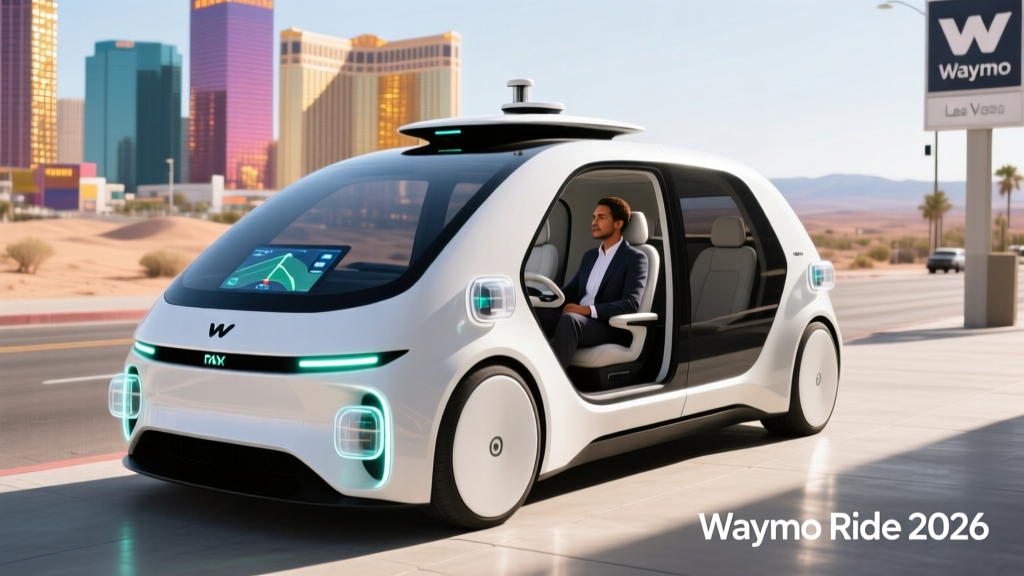
- Wait for your vehicle. A Jaguar I-PACE equipped with Waymo's 6th-generation driver system will arrive — no human in the driver's seat.
- Unlock via the app. Tap "Start Ride" on the rear seat screen, and the vehicle departs autonomously.
- Arrive and exit. The ride ends automatically at your destination.
There's no driver to tip, no small talk, and no rating exchange. You can make stops, adjust climate, and play music through the in-car screens.
| Service | Typical 5-Mile Fare (Vegas) | Surge Pricing | Tipping | Wait Time Fees |
|---|---|---|---|---|
| Waymo One | $12–$20 | Dynamic pricing (less volatile than rideshare surge) | None | Minimal; vehicle waits or re-routes |
| UberX | $14–$28 | Frequent surge (2–3x on Strip weekends) | Expected ($2–$5) | $0.50–$1.00/min after 5 min |
| Lyft Standard | $13–$26 | Prime Time pricing | Expected ($2–$5) | Similar to Uber |
Bottom line on pricing: Waymo fares in Las Vegas are generally competitive with UberX and Lyft, and often cheaper during peak surge periods when human-driver rideshare prices spike dramatically. The absence of tipping (saving $2–$5 per ride) further narrows the gap. However, Waymo does implement dynamic pricing during high demand — it's just typically less extreme than 2.5x Uber surges on a Saturday night on the Strip.
Safety Record: What the Data Actually Shows
- 30+ million fully autonomous (driverless) miles completed across all markets
- ~85% fewer police-reported injury crashes per million miles compared to human benchmarks in comparable urban environments (per Waymo's peer-reviewed safety study)
- ~90% fewer property-damage-only crashes vs. human baseline
- Contact events: predominantly low-speed (<15 mph), minor bump scenarios — no fatalities attributed to Waymo driverless operations as of publication
Waymo has published multiple safety analyses comparing its driverless crash rates against human driver benchmarks using NHTSA data and insurance industry baselines. The core finding: Waymo vehicles are involved in significantly fewer injury-causing and property-damage crashes per million miles driven in the urban environments where they operate.
That said, incidents have occurred. Waymo vehicles have been involved in minor collisions — typically low-speed contacts with stationary objects, other vehicles making unpredictable maneuvers, or complex construction-zone scenarios. The National Highway Traffic Safety Administration (NHTSA) requires standing general orders for crash reporting from AV operators, and Waymo's filings are publicly accessible.
Context matters: Robotaxis operate in dense, complex urban environments where minor contacts are statistically common even for human drivers. The relevant metric is the rate per million miles, and on that measure, Waymo's data shows a meaningful safety advantage — particularly in eliminating drunk, distracted, and drowsy driving, which account for a significant share of urban crashes.
Technology Stack: Lidar, Cameras, and the 6th-Gen System
Waymo's approach to autonomy is sensor-rich and fundamentally different from camera-only systems (like Tesla's FSD). The current fleet in Las Vegas runs the Waymo Driver 6th generation, mounted on the all-electric Jaguar I-PACE platform. Here's what's under the hood:
- Lidar: Multiple custom-built lidar units providing 360° high-resolution 3D point clouds — effective at 500+ meters, reliable in varied lighting
- Cameras: High-resolution camera array (multiple overlapping fields of view) for object classification, traffic-light state detection, and sign reading
- Radar: Imaging radar units for velocity detection and all-weather object tracking
- Audio sensors: External microphones to detect emergency vehicle sirens
- Compute: Custom Waymo-designed compute platform with redundant processing paths
- HD Maps: Pre-mapped, centimeter-accurate maps of every street in the geofence, updated continuously
The system also relies on geofencing — Waymo vehicles only operate in areas that have been extensively mapped and validated. If a road hasn't been approved for autonomous operation, the vehicle simply won't drive there. This is a deliberate constraint that trades universal coverage for higher confidence and safety within the operational zone.
Regulatory Landscape: Who Approves Waymo in Nevada?
Autonomous vehicle regulation in the United States is a patchwork of federal and state authority:
- Federal (NHTSA): Sets vehicle safety standards (FMVSS) and investigates crashes. NHTSA does not currently "approve" AV software, but mandates crash reporting and can issue recalls.
- Nevada (state level): Nevada was one of the first states to pass AV legislation (AB 511 in 2011), creating a framework for testing and deployment. The Nevada DMV issues autonomous vehicle testing and deployment permits. Operators must carry minimum insurance, submit safety documentation, and comply with state traffic law.
- Local jurisdictions: Clark County and the City of Las Vegas have input on operational zones, particularly for high-traffic areas like the Strip corridor and airport access.
Waymo holds the necessary Nevada state permits for commercial driverless operations. This is distinct from California, where the CPUC (California Public Utilities Commission) regulates commercial robotaxi fares and service terms in addition to DMV testing permits. Nevada's framework is generally considered more permissive for AV deployment, which is partly why Las Vegas has attracted multiple AV operators.
Current Limitations: Where Waymo Falls Short
For all its technological sophistication, Waymo's Las Vegas service has real-world constraints that riders should understand before booking:
- Geofence boundaries: Pickup and drop-off must both fall within the approved zone. Suburban Henderson or Summerlin destinations may not be available.
- Weather restrictions: While Las Vegas rarely sees rain, heavy monsoon downpours or dust storms (haboobs) can trigger service suspensions. Waymo's sensors handle light rain, but visibility-degrading events cause the system to pull over safely and wait.
- Construction zones: Major roadwork with shifted lanes, temporary barriers, or flaggers can confuse the system. Waymo routes around known construction when possible but may decline routes through active zones.
- No highway driving (limited): Waymo's Las Vegas operations primarily cover surface streets. Highway/freeway segments within the geofence may or may not be enabled depending on current validation status.
- Wait times: During peak demand (convention weeks, holiday weekends), vehicle availability can be limited. Expect 5–15 minute waits in busy periods — sometimes longer than Uber/Lyft which have larger driver pools.
- No special accommodations: Child car seats are not provided. Wheelchair-accessible vehicle availability is limited. Pets must be in carriers.
- Edge cases: Unusual scenarios — police directing traffic with hand signals, extreme jaywalking crowds (common on the Strip), or parade routes — may cause the vehicle to stop and wait for human remote assistance.
The "remote assistance" point is important: Waymo vehicles are not 100% self-sufficient. When the AI encounters a scenario it can't confidently resolve, it contacts a remote human operator who can provide guidance (not remote-control driving, but high-level decision support like "proceed past the cone" or "wait for the officer to wave you through"). This is a key part of the Level 4 safety architecture — the vehicle defaults to a safe state (stopped, hazard lights on) and escalates.
Frequently Asked Questions
Is Waymo in Las Vegas truly self-driving, or is there a safety driver?
Waymo's commercial service in Las Vegas is fully driverless — there is no human in the driver's seat. This is SAE Level 4 automation within the geofenced service area. The vehicle handles all driving tasks autonomously, with remote assistance available for edge cases. This is categorically different from Level 2 systems like Tesla FSD (Supervised), which require a licensed, attentive driver at all times.
How much does a Waymo ride cost compared to Uber in Las Vegas?
Typical Waymo fares for a 5-mile trip in Las Vegas range from $12 to $20, comparable to or slightly below UberX ($14–$28) and Lyft ($13–$26), especially during surge pricing periods. There's no tipping with Waymo, which saves an additional $2–$5 per ride. Dynamic pricing applies during high demand but is generally less volatile than rideshare surge multipliers.
Is Waymo safe? What do the crash statistics show?
Waymo has published peer-reviewed analyses showing approximately 85% fewer injury-causing crashes and 90% fewer property-damage crashes per million miles compared to human driver benchmarks in similar urban environments. The fleet has logged over 30 million fully driverless miles. No fatalities have been attributed to Waymo's driverless operations as of early 2026. All crash data is reported to NHTSA under standing general orders.
Can I take a Waymo from the Las Vegas airport to my hotel?
This depends on whether Harry Reid International Airport is within the active geofence and whether Waymo has secured airport pickup agreements. Airport access has been a phased rollout — check the Waymo One app for current airport availability. If the airport is not yet enabled, you'll need alternative transport to a location within the geofence.
What happens if the Waymo vehicle encounters something it can't handle?
The vehicle defaults to a safe state — typically pulling over or stopping with hazard lights — and contacts a remote assistance operator. The remote operator provides guidance (not direct remote control) to help the vehicle resolve the situation. If the issue can't be resolved, Waymo dispatches roadside support. Passengers can also contact support through the in-app help function at any time.
Does Waymo operate 24/7 in Las Vegas?
Service hours vary by market and may not be 24/7 in Las Vegas during early deployment phases. Check the Waymo One app for current operating hours. In more mature markets like Phoenix, Waymo has expanded to near-24-hour service.
What vehicle does Waymo use in Las Vegas?
Waymo's Las Vegas fleet consists of the Jaguar I-PACE, an all-electric SUV with a 90 kWh battery pack (EPA range ~234 miles). The I-PACE is fitted with Waymo's 6th-generation sensor suite including lidar, cameras, radar, and external microphones. The vehicle's electric powertrain provides smooth, quiet acceleration — appropriate for a premium rider experience.
Editor's note: Robotaxi service areas, pricing, and regulations evolve rapidly. Verify current availability and terms through the Waymo One app and the Nevada DMV before planning trips around autonomous ride availability. This article reflects conditions as of early 2026.