Los Angeles is the second major U.S. market where Waymo One, Alphabet's driverless taxi platform, operates commercially without a human behind the wheel. For Angelenos and visitors, the big questions are practical: where exactly can you hail one, what does it cost compared to Uber or Lyft, and how safe are these vehicles in LA's famously chaotic traffic? This guide breaks down the Waymo LA service area with current operational boundaries, pricing benchmarks, safety records, and the technology that makes Level 4 autonomy possible on the 405.
What the Waymo LA Service Area Actually Covers
As of early 2026, Waymo One's Los Angeles commercial service zone spans roughly 80 square miles across the city's west side and central corridors. The operational geofence includes Santa Monica, Venice, Westwood, Beverly Hills, West Hollywood, Hollywood, Downtown LA, and portions of the Mid-Wilshire and Koreatown districts. The service boundary generally stretches from the Pacific coastline eastward to roughly Interstate 110, and from the Santa Monica Mountains south to the I-10 freeway corridor.
Waymo has been expanding this zone incrementally since its initial limited launch. The company first began driverless operations in LA with a restricted area focused on Santa Monica and Venice before progressively adding Hollywood, Downtown, and the corridor connecting them. Expansion continues in phases, with each new zone requiring California Public Utilities Commission (CPUC) approval and extensive internal validation miles.
| City | Approx. Coverage | Status | Vehicle |
|---|---|---|---|
| Phoenix (Metro) | ~315 sq mi | Open to public | Jaguar I-PACE (Gen 6) |
| San Francisco | ~50 sq mi | Open to public | Jaguar I-PACE (Gen 6) |
| Los Angeles | ~80 sq mi | Open to public | Jaguar I-PACE (Gen 6) |
| Austin | Limited zone | Early rider / expanding | Jaguar I-PACE (Gen 6) |
If your destination falls outside the current LA geofence, the Waymo app will not let you book the ride. The app shows a live map of the service area, and both pickup and drop-off must fall within the boundary. You cannot, for example, hail a Waymo from LAX to Pasadena — LAX itself is not yet in the service zone, and Pasadena is well outside the current boundary.
SAE Level 4 Autonomy: What "Driverless" Actually Means Here
It is critical to distinguish Waymo's robotaxi service from the driver-assistance systems available in consumer vehicles. Waymo One operates at SAE Level 4 — high automation — within its defined operational design domain (ODD). This means the vehicle performs all driving tasks without any human intervention within its geofenced service area. There is no driver in the front seat, no steering wheel to grab, and no expectation that a passenger will take over.
| Level | Name | Who Drives? | Example |
|---|---|---|---|
| Level 0 | No Automation | Human | Conventional vehicle |
| Level 1 | Driver Assistance | Human (system assists) | Adaptive cruise control |
| Level 2 | Partial Automation | Human (must supervise) | Tesla Autopilot, GM Super Cruise, Ford BlueCruise |
| Level 3 | Conditional Automation | System (human on standby) | Mercedes Drive Pilot (limited conditions) |
| Level 4 | High Automation | System (no human needed in ODD) | Waymo One, Zoox |
| Level 5 | Full Automation | System (everywhere, all conditions) | Does not yet exist commercially |
This is fundamentally different from Tesla's FSD (Supervised), GM's Super Cruise, or Ford's BlueCruise, all of which are SAE Level 2 systems. Level 2 requires continuous driver supervision — your hands may leave the wheel briefly, but your eyes must stay on the road and you remain legally responsible for the vehicle. Waymo's Level 4 system assumes full liability while operating within its ODD. Passengers are cargo, not drivers.
The trade-off for this higher automation level is geographic restriction. Waymo vehicles can only operate within their mapped and validated geofence, under specific conditions. A Level 2 system like Super Cruise works on hundreds of thousands of mapped highway miles nationwide but still requires you to pay attention.
How to Hail a Waymo in LA and What It Costs
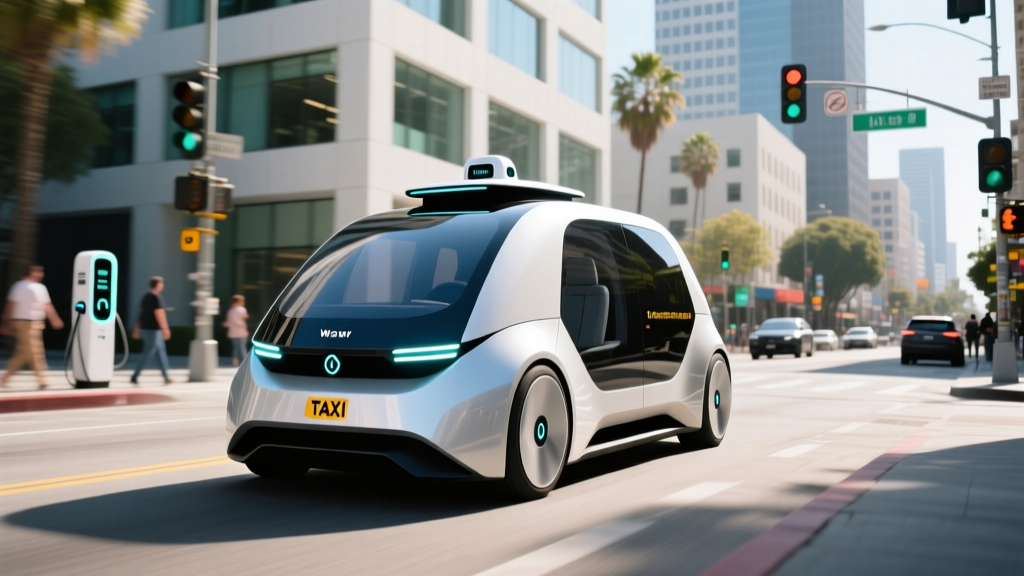
Using Waymo One in Los Angeles follows a familiar rideshare workflow. Download the Waymo One app (available on iOS and Android), create an account, and enter your pickup and destination. If both fall within the service area, you'll see a fare estimate and estimated wait time. Waymo vehicles are Jaguar I-PACE electric SUVs equipped with the company's 6th-generation driver system, and you'll spot them by their prominent roof-mounted lidar dome and side sensor arrays.
Wait times in LA typically range from 3 to 10 minutes depending on time of day and location within the geofence. Santa Monica and West Hollywood tend to have shorter waits due to higher fleet density in those zones.
| Route (Approx. Distance) | Waymo One | UberX | Lyft Standard |
|---|---|---|---|
| Santa Monica → Westwood (~6 mi) | $16–$22 | $14–$20 | $13–$19 |
| Hollywood → Downtown LA (~5 mi) | $14–$19 | $12–$17 | $11–$16 |
| Beverly Hills → Venice (~9 mi) | $22–$30 | $19–$27 | $18–$25 |
| West Hollywood → DTLA (~7 mi) | $18–$25 | $15–$22 | $14–$20 |
Waymo's pricing is broadly competitive with standard UberX and Lyft rides, though it tends to run slightly higher — typically 5% to 15% above the cheapest rideshare option on the same route. However, Waymo pricing does not surge in the same dynamic way that Uber and Lyft do during peak demand. During high-demand events or rush hour, a Waymo can sometimes be the cheaper option when rideshare surge multipliers push Uber/Lyft prices well above baseline. Waymo does not offer shared/pool rides or a budget tier; every ride is a private, single-party trip.
Tipping is not expected or prompted in the Waymo app, which can make the effective cost lower than a comparable rideshare where a 15–20% tip is customary.
Safety Record: What the Data Actually Shows
Waymo's safety data is the most extensively documented in the autonomous vehicle industry, though interpreting it requires context. As of late 2025, Waymo reported over 30 million cumulative fully autonomous miles driven across its commercial fleet, with the majority accumulated in Phoenix and San Francisco and a growing share in Los Angeles.
Waymo Safety Metrics (Cumulative Through Late 2025)
- Total autonomous miles driven: 30+ million
- Fatalities: 0 attributed to Waymo system fault
- Police-reported crash rate: ~85% fewer than human benchmarks for comparable urban driving (per Waymo's published analysis, peer-reviewed by external researchers)
- Injury-causing crash rate: ~57% lower than human baseline in same operating environments
- Contact rate with other vehicles/objects: Significantly below human benchmarks per million miles
Sources: Waymo Safety Report, NHTSA AV Safety Data
Waymo has published comparative analyses, some validated by third-party researchers at institutions like the Insurance Institute for Highway Safety (IIHS), showing that its vehicles are involved in fewer police-reported crashes per million miles than human drivers in the same urban environments. The key caveat: Waymo's miles are accumulated in geofenced, mapped urban areas with favorable weather — not on rural highways or in blizzards. Direct comparison to the national average (which includes rural roads, drunk driving, and extreme weather) is imperfect.
LA-specific incidents have been minor. The most commonly reported issues involve Waymo vehicles stopping unexpectedly in traffic lanes — a conservative safety response to uncertain situations that can frustrate human drivers behind them but rarely causes collisions. The California Public Utilities Commission requires Waymo to report any incidents involving injury, property damage above a threshold, or contact with vulnerable road users.
NHTSA's Standing General Order requires all AV operators to report crashes. Waymo's reported incidents under this order are predominantly low-speed contacts (often under 5 mph) where another party rear-ended or side-swiped a stationary or slow-moving Waymo vehicle — a pattern consistent with the vehicle driving more cautiously and stopping more frequently than human drivers expect.
Under the Hood: Waymo's Sensor and Software Stack
Waymo's 6th-generation driver system, which equips the current Jaguar I-PACE fleet in LA, represents a significant hardware evolution from earlier generations. The sensor suite is designed for redundancy — if one sensor type is degraded, others compensate.
Waymo Gen 6 Sensor Suite
| Sensor Type | Count | Function |
|---|---|---|
| Lidar (custom-built) | 5 units | 360° 3D point-cloud mapping up to 500+ meters; works in darkness |
| Cameras (high-resolution) | 29 units | Traffic light state, signage, lane markings, object classification |
| Short-range lidar | 4 units | Near-field detection (curbs, bollards, close-proximity objects) |
| Radar | 6 units | Velocity detection, performance in rain/fog |
| External audio receivers | Multiple | Siren detection, horn detection |
The camera-and-lidar approach contrasts sharply with Tesla's camera-only ("Tesla Vision") philosophy. Waymo's reliance on lidar provides precise depth measurement independent of lighting conditions — a significant advantage at night, in tunnels, and in the harsh sun glare common on LA freeways. The trade-off is cost: each Gen 6 sensor suite is estimated to cost tens of thousands of dollars per vehicle, though Waymo has not disclosed exact figures and costs have decreased with each generation.
The software stack includes Waymo's proprietary "Waymo Driver" AI, which handles perception (understanding the environment), prediction (anticipating what other road users will do), and planning (deciding the vehicle's trajectory). The system relies on HD maps of every street in its geofence, updated continuously. This map dependency is why Waymo cannot simply drive into an unmapped neighborhood — the vehicle needs centimeter-accurate prior knowledge of the road environment.
Remote assistance is available but not remote driving. If a Waymo vehicle encounters a scenario it cannot resolve (e.g., an unusual construction zone configuration), it can contact a remote operations specialist who can provide guidance — such as confirming a route around an obstacle — but the specialist does not steer or control the vehicle in real time. The AI still executes all driving actions.
Regulatory Framework: Who Approves Waymo in LA
Operating a commercial robotaxi in California requires navigating a layered regulatory structure. Waymo holds permits from multiple agencies:
- California DMV: Autonomous Vehicle Testing and Deployment permits, required for any vehicle operating without a human driver on public roads in the state.
- California Public Utilities Commission (CPUC): The CPUC regulates commercial passenger service. Waymo holds a TCP (Transportation Charter-Party Carrier) permit with autonomous vehicle authorization, allowing it to charge fares for driverless rides.
- NHTSA (Federal): While NHTSA does not currently "approve" AV deployments, it enforces the Standing General Order requiring crash reporting and can issue recalls or investigations. The Jaguar I-PACE itself meets all FMVSS (Federal Motor Vehicle Safety Standards) as a production vehicle.
- City of Los Angeles / LADOT: Local coordination for curb management, pickup/drop-off zones, and data sharing. LA does not issue a separate AV permit but coordinates on operational logistics.
This regulatory patchwork means that expansion to new neighborhoods or cities requires fresh validation and, in some cases, updated permits. It also means that a robotaxi legal in LA is not automatically legal in, say, Las Vegas or Miami — each jurisdiction has its own rules, and some states have no AV framework at all.
Current Limitations: Where Waymo in LA Falls Short
Level 4 autonomy is impressive within its domain, but that domain has firm boundaries. Here are the practical limitations riders should understand before booking:
- Geofence restriction: Pickup and drop-off must both be inside the ~80 sq mi service area. No LAX runs, no trips to Pasadena, Long Beach, or the Valley.
- Rain and extreme weather: While Gen 6 hardware handles light rain better than earlier systems, heavy downpours can degrade sensor performance. LA's infrequent but intense rainstorms may trigger service slowdowns or temporary pauses.
- No freeway driving (limited): Waymo has been testing on select freeway segments, but the majority of LA rides use surface streets. A trip from Santa Monica to Downtown will likely route via Santa Monica Blvd or Wilshire rather than the I-10, adding time.
- Construction zones: Major, unmapped road work can confuse the system. Waymo vehicles may stop and request remote guidance, adding delays.
- Accessibility: The Jaguar I-PACE fleet is not wheelchair-accessible. Waymo has announced plans to add accessible vehicles (partnering with Zeekr on a custom robotaxi), but these are not yet in commercial service in LA.
- No trunk access: Passengers cannot currently access the I-PACE's trunk for luggage or large items. Rides are effectively limited to what fits in the passenger cabin.
- Children: Riders must be 18+ with a valid account. Unaccompanied minors cannot ride.
- Pets: Service animals are permitted; personal pets are generally not accommodated.
For many LA trips — a dinner run from West Hollywood to a restaurant in Beverly Hills, a meeting hop from Santa Monica to Westwood — these limitations are irrelevant. For airport runs, cross-town freeway commutes, or trips with heavy luggage, traditional rideshare or a personal vehicle remains necessary.
Waymo LA vs. the Alternatives: When It Makes Sense
Waymo One in LA is best understood as a premium, novel, and genuinely driverless option for medium-distance trips within its service zone. The novelty factor is real — riding in a vehicle with an empty driver's seat navigating Hollywood Boulevard traffic is an experience that still draws reactions from pedestrians and other motorists.
From a pure utility standpoint, Waymo wins when you value privacy (no driver conversation), predictability (no surge pricing), and the assurance that your driver will not be fatigued, distracted, or unfamiliar with the route. It loses on coverage area, freeway speed, luggage capacity, and airport access.
For EV enthusiasts, the experience also offers a close-up look at how a production electric vehicle — the Jaguar I-PACE, with its 90 kWh battery pack and ~234-mile EPA range — integrates into a high-utilization commercial fleet. Waymo vehicles return to depots for charging, typically using high-power DC fast charging, and the fleet's operational patterns provide real-world data on EV durability under intensive urban cycling.
Frequently Asked Questions
Where can I use the Waymo robotaxi service right now?
Waymo One is commercially available to the public in Phoenix (metro-wide, including Scottsdale, Tempe, Mesa, and Chandler), San Francisco (most of the city), and Los Angeles (west side and central LA, roughly Santa Monica to Downtown). Austin is in early-rider or limited commercial phases. Expansion to additional cities is ongoing but requires regulatory approval and validation in each market.
How much does Waymo cost compared to Uber and Lyft?
Waymo pricing is generally within 5–15% of standard UberX or Lyft fares on the same route, though it does not surge dynamically during peak demand. A typical 5–7 mile ride in LA costs $14–$25. Tipping is not expected, which can make the effective total cost comparable to or lower than rideshare after tip.
How safe are Waymo robotaxis based on real data?
Waymo has accumulated over 30 million fully autonomous miles with zero fatalities attributed to system fault. Published analyses, some peer-reviewed, show police-reported crash rates approximately 85% lower and injury-causing crash rates roughly 57% lower than human driver benchmarks in comparable urban environments. Most reported incidents are low-speed contacts initiated by other road users.
What are the current limitations of Waymo in Los Angeles?
The primary limitations are geographic (service area covers ~80 sq mi of west/central LA, no LAX or freeway-dominant routes), weather-related (heavy rain can slow or pause service), and practical (no trunk access, no wheelchair-accessible vehicles yet, no unaccompanied minors). Trips outside the geofence cannot be booked.
Is Waymo truly self-driving or is it driver-assist like Tesla Autopilot?
Waymo One is SAE Level 4 — fully driverless within its operational domain. There is no human driver in the vehicle, and passengers have no driving responsibility. This is fundamentally different from Level 2 driver-assist systems like Tesla Autopilot/FSD (Supervised), GM Super Cruise, or Ford BlueCruise, all of which require an attentive human driver ready to take over at any moment.
Can I take a Waymo from LAX to my hotel in Santa Monica?
Not currently. LAX is outside the Waymo LA service area as of early 2026. You would need to use a traditional rideshare, taxi, or rental car for airport transfers. Waymo has indicated airport service is a priority for future expansion, but no timeline has been announced for LAX specifically.