The Waymo Jaguar I-PACE: America's Most-Deployed Robotaxi
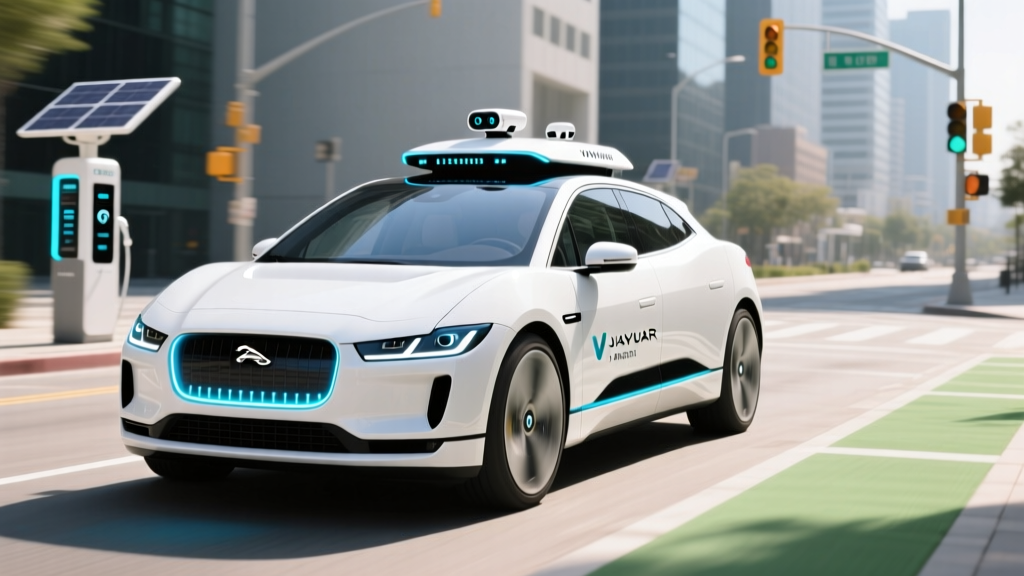
If you've seen a white Jaguar I-PACE crawling through downtown Phoenix or San Francisco with a roof rack that looks like a small satellite dish, you've spotted the Waymo Jaguar — the workhorse of the Waymo One commercial robotaxi fleet. As of early 2026, Jaguar's all-electric crossover remains the primary vehicle platform for Waymo's driverless ride-hailing service, logging millions of fully autonomous miles across multiple U.S. metro areas.
This guide breaks down exactly what the Waymo Jaguar I-PACE robotaxi is, where you can hail one today, how much a ride costs compared to Uber or Lyft, what the real safety data shows, and where the technology still falls short. No hype, no hand-waving — just the specs, data, and operational realities you need to understand this platform.
SAE Automation Level: Level 4 (High Automation)
The Waymo Jaguar I-PACE operates at SAE Level 4 within its geofenced service areas. This means the vehicle handles all driving tasks — steering, acceleration, braking, route navigation, and obstacle response — with no human driver present and no expectation of human intervention within its operational design domain (ODD). This is fundamentally different from Level 2 driver-assist systems like Tesla Autopilot, GM Super Cruise, or Ford BlueCruise, which require an attentive human driver at all times. There is no steering wheel interaction, no "hands-on" prompt, and no remote teleoperator controlling the vehicle in real time during normal operations.
Where Can You Ride the Waymo Jaguar Right Now?
Waymo One, the commercial ride-hailing service powered by Jaguar I-PACE vehicles, operates in a growing but still geographically constrained set of metro areas. Service availability is gated by regulatory approval, mapping maturity, and operational testing. Here's the current landscape as of Q1 2026:
| Metro Area | Status | Service Area Coverage | Hours |
|---|---|---|---|
| Phoenix, AZ (East Valley + Downtown) | Fully commercial — open to public | ~250+ sq mi across Chandler, Tempe, Mesa, Scottsdale, downtown Phoenix | 24/7 |
| San Francisco, CA | Fully commercial — open to public | Most of SF proper; expanded to select peninsula routes | 24/7 |
| Los Angeles, CA | Fully commercial — open to public | Downtown LA, Hollywood, Santa Monica, Westside corridors | Extended hours (not yet 24/7 in all zones) |
| Austin, TX | Commercial launch phase — waitlist/limited access | Central Austin, downtown, select corridors | Limited hours during ramp-up |
| Mountain View / Sunnyvale, CA | Testing with early rider access | Defined geofence within Silicon Valley suburbs | Daytime/early evening |
Phoenix remains Waymo's most mature market, with the broadest geofence and 24/7 availability. San Francisco followed as the second fully commercial city, though its denser street environment — with more cyclists, pedestrians, and construction zones — presented a steeper validation challenge. Los Angeles expanded through 2025 into a broader commercial footprint. Austin is in earlier-stage commercial deployment, and riders in new markets typically start on a waitlist before gaining full app access.
For real-time service maps and availability, Waymo maintains an up-to-date service area page at waymo.com/waymo-one.
How to Use Waymo One and What a Ride Costs
Using Waymo One is straightforward and mirrors the Uber/Lyft experience: download the Waymo One app (iOS or Android), set your pickup and dropoff within the service zone, confirm the ride, and a Jaguar I-PACE arrives driverless. The app shows the vehicle's approach in real time, lets you unlock the doors via phone when it arrives, and displays the route and ETA in-cabin on rear-seat screens.
Typical Pricing vs. Rideshare
Waymo prices rides competitively with Uber and Lyft in the same markets, though surge dynamics differ. Because Waymo's supply is fleet-managed rather than driver-dependent, you won't see the same 2x–3x surge multipliers during rain or rush hour — but wait times can lengthen when demand outpaces fleet availability.
| Ride Scenario | Waymo One (est.) | UberX (est.) | Lyft Standard (est.) |
|---|---|---|---|
| Short trip (~3 mi, off-peak) | $8–$12 | $9–$14 | $8–$13 |
| Medium trip (~8 mi, off-peak) | $16–$24 | $17–$26 | $15–$25 |
| Airport run (~15 mi, off-peak) | $30–$42 | $32–$48 | $30–$45 |
| Same routes during peak/surge | $18–$35 (moderate increase) | $30–$65+ (heavy surge common) | $28–$60+ (heavy surge common) |
The key difference: Waymo's pricing is more stable. Without independent drivers choosing when to log on, supply is centrally managed, which flattens peak pricing but can mean 8–15 minute waits during high-demand windows instead of the 3–5 minute waits you might get from a nearby Uber driver. Tipping is not expected or possible — there's no driver.
The Technology Stack: Lidar, Cameras, and the 5th-Gen Waymo Driver
The Jaguar I-PACE robotaxi carries Waymo's 5th-generation hardware suite, branded the "Waymo Driver." Unlike Tesla's camera-only approach, Waymo relies on a multi-sensor fusion stack that includes active lidar — a deliberate engineering choice that trades higher hardware cost for redundancy and performance in challenging conditions.
Sensor Suite Breakdown
- Lidar (6+ units): Roof-mounted and fender-integrated lidar sensors provide 360° 3D point-cloud mapping out to ~500 meters. Lidar works independently of ambient light, giving the system reliable depth perception at night, in glare, and in shadow transitions.
- Cameras (29+ units): High-resolution cameras cover all directions with overlapping fields of view, handling traffic-light state detection, signage reading, lane-marking identification, and object classification.
- External audio receivers: Microphones detect emergency vehicle sirens and trigger appropriate pull-over or yield behavior before the vehicle visually confirms the source.
- Radar: Complements lidar for velocity tracking of moving objects, particularly useful for highway-speed merging scenarios.
- HD mapping + localization: Every inch of the geofenced service area is pre-mapped at centimeter-level resolution. The vehicle continuously matches its sensor data against this map for precise lane-level positioning, independent of GPS accuracy.
The compute stack runs Waymo's proprietary perception, prediction, and planning software. The system doesn't just detect objects — it models their likely future trajectories (a pedestrian stepping off a curb, a cyclist filtering between lanes) and plans conservative, defensive paths accordingly.
Why Jaguar I-PACE?
The I-PACE was selected for the 5th-gen fleet because it offered a suitable EV platform with adequate range (~234 miles EPA), a flat floor for sensor integration, and a manufacturing partnership with Jaguar Land Rover that allowed Waymo to specify custom wiring harnesses, cooling circuits for the compute stack, and roof-mount hardpoints for the sensor array. The production I-PACE carries a 90 kWh battery pack (NMC chemistry), but the robotaxi variant dedicates a meaningful portion of that capacity to powering sensors and computers — reducing effective driving range to an estimated 150–180 miles between charges, which is sufficient for shift-based urban operations with mid-day charging.
Safety Record: What the Real Data Shows
Waymo publishes safety data periodically and has submitted findings to NHTSA. As of late 2025 reporting, the cumulative data set covers tens of millions of fully driverless miles — the largest publicly disclosed Level 4 data set in the U.S.
Key Safety Metrics (Cumulative Through 2025)
- Total fully driverless miles: 40+ million miles (Waymo One commercial operations)
- Injury-relevant crash rate vs. human benchmark: Waymo's published analysis, using insurance-claim-comparable methodology, shows a ~85% reduction in injury-causing crash involvement compared to human drivers in the same metro areas, per million miles driven.
- Property-damage-only contact rate: ~57% lower than the human benchmark in comparable urban environments.
- Contact severity: The vast majority of contacts involving Waymo vehicles are low-speed (<15 mph), rear-end or side-swipe incidents where the Waymo vehicle was typically the struck party — not the at-fault initiator.
- Disengagement metric (not applicable in the traditional sense): Because Waymo operates at Level 4 with no human safety driver in commercial service, traditional "disengagements per 1,000 miles" (a DMV reporting metric for test vehicles with safety drivers) is not the relevant measure. Instead, Waymo tracks "remote assistance events" — moments where the vehicle's AI requests guidance from a remote fleet-response specialist. These are typically edge-case routing decisions (e.g., an unmapped construction zone), not emergency interventions.
Context for the Safety Numbers
The human benchmark comparison matters. Urban driving in Phoenix or San Francisco carries inherent risk — the NHTSA-reported human crash rate in dense metro areas is substantially higher than the national average. Waymo's advantage stems from 360° persistent sensor coverage (no blind spots, no distraction, no fatigue), sub-second reaction times, and conservative driving behavior that prioritizes safety over speed. The vehicles don't run yellow lights, don't roll through stop signs, and maintain generous following distances.
That said, incidents do occur. In San Francisco, there have been documented cases of Waymo vehicles making contact with pedestrians in complex crosswalk scenarios and occasionally causing traffic disruption by stopping conservatively in travel lanes. NHTSA has reviewed specific incidents, and Waymo has issued software updates in response. The safety record is strong in aggregate but not zero-incident — and the company's transparency about publishing crash data is notably higher than most competitors.
Current Limitations: What the Waymo Jaguar Cannot Do
Level 4 autonomy within a geofence is a remarkable achievement, but it comes with defined boundaries. Understanding these limitations is essential for anyone considering robotaxi use as a daily mobility option.
Operational Constraints
- Geofence dependency: The vehicle cannot operate outside its pre-mapped service area. You cannot hail a Waymo from downtown Phoenix to Tucson — it simply won't allow a destination outside the geofence. Suburban expansion is incremental, not continuous.
- Weather limitations: Heavy rain, dense fog, and snow degrade lidar and camera performance. In Phoenix (dry climate), this is rarely an issue. In San Francisco, heavy fog or downpours can trigger service slowdowns or temporary pauses. Snow-covered roads in northern markets remain a hard barrier to deployment.
- Construction zones and unmapped changes: While the system handles many temporary lane shifts, major unmapped construction can cause the vehicle to stop and request remote assistance, adding delay. The HD maps are updated regularly but not in real time.
- No highway driving (in most markets): Waymo's commercial service is predominantly surface-street and arterial-road focused. Limited highway segments are included in some markets, but long-distance highway trips are outside the current ODD.
- Accessibility gaps: The I-PACE is a crossover SUV, which means step-up entry. Wheelchair-accessible vehicles are not yet part of the standard Waymo One fleet, though Waymo has announced partnerships to develop accessible options.
- Multi-stop and complex routing: You cannot currently add intermediate stops (e.g., "stop at the pharmacy on the way") the way you can with Uber. It's point A to point B only.
- Child seats: Waymo does not currently offer vehicles equipped with child safety seats, limiting use for families with young children.
Regulatory Framework: Who Approves Robotaxi Operations?
Robotaxi deployment in the United States is governed by a patchwork of state and local regulations — there is no single federal license that allows nationwide operation.
- California: The California Public Utilities Commission (CPUC) issues permits for commercial driverless passenger service, separate from the California DMV's testing permits. Waymo holds both. The CPUC can impose conditions on service hours, geographic scope, and incident reporting.
- Arizona: Arizona has taken a permissive regulatory stance since 2015, with executive orders enabling autonomous vehicle testing and commercial deployment with minimal state-level friction. Waymo's Phoenix operations benefit from this environment.
- Texas: Austin's entry required coordination with city and state authorities. Texas passed autonomous vehicle legislation that allows commercial deployment under specific insurance and reporting requirements.
- Federal (NHTSA): NHTSA does not currently "approve" robotaxi services but retains authority over vehicle safety standards and can investigate incidents or issue recalls. The agency has issued standing general orders requiring crash reporting from ADS-equipped vehicles.
The regulatory landscape is evolving. Each new city requires separate engagement with local transportation authorities, emergency services, and sometimes city councils. This is why expansion, while accelerating, remains measured rather than rapid.
The Jaguar I-PACE Platform: EV Specs Underneath the Robotaxi Shell
For EV-curious readers, the underlying vehicle is worth a brief technical note. The production Jaguar I-PACE (sold to consumers through 2024 before Jaguar's brand restructuring) carries these specs:
| Spec | Production I-PACE (Consumer) | Waymo Robotaxi Variant |
|---|---|---|
| Battery | 90 kWh (NMC) | 90 kWh (NMC), partial capacity allocated to compute/sensors |
| EPA Range | ~234 miles | ~150–180 miles (estimated, due to compute load + weight) |
| Powertrain | Dual-motor AWD, 394 hp | Dual-motor AWD (same hardware) |
| DC Fast Charge | Up to 100 kW (CCS) | Same — fleet charging at depot-based DC chargers |
| 0–60 mph | 4.5 sec | N/A — software-limited to conservative urban speeds |
Waymo is expected to transition to a next-generation vehicle platform (the Zeekr-built custom robotaxi) for future fleet expansion, which will feature a purpose-built interior with no driver controls, lower floor for easier entry, and integrated 6th-gen sensor hardware. However, the Jaguar I-PACE remains the backbone of the current commercial fleet through 2026.
Frequently Asked Questions
Is the Waymo Jaguar truly self-driving, or is there a remote human controlling it?
The vehicle drives itself entirely within its geofenced service area — no human behind the wheel, no remote joystick operator. Waymo's remote "fleet response" specialists provide guidance on ambiguous routing decisions (e.g., which lane to take around an unusual obstacle) but do not steer or brake the vehicle in real time. This is SAE Level 4: full automation within a defined operational domain.
How does Waymo's cost compare to owning a car for city commuting?
For a daily 8-mile round-trip commute, Waymo One would cost roughly $32–$48/day ($800–$1,200/month). That's more expensive than the monthly cost of owning an economy EV charged at home (~$400–$600/month all-in including payment, insurance, charging, and maintenance). Robotaxis currently make the most economic sense for occasional trips, airport runs, and nights out — not as a full daily-commute replacement, unless you're in a market where car ownership costs (parking, insurance, tolls) are very high.
What happens if the Waymo Jaguar gets into an accident?
The vehicle is equipped with an in-cabin support button and the Waymo One app provides immediate incident support. Waymo carries commercial insurance for all rides. After any contact event, the vehicle is typically pulled from service for inspection, and the incident is reported to NHTSA under the standing general order for ADS-equipped vehicles.
Can I hail a Waymo Jaguar to take me across town in any city?
No. Service is restricted to specific geofenced zones within approved metro areas. If your destination falls outside the geofence, the app will not allow you to book the ride. Expansion is ongoing but measured — each new zone requires mapping, validation, and regulatory clearance.
Will Waymo switch from Jaguar to a different vehicle?
Yes. Waymo has announced a partnership with Zeekr (Geely group) to develop a purpose-built robotaxi with no steering wheel, lower floor height, and integrated 6th-generation sensor hardware. This vehicle is expected to begin entering the fleet in late 2026 or 2027, but the Jaguar I-PACE will remain in service alongside it during the transition period.
How does Waymo handle situations it can't navigate?
When the AI encounters a scenario it cannot resolve — an unusual road closure, an ambiguous detour, a complex interaction with a human flagger — it will stop safely and request remote assistance from a fleet response specialist. This typically adds a few minutes to the trip. The vehicle does not guess or take risks in uncertain situations; the default behavior is to stop and wait for guidance.