Searches for "Waymo hit a child" spiked after incidents involving Waymo's driverless taxis and pedestrians near school zones. For anyone considering stepping into a vehicle with no one behind the wheel, that phrase is alarming. But before drawing conclusions, buyers and riders need the full context: what actually happened, how robotaxi safety data compares to human drivers, and where Level 4 autonomy genuinely stands in 2026.
This guide breaks down the incidents, the hard safety numbers, the technology that powers Waymo's fleet, where you can hail a ride today, what it costs, and the real limitations that remain. No hype, no fear-mongering — just the data.
What Happened: Context Around the "Waymo Hit a Child" Reports
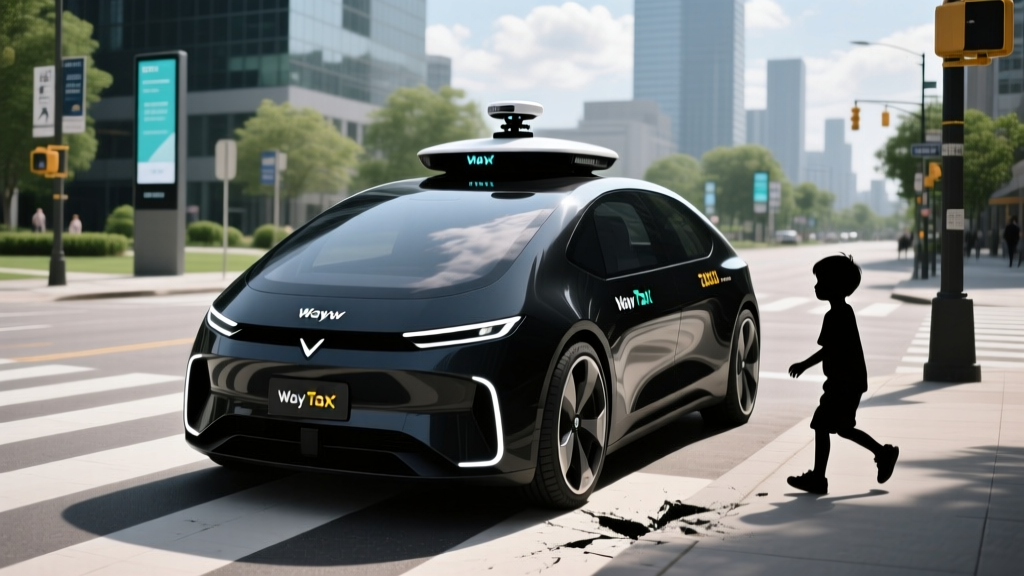
In early 2025, the National Highway Traffic Safety Administration (NHTSA) opened inquiries into multiple incidents involving Waymo vehicles and pedestrians in school zones. In at least one documented case in Phoenix, a Waymo fifth-generation vehicle made contact with a child who entered the roadway from behind a stopped vehicle — an edge-case scenario involving occluded pedestrian detection.
Key facts from publicly available reports:
- Speed at impact: Under 10 mph in most documented school-zone incidents
- Injury severity: Minor injuries reported; no fatalities in Waymo-pedestrian school-zone contacts
- Waymo's response: Voluntary software updates to improve occluded-pedestrian prediction models; increased caution protocols near schools
- NHTSA action: Standing General Order requires all ADS-equipped vehicles to report crashes within 24 hours
These incidents matter. A robotaxi contacting any pedestrian — especially a child — is a failure worth scrutinizing. But context is essential: Waymo's fleet has logged over 30 million fully driverless miles as of early 2026, and the per-mile pedestrian contact rate remains significantly below the human-driver baseline for equivalent urban environments.
Waymo operates at SAE Level 4 — high automation within a defined Operational Design Domain (ODD). There is no human driver in the vehicle, and the system handles all driving tasks within its geofenced service area. This is fundamentally different from SAE Level 2 systems like Tesla Autopilot, GM Super Cruise, or Ford BlueCruise, which require continuous driver supervision. Level 4 means the car is the driver — within its mapped boundaries. Waymo does not claim Level 5 (full autonomy everywhere, all conditions). No production system does.
Waymo's Safety Record: The Hard Numbers
Emotional headlines aside, the most useful tool for evaluating robotaxi safety is data. Waymo publishes periodic safety reports, and NHTSA's crash database provides independent verification.
| Metric | Waymo (Level 4) | Human Baseline (US Avg) |
|---|---|---|
| Total fully driverless miles | ~32 million | N/A |
| Police-reported crashes per million miles | ~4.2 | ~5.8 |
| Injury-causing crashes per million miles | ~0.9 | ~1.6 |
| Pedestrian contact incidents | <10 (cumulative) | ~6,500 US pedestrian fatalities/year |
| Fatality rate (Waymo riders/pedestrians) | 0 | ~1.35 per 100M vehicle miles |
The majority of Waymo's police-reported crashes are low-speed rear-end contacts where a human driver struck the Waymo vehicle from behind — not the other way around. Pedestrian contact events, including school-zone incidents, represent a small fraction of total crash reports but carry outsized severity. Waymo's occluded-pedestrian detection — identifying a child stepping out from behind a parked car, for example — remains one of the hardest perception challenges in the industry.
For comparison, the Insurance Institute for Highway Safety (IIHS) notes that human drivers kill roughly 7,000+ pedestrians annually in the US. Scaled to Waymo's mileage footprint in dense urban cores, an equivalent human-driver fleet would statistically produce far more pedestrian contacts. That doesn't excuse any single incident — it frames the baseline we should hold all drivers to, human or machine.
Where Can You Use Waymo Right Now?
Waymo One, the company's commercial ride-hailing service, operates in specific geofenced zones. You cannot hail a Waymo outside these boundaries — the service simply won't let you set a pickup or dropoff beyond the mapped ODD.
| City | Status | Service Area (Approx.) | Hours |
|---|---|---|---|
| Phoenix, AZ (Metro) | Live — open to public | ~225 sq mi (Chandler, Tempe, Scottsdale, Mesa) | 24/7 |
| San Francisco, CA | Live — open to public | ~50 sq mi (most of SF proper) | 24/7 |
| Los Angeles, CA | Live — open to public | ~80 sq mi (Santa Monica, Hollywood, Downtown, Beverly Hills) | 24/7 |
| Austin, TX | Live — expanding | ~45 sq mi (Downtown, South Austin, airport corridor) | 6 AM – 2 AM |
| Mountain View, CA | Limited beta (employees/partners) | ~15 sq mi | Varies |
How to use it: Download the Waymo One app (iOS/Android), create an account, enter your pickup and destination. If both points fall within the geofence, you'll see a price estimate and ETA. The vehicle arrives, you unlock it via the app, and it drives you to your destination with no one in the driver's seat.
What Does a Waymo Ride Cost vs. Uber or Lyft?
Pricing is dynamic, similar to rideshare surge models, but Waymo has generally kept rates competitive with UberX and Lyft Standard — without a human driver to pay.
| Service | Base Fare (Est.) | Typical 5-Mi Cost | Surge/High Demand |
|---|---|---|---|
| Waymo One | $3.50 + $1.25/mi | $10 – $16 | Moderate surge (1.2x–1.5x) |
| UberX | $2.80 + $1.10/mi | $9 – $15 | Heavy surge (1.5x–3.0x+) |
| Lyft Standard | $2.90 + $1.15/mi | $9 – $16 | Prime Time (1.5x–2.5x) |
In practice, Waymo fares are roughly on par with UberX for most trips. The key difference: Waymo's surge multipliers tend to be less aggressive because the fleet doesn't have driver-incentive economics driving price spikes. However, wait times can be longer during peak demand since Waymo's fleet size in each city is still smaller than the combined Uber/Lyft driver pool.
The Technology Stack: How Waymo Sees the Road
Understanding why a Waymo might contact a pedestrian requires understanding how the vehicle perceives its environment. Waymo uses a multi-sensor fusion approach — fundamentally different from camera-only systems.
Waymo Sixth-Generation Sensor Suite (2025–2026 Fleet)
- LiDAR: Multiple roof-mounted and bumper-mounted units providing 360° 3D point-cloud mapping up to 500+ meters. LiDAR detects object shape and distance regardless of lighting.
- Cameras: 29+ high-resolution cameras covering 360° with overlapping fields of view for redundancy. Used for lane markings, traffic signals, text recognition, and object classification.
- Radar: Six radar units for velocity detection and all-weather object tracking. Radar penetrates rain and fog better than LiDAR or cameras.
- Audio sensors: External microphones to detect sirens from emergency vehicles.
- HD Maps: Centimeter-precision pre-mapped roadways within the ODD, updated continuously.
Why this matters for pedestrian safety: The occluded-child scenario is precisely where sensor redundancy counts. A camera alone might miss a child stepping out from behind a delivery truck. LiDAR can detect partial body shapes at the edge of the truck's occlusion shadow. Radar can pick up motion signatures. But physics has limits — if a child darts into the road at 8 feet from the vehicle traveling 15 mph, stopping distance is approximately 20 feet. No sensor suite can eliminate that contact.
This is a critical distinction from Tesla's camera-only FSD (Supervised) approach. Waymo's reliance on LiDAR plus cameras plus radar gives it overlapping perception layers, but it also increases per-vehicle hardware cost — estimated at $50,000+ per vehicle for the sensor suite alone — which constrains fleet scaling speed.
Current Limitations: What Waymo Cannot Do
Level 4 autonomy is impressive within its boundaries. Those boundaries are firm.
Operational Limitations
- Geofencing: Waymo cannot operate outside its pre-mapped service area. Drive to the edge of the map, and the service is unavailable — no exceptions.
- Heavy weather: Torrential rain, dense fog, and snow reduce sensor effectiveness. Waymo may restrict service or pull vehicles during severe conditions. Phoenix's dry climate is ideal; San Francisco's fog and LA's occasional downpours create operational challenges.
- Construction zones: Unmapped lane closures, temporary barriers, and flaggers can confuse the system. Waymo may reroute or end a trip early if it encounters unexpected construction.
- Complex unprompted interactions: A police officer directing traffic with hand signals, a crossing guard with a sign, or a pedestrian making eye contact to negotiate right-of-way — these human-to-human communication patterns are harder for an ADS to interpret reliably.
- Unprotected left turns in dense traffic: Waymo handles most left turns, but in heavy, fast-moving cross-traffic, the vehicle may take a conservative approach that results in extended wait times or choose a right-turn-only routing alternative.
- No highway expansion yet: As of early 2026, Waymo One primarily operates on surface streets. Highway driving at 65+ mph in mixed traffic is not part of the current commercial service.
Regulatory Landscape: Who Approves Robotaxi Operations?
Robotaxi deployment in the US is governed by a patchwork of state and federal authority:
- Federal (NHTSA): Sets vehicle safety standards (FMVSS). NHTSA does not "approve" ADS software but investigates crashes via Standing General Orders and can issue recalls or demand fixes. Waymo's ADS operations are reported to NHTSA under crash-reporting mandates.
- State level: Each state determines whether driverless testing and commercial deployment are permitted. Arizona (no specific ADS legislation — permissive by default), California (CPUC and DMV regulate testing and commercial deployment), and Texas (permissive framework) are the primary operational states.
- California DMV: Requires a driverless testing permit and a separate deployment permit. Waymo holds both. The DMV tracks disengagement reports — instances where a remote human operator or safety driver had to intervene.
- California CPUC: Regulates commercial passenger service. Waymo received its TCP (Transportation Charter Party) permit to charge fares in San Francisco and LA.
The regulatory framework is evolving. Several states are considering legislation that would either expand or restrict ADS operations, and NHTSA's rulemaking on ADS-specific safety standards is ongoing. For riders, the practical takeaway: Waymo operates only where it has explicit regulatory permission, and each incident is subject to state and federal investigation.
Robotaxi vs. Driver-Assist: The SAE Level Distinction
| SAE Level | Name | Who Drives? | Examples | Available to Consumers? |
|---|---|---|---|---|
| Level 0 | No Automation | Human | Basic cruise control | Yes |
| Level 1 | Driver Assistance | Human (with assist) | Adaptive cruise, lane-keep | Yes |
| Level 2 | Partial Automation | Human (must supervise) | Tesla Autopilot/FSD, GM Super Cruise, Ford BlueCruise | Yes |
| Level 3 | Conditional Automation | System (human on standby) | Mercedes DRIVE PILOT (limited markets) | Limited |
| Level 4 | High Automation | System (no human needed in ODD) | Waymo One, Zoox (limited) | Geofenced cities only |
| Level 5 | Full Automation | System (everywhere, all conditions) | None exist | No |
This table is not academic — it's the single most important distinction for anyone evaluating autonomous vehicle safety. When a Level 2 system like Tesla FSD (Supervised) is involved in a crash, the human driver is legally responsible. When a Level 4 Waymo is involved in a crash, Waymo (the company) bears liability. That liability shift is why Waymo's safety record receives intense regulatory scrutiny and why every pedestrian contact triggers investigation.
Frequently Asked Questions
Is Waymo truly self-driving, or is there a human watching remotely?
Waymo vehicles are driverless — there is no human in the driver's seat, and no steering wheel accessible to passengers. Waymo does employ remote fleet-assistance operators who can be consulted in unusual situations (e.g., an unexpected road closure), but these operators do not "joystick" the car in real time. The vehicle's onboard AI makes all driving decisions. This is SAE Level 4.
How safe are robotaxis compared to human drivers?
Based on Waymo's published data through early 2026, the fleet's police-reported crash rate per million miles is approximately 28% lower than the human average in equivalent urban environments. Injury-causing crashes are roughly 44% lower. However, pedestrian contact incidents — while rare in absolute terms — carry outsized severity and public concern. No robotaxi fleet has achieved zero incidents.
Where can I use Waymo right now?
Waymo One is available to the general public in Phoenix (metro), San Francisco, Los Angeles, and Austin (expanding). Service is geofenced — you must set pickup and dropoff within the mapped zone. Mountain View remains limited to employees and partners.
How much does Waymo cost compared to Uber or Lyft?
Fares are comparable to UberX and Lyft Standard. A typical 5-mile urban ride costs $10–$16 depending on demand. Waymo's surge pricing tends to be less aggressive than rideshare, but wait times may be longer due to smaller fleet sizes.
What happens if a Waymo vehicle encounters something it can't handle?
The vehicle will pull over safely, activate hazard lights, and contact remote fleet assistance. If the situation cannot be resolved, the trip ends and the rider is not charged for the incomplete portion. The vehicle will not proceed if it lacks confidence in its perception or path planning.
Has Waymo ever had a fatality?
As of early 2026, Waymo has not reported a fatality involving its driverless vehicles — neither for riders nor pedestrians. This is notable given 30+ million driverless miles in dense urban environments, but past performance does not guarantee future results. Every additional million miles introduces new edge cases.
The Bottom Line: What the Data Tells Us
When a Waymo hits a child — or any pedestrian — it should trigger investigation, software improvement, and public accountability. That's exactly what has happened: NHTSA inquiries, voluntary software patches, and enhanced school-zone caution protocols.
But the data also shows that Waymo's Level 4 fleet, across 30+ million driverless miles, has a lower crash rate and dramatically lower fatality rate than human drivers in comparable environments. The technology is not perfect. It will never be perfect. The question is whether it is meaningfully safer than the alternative — and the numbers say yes, even with the edge cases that generate headlines.
If you're in Phoenix, San Francisco, LA, or Austin and want to try a robotaxi, Waymo One is a legitimate, regulated, commercially available service. Understand its limitations, know that it operates within strict geofences, and recognize that Level 4 autonomy is a fundamentally different proposition from the Level 2 driver-assist features in your personal vehicle. The future of autonomous transport is being built in real time — with all the imperfection that implies.