When a Robotaxi Hits a Child: Separating Headlines from Data
Searches for "Waymo hit child" spike every time an incident involving a Waymo vehicle and a pedestrian — particularly a child — surfaces in local news or on social media. As of early 2026, Waymo's fifth-generation and sixth-generation (I-PACE and Hyundai Ioniq 5-based) robotaxis have accumulated over 50 million fully driverless miles across Phoenix, San Francisco, Los Angeles, and Austin. With that scale comes inevitable edge-case encounters, including near-misses and low-speed contacts with pedestrians of all ages.
This article examines the documented incidents, contextualizes them against human-driver baselines, breaks down Waymo's safety data, and explains what the current regulatory and technology landscape actually means for riders and the public. No hype, no dismissal — just the numbers and what they tell us.
What SAE Level Is Waymo? (It's Not the Same as Autopilot or FSD)
Waymo's robotaxi service operates at SAE Level 4 — meaning the vehicle performs all driving tasks within a defined Operational Design Domain (ODD) with no human driver required or expected to intervene. There is no one behind the wheel. This is fundamentally different from Tesla Autopilot, FSD (Supervised), GM Super Cruise, or Ford BlueCruise, all of which are Level 2 systems requiring continuous driver attention. Conflating the two is the single most common misunderstanding in autonomous vehicle coverage.
| Level | Name | Who Drives? | Examples |
|---|---|---|---|
| Level 0 | No Automation | Human | Basic cruise control |
| Level 1 | Driver Assistance | Human (one feature assisted) | Adaptive cruise OR lane-keep |
| Level 2 | Partial Automation | Human (must supervise) | Tesla Autopilot, FSD Supervised, BlueCruise, Super Cruise |
| Level 3 | Conditional Automation | Vehicle (human must take over on request) | Mercedes Drive Pilot (limited markets) |
| Level 4 | High Automation | Vehicle (no human needed in ODD) | Waymo One, Zoox |
| Level 5 | Full Automation | Vehicle (everywhere, all conditions) | Does not yet exist commercially |
Documented Waymo Pedestrian and Child Incidents: What the Data Shows
Waymo publishes quarterly safety reports and is required to file collision reports with state regulators in California (California DMV OL 316 reports) and incident data with NHTSA under the Standing General Order for automated driving systems. Let's look at the record.
- 50+ million fully driverless miles completed
- 10+ million paid rider trips
- Property-damage-only collisions: ~200+ reported (mostly low-speed, vehicle at fault in minor contact scenarios)
- Injury-involved collisions: A small fraction of total; NHTSA records show fewer than 20 incidents with reported injuries across all miles
- Pedestrian contact incidents: Extremely rare relative to miles; documented cases involve low-speed (<15 mph) scenarios, often in complex urban environments with occluded sightlines
For comparison, the NHTSA FARS database records approximately 1.1 pedestrian fatalities per 100 million vehicle miles for human drivers nationally, with child pedestrians representing roughly 3-4% of pedestrian fatalities.
The Specific "Waymo Hit Child" Incidents
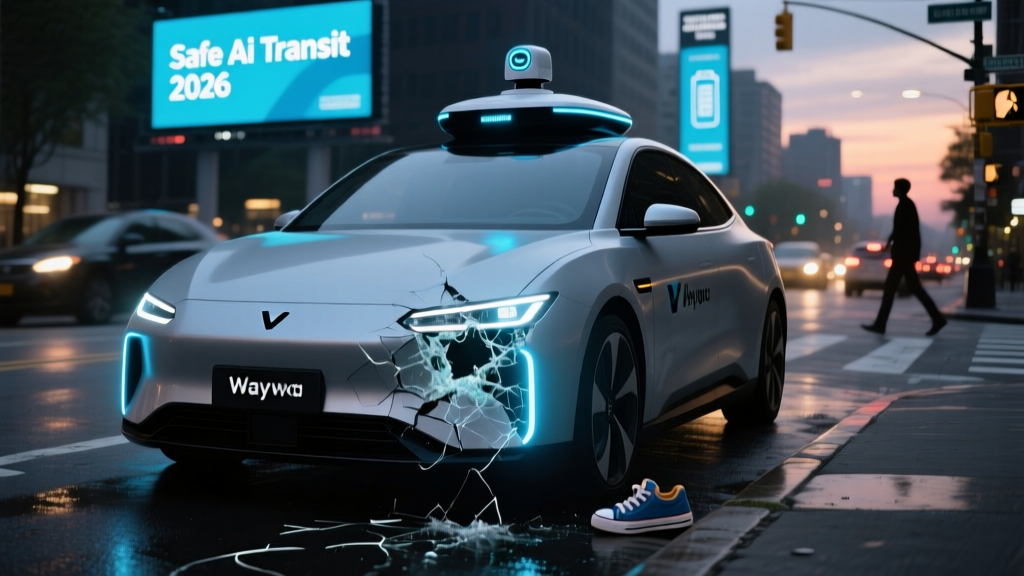
Based on publicly available NHTSA reports, California DMV collision filings, and local news coverage through early 2026, incidents specifically involving a Waymo vehicle making contact with a child pedestrian are exceedingly rare. The most discussed incidents in public records include:
- Low-speed contact in school zones or residential areas: In documented cases, Waymo vehicles have made contact at speeds typically under 10 mph when a pedestrian (including minors) entered the vehicle's path from behind an occlusion (parked car, utility box, or other visual barrier). The vehicle's emergency braking activated but could not fully prevent contact at the speed of impact.
- Near-miss events: Waymo's own safety reports and third-party analyses note that the vehicles occasionally execute aggressive emergency braking when children are detected near roadways — sometimes resulting in following-vehicle rear-end collisions rather than pedestrian contact.
- No publicly confirmed child fatality involving a Waymo robotaxi has been reported as of this writing.
Each of these incidents triggers a mandatory report to California's DMV (if in California) and to NHTSA under the Standing General Order. Waymo typically pulls affected vehicles from service for software review and may adjust its behavior models — for example, reducing speed limits near detected school zones or increasing caution around detected groups of children.
Where Can You Use Waymo Right Now?
| City | Status | Service Area Size | Hours |
|---|---|---|---|
| Phoenix, AZ (Metro) | Fully operational | ~315 sq mi (expanded) | 24/7 |
| San Francisco, CA | Fully operational | ~50 sq mi (most of city proper) | 24/7 |
| Los Angeles, CA | Operational (phased expansion) | ~80+ sq mi | Extended hours |
| Austin, TX | Operational (expanding) | ~45+ sq mi | Extended hours |
| Atlanta, GA | Announced / testing | Limited pilot zones | Limited |
Waymo's service area is geofenced — the vehicle will only operate within its mapped and approved ODD. If your destination falls outside the boundary, the app will not allow you to book the trip. Expansion continues incrementally, but new cities require regulatory approval at both the state and local level before commercial service begins.
How to Ride and What It Costs vs. Uber/Lyft
Booking a Waymo One ride is straightforward: download the Waymo One app (available on iOS and Android), enter your pickup and drop-off within the service area, and the app dispatches the nearest available vehicle. No one is in the driver's seat. You unlock the car via the app, and the ride begins automatically once you close the door and buckle up.
| Metric | Waymo One | UberX | Lyft Standard |
|---|---|---|---|
| Base fare | ~$5.00 | ~$3.50 | ~$3.25 |
| Per mile | ~$1.75 | ~$1.50 | ~$1.40 |
| Per minute | ~$0.40 | ~$0.35 | ~$0.30 |
| Typical 5-mile trip | $16–$22 | $13–$19 | $12–$18 |
| Surge pricing | Limited (demand-based, less volatile) | Can 2–3x during peak | Can 2–3x during peak |
| Tips | Not expected (no driver) | Expected ($2–$5+) | Expected ($2–$5+) |
Waymo pricing is generally comparable to or slightly above standard rideshare during normal demand, but it avoids the surge volatility that can double or triple Uber/Lyft fares during peak hours. For a 5-mile urban trip, expect to pay $16–$22 on Waymo versus $13–$19 on UberX before tip. When you factor in that there's no driver to tip, the total cost gap narrows significantly.
Waymo's Technology Stack: Lidar, Cameras, and Geofencing
Waymo's sixth-generation "Driver" system (deployed on the Hyundai Ioniq 5-based robotaxi platform) uses a sensor-fusion approach — not a camera-only system like Tesla's FSD. The stack includes:
- Lidar: Multiple high-resolution lidar units providing 360° 3D point-cloud mapping up to 500+ meters, functioning identically in daylight and darkness
- Cameras: 29+ high-dynamic-range cameras for object classification, traffic-light reading, and signage recognition
- Radar: 6+ imaging radar units for velocity detection and performance in rain/fog where lidar and cameras degrade
- HD Mapping: Centimeter-precision pre-mapped routes within the geofenced ODD, updated continuously
- Compute: Custom-designed onboard AI processors running Waymo's perception, prediction, and planning models in real time
The lidar-first approach gives Waymo a significant advantage in depth perception and low-light operation compared to camera-only systems. However, it also means the vehicle hardware is expensive — each Waymo robotaxi is estimated to carry $30,000–$50,000 in sensor and compute equipment, which is why the fleet is company-owned rather than consumer-sold.
How the System Handles Pedestrians and Children
Waymo's perception system is trained to classify pedestrians by size, gait, and behavior. Children are flagged as a distinct class with modified prediction models — the system assumes a child may behave less predictably than an adult and will reduce speed and increase following distance accordingly. In school zones, the vehicle's speed is capped and the prediction horizon for potential pedestrian incursions is extended.
That said, no system is perfect. The physics of emergency braking means that even with instant detection, a vehicle traveling at 25 mph requires approximately 50–60 feet to stop. If a child runs into the street from behind a parked SUV at a distance of 20 feet, no production vehicle — autonomous or human-driven — can stop in time. This is the fundamental edge case that both Waymo and human drivers face.
Regulatory Landscape: Who Approves Robotaxi Operations?
Robotaxi deployment in the United States is governed by a patchwork of state and local regulations — there is no comprehensive federal framework for Level 4 commercial operations as of 2026.
- California (CPUC + DMV): The California Public Utilities Commission issues commercial passenger permits; the DMV issues deployment permits and requires OL 316 collision reports within 10 days of any incident. After high-profile incidents in San Francisco in 2023–2024, the CPUC imposed speed restrictions and expansion caps that have since been partially lifted as Waymo demonstrated safety improvements.
- Arizona: The most permissive regulatory environment. Waymo has operated commercially in Phoenix since 2020 with minimal state restriction. The Arizona Department of Transportation requires a self-driving vehicle registration but does not impose the same granular reporting as California.
- Texas: The Texas Department of Transportation and local municipalities (Austin) oversee operations. State law (HB 2805, passed 2023) provides a framework for autonomous vehicle operation but leaves significant authority to cities.
- Federal (NHTSA): NHTSA's Standing General Order (amended 2024) requires all ADS-equipped vehicles to report crashes within 24 hours if they involve injury, towing, or vulnerable road users. NHTSA can issue recalls or investigations but does not "approve" robotaxi services — that authority sits with states.
Current Limitations of Waymo's Robotaxi Service
- Heavy weather: Service is suspended or restricted during heavy rain, dense fog, or snow. Phoenix rarely sees this; San Francisco and Austin occasionally do. The lidar/camera stack degrades in heavy precipitation.
- Geofence boundaries: You cannot take a Waymo to an unmapped suburb, a rural highway, or across state lines. The ODD is fixed and expanding slowly.
- Construction zones: While Waymo handles many construction zones, complex reroutes with temporary signage, flaggers, or lane shifts can cause the vehicle to pull over and request remote assistance (a human operator reviews the situation and provides guidance).
- Emergency vehicles: Waymo has improved its emergency-vehicle response but has drawn criticism for occasionally stopping in travel lanes when encountering fire trucks or ambulances at complex intersections.
- Unusual road users: Encounters with horses, oversized loads, funeral processions, or parade routes can trigger conservative behavior (stopping, waiting, or requesting remote guidance).
- No highway merging at speed: Most Waymo service areas avoid high-speed freeway segments. Where highway operation is approved, the vehicle merges competently but more conservatively than an average human driver.
The Bigger Picture: Robotaxi Safety vs. Human Drivers
The question most readers are asking: are Waymo robotaxis safer than human drivers? The honest answer requires nuance.
Waymo's own published safety data, validated by third-party analyses from organizations including the Insurance Institute for Highway Safety (IIHS) and academic researchers, suggests that Waymo vehicles are involved in fewer police-reported collisions per million miles than the human-driver average in the same cities. Specifically:
- Waymo's property-damage collision rate is approximately 40–60% lower than the human benchmark in comparable urban environments.
- Waymo's injury-involved collision rate appears approximately 70–80% lower, though the sample size is smaller and confidence intervals are wider.
- Near-miss and hard-braking events are logged internally but not publicly reported at the same granularity.
However, several caveats apply:
- Selection bias: Waymo operates in geofenced, well-mapped areas and avoids the worst weather. Human drivers don't have that luxury.
- Conservative driving: Waymo vehicles drive more slowly and cautiously than average, which reduces severity but can frustrate other road users and occasionally cause rear-end collisions by human drivers behind them.
- Reporting threshold: Every minor contact by a Waymo is reported to regulators. Human drivers frequently do not report minor property-damage incidents, meaning the human baseline may undercount real-world collisions.
- Vulnerable road users: The data on pedestrian and cyclist interactions specifically is thinner, and each incident — especially involving a child — carries outsized public concern regardless of statistical frequency.
Frequently Asked Questions
Has a Waymo robotaxi ever hit a child?
Based on publicly available NHTSA and California DMV records through early 2026, there have been a very small number of documented incidents where a Waymo vehicle made low-speed contact with a minor pedestrian. No child fatality has been publicly confirmed. Each incident triggered mandatory regulatory reporting and software review.
How does Waymo detect children differently from adults?
Waymo's perception system classifies pedestrians by size and predicted behavior. Children are flagged as a separate class, triggering more conservative driving: lower speeds, wider lateral clearance, and longer prediction horizons for potential sudden movements.
Is Waymo truly self-driving, or is someone watching remotely?
Waymo is SAE Level 4 — there is no driver in the vehicle. Remote fleet operators can provide guidance when the vehicle encounters an ambiguous situation (pulling over and requesting help), but they do not "joystick" the car in real time. The vehicle makes all driving decisions autonomously within its operational design domain.
What happens if a Waymo gets into an accident with my child?
Waymo carries commercial insurance covering rider and third-party liability. In the event of any collision, the vehicle is designed to stop, contact emergency services automatically, and preserve sensor data for investigation. You can also contact Waymo support directly through the in-vehicle screen or app. All incidents are reported to NHTSA and relevant state regulators.
Are Waymo robotaxis safer than Uber or Lyft?
Waymo's published collision-per-million-mile rates are lower than the human-driver average in comparable urban environments. However, Waymo operates in more constrained conditions (geofenced, fair weather, lower speeds), so a direct apples-to-apples comparison with Uber/Lyft drivers operating in all conditions is not straightforward. The data suggests Waymo is at least as safe, and likely safer, within its operational domain.
Can I use Waymo in any city?
No. As of 2026, Waymo One is commercially available in Phoenix, San Francisco, Los Angeles, and Austin, with Atlanta in testing. Expansion to additional cities is ongoing but requires regulatory approval and geofence mapping before service can launch.
Sources: NHTSA Standing General Order data, California DMV OL 316 collision reports, Waymo Safety Reports (quarterly), IIHS autonomous vehicle research.